
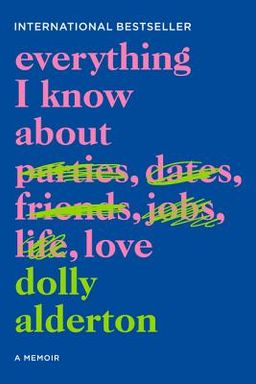
Everything I Know about Love cover

Everything I Know about Love

by Dolly Alderton

Everything I Know About Love is a hilarious and raw memoir by Dolly Alderton, chronicling her tumultuous twenties filled with bad dates, deep friendships, and invaluable lessons on self-love. This candid account invites readers to explore the messy yet rewarding journey of growing up.

Everything I Know About Love — Learning the Truth About Growing Up

What if everything you believed about love turned out to be incomplete—not wrong, but only a fragment of a much larger truth? In Everything I Know About Love, Dolly Alderton explores the transformation from youthful romantic obsession to mature self-understanding. She argues that the most enduring lessons about love don’t come from men, romance, or heartbreak—but from friendship, self-discovery, and surviving the complex transitions of womanhood.

Through a blend of hilarious confessions, emotional truth, and reflective essays, Alderton chronicles her life from awkward teenagehood through the hazardous twenties and into the dizzy calm of thirty. Along the way, she reveals that love—every kind of love—is both heartbreakingly fragile and infinitely resilient. Her experiences of dating disasters, friendship upheavals, grief, therapy, and self-acceptance form the heart of this coming-of-age memoir for modern women.

The Many Forms of Love

Alderton’s central thesis is simple but radical: love is plural. As she stumbles through disastrous dates, doomed relationships, and eventually self-reconciliation, she redefines love beyond its romantic limits. Whether she’s kissing strangers at New Year’s Eve parties, crying over boyfriends, or making “meltdown birthday cake” with friends, she comes to see friendship as the deepest, most transformative expression of love. Where her teenage self saw romantic love as the ultimate goal, her adult self realizes that friendship can provide the same comfort, intimacy, and meaning.

Through her closest friend, Farly, Alderton experiences unconditional loyalty, brutal honesty, and forgiveness—the kind of sustenance that many romantic partners failed to offer. It’s through these female connections that she learns true devotion. This mirrors themes seen in works like Glennon Doyle’s Untamed or Brené Brown’s Daring Greatly, which similarly contend that we uncover love’s depth only through vulnerability and self-truth, not fantasy or external validation.

The Cultural Moment of Modern Womanhood

Alderton captures the pulse of a generation—millennial women navigating the pressures of Instagram perfection, online dating, and late capitalism’s version of adulthood. From MSN Messenger to Tinder, her coming-of-age parallels technology’s evolution. Love becomes transactional, performative, even exhausting. Yet beneath the chaos lies a consistent craving: connection. This desire is timeless, even as its medium changes.

By framing her life through romantic and digital misadventures, Alderton reflects a universal twenty-first-century anxiety: how do you mature in a culture obsessed with youth and coupling? She walks readers through drunken nights, flat shares, therapy sessions, and milestone birthdays, gradually reconciling the contradiction between wanting freedom and fearing loneliness. Each story becomes a lens on identity formation—how being single, female, and full of contradictions can still be a life lived in full.

From Chaos to Clarity

At the book’s emotional core lies Alderton’s transformation. The fun-loving party girl who measures her worth by others’ attention becomes a woman who finds stillness in solitude and purpose in her work and friendships. After heartbreak, the death of her best friend’s sister Florence, and her own reckoning in therapy, Alderton learns to exchange youthful chaos for self-compassion. Her journey mirrors the archetypal Bildungsroman: through loss comes maturity. The final chapters offer not an ending, but equilibrium—the moment she moves into her own flat and realizes home isn’t where she lives, but what she carries within herself.

“Love was there all along—hidden in friendship, laughter, grief, and the quiet acts of everyday care.”

Why This Book Matters

At its heart, Alderton’s memoir is a manifesto for self-acceptance. It speaks to anyone who has equated self-worth with romantic approval, only to discover that the most reliable love resides within and around them. It’s a book about leaving behind girlhood without abandoning its hope, about realizing that growing up is a form of love in itself.

Alderton becomes an emotional cartographer for the modern woman—mapping all the detours, heartbreaks, friendships, loneliness, and revelations that define love today. By the end, you understand her central truth: you cannot be loved well until you believe you are enough. And when that conviction finally settles in your bones, every kind of love—romantic, platonic, familial, and self-love—flows more freely.


The Education of a Teenage Romantic

Dolly Alderton’s romantic education begins in suburban North London, where she grows up soaked in pop culture fantasies and MSN Messenger-fuelled crushes. As a teenager, love means spectacle—late-night chats, rumors, and daydreams about boys who barely know she exists. She believes adulthood will begin the day she has a boyfriend. It’s a conviction shared by many girls raised on the glamorous fictions of Hollywood, rom-coms, and the suggestion that happiness starts when he notices you.

Fantasy Meets Suburbia

Her early life in Stanmore is the opposite of cinematic. The social scene is small, the houses all look the same, and every night ends in front of Friends reruns. MSN Messenger becomes her lifeline—a digital stage where she experiments with identity and desire. Talking to unseen boys online allows her to shape herself into the girl she imagines she should be. These interactions, though innocent, establish early patterns of fantasy over reality, texting over talking—a theme that follows her into adulthood.

Her first heartbreaks also happen virtually or peripherally: a boy she never properly meets loses interest; another date lasts twelve minutes in a shopping mall café. Each cringe-worthy moment becomes an initiation rite. Alderton treats these adolescent catastrophes with humor and tenderness, acknowledging how absurd yet formative they are. They teach her about ego, performance, and the hunger to be loved before you even know yourself.

Friendship as First Love

While boys dominate her imagination, it’s her friendship with Farly—her childhood best friend—that forms the book’s emotional foundation. Their bond becomes the first template for unconditional love. Together, they obsess over pop idols, host chaotic sleepovers, and share humiliations in real time. Farly is her mirror and her anchor, the person who knows both the performance and the truth. Through this relationship, Alderton learns that love can be loud, funny, and non-romantic—a revelation that continues to echo throughout her life.

“Nothing luckier ever happened to me than the day Farly sat next to me in maths class.”

The Digital Dawn of Desire

Technology is Alderton’s first conduit for intimacy. MSN Messenger, later Facebook, and texting shape how she perceives relationships. Conversations become performances; flirtation becomes composition. It’s safer to type than to speak, easier to imagine than to act. This dependence on digital affection cultivates both confidence and anxiety. When fantasy meets physical reality, the illusion collapses. Her early disappointments foreshadow the millennial struggle between self-presentation and self-knowledge.

By chronicling these formative years with humor and hindsight, Alderton invites readers to laugh at their own teenage absurdities while recognizing their deep influence. This is not just a nostalgic memoir—it’s an origin story of how a generation learned to love in the age of AOL, dial-up tones, and the intoxicating power of the unread message.


Partying, Pain, and Self-Destruction in Her Twenties

When Alderton enters university, she dives headfirst into chaos. Her early twenties are defined by drinking, hangovers, and a desperate need to feel alive. Like many young adults, she mistakes self-destruction for self-expression. At Exeter, the culture of binge-drinking and hookup bravado becomes both a coping strategy and a trap. The result is comic gold and emotional devastation. Through anecdotes involving vodka-fueled road trips, late-night taxis to other cities, and disastrous parties, Alderton unpacks the underlying search for meaning beneath all the self-sabotage.

The Illusion of Freedom

Freedom, for a twenty-one-year-old in London, looks like martinis, cigarettes, and boys with guitars. She wants to be Joan Didion’s heroine and Bridget Jones’s cousin rolled into one—reckless but adored. Alcohol, however, becomes her license to rebel and her prison. She describes her drinking not as glamorous but as grasping: the elixir that flips self-consciousness into liberation. The hangover, both physical and emotional, is the inevitable price. In this, Alderton recalls the restless honesty of writers like Caitlin Moran or Phoebe Waller-Bridge, who blend feminist humor with confessional chaos.

Chasing Experience

Alderton sees herself as a “collector of stories.” Every disaster—nightclub fights, bad dates, naked escapades—is a future anecdote. The pursuit of narrative becomes an addiction. Experiences validate her existence. Yet there’s a hollow echo under the laughter: she’s always searching for something that feels real. When she moves to London, she channels this energy into work as a TV producer, pouring herself into the same frenetic rhythm of consuming life before it consumes her.

Through these years, friendship remains her safety net. Her group of university women—AJ, Hicks, Lacey, and Farly—share the mantra of “Broken Britain”: outrageous adventures and unfiltered gossip. Their female camaraderie becomes a defiant act in a male-dominated club culture. They live with reckless joy, but also tenderness for each other when things fall apart. These friendships prefigure the emotional stability Alderton will later draw from when romantic love consistently disappoints.

Breaking Point

A series of heartbreaks leads to obsession—with control, thinness, and performance. After her first serious breakup, she loses herself in disordered eating and ruthless self-discipline. This section of her life is one of the book’s most vulnerable, illustrating how the desire for love can morph into the destruction of self. The tension between freedom and fragility defines her twenties. Each extreme—partying or starving—becomes a reaction to the same hunger: to feel adequate, wanted, enough.

By the end of this tumultuous decade, Alderton emerges exhausted yet wiser. She’s collected her “stories for later,” but realizes that no number of wild nights or romantic entanglements can fill the emptiness of not liking yourself. The chase for love through destruction has only led her back to herself.


Friendship: The Great Love Story

If Everything I Know About Love has a single through line, it’s that friendship—especially female friendship—is life’s most profound love story. Alderton reframes the word “soulmate” to include the women who held her hair as she vomited, listened to her heartbreaks at 2 a.m., and sent endless texts that said, “Are you OK?” Her bond with Farly, in particular, becomes the emotional spine of the memoir—a love that outlasts boyfriends, heartbreaks, and relocations.

The Uneven Seasons of Friendship

As adulthood unfolds, Alderton and her friends drift in and out of sync. Some get engaged, others chase careers or chaos. “Nothing will change,” friends often promise. But everything does. When Farly gets engaged to Scott, Alderton wrestles with jealousy and grief, not out of malice but fear—the terror of losing her primary love to a man. This emotional realism makes her story relatable to any woman who’s mourned a closeness altered by marriage, children, or distance.

The book’s most heartbreaking and transformative moment comes with the death of Florence, Farly’s younger sister. Through this shared grief, Alderton sees love stripped to its essence: presence, empathy, endurance. Helping Farly through tragedy teaches her that to love someone fully sometimes means silence, patience, and simply staying. Florence’s death reframes their friendship not as a temporary phase but as familial devotion.

Redefining Commitment

Through Farly, Alderton learns that commitment doesn’t require romance. Their friendship mirrors a marriage—complete with loyalty, conflict, humor, and forgiveness. “I’ve only ever done long-term love well with her,” Alderton admits later. Their love endures miscommunications, competing boyfriends, and years of separation. This revelation dismantles societal hierarchies of love: friendship need not sit below romantic partnership. In the end, it’s Farly, not a boyfriend, who helps Alderton move into her first solo flat and reminds her she is enough.

“Perhaps Farly was what a good relationship felt like all along.”

By centering friendship as the book’s true romance, Alderton redefines love for a generation exhausted by heterosexual expectations. Like Elena Ferrante in My Brilliant Friend, she shows that the bonds between women can sustain, challenge, and outlast everything else. It’s a quietly radical act—to claim platonic love as the heart of a love story.


Healing and Self-Discovery Through Therapy

After years of chasing others’ approval, Alderton finally confronts the person she’s been avoiding: herself. In a candid chapter about therapy, she finds the courage to face her anxieties, addictions, and insecurities. The process is painful—a deconstruction of every defense mechanism she’s built since youth. Yet, unlike the drama of breakups or drunken nights, this slow, introspective work becomes her most profound love story yet: learning to care for her own mind.

Facing the Fear of Falling

Her therapist, Eleanor, tells her, “You feel like you’re going to fall because you’ve got no roots.” The metaphor transforms Alderton’s entire perspective. She realizes she’s lived as fragments scattered across relationships and roles—daughter, friend, lover, employee—without ever forming a solid self. Therapy becomes an excavation. Each memory, insecurity, and compulsive habit is a clue in the archaeology of who she really is.

This section echoes similar arcs in Cheryl Strayed’s Wild or Glennon Doyle’s Untamed: healing is not catharsis but discipline. Each session dismantles her armor—the humor, the partying, the performance—and leaves her raw but freer. For the first time, she stops chasing validation and learns to sit in discomfort. The very act of staying becomes revolutionary.

Learning Accountability

Eleanor refuses to let her blame her heartbreaks on bad men or unlucky timing: “Unless someone dies, you have a part to play.” This lesson undoes Alderton’s favorite narrative—that she’s the victim of messy love stories. Instead, she confronts her patterns: performing for affection, oversharing to be liked, numbing pain with alcohol. By stopping the excuses, she begins to experience agency. Therapy teaches her that kindness to others is meaningless without responsibility to oneself.

Through self-awareness, Alderton discovers a quieter, steadier rhythm of life. She drinks less, writes more, and fills her flat with plants—signs of growth she can finally sustain. Therapy does not solve her life, but it gives her permission to live it. By accepting imperfection and nurturing her own roots, she becomes the grounded, whole person she longed to be.


Finding Home in Solitude and Adulthood

The book’s final act is its most peaceful: Alderton, turning thirty, moves into her own flat and realizes she is her own home. After decades of defining herself through others—boyfriends, friends, family—she discovers contentment in solitude. It’s not a lonely independence but a gentle confidence built on everything she has lost, learned, and loved. Her move symbolizes emotional adulthood: no longer searching for belonging, but choosing it.

Rewriting What Love Looks Like

Alderton’s thirties are not about settling down, but settling in. She rejects cultural panic around milestones—marriage, motherhood—and instead celebrates stability within herself. The act of making toast alone or decorating her flat becomes a declaration: she’s enough. “Homecoming” is not just geographical; it’s spiritual. In finding peace in responsibility, she proves that adulthood doesn’t have to mean loss of wonder—it can mean the freedom to sustain joy.

Love Beyond Romance

By the time she celebrates thirty, Alderton reframes love’s meaning one last time. It’s found in small daily rituals—the texts that say “home safe,” the friends who help you move, the quiet mornings spent writing. These are the moments that build a life. The book ends not with a man but with companionship, community, and self-laughter. She writes, “Love was there all along.” This simple truth—discovered through heartbreak, therapy, and friendship—forms her ultimate revelation.

In this final realization, Alderton joins writers like Nora Ephron and Elizabeth Gilbert, whose later works transformed personal confusion into wisdom. She closes her story not by mastering love, but by integrating it—embracing the messy, enduring, everyday miracle of being alive and connected. Her home is no longer an address; it’s herself.

Dig Deeper

Get personalized prompts to apply these lessons to your life and deepen your understanding.

Go Deeper

Get the Full Experience

Download Insight Books for AI-powered reflections, quizzes, and more.