
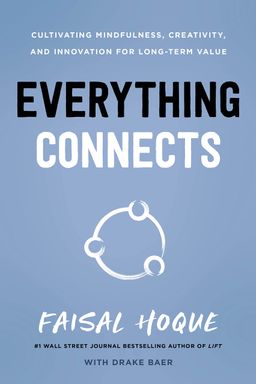
Everything Connects cover

Everything Connects

by Faisal Hoque and Drake Baer

Explore how interconnectedness in business can enhance creativity and innovation. Learn to transform your leadership approach by embracing mindfulness, cultivating a diverse team, and fostering a supportive environment.

Everything Is Connected: Mindfulness Meets Innovation

How can you truly thrive in a world that never stops changing? In Everything Connects, Faisal Hoque and Drake Baer argue that sustainable business success—and a fulfilling life—are built on recognizing that everything is connected: our inner state, our relationships, and the intricate systems of organizations and societies that surround us. They contend that meaningful innovation doesn’t come from spreadsheets or formulas, but from human connection, mindfulness, and a deep awareness of how the parts of life and business form a living, breathing whole.

At its heart, this book marries mindfulness with management science. Hoque and Baer show that the way we lead, create, and adapt has to mirror the complexity of our world. They describe how innovation arises when we align three interconnected dimensions—the individual’s inner experience, team dynamics, and organizational structure. Together these dimensions form what they call the “matryoshka model”: organizations, like nesting dolls, reflect the minds, relationships, and values of the people within them.

Why It Matters Now

We live in an age of disruption and perpetual flux. Technologies evolve faster than we can understand, economies shift overnight, and political instability defines the global landscape. The authors argue that such complexity demands leaders who can see patterns rather than fragments. They call this awareness “holistic innovation” — the ability to perceive connections between disciplines, people, and ideas, rather than focusing only on isolated metrics. In short, our future belongs to those who can integrate creativity and stability, long-term vision and short-term execution.

Mindfulness as a Business Tool

Mindfulness isn’t just about meditation or serenity—it’s about cultivating clarity and awareness. Hoque, drawing on neuroscience and Buddhist philosophy, shows that mindfulness helps leaders respond thoughtfully instead of reactively, see patterns others miss, and show empathy that strengthens teams. (Marshall Goldsmith reinforces this in the book’s foreword, noting that leadership transformation starts with self-understanding.) Mindful leadership means acting from awareness of your thoughts and emotions, and using that insight to foster trust and creativity within your organization.

From the Individual to the Organization

The book unfolds in four parts. First, it explores the personal journey of curiosity, authenticity, and mindfulness—the inner scaffolding for mature leadership. Second, it looks outward, revealing how integrated cultures and collaborative structures unleash innovation. Third, it connects ideas to practice, showing how decisions and value creation emerge from systems thinking. Finally, the updated edition adds insights on managing change, resilience, and everyday mindfulness in a post-pandemic world.

The Human Side of Innovation

Hoque and Baer remind us that innovation is a human process. Data and technology are vital, but they don’t dream, empathize, or imagine. Human beings do. Sustainable innovation, therefore, starts by nurturing people’s creativity and well-being. Companies like P&G, Apple, and Yammer serve as living examples: their success stems not from mechanical efficiency but from cultures that reward curiosity, collaboration, and long-term value over short-term gain.

Taking the Long View

Above all, Everything Connects asks you to slow down and take the long view of your work and life. The authors echo leaders like Jeff Bezos and Joseph Schumpeter by emphasizing that durable success depends on creative destruction balanced with mindful renewal. You can’t “optimize” forever; you must continually reinvent, stay humble, and acknowledge uncertainty. Mindfulness, authenticity, partnership, and curiosity are not just spiritual traits—they’re strategic skills in the 21st-century innovation economy.

The book’s ultimate promise: Whether you’re an entrepreneur, leader, or dreamer, discovering how “everything connects” can transform not just your organization’s performance, but your experience of work itself. When business becomes human, creativity, resilience, and sustainability thrive together—and everything begins to align in the rhythm of life itself.


Beginner’s Mind in an Innovation Economy

Faisal Hoque opens with a Zen metaphor: the mind is like a cup. When it’s full, nothing new can enter; when empty, it’s ready to receive. This image captures the essence of the “beginner’s mind,” which Shunryu Suzuki described as seeing infinite possibilities instead of rigid expertise. In business terms, the beginner’s mind is a mindset of humility and curiosity that keeps you adaptive in a world of constant change.

Creative Destruction and Change

Economist Joseph Schumpeter’s idea of “creative destruction”—the cycle in which innovation destroys old forms and creates new industries—is the backdrop for Hoque’s argument. Blockbuster fell because it optimized the wrong thing: the store rather than the user experience. Netflix thrived by aligning with emerging technology and changing behavior. Like Schumpeter’s capitalism, the innovation economy rewards those who can embrace flux rather than resist it.

Ignorance as a Skill

Hoque reframes ignorance as a positive trait—being “skillfully ignorant” means recognizing what you don’t know and staying open to discovery. This resonates with Nassim Taleb’s idea from Antifragile: systems that survive chaos are those that learn from volatility. Leaders who admit uncertainty gain the psychological flexibility to adapt and innovate.

Commitment over Stardom

One of the book’s most compelling insights comes from Stanford professors James Baron and Michael Hannan. Their study of Silicon Valley startups found that “commitment” cultures—where employees feel familial loyalty to the company—are more likely to achieve long-term success than “star” cultures that celebrate elite individual talent. In Hoque’s terms, sustainability comes from collectivism rather than ego, from tortoise-like endurance rather than hare-like speed.

Union of Timeless and Timely

Across cultures and economies, successful entrepreneurs keep one foot in timeless wisdom—self-awareness, purpose, relational integrity—and another in timely innovation—technology, data, and agility. Hoque reminds you that both streams must flow together. You can study Socrates to learn self-reflection, but look to Satya Nadella or Elon Musk to see real-time experimentation. Mindfulness balances the eternal with the immediate.

The key takeaway: Success in today’s innovation economy doesn’t hinge on knowing all the answers—it depends on remaining open to new ones. A beginner’s mind, grounded in curiosity and humility, makes adaptation not a struggle, but a natural rhythm of learning and creation.


Mindfulness and Authentic Leadership

Most leadership advice tells you to focus on goals and results. Hoque flips this formula: before you lead others, you must first lead yourself. Through mindfulness, authenticity, and devotion, the book guides you to cultivate inner stability that mirrors outer complexity. This is leadership as self-mastery.

From Stress to Awareness

LinkedIn’s Paul Slakey serves as an example. A former McKinsey consultant overwhelmed by stress, he discovered mindfulness through Jon Kabat-Zinn’s teachings. By developing daily meditation habits, Slakey learned to create space between stimulus and response—pausing before reacting. That inner calm transformed his leadership: by learning to manage his mind, he could manage his team with empathy instead of fear.

Devotion and Discipline

Hoque defines devotion as “life’s pursuit with discipline.” Drawing from Buddhist philosophy, he integrates right effort, right mindfulness, and right concentration—the classic triad of mental development. This echoes Mihaly Csikszentmihalyi’s Flow theory, where complete absorption in purposeful activity creates happiness and effectiveness. Devotion, in this sense, is both spiritual and strategic—it’s about sustained focus on what matters most.

Authenticity and Self-Discovery

To act authentically, you must first know yourself. The author references Joseph Campbell, David Whyte, and Nietzsche to illustrate how identity evolves through reflection and practice. In business, this means aligning your decisions with your true values instead of chasing status. When leaders act from authenticity, they create trust, transparency, and psychological safety—conditions where innovation flourishes.

Lesson: Leadership begins within. Through mindfulness and devotion, you transform your inner chatter into clarity, authenticity into confidence, and introspection into creative power. Only by leading yourself can you lead others toward meaningful innovation.


The Art of Working Together

A famous parable describes blind men touching different parts of an elephant—each claims to know what it is, but none can see the whole. Hoque and Baer use this metaphor to explain organizational collaboration: no one person sees the full picture. True teamwork arises when we combine perspectives to understand complexity.

Human Partnerships

Partnership, the authors argue, is “mutual flourishing.” It’s built on trust, honesty, and long-term intent—not efficiency alone. Studies from Towers Watson and McKinsey show that firms with high employee engagement achieve triple the margins of their peers. Aristotle’s “eudaimonia,” virtuous activity aligned with reason, finds its modern echo in engaged employees who align passion with purpose.

Reptiles vs. Mammals

Hoque introduces a striking psychological analogy from Stephen Porges: reptilian organizations are fear-driven and defensive, while mammalian organizations operate from connection and safety. Fear kills creativity; trust cultivates it. A “mammal mindset” company—safe, collaborative, and emotionally intelligent—encourages vulnerability, experimentation, and shared compassion. That safety becomes the soil from which innovation grows.

Managing Time and Consciousness

French philosopher Henri Bergson saw time as “durée”—a living flow, not a ticking clock. Similarly, management is managing consciousness, not hours. Harvard’s Bob Pozen urges leaders to measure productivity by results, not time on the clock. True collaboration alternates between deep focus and structured teamwork—a rhythm of solitude and togetherness that mirrors the natural cycles of creativity.

Insight: When partnership becomes human, innovation becomes natural. By making workplaces safe for mammals—not filled with reptiles—you build the psychological oxygen creativity needs to breathe.


Visioning and Long-Term Thinking

How do you balance the daily grind with long-term purpose? The authors remind us that eating the marshmallow now may feel good—but waiting yields greater rewards. Inspired by the Stanford “Marshmallow Experiment,” Hoque applies this psychology to leadership: successful companies delay gratification and invest in enduring value.

Vision as Purpose

Vision isn’t just a statement—it’s a sacred contract. In the book, Jeff Bezos emerges as the archetype of long-term thinking. His annual letters emphasize customer trust and patience. Amazon sacrifices immediate profit to “delight customers,” knowing that loyalty compounds. Similarly, Nike’s mission—“to bring inspiration and innovation to every athlete* in the world”—transcends products, expressing moral purpose (*If you have a body, you are an athlete).

Platforms and Ecosystems

Companies grow sustainably by finding new platforms—hidden assets that can serve multiple needs. UPS discovered that its logistics expertise was itself a marketable product, spawning the Service Parts Logistics division. IKEA elevated affordability into a philosophy of design democracy. Each shows how understanding one’s internal capabilities can create external innovation.

Interconnected Systems

Using Hindu mythology’s Indra’s Net, Hoque visualizes the world as countless jewels reflecting one another—a metaphor for ecosystems and global capitalism. Every action reverberates through networks of people, data, and culture. Sustainable value comes from seeing those reverberations clearly, designing for mutual benefit rather than narrow profit.

The takeaway: Long-term value isn’t about patience alone—it’s about seeing systems clearly. A visionary leader connects purpose with structure, inner intention with external results, just as sunlight connects each jewel in Indra’s Net.


Structures That Foster Innovation

Every organization produces what its structure allows. To paraphrase Melvin Conway, companies build systems that mirror their communication patterns. This simple truth explains why some firms stagnate while others evolve. Hoque and Baer argue that innovation demands flexible, living structures—organic systems that adapt instead of petrifying.

Breaking Bureaucracy

Lauren Rivera’s research found that elite firms often hire by cultural similarity rather than merit. This replication—hiring people “like us”—produces homogeneity and kills creativity. In contrast, Hoque advocates “intersectional diversity,” echoing John Stuart Mill’s marketplace of ideas: innovation flourishes when many perspectives converge.

Yammer and Iterative Design

Yammer’s fluid structure exemplifies living architecture. Teams form around projects and dissolve when tasks end. This constant iteration builds resilience; everyone learns to think about the system, not just their job. Adam Pisoni calls this “organizational agility”—a culture where change isn’t feared but expected. The result is speed: decisions, prototypes, and feedback loops occur weekly, not yearly.

Clusters: Teams That Breathe

Hoque introduces the concept of “clusters”—temporary cross-disciplinary teams that unite around specific challenges. Clusters evolve, dissolve, and re-form as complexity shifts. They ensure autonomy without anarchy, echoing IDEO’s flexible design studios. P&G’s Crest Whitestrips emerged from such cross-pollination: combining bleach chemistry from laundry with sciences from dental care created a billion-dollar market.

Insight: A company’s structures are its DNA. To evolve, you must rewire communication—replace rigid hierarchies with clusters of experimentation. Innovation isn’t born in departments; it’s born in connection.


Resilience in a Changing World

In the updated edition, Hoque expands on a theme that feels more urgent than ever: resilience. The pandemic, polarization, and digital acceleration have tested humanity’s capacity to adapt. Resilience, he argues, isn’t stoic endurance—it’s growth through adversity, a skill we can learn and strengthen like mindfulness itself.

From Crisis to Opportunity

Drawing on lessons from Survive to Thrive and LIFT, Hoque reframes turbulent times as opportunities for reinvention. The COVID-19 pandemic, he notes, forced individuals and organizations into reflection, prompting new forms of mindfulness and collaboration. Resilient people transform setbacks into seeds for creativity—like entrepreneur Julie Wainwright, who rebounded from Pets.com’s failure to found The RealReal, a billion-dollar enterprise.

Empathy as Strength

Resilience isn’t isolation—it’s interdependence. Hoque emphasizes empathy and community as antidotes to despair. Helping others reinforces your own strength. “We are all in this together” becomes not a slogan but a survival strategy. Empathy bridges the fear divide and restores hope in shared purpose.

Mindfulness for Recovery

Mindfulness techniques, from controlled breathing to gratitude and reflection, help regulate emotion and realign perspective. The author cites psychology research showing that resilient people don’t deny struggle—they face it mindfully, reframing challenge as growth. This echoes Viktor Frankl’s insight from Man’s Search for Meaning: our power lies not in the circumstances we face, but in the attitude we choose toward them.

The message: Resilience isn’t about bouncing back—it’s about bouncing forward. By combining mindful awareness with compassion and purpose, you turn uncertainty from a threat into an invitation for renewal.

Dig Deeper

Get personalized prompts to apply these lessons to your life and deepen your understanding.

Go Deeper

Get the Full Experience

Download Insight Books for AI-powered reflections, quizzes, and more.