
Idea 1
Everyone Deserves a Great Manager: Why Leadership Matters More Than Ever
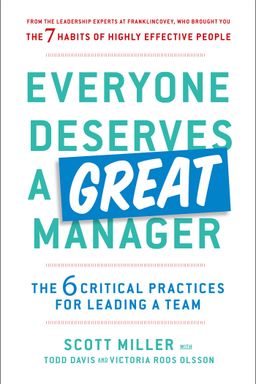
Have you ever had a boss who made you dread work every day—or one who inspired you to do your best? That contrast lies at the heart of Everyone Deserves a Great Manager by Scott Miller, Todd Davis, and Victoria Roos Olsson. Drawing from decades of leadership research at FranklinCovey, the authors argue that being a great manager isn’t about authority, charisma, or experience—it’s about mastering a set of simple but profoundly effective practices that help people thrive. In their view, management is one of the most noble professions because it puts leaders in a position to shape not only performance but also lives.
The book’s central claim is clear: every employee deserves a manager who helps them grow, supports them through challenges, and leads with empathy and accountability. Achieving that, however, takes more than good intentions. Most new managers are promoted for their technical success, not their leadership skill, and are thrust into roles with little training. Many flounder for years without guidance. The authors found that on average, people become managers at age thirty but don’t receive formal leadership training until their early forties. That’s a decade of unprepared influence—time that can discourage teams, stall productivity, and corrode culture.
The Six Critical Practices
To close this training gap, FranklinCovey distilled dozens of leadership frameworks into the Six Critical Practices for Leading a Team—simple, actionable habits that move leaders from uncertainty to mastery:
- Develop a Leader’s Mindset: Shift from achieving results alone to achieving results through others.
- Hold Regular 1-on-1s: Engage team members through meaningful conversations that build trust, not just status updates.
- Set Up Your Team to Get Results: Clarify goals, connect everyone to the “why,” and delegate wisely.
- Create a Culture of Feedback: Give and seek feedback to improve performance and strengthen relationships.
- Lead Your Team Through Change: Manage the emotional journey of disruption and guide your team to renewed performance.
- Manage Your Time and Energy: Model balance and productivity for sustainable excellence—for yourself and your people.
These practices build on timeless leadership principles championed by FranklinCovey and make them concrete for first-level managers—the people leaders who often have the most daily influence on employees but the least support.
Why First-Level Leaders Are the Linchpin
In today’s flattened organizations, first-level leaders have become the linchpins of culture and engagement. As information technology has removed layers of middle management, these frontline managers now juggle unprecedented scope and responsibility. They guide the majority of the workforce, shape people’s experiences daily, and directly affect engagement levels. Gallup data backs this up: managers account for 70% of the variance in team engagement across organizations.
Yet most new managers feel unprepared and anxious. They’re expected to deliver results, motivate diverse people, and make tough calls—all with minimal training. The FranklinCovey authors empathize deeply here: each admits to having failed spectacularly early in their leadership careers. Scott Miller’s infamous story of being “un-promoted” after three weeks of tyrannical management serves as both a warning and a lesson. Leadership isn’t about control—it’s about connection, accountability, and continuous learning.
From Ego to Empathy
A major theme throughout the book is mindset transformation—the inner shift from seeing yourself as the hero to becoming a hero-maker. As Todd Davis puts it, the critical question is: “Do I want to be a great leader, or do I want my team to be led by a great leader?” The first focuses on self-image; the second on service. The best leaders see their role as multiplying others’ success rather than showcasing their own brilliance (echoing Liz Wiseman’s concept of “genius makers”).
This people-first philosophy carries through every practice. Whether you’re conducting a 1-on-1, setting goals, or giving feedback, the point isn’t to manage tasks but to manage meaning—to make people feel seen, heard, and valued. By combining FranklinCovey’s principle-centered approach with FranklinCovey’s hallmark tools—like the See-Do-Get model and the 7 Habits’ focus on influence and renewal—the authors show that great management is measurable, transferable, and profoundly human.
Why This Book Matters
In an era of burnout, disengagement, and constant change, Everyone Deserves a Great Manager is both a survival guide and a manifesto. It’s for the individual contributor suddenly promoted and terrified, the seasoned manager seeking renewal, and the executive hoping to cascade better leadership throughout the company. The message is clear: managers are culture-makers. When they’re supported, equipped, and intentional, entire organizations flourish. When they’re neglected, even the best strategies fail.
“Your people are your results.” That simple idea, repeated throughout the book, reframes leadership as not just getting work done but building capable, confident, purpose-driven people who do great work together.
Across its six practices, this book delivers what most managers wish they’d had from day one: a blueprint for turning confusion into competence, anxiety into confidence, and everyday management into meaningful leadership. The following key ideas unpack each practice with practical wisdom, heartfelt stories, and field-tested strategies for becoming the leader your team truly deserves.