
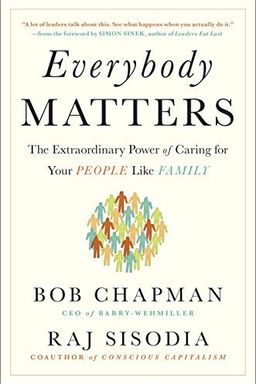
Everybody Matters cover

Everybody Matters

by Bob Chapman & Raj Sisodia

Everybody Matters reveals how treating employees like family can transform your business. By fostering trust, empowerment, and recognition, leaders can create a thriving workplace where innovation and success flourish together. Discover the extraordinary power of caring leadership.

Everybody Matters: Building Businesses Where People Thrive

What if business could heal instead of harm? What if work could restore people’s confidence, strengthen their families, and make the world a softer place to live? In Everybody Matters, Bob Chapman, CEO of Barry-Wehmiller, and business philosopher Raj Sisodia answer exactly that question. Through decades of transforming struggling manufacturing companies into thriving, people-centered communities, they argue that leadership done right—what they call Truly Human Leadership—has the power to change lives, not just balance sheets.

Chapman’s central message is simple but radical: “We measure success by the way we touch the lives of people.” Every person matters, and every leader is responsible for being a good steward of the lives entrusted to them. In other words, leadership isn’t about status or shareholders—it’s about stewardship, caring, and human connection. The authors show how this philosophy emerged from moments of personal revelation and was tested across acquisitions, recessions, and plant floors filled with skepticism and fear.

The Roots of a Revolution in Leadership

The transformation began in the most unlikely place: an old family-owned manufacturing business in St. Louis on the verge of collapse. Chapman inherited Barry-Wehmiller in the mid-1970s amid financial crisis and traditional command-and-control management. Early on, he led like most CEOs—focusing on survival, growth, and profits. But through experiences both professional and personal—including playing “games” at work that unexpectedly boosted joy and performance—he started to see that success came when people felt valued rather than managed.

This awakening led to the company’s most distinctive practice: the Guiding Principles of Leadership, born in 2002 after a two-day retreat of twenty employees asking what great leadership really meant. The first line crystallized the Barry-Wehmiller ethos: “We measure success by the way we touch the lives of people.” This wasn’t corporate wallpaper—it became an action plan that redefined every decision. No layoffs during recessions, transparency in finances, and relentless focus on trust and empathy became the new normal.

From Crisis Management to Human Stewardship

Many business books claim that culture matters. Few show how to build one from scratch in a struggling factory surrounded by cynicism. Chapman doesn’t romanticize the process. When Barry-Wehmiller acquired dying companies like Paper Converting Machine Company (PCMC), morale was broken, layoffs were routine, and distrust was high. But instead of the usual corporate pruning, Chapman’s team started by listening—hanging the Guiding Principles in hallways and asking, “What are we doing that doesn’t live up to this?” The answers often hurt, but they guided deep transformation.

Out went time clocks, surveillance cages, and punitive rules. In came trust, listening circles, and empowerment. Managers became “leaders” responsible not for output, but for people’s well-being. Continuous improvement (Lean) was introduced—but reframed from a cost-cutting tool to what they called L3, the Living Legacy of Leadership, focusing on joy, significance, and engagement. When the 2008 recession hit, this philosophy faced its ultimate test. Instead of layoffs, Chapman and his team instituted a company-wide furlough—everyone took a few unpaid weeks off so that no one lost a job. The result: morale soared, loyalty deepened, and Barry-Wehmiller had a record financial year immediately after the downturn.

Why This Model Matters Now

Why should all of this matter to you? Because most people still live in what Simon Sinek (who wrote the foreword) calls a “culture of paranoia.” About 88% of employees say they feel unseen or uncared for at work. Stress, cynicism, and disengagement are epidemic—not because of laziness, but because of environments that fail to make people feel safe or significant. Chapman and Sisodia argue that the old industrial model—where people are treated as functions or costs—isn’t just outdated, it’s morally broken. If you lead people, you have the chance, and the responsibility, to lead them home each night safe, fulfilled, and excited about their lives.

In the pages that follow, you’ll see how these principles take shape. You’ll learn why leadership is stewardship, how purpose-driven visioning can transform companies, why recognition and celebration are strategic, and how institutions like Barry-Wehmiller University train “professors of leadership” from within. You’ll meet blue-collar machinists turned teachers, cynical supervisors turned mentors, and companies reborn through patience, empathy, and courage. Ultimately, Everybody Matters shows that by caring for people first, businesses don’t just perform better—they create a ripple effect that strengthens families, communities, and the wider world.


Leadership as Stewardship: The Radical Reframe

Most leadership books focus on influence or results. Chapman redefines leadership as stewardship—the moral responsibility to care for the people entrusted to you. Borrowing from parenting and spiritual traditions, he insists that a leader’s first duty is not to shareholders but to the human beings whose hands, hearts, and minds make the business possible. The book’s most memorable moment comes when Chapman watches a father give his daughter away at her wedding and realizes: every employee is someone’s precious child. From that day, he vowed to lead as if each worker had been placed in his care by their family.

From Managing Numbers to Nurturing Lives

At Barry-Wehmiller, this shift meant replacing “management” with true leadership. Chapman argues that leaders create environments—either safe and trusting or fearful and exploitative. The statistics are damning: roughly 130 million Americans, 88% of the workforce, leave their jobs each day feeling uncared for (similar to Gallup’s engagement data in Leaders Eat Last). This is the moral failure of business as usual. Real leaders send people home safe, healthy, and fulfilled—the same things we want for our own children.

People as the Purpose

Unlike companies that tack charitable giving onto profit-driven motives, Barry-Wehmiller integrates care into its core. Chapman rejects the idea that charity begins after work. “We are creating the need for the United Way,” he quips, by breaking people all week and writing checks on Friday. Instead, the company’s higher purpose is to use business to improve lives. Making machinery is simply the economic engine that funds that mission. Just as Whole Foods pursues conscious capitalism around food, Barry-Wehmiller’s noble product is human flourishing itself.

Making Work Feel Like Family

A workplace should operate like a business family, not a rigid family business. Being a business family means unconditional respect and shared growth. Chapman, echoing leadership coach Roy Spence, describes this family as one where people “build each other to greatness.” Mistakes are met with patience, celebrations are shared, and leaders act as coaches who let people “grow, then let them go” when their calling takes them elsewhere. By contrast, traditional family firms often confine people or favor bloodlines—Chapman’s version welcomes everyone as kin.

The Moral Edge of Caring

Truly Human Leadership is not soft; it’s profound. Simon Sinek reminds us: “In the military, we give medals to those who sacrifice for others. In business, we give bonuses to those who sacrifice others.” Chapman’s culture flips that script. Care drives performance, because trust ignites creativity. The company’s motto, “Everybody matters,” becomes a daily moral test. This stewardship philosophy now fuels dozens of acquired companies, proving that even in blue-collar manufacturing, love—not fear—is the ultimate competitive advantage.


From Fear to Trust: Hardwiring Culture

Most corporate cultures run on fear—fear of criticism, layoffs, or failure. Barry-Wehmiller sought to design one intentionally free of fear, gossip, and politics. Chapman’s VP Carol O’Neill captured it best: “It’s just not the norm here to point out someone else’s weaknesses.” Instead, leaders model respect and optimism until it becomes contagious. As Toyota’s pioneer Edward Deming taught, “Drive out fear so that everyone can work more effectively.”

Sustaining Culture Beyond the Founder

Chapman’s greatest fear was that his culture would die with him. So the company “hardwired” care into structure through disciplined initiatives like its L3—Living Legacy of Leadership—program and Barry-Wehmiller University. These initiatives ensured that leadership habits weren’t just inspirational but institutional. Culture became a system, not sentiment.

Lean and Serene: Redefining Improvement

Where most firms use Lean manufacturing to cut waste and costs, Chapman reframed it as a human-centered journey. He even walked out of a Lean seminar when a consultant said the goal was to “get more out of people.” Barry-Wehmiller’s version—L3—aimed not to extract but to empower. Workers in Green Bay, for example, transformed their workflow and morale, leading one machinist, Steve Barlament, to say, “My wife now talks to me more,” because he felt valued at work. That single line, Chapman writes, changed his view of business forever.

The Ripple Effect of Caring

Caring isn’t confined to company walls. When people leave work feeling proud and recognized, their kindness spills over into homes and communities. This “ripple effect of caring” extends through families—wives, children, and neighborhoods. Business professor Srikumar Rao calls this Barry-Wehmiller’s unique virtue: its goal isn’t just for employees to “meet numbers” but to go home fulfilled as better parents and citizens. Emotional contagion—how moods spread like viruses—means a single leader’s optimism can lift hundreds. That insight became foundational to Barry-Wehmiller’s philosophy: healing business begins with healing emotional lives.


Crisis as Character: Leading Through the Recession

When the 2008 financial crisis hit, Barry-Wehmiller’s “people first” philosophy faced an existential test. Orders evaporated, revenues plunged, and pressure from banks mounted. Most companies reached for the standard cure: layoffs. Instead, Chapman asked, “What would a caring family do?” The answer: share the pain so no one suffers alone.

Shared Sacrifice Instead of Layoffs

Everyone across the firm—from machinists to executives—took four weeks of unpaid leave. Leaders gave up bonuses. Chapman cut his own salary to his 1968 starting wage of $10,500. They suspended 401(k) matches and tightened expenses but made one promise: no jobs would be lost. Crucially, employees could choose when to take their furlough, respecting individual needs. Morale soared. Fear was replaced by solidarity.

Trust and Transformation

Reactions were extraordinary. Teams volunteered to take extra weeks off to help struggling colleagues. Union leaders and executives alike praised the fairness of the plan. When the economy recovered, Barry-Wehmiller repaid the lost 401(k) contributions with interest. No gesture better broadcast the company’s authenticity. As Simon Sinek observed, “You can’t judge a crew when the seas are calm. You judge them when the seas are rough.” In those rough waters, Barry-Wehmiller’s moral compass held true.

The result: no layoffs, no shattered trust, and a record-breaking rebound the next year. The crisis didn’t weaken its culture—it cemented it. “Who you are in the worst of times,” Chapman reflects, “is who you really are.” Every leader, he insists, will face their own test. In those moments, your choices reveal whether people truly matter—or just your profits.


Envisioning a Future Built on Purpose

To turn compassion into a lasting system, Barry-Wehmiller embedded visioning—the art of imagining a future worth working toward—into every business unit. A good vision, Chapman explains, is like a lighthouse guiding decisions through storms. It answers not “What can we earn?” but “Who can we become, and how will this serve our people?”

People, Purpose, and Performance

The company’s philosophy rests on three Ps: People, Purpose, and Performance. Profit matters, but only as fuel for the mission. Barry-Wehmiller defines its purpose not by its machines but by its ability to unleash potential. Joe Wilhelm, leader of the Design Group, recounts how their “Horizon Plan” doubled revenues by focusing not on numbers but on inspiring engineers with a shared dream of growth and career fulfillment. This aligns with ideas from Conscious Capitalism (co-authored by Sisodia): when purpose is clear, profits follow organically.

Visioning in Action

Through structured “visioning sessions,” employees craft statements describing ideal futures for safety, communication, or customer service. These aren’t top-down decrees; they’re created by cross-functional teams who then own the outcomes. For example, after tragic accidents, the team developed the Safety Covenant: “We commit to sending our team members home safely each day.” Within a year, worker’s compensation costs halved—not because of compliance rules, but because people cared for each other like family.

Every visioning process asks: “What would great look like?” then translates the answers into practices, metrics, and celebrations. As Barry-Wehmiller discovered through decades of acquisitions, shared vision replaces fear with unity and focuses everyone on human value creation. “We build great people to do extraordinary things,” Chapman sums up. That is the future he sees—and trains others to see too.


The Leadership Checklist: Daily Habits of Humanity

One of Barry-Wehmiller’s simplest tools has become one of its most transformative: the Leadership Checklist. Inspired by medical and aviation safety checklists, it distills leadership into twelve tangible daily actions, from “I practice stewardship of the Guiding Principles” to “I recognize and celebrate the greatness in others.”

From Abstract Values to Observable Behaviors

The checklist makes empathy measurable. Each statement—such as “I commit to daily continuous improvement” or “My communication cultivates fulfilling relationships”—keeps leaders accountable to behaviors that touch real lives. For Carol O’Neill, it became a weekly reflection tool; she used a spreadsheet to track which actions she’d practiced, from fostering wellness to recognizing peers. “If I couldn’t say I’d advanced that,” she noted, “I asked what I’d do differently next week.”

Deep Listening, Vulnerability, and Patience

Chapman identifies three “master keys” to unlock these behaviors: deep listening, authentic vulnerability, and courageous patience. Listening means “squinting with your ears,” as leadership expert Kevin Cashman puts it. Vulnerability allows leaders to drop their armor and connect as equals—so much so that Barry-Wehmiller jokingly measures progress in “man tears.” Patience, the rarest virtue in corporate life, means waiting for hearts to heal—because people conditioned by toxic cultures need time to rebuild trust. Ex-skeptics like Randall Fleming, once known as a “storm trooper,” became passionate advocates for culture change after years of patient mentorship.

The checklist reframes leadership as a discipline of compassion—a set of habits that, practiced daily, form character. “We speak often of the awesome responsibility of leadership,” Chapman says, “because each decision touches a life.” Leaders armed with this checklist no longer guess what leadership looks like—they live it, one behavior at a time.


Humanizing Processes: Lean with Compassion

Can process improvement become an act of love? In Everybody Matters, the answer is yes. Chapman takes the mechanical philosophy of Lean—often used to cut costs—and rebuilds it around dignity. In one striking story, machinist Jimmy Hughes, once dismissed as lazy, became a tour highlight after leaders invited him to redesign his workflow. “I was bored to death watching the machine run,” he admits. “Now I lead a team of six.” When people can shape their own work, they rediscover meaning—and the business heals in the process.

From Waste to Frustration Elimination

Barry-Wehmiller’s Lean is built around 7S—adding “Safety” and “Satisfaction” to the traditional 5S principles. The focus shifts from removing waste to removing frustration. “Waste is about things,” Chapman says, “but frustration is human.” In practice, cross-functional teams now meet to improve workstations, finances, or communication processes. The emotional question “How did it make you feel?” closes every improvement report. Leaders find that when work processes improve, personal lives follow. One worker confessed, “If I knew then what I know now, my marriage wouldn’t have ended in divorce.”

Through compassionate Lean, the company achieved hundreds of improvements—safer environments, faster workflows, and deeper pride—but the real victories were human. “It’s not about learning tools,” writes Chapman, “it’s about listening.” When people participate in shaping their world, they grow beyond the factory floor. That is process humanized: continuous improvement as continuous healing.


Responsible Freedom: Trust as the New Control System

Freedom at work often sounds risky, but Chapman argues that trust, not control, is what makes organizations strong. Borrowing from philosopher Peter Koestenbaum, Barry-Wehmiller calls its approach responsible freedom: a blend of autonomy and accountability rooted in moral maturity. Leaders remove oppressive rules (“freedom from”) and replace them with responsible choice (“freedom to”).

Freedom to Create, Freedom to Care

A vivid example comes from machinist-turned-leader George Senn, who asked his team to document their machining setups. Other supervisors warned he’d lose control. Instead, his crew created 10,000 setup sheets, improved quality threefold, and learned to manage themselves. Similarly, Lance Johnson’s team studied and self-approved a $250,000 laser cutter purchase—the largest in plant history—because leadership trusted their judgment. Performance soared alongside pride.

The Psychology of Trust

Trust, Chapman teaches, is built through CCCI: compassion, competence, consistency, and integrity. Compassion shows care, competence earns credibility, consistency builds safety, and integrity cements reliability. When trust circulates at every level, fear dissipates and creativity blooms. Former U.S. Navy captain David Marquet’s phrase—“Turn the ship around”—captures this shift: people thrive when permission replaces command.

In a world obsessed with control, “responsible freedom” reframes leadership. Employees who own their decisions think like owners; leaders who trust them multiply engagement. “We’ve paid people for their hands,” Chapman says, “but they would have given us their heads and hearts for free if we’d only known how to ask.”


Celebrating Goodness: Recognition as Leadership

Recognition at Barry-Wehmiller is not decorative—it’s structural. Chapman learned this standing in the bleachers at Lambeau Field, watching football star Brett Favre score a touchdown. The crowd roared for the player, but he wondered: why not celebrate the whole team—the blockers, the coach, the strategist? That insight birthed the High Five Award, where any employee can thank anyone who helped them succeed.

Recognition as a Moral Imperative

In a world where feedback is mostly critical, Barry-Wehmiller reverses the ratio—more than half of all communication must be positive. Employees nominate peers for the Guiding Principles of Leadership SSR Award, honoring those who embody the firm’s values. Winners receive not money, but a yellow Chevy SSR convertible to drive for a week—a symbol seen across towns, sparking pride and stories. The deeper reward? Each nominee receives copies of their peers’ written appreciation, often more moving than the prize itself.

Making It Safe to Care

At first, some resisted public recognition. “Why thank someone for just doing their job?” they asked. But Chapman reframed it. Feeling valued is part of the job. Leaders learned to make gratitude deliberate, personal, timely, and proportionate. Letters sent to families turned simple praise into legacy moments. Decades later, employees still keep those notes pinned at home. Even during recessions, when budgets tightened, recognition programs were never cut—they grew more creative. Because in hard times, gratitude is the most cost-effective morale booster.

Recognition, Chapman concludes, is leadership in its purest form: seeing the goodness in others and reflecting it back. It teaches everyone to be givers—to notice, to thank, to celebrate. The culture of Barry-Wehmiller thrives not because of slogans, but because it fills its airwaves with love.


Educating for Transformation: Barry-Wehmiller University

To sustain Truly Human Leadership, Chapman created a school unlike any other: Barry-Wehmiller University (BWU). Founded in 2008, BWU builds human capacity, not corporate compliance. Its credo: “Develop an integrated, inspirational, and sustainable way of living our vision.” Every professor is an internal team member, every class opt-in, and every session designed to be transformative rather than instructional.

Feeding the Hungry

Attendance isn’t mandatory—only the “hungry” may apply. Chapman believes in feeding those eager to learn and letting their enthusiasm ripple out. Leadership training begins with Communication Skills Training (CST), which teaches deep listening and empathy. Students like Bart Hardy, once a multitasking manager, discovered that real transformation begins by shutting up and paying attention. Bart applied these lessons in one-on-one listening sessions with 300 factory employees, rebuilding trust so fully that his union later extended their contract three years without negotiation.

Leadership Fundamentals

The flagship program, Leadership Fundamentals, spans weeks and immerses participants—executives and machinists alike—in reflection, storytelling, and vulnerability. Titles are left at the door. People share their “stars and scars,” tears flow, and connections deepen. As participant and former U.S. Air Force officer Matt Whiat wrote, “In the military, we took care of people to protect the mission. Here, we lead to change society.”

BWU proves that training hearts transforms organizations. By teaching the “whole person,” it ensures that leadership lessons ripple into marriages, families, and communities. As Chapman puts it, “If every business did this, we could transform the world.”

Dig Deeper

Get personalized prompts to apply these lessons to your life and deepen your understanding.

Go Deeper

Get the Full Experience

Download Insight Books for AI-powered reflections, quizzes, and more.