
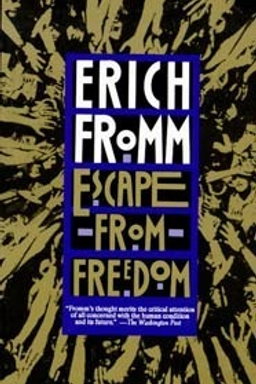
Escape from Freedom cover

Escape from Freedom

by Erich Fromm

Escape from Freedom by Erich Fromm delves into the complex nature of human freedom, exploring how increased autonomy can lead to anxiety and isolation. Through vivid illustrations, it emphasizes the importance of balancing personal choices with communal ties, offering a nuanced understanding of freedom in both individual and historical contexts.

Freedom and the Human Struggle for Meaning

How can you bear freedom without losing yourself? In Escape from Freedom, Erich Fromm argues that modern human beings face a dual condition. You have gained independence from traditional authorities—family, church, tribe—but at the cost of isolation. Freedom, Fromm insists, is not a single victory; it is a tension between freedom from external bonds and freedom to realize your individuality through spontaneous, loving, and productive engagement with the world.

Two Faces of Freedom

Fromm begins by showing how individuation—your emergence as a distinct self—has both liberating and painful sides. In history, the Renaissance marked the break from medieval unity into self-awareness and rational autonomy. Psychologically, the child’s realization of “I am I” echoes this historical pattern. Yet separation from collective security also creates anxiety. This dilemma runs through all epochs: emancipation gives autonomy but exposes you to existential loneliness.

Freedom’s Historical Development

To understand why freedom becomes unbearable, Fromm retraces Western history. The Reformation and the rise of capitalism released individuals from feudal and religious constraints, multiplying “freedom from.” But as communal structures dissolved, many could not achieve “freedom to”: the active realization of one’s potential through love and creative work. Protestantism answered the anxiety of independence with doctrines of submission (Luther) and compulsive work (Calvin), and capitalism channeled these tendencies into productivity that concealed alienation.

Psychological Parallel: Individuation versus Isolation

Every cultural transformation mirrors inner development. When you separate from primary ties, you may experience insecurity. Some respond by developing spontaneous relatedness—authentic connection through creativity and love. Others, unable to bear aloneness, seek escape in authoritarian submission or mechanical conformity. Fromm emphasizes that the Biblical myth of the Fall symbolizes this paradox: eating from the tree makes humans free and ashamed at once.

The Choice

You can neither return to pre-modern unity nor evade the pain of separation. The only path forward is positive freedom—an inner strength that allows active participation in life. If you fail, you drift into escape mechanisms: dependency, destructiveness, or conformity. Fromm’s entire book explores these routes, not merely as pathology but as historical responses to the difficulty of living as free individuals within alienating social systems.

Key insight

Freedom is not the absence of restraint but the presence of self-directed activity. If you do not develop the ability to act spontaneously and love productively, the very independence you gain becomes the seed of anxiety and submission.

This central dialectic—between liberation and isolation—anchors every theme in Fromm’s work. From theology and economics to psychology and politics, he shows how modern humanity oscillates between craving autonomy and fleeing from it. The solution, he argues, is not a return to authority but a renewal of spontaneous life rooted in reason, love, and social participation.


Society Shapes Character and Freedom

Fromm redefines human nature as a dynamic interplay between biological needs and social processes. You are not simply driven by fixed instincts; your desires, fears, and habits are molded by the structure of your society. Economic systems, family relations, and cultural norms form character orientations that in turn sustain those very systems.

Beyond Biological Fixity

Freud saw civilization as repression of instinct. Fromm accepts unconscious motivation but rejects the idea that human drives are static or antisocial. Instead, human beings adapt dynamically: society builds enduring character patterns—like thrift, submission, or competitiveness—that perpetuate its institutions. A capitalist world needs disciplined, self-reliant workers; a feudal order cultivates devotion and obedience.

Dynamic Adaptation and Human Needs

Fromm distinguishes static adaptation (acquiring a habit) from dynamic adaptation (reshaping personality). For instance, a child who fears his authoritarian father internalizes submission and develops repressed hostility; that character structure then influences the adult’s political and economic behavior. Two basic needs—self-preservation and relatedness—remain universal, but the forms they take depend on social life. When a society blocks spontaneous relatedness, individuals bend toward conformity or destructiveness rather than love and creativity.

Social Character and History

Fromm’s major insight is that historical change generates and depends upon shifts in social character. The Protestant work ethic and capitalist asceticism are not irrational leftovers; they express a deep emotional pattern formed by insecurity and the need for proof of worth. Understanding these psychological underpinnings allows you to see history not as abstract progress but as transformations of how people feel, think, and act.

Key insight

Social systems don't just limit what you do—they shape who you are. When culture molds personality to fit its economy, freedom depends on your ability to resist turning adaptation into self-betrayal.

The lesson: psychology and history are inseparable. You cannot reform society without understanding the characters it creates, nor understand individuals without tracing the societal forces that form their inner life.


Religion, Submission, and Work as Escape

When medieval faith crumbled, Protestantism arose not only as a new theology but as a psychological answer to insecurity. Luther and Calvin provided doctrines that soothed the anxiety of freedom by redefining submission and work as moral virtues. Fromm interprets these doctrines as emotional strategies in a world suddenly without traditional anchors.

Luther’s Rebellion and Self-Surrender

Luther freed believers from papal authority but replaced it with inward tyranny: man is corrupt, will is impotent, salvation depends entirely on grace. This relieved tormenting doubt—if you feel sinful and helpless, surrender brings certainty. Yet psychologically it produced dependence. Submission to God mirrored submission to princes. The individual became spiritually passive, trading the burden of agency for emotional safety.

Calvin’s Anxiety and the Compulsion to Work

Calvin intensified helplessness with predestination: salvation is fixed, but worldly order reveals divine election. People sought assurance through disciplined effort—unceasing labor and thrift signified grace. This theology transformed anxiety into compulsive activity. Work ceased to be a practical need and became a moral proof, turning conscience into a harsh inner authority demanding constant effort.

From Religion to Capitalist Morality

Fromm connects this mindset directly to capitalism. The Protestant ethic converted theological anxiety into economic drive. Success proved virtue; failure implied unworthiness. Work became both product and symptom of escape from freedom. You obey not an external ruler but an inner compulsion—profiling modern man’s self-alienation. What began as faith evolved into the moral machinery of productivity and guilt.

Key insight

When work and conscience turn into self-punishment, freedom becomes servitude in disguise. True productivity must flow from spontaneity, not anxiety.

Fromm’s reading of Protestantism reveals how psychological needs can shape whole moral codes. Submission and diligence appear righteous but often mask fear—the authoritarian seed that later blooms in political and economic systems of control.


Capitalism, Conformity, and the Isolated Self

Modern capitalism, Fromm argues, fulfills the promise of external freedom and simultaneously deepens inner alienation. You are free to sell your labor, choose your leaders, and consume—but these freedoms often hollow the self. Relationships become transactions and identity turns into a commodity.

Economic Freedom and Its Contradictions

Capitalism’s rise magnified individual initiative and mastery over nature. But in freeing you from feudal dependencies, it replaced those ties with anonymous markets and bureaucratic structures. You exchange personal bonds for impersonal functions. A grocer once served neighbors; now a clerk obeys a system. This substitution of autonomy with mechanism creates loneliness masked by consumer excitement.

Advertising, Personality, and Automatism

Fromm shows how modern culture reinforces pseudo freedom. Advertising and propaganda implant desires while promising individuality. You feel free because you choose—but you choose from predesigned options. Employers seek a pleasant demeanor; products sell with ritualized emotion. Personality becomes a marketable asset, not an expression of authenticity. Kafka’s helpless protagonists and Mickey Mouse’s perpetual victimhood symbolize the absurdity of the small individual facing enormous systems.

Automaton Conformity

When spontaneous thinking and feeling are replaced by pseudo processes—opinions copied, emotions prescribed—you become an automaton. You believe your thoughts are your own, while they echo mass culture. The pseudo self replaces spontaneity with compliance, leaving people ready to accept manipulation or dictatorship under the illusion of self-expression.

Key insight

Without inner spontaneity, technical freedom degenerates into mechanical conformity. You may act efficiently and feel independent while serving invisible commands.

For Fromm, capitalism represents freedom’s double bind: it multiplies choice while destroying inner capacity to choose authentically. The task is not to deny progress, but to recover the personal and collective spontaneity that makes freedom human.


Authoritarian Escape and Social Sadomasochism

Unable to bear isolation, many people flee freedom by fusing themselves with a power greater than they are. Fromm identifies three main escape mechanisms: authoritarianism (submission and domination), destructiveness, and automaton conformity. The first—the authoritarian response—expresses the longing for security through symbiosis: either surrendering to or controlling others.

Sadism and Masochism

Masochists find relief in obedience; they shrink, degrade themselves, and avoid choice. Sadists find relief in domination; they expand by subjugating others. Both depend on each other emotionally and negate individuality. Fromm calls this symbiosis—a psychological fusion that cancels autonomy while simulating connection. In religion, politics, and erotic life these patterns recur whenever uncertainty becomes unbearable.

Power versus Potency

Fromm’s crucial distinction clarifies the pathology. Potency is the ability to act and create; power as domination is the perversion of potency born from inner impotence. The authoritarian personality admires strength because it feels weak, and seeks rulers who promise belonging by commanding. Simultaneously, it craves the chance to humiliate others to regain feeling of control. Nazism exemplifies this dynamic: mass submission and cruelty fed each other through Hitler’s sado-masochistic leadership.

Destructiveness and Social Distribution

When impotence turns hopeless, domination gives way to destruction. If you cannot influence the world, you annihilate it. Fromm traces this drive to blocked life forces—the energy of unlived spontaneity. The lower middle class of interwar Europe, frustrated and isolated, exemplified how thwarted existence turns into political destructiveness. Nazism used this energy, offering both submission and license.

Key insight

Authoritarianism satisfies the wish to belong by abolishing freedom. When people cannot realize potency, they mistake domination and destruction for power.

Understanding these mechanisms turns fear into knowledge. You can escape the unconscious longing for masters by cultivating inner strength—potency rather than power—and building mutual relationships based on shared growth rather than control.


Authority, Dependency, and the Roots of Neurosis

Authority does not always look like a ruler. Fromm disentangles rational authority—from which you learn and grow—from exploitative and anonymous authority—which make obedience feel like self-evidence. This distinction helps you see how dependency and neurosis grow when autonomy collapses under invisible pressures.

Rational versus Inhibiting Authority

A teacher guides you toward strength; a slave master keeps you weak. Rational authority dissolves when you mature; inhibiting authority perpetuates submission. Modern society celebrates independence but often hides control behind expertise and normality. You obey consensus, advertising, and social norms without feeling coerced—anonymous authority works precisely because it feels natural.

The Magic Helper and Dependency

When spontaneity is suppressed early in life, you look outward for protection. Fromm calls this the search for a “magic helper”—a person or institution that guarantees safety. The helper may appear as God, a lover, a boss, or analyst. Dependence comfortingly transfers responsibility but traps you in emotional slavery. Neurotic dependence often reflects an incomplete struggle to reclaim autonomy while clinging to the helper’s security.

Breaking the Cycle

You reduce neurosis not by renouncing needs but by restoring spontaneity. The ability to act, think, and love from your own center dissolves dependence. Awareness of anonymous authority—norms that masquerade as common sense—is the first step to freedom. Recognizing the “voices” that shape your conscience allows you to choose which ones deserve obedience and which require resistance.

Key insight

Freedom begins when you name your invisible masters. Awareness transforms dependence into choice; spontaneity turns obedience into creative participation.

Fromm’s analysis of authority and dependency reveals freedom’s inner dimension: liberation from disguised coercion. To grow, you must learn to trust your creative center instead of surrendering it to external or invisible powers.


Nazism and the Psychology of Totalitarianism

Why did millions follow Hitler? Fromm integrates economics, ideology, and psychology to answer. Nazism succeeded because it matched the authoritarian and automaton character of its society. Economic insecurity, blocked ambition, and emotional impotence made large populations seek submission and domination simultaneously.

Social Character and Class Base

The lower middle class—small shopkeepers, clerks, artisans—suffered postwar decline. Their traditional security vanished while capitalist forces limited opportunity. Their character emphasized obedience, thrift, envy, and resentment. These emotional traits prepared them to follow a leader promising strength and moral revival. Fromm calls this the authoritarian character ready-made for fascism.

Hitler’s Sado-Masochistic Appeal

Hitler’s rhetoric glorified submission to destiny and cruelty toward weakness. He both dominated and served higher powers—History, Nature—creating a perfect psychological resonance. His followers could dissolve their insecurity by merging with his power and projecting their hostility onto scapegoats. Industrialists and conservative elites exploited this character structure to stabilize property interests while unleashing mass resentment.

Freedom’s Political Lesson

Totalitarianism thrives on unfulfilled freedom: when people cannot bear autonomy, they trade it for security. Modern democracies are not immune; conformist societies can drift toward submission through propaganda and emotional manipulation. Political defenses must therefore include psychological resilience—cultivating inner potency, critical reason, and love.

Key insight

Dictatorship feeds on character weakness. Educating for emotional maturity and spontaneity is as vital to democracy as laws or constitutions.

Fromm’s study of Nazism thus expands beyond history: it warns that any modern society that neglects emotional development can breed new authoritarianism under democratic guise.


Positive Freedom and the Renewal of Democracy

The culmination of Fromm’s argument is constructive. Escape from freedom ends only when you find the courage to live it positively. Positive freedom is not license or rebellion; it is spontaneous affirmation—acting from your integrated self. This inner freedom becomes social only when institutions allow genuine participation and creativity.

Spontaneity and Love

Spontaneity appears in authentic love and creative work. Love, for Fromm, is union without loss of integrity. Work, rightly understood, is productive cooperation with nature, not mechanical performance. These experiences dissolve isolation by engaging your reason, emotion, and sensuous life together. They make you active without domination and connected without submission.

Social Preconditions for Inner Freedom

Inner change requires outer conditions. Economic democracy—planned but participatory—can replace alienation with agency. Education must shift from conformity to self-expression. Culture must value personal growth as its purpose, not entertainment or utility. Fromm emphasizes that freedom without structural support decays into anxiety and conformity; institutions must nourish spontaneity.

Making Freedom Real

Freedom’s victory is practical, not metaphysical. You can study which environments foster spontaneity and adjust policies accordingly. The aim is a society where individuality and community reinforce each other—a living democracy built on active citizens. When you cultivate positive freedom, you make democracy resilient against authoritarian temptation.

Key insight

Freedom survives only when culture makes individual growth its purpose. Spontaneous love and creative work are not luxuries—they are the foundation of democracy.

Fromm’s closing vision transforms morality and politics alike: you defend freedom not through obedience but through living fully. When people act spontaneously, democracy becomes not an external system but the shared expression of liberated human beings.

Dig Deeper

Get personalized prompts to apply these lessons to your life and deepen your understanding.

Go Deeper

Get the Full Experience

Download Insight Books for AI-powered reflections, quizzes, and more.