
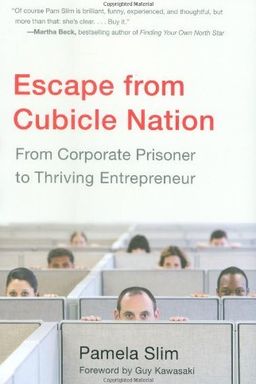
Escape from Cubicle Nation cover

Escape from Cubicle Nation

by Pamela Slim

Escape from Cubicle Nation is a transformative guide for aspiring entrepreneurs trapped in unfulfilling corporate jobs. Pamela Slim offers practical strategies to align personal values with work, overcome social pressures, and discover where passion and profit meet, empowering readers to build thriving self-employed careers.

Escaping the Corporate Cage

How can you build a career that feeds your spirit rather than drains it? In Escape from Cubicle Nation, Pamela Slim argues that the modern corporate world, while offering stability and benefits, often suffocates creativity, erodes personal agency, and misaligns with our core values. Her central claim is that meaningful work and freedom come not from rebellion but from thoughtful design—building a life and business that fit who you truly are.

This book serves as both diagnosis and roadmap. It begins by dissecting why corporations make so many talented people miserable, then helps you face the primal fears that keep you trapped. It guides you through detoxing your creativity, designing an intentional life, and crafting a business that works with your strengths and values. Finally, Slim walks you step-by-step through practical realities—from testing ideas and pricing to building support systems and planning your leap.

The corporate illusion

Slim opens by exposing the emotional and structural traps inside big organizations. Constant reorganizations, empty mission statements, and leadership hypocrisy create what she calls bureaucratic theater—hours of meaningless meetings and presentations that serve appearances rather than results. Her father’s sudden firing after decades of loyal service becomes emblematic of a broader truth: job security is an illusion.

You sense that something’s off when your work feels hollow despite external success—a mismatch between your essential self and the demands of corporate culture. That misfit, Slim argues, isn’t a personal flaw but a system problem that treats people as interchangeable rather than individual.

Facing your fears

Leaving corporate life activates your “lizard brain,” the ancient part of you hardwired for survival. It whispers catastrophic stories: “You’ll go broke,” “Your family will starve,” “You’ll end up living in a van down by the river.” Slim dismantles these scripts using exercises adapted from Martha Beck and Byron Katie—identify your fears, question whether they are true, and replace vague panic with specific tests and plans. The result isn’t fearlessness but mastery: converting anxiety into data and preparation.

Rediscovering your creative self

After prolonged corporate confinement, your “inner tiger”—your creative drive—may be chained. Slim recommends a detox: reclaim time, reset to “beginner mind,” and make space for curiosity. Through tools like Julia Cameron’s Morning Pages, physical play, and daily creative rituals, you rebuild the neural and emotional muscle for invention. This psychological renewal becomes the launchpad for any entrepreneurial move.

Designing from life outward

Before you rush toward a random idea, Slim insists you design your life first: picture the home, family rhythm, health, and work patterns you desire. From there, you reverse-engineer a business that supports that life. This “life-first, business-second” principle becomes the moral spine of the book—refusing the myth that entrepreneurship must mean endless hustle or glamour at the expense of wellbeing.

Experimenting and learning

Slim reframes entrepreneurship as a scientific process. Generate ideas from your passions and strengths, pick a narrow niche (“inch wide, mile deep”), and test small prototypes—workshops, landing pages, short trials—to validate demand. Don’t wait for perfection; as she notes through the PBwiki example, quick imperfect launches teach faster and cheaper than grand business plans written in isolation.

Building support and structure

Freedom isn’t solitary. You’ll need a “tribe”—mentors, peers, collaborators—who challenge you and celebrate wins. Tribe-building, financial strategies, operational planning, and honest conversations with family turn your dream into a stable enterprise. The leap, when it comes, should be informed courage, not a blind escape.

Ultimately, Escape from Cubicle Nation asks you to awaken all facets of yourself—emotional, creative, pragmatic. Slim’s message is clear: you’re not crazy for wanting more. The dissatisfaction you feel is a compass pointing toward authentic work. Follow it deliberately, backed by research, planning, and courage, and you can craft a business—and a life—that feels like your own skin.


Recognize the Corporate Trap

Pamela Slim begins with compassionate honesty: if you feel bored, alienated, or disconnected in your corporate job, you’re not crazy. Modern organizations create conditions that often produce misery—permanent churn, contradictory leadership, and environmental numbness. The supposed perks—benefits, titles, prestige—mask a deeper trade-off: loss of autonomy and purpose.

Structural churn and illusion of security

Slim’s memory of her father’s layoff symbolizes the collapse of corporate loyalty. Once, decades of service promised stability; now constant reorganizations, outsourcing, and “mission redefinitions” make layoffs routine. This endless churn breeds cynicism and disengagement. Work feels performative—endless PowerPoints, jargon-heavy strategy decks, and committees that exist mainly to signal diligence rather than deliver outcomes.

Culture and leadership contradictions

Slim’s viral “Open Letter to CXOs” highlights the hypocrisy between declared company values and tolerated behaviors. Vision posters can’t offset toxic management. Cultural integrity arises when leaders back values with hard decisions: firing bullies, telling uncomfortable truths, and foregoing empty motivational theater. She argues that many corporate pathologies trace back to misaligned incentives and fear-based management systems.

The physical and cognitive toll

The cubicle environment itself—airless, repetitive, and sensory-starved—can degrade mental performance. Slim connects this to Kathy Sierra’s ideas about neurogenesis: creativity depends on novelty and stimulation. Over years, gray walls and monotonous routines flatten vitality. The sense of burnout and physical discomfort (dry eyes, repetitive injury, dull fatigue) isn't weakness; it's biology resisting monotony.

Misfit and meaning

Slim’s “ill-fitting shoe” metaphor captures what thousands feel: external success coupled with internal deadness. You may perform well but still sense that your personal values or working style don’t fit. Her Cisco workshop story, where a woman discovered none of her ten core values matched her company’s, reinforces that misalignment—not money—is the chief predictor of disengagement. Understanding this allows you to quit feeling defective and start designing alignment elsewhere.

In examining these structures, Slim invites a shift from self-blame to systemic awareness. The corporate model was built for industrial efficiency, not human flourishing. Recognizing this truth is the first act of liberation—because once you name the trap, you can begin imagining work that fits your real size.


Taming the Fear that Holds You Back

Leaving the security of a paycheck activates primal anxiety. Slim calls it the “lizard brain” response—your body’s hardwired fear circuit whispering scenarios of disaster. She teaches you to name, investigate, and retrain these instincts through deliberate cognitive and practical strategies.

Naming and examining fear

Using Martha Beck’s framework, Slim explains that the reptile brain fears two things: lack and attack. It overestimates danger, assuming that quitting your job equals death. Write the fear down, she instructs, then dissect it. For instance, “I’ll never support my family” becomes a series of testable assumptions—How much income is required? How many clients would that mean?—transforming terror into solvable math.

Four questions to reframe thought

Borrowing from Byron Katie’s method, you interrogate fearful thoughts: Is it true? Can I know it’s absolutely true? How do I act when I believe it? Who would I be without it? One client realized her nightmare of homelessness was improbable after she calculated savings, part-time work options, and support networks. The fear didn’t vanish; it shrank into proportion.

Building safety nets and resistance

  • Save and plan: accumulate six months of expenses before a leap.
  • Test your market early to replace guessing with data.
  • Practice small discomforts daily—cold calls, public posts—to make fear less dominating.

Barry Moltz adds that failure should be treated as information. When you see each attempt as a test, you liberate yourself from perfectionism.

Essential self versus social self

Your essential self seeks joy and creative risk; your social self worries about approval. Much entrepreneurial hesitation comes from fearing social shame, not actual poverty. Slim’s reminder—“You live in your own skin”—grounds the transition in personal authenticity rather than validation from others.

Fear doesn’t disappear; it transforms. Like Becky, who literally lived in a van to confront her doom story, you discover that reality is survivable and often liberating. Once your lizard brain becomes a partner instead of a tyrant, you gain freedom to act with clarity rather than panic.


Rediscovering Energy and Creativity

Corporate conditioning narrows your imagination. To build something new, you must first clear mental clutter and revive your creative instincts. Slim’s concept of unleashing the “inner tiger” makes creativity not mystical but physiological—a muscle that strengthens through time, space, and play.

Creating space for renewal

Creativity demands capacity. Begin by reclaiming time from unnecessary obligations—say no to draining commitments, trim digital noise, and open white space in your schedule. Even one freed afternoon weekly can yield remarkable ideas. Slim’s message: creative energy expands in proportion to unused space.

Return to beginner mind

Experienced professionals often kill innovation by assuming expertise. A Fortune 500 marketer who believes she “knows branding” may miss how small-business customers differ radically from corporate ones. Slim echoes Zen teaching: approach learning like a novice. Engage curiosity—not credentials—to rediscover market reality.

Rebuild creative habits

Daily rituals reignite connection to intuition. Morning Pages, meandering walks, museum visits, and photography all feed sensory curiosity. Physical movement—dance, exercise, even intimate play—restores energy to the nervous system and refreshes insight pathways. As Slim writes, motion dislodges mental stuckness.

Capture sparks, make them tangible

Ideas die faster than they appear. Keep notebooks, voice memos, or index cards handy. Store fragments before your critical mind dismisses them. Vision boards or digital inspiration folders translate intuition into visible intention. These tools anchor dream energy to reality.

The Neutral Zone

Drawing from William Bridges, Slim reframes the uncertain in-between period after leaving a job as sacred. This “Neutral Zone” is not lost time but the creative incubator where your next identity forms. Rather than rushing to replace the void, dwell in discovery.

Creativity, Slim insists, is not optional—it’s the oxygen of entrepreneurial life. When you feel playful curiosity again, you’ve begun the deepest transformation: from employee reacting to structure to creator shaping your own.


From Vision to Tested Idea

Once you rediscover energy, your next challenge is direction. Slim helps you channel curiosity into specific, testable business ideas. The key is disciplined experimentation—shaping ideas where passion, skill, and market demand intersect, then verifying them with small, low-risk trials.

Finding your sweet spot

Using Jim Collins’ triple-circle model, identify what you love, what you’re good at, and what the market will pay for. Slim adds a personal tool—the “Bug Called You” notebook—to capture recurring fascinations and frustrations. Patterns reveal strategic directions better than brainstorming alone.

Narrow your focus

Avoid the trap of trying to serve everyone. Adopt the “inch wide, mile deep” philosophy (Suzanne Falter-Barns). Define a niche by life stage, psychographics, or problem clarity—like “parents of ADD children navigating schools” or “hybrid car owners seeking ethical maintenance.” Real-world examples—Pat’s Garage specializing in Hondas or Sergio photographer’s documentary wedding style—show how tight focus builds trust and visibility.

Validate your ideas

Entrepreneurs often build too much before testing demand. Slim prescribes micro-experiments: workshops, surveys, mock ads, or quick prototypes. Her own story of a full program launched without pre-sales—only to find no buyers—proves costly lessons. When you test small, the market tells you what works before you invest heavily.

Prototype and iterate

Borrowing from software culture, Slim promotes rough, rapid output. Use cardboard prototypes, simple PDFs, or fake-door tests (advertise, see who clicks). The PBwiki founders built a version in 48 hours and gained 1,000 users—proof that early imperfection accelerates evolution. In her phrase, “ghetto but it works” beats elegant but invisible.

Teach customers to excel

Kathy Sierra’s maxim “Help your users kick ass” reframes value creation: design offerings that make clients demonstrably better. When customers win, your product spreads. This flips marketing from hype to empowerment.

The transformation from concept to validated business comes through cycles of curiosity, testing, and feedback. Entrepreneurship becomes less about leap of faith and more about learning loop—a series of experiments guided by purpose and evidence.


Design the Life and Business You Want

Slim brings discipline to dreaming. Her roadmaps and models insist that you design your business as a system that serves your life—not the reverse. This design requires planning, pragmatic financial awareness, and clarity about values.

Life-first design

Start with your Ideal Life exercise: describe where you live, your relationships, health, work patterns, and income goals. This vision becomes a decision filter—if an opportunity violates your chosen rhythm, reject it. Slim calls this choosing wheatgrass over crack: slow vitality versus fast burnout. True success is daily satisfaction, not external applause.

Choose your business model

Slim unpacks model elements—offer, purpose, delivery, location, audience. By defining these deliberately, you avoid building a structure that constrains you. The best models mix active and scalable components suited to your temperament. She highlights hybrid entrepreneurs like Bob Walsh and Neenz Faleafine who blend consulting, digital products, and lifestyle design.

Avoid fantasy shortcuts

Beware passive-income myths and multilevel-marketing traps. Sustainable income flows from consistent value and audience trust, not “set-it-and-forget-it” schemes. Even advertising revenue is labor-intensive: content, engagement, maintenance. Her cautionary Amway story drives the point—study structure before committing.

Plan and test assumptions

Planning is not paperwork; it’s strategy made visible. Tim Berry’s block-based method encourages modular work: mission, market, finances, and execution. Treat your plan as a living hypothesis—dated and tested regularly. Each revision moves you from fantasy to evidence-based design.

Master the money game

Pricing and cash management keep dreamers solvent. Slim synthesizes Andrea Lee’s “Money Game” tool—mapping income goals to service mix—and Denise O’Berry’s cashflow disciplines: require deposits, align billing with work cycles, and maintain reserves. Price for outcomes, not hours. When clients see measurable returns, premium fees feel fair.

Building aligned business systems turns autonomy into stability. When life design, planning, and money clarity meet, entrepreneurship stops feeling risky and starts feeling intentional.


Build Your Tribe and Take the Leap

No one escapes alone. Slim credits her success to comadres, mentors, and tribes—the collective intelligence that steadies courage. She teaches how to recruit allies, safeguard relationships, and orchestrate a responsible exit from corporate life.

The power of connection

A strong tribe accelerates learning and sanity. Advisors give honest feedback; peers share resources; supporters amplify your voice (as Guy Kawasaki did for Slim’s blog). Mentors come in varieties: technical, strategic, and life-wise. Relationships grow through small authentic exchanges, not formal requests.

Practicing TAO

Following Martha Beck’s TAO—transparency, authenticity, openness—you admit limits, ask for help, and reciprocate generously. This openness attracts collaboration. Be a connector: introduce others, start mastermind groups like Slim’s “Fantastic 4x4,” and guard your tribe against exploiters and frauds.

Preparing family and operations

Entrepreneurship shifts family systems. Discuss your plans openly with partners, agree on boundaries and financial triggers, and listen. Set up practical infrastructure: legal entity, bank accounts, insurance, and advisory team (lawyer, accountant, banker, insurance specialist). These moves turn dreams into a functioning enterprise before revenue arrives.

Know when and how to leap

Slim outlines readiness checkpoints: strong emotional pull, tested product, partial income or cash cushion, supportive relationships, and contingencies. The optimal leap is informed, not impulsive. Guy Kawasaki’s maxim—focus on cash flow, try stuff daily, ignore “schmexperts”—captures the mindset. Courage grounded in preparation—not recklessness—marks the genuine escape.

By blending community, transparency, planning, and timing, Slim redefines freedom as relational resilience. Your tribe becomes both witness and safety net, making independence sustainable. When you finally step out, you’ll be walking with a network, not alone into the unknown.

Dig Deeper

Get personalized prompts to apply these lessons to your life and deepen your understanding.

Go Deeper

Get the Full Experience

Download Insight Books for AI-powered reflections, quizzes, and more.