
Idea 1
Designing a World Where Everyone Thrives
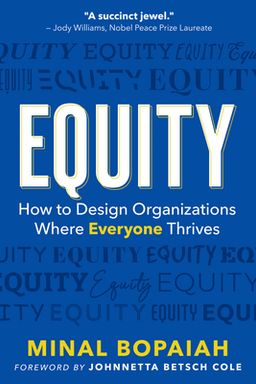
What would it take to create a workplace—or even a society—where everyone genuinely thrives? This question sits at the heart of Minal Bopaiah’s Equity: How to Design Organizations Where Everyone Thrives. Bopaiah argues that equity isn’t just about fairness or empathy—it’s about intentionally designing systems that work for everyone, not just for those historically at the center of power. Her central contention is that inequity isn’t accidental; it was designed. And if it was designed, it can be redesigned.
Most people assume inclusion means “being nice” or about helping people feel welcome. But Bopaiah flips this idea on its head: inclusion without equity is “toothless.” Equity is what makes inclusion real. When systems themselves are designed to promote fairness—through policy, behavior, and culture—then inclusion becomes a lived experience. In other words, she’s not asking us to change hearts alone; she’s asking us to change structures.
Why Systems Matter
Bopaiah opens the book with her parents’ immigration story, revealing how systemic design shaped both their hardships and opportunities. Her parents, doctors from India, benefitted from socialized education in India—an advantage that the U.S. system didn’t provide its own citizens because education is funded by local property taxes. This design extracts talent from other nations while limiting opportunity at home. Here, Bopaiah shows readers how systems can create or restrict success, depending on who they serve. It’s not just about effort or intelligence—it’s about who the system is designed to favor.
She uses this story to highlight how inequity in education or opportunity stems from systemic design choices, not moral failings. Just as design has been used for oppression—whether through colonial hierarchies, racial categorization, or exclusionary workplace norms—it can be redesigned to support justice, fairness, and opportunity.
Equity vs. Equality
A key distinction in the book is between equality and equity. Equality gives everyone the same thing; equity gives each person what they need to thrive. The famous Robert Wood Johnson Foundation illustration she cites—where people of different heights watch a baseball game from behind a fence—shows that giving everyone the same box to stand on (equality) still leaves shorter people unable to see. Equity, however, adjusts the system so all can watch comfortably. It's a powerful metaphor for workplaces and policies that seek uniformity instead of fairness.
“In an equitable society, all people have full and unbiased access to livelihood, education, and participation in community,” Bopaiah writes. Fairness, not sameness, should drive our design choices.
Three Preconditions for Equity
Equity requires three preconditions in any organizational system: (1) valuing differences, rather than minimizing or fearing them; (2) seeing the systems and how they shape opportunity; and (3) ensuring people with power use that power to create opportunity for others. These are not just moral principles—they’re design conditions. Without them, attempts at inclusion fail.
The rest of the book walks readers through how to achieve these preconditions. Chapter 1 explores how bias is embedded into every system, from laws to organizational policies. Chapter 2 introduces human-centered design (HCD) as a method to redesign those systems equitably. Chapter 3 focuses on leadership—how people with power can learn to value difference and rewrite their “story of success” to acknowledge the system that helped them. Chapter 4, 5, and 6 expand the scope: from implementing observable behaviors and communications strategies that “nudge” inclusivity, to designing equitable media and marketing practices that reshape culture itself.
From Empathy to Design
A defining idea is that well-intentioned empathy or awareness isn’t scalable. It’s not enough to ask every employee to become an “equity expert.” The real challenge is designing systems that make equitable behavior easy and automatic. For instance, in a fire department example, instead of lengthy diversity trainings, a simple rule—asking people for their pronouns—can institutionalize inclusive norms far more effectively. Equity, she shows, is about changing defaults, not just changing hearts.
This approach echoes thinkers like Antionette Carroll (TED’s “Designing for a More Equitable World”), who argue that oppression is a design problem that can be solved through intentional redesign. Bopaiah builds on that by merging human-centered design with behavioral science, showing leaders how to anchor empathy, power awareness, and communication in structural change. (In spirit, it aligns with concepts in Switch by Chip and Dan Heath, which emphasizes shaping behavior by changing context rather than motivation alone.)
Equity as a Virtue
Near the end of her introduction, Bopaiah elevates equity from strategy to moral practice. “Amid unfairness and heartbreak,” she writes, “the greatest expression of our humanity is the creation of fairness.” Designing equitable organizations isn’t just practical—it’s spiritual. Equity becomes an antidote to despair, grief, and revenge. It allows us to transform suffering into shared compassion and creativity.
Ultimately, Bopaiah invites every leader, designer, and citizen to become a co-designer of fairness—to see systems as artifacts we can reshape and to embrace interdependence as our strength. Her message is both pragmatic and profound: the world we live in was designed—so let’s design better.