
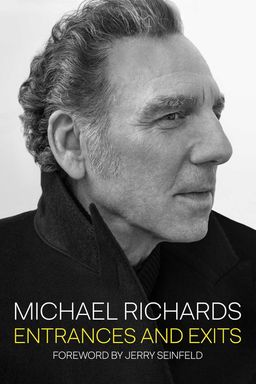
Entrances And Exits cover

Entrances And Exits

by Michael Richards

The comedic actor, known for his role as Kramer on “Seinfeld,” shares insights on physical comedy and moments from his life.

Comedy as Vocation, Body, and Soul

Comedy as Vocation, Body, and Soul

How can you make comedy that feels necessary, not optional? In Entrances and Exits, Michael Richards argues that great comedy is a sacred calling carried out through disciplined, embodied craft. He contends that comedians like him don’t dabble; they treat laughter as a life-and-death ritual. But to reach that standard, you must understand comedy as both a spiritual mission and a physical practice—one that joins mythic imagination, exact rehearsal, and a ruthless production machine.

A working creed

“There’s only a small few who approach it like this and it’s not by choice, it’s by birth... We must ‘kill.’ The audience ‘died laughing.’” — Jerry Seinfeld (Foreword)

The claim: comedy as sacred work

Richards and his peers approach stand-up and character work like priests at altar—fully invested, zero irony about the stakes. You see that ethos in his preparation for a Tonight Show sketch with Jay Leno: no script, but total commitment to costume, props, and danger (barbells, chalk, rowing machine, a towel slap to Jay’s rear). For Richards, the aim is not just a laugh; it’s a moment where the room changes state. (Note: this “sacral” view echoes Buster Keaton’s devotion to precision and Jacques Tati’s choreographies of the everyday.)

Embodiment: the body finishes the joke

Milton Berle’s maxim—“saying a joke and playing a character are two different things”—sits at the center of Richards’s craft. He builds characters you can see and feel: Dick on Fridays, later Kramer on Seinfeld. Words set up an idea; the body lands the laugh. His audition history proves it—gliding a wheeled chair, slamming a door on Larry David standing outside, and executing a headstand that careened into a chair before NBC brass. These risks weren’t stunts; they were arguments that physical choices create character.

The Trickster/Fool function

As Kramer, Richards embodies the Fool and Trickster, a Jungian archetype he studied through Joseph Campbell and Manly P. Hall. The “hipster doofus” (Larry David’s phrase) is simultaneously naive and canny, bound by no guilt, free to test social edges—bringing the audience’s buried desires for freedom into the open. The mythic device of kavorka in “The Conversion” distills this function—animal magnetism as comic metaphor for creative Eros, the irrational current that drives invention. (Compare to Dionysian figures in theatre or Neal Cassady in Beat lore.)

From workshop to machine

Seinfeld becomes a creative factory where this vision turns into weekly deliverables. Larry David and Jerry Seinfeld “police the meat”—writing, rewriting, and trimming. Tom Cherones and Andy Ackerman time movements and camera. The crew adds a “fourth camera” for wide-body falls, builds sets like the subway car, and integrates playback to showcase physical bits (e.g., the laundromat cement-bag routine in “The Revenge”). The loop—table read, rehearsal, rewrite, tape—turns spiritual intent and physical skill into broadcast art. (Note: this paired leadership mirrors other high-output shops—think Sorkin/Schlamme’s West Wing era—where a writer-performer axis governs tone.)

Crisis and repair as part of the path

The calling doesn’t exempt you from failure. After Seinfeld, The Michael Richards Show implodes, a case study in misalignment of format and talent. Then the Laugh Factory incident turns a private meltdown public. Richards refuses PR spin; he apologizes awkwardly on Letterman (“I’m not good”), then disappears into work—Jungian therapy, Rumi’s Sufi path in Konya, Iyengar yoga, cycling, breath practices in a backyard pool, and photography as devotional seeing. He rebuilds in small rooms and personal relationships, not press conferences.

What you learn to do

You learn to fuse seriousness and play: train like an athlete, invent like a poet, and collaborate like a pro. You treat props as partners, clothes as scripts, and entrances as musical cues. You protect your body (padding, rehearsal, choreographed falls) so you can risk more. You work within a system that prizes iteration and quality control while guarding your inner life from celebrity’s glare. And when you fail, you do sustained heart-work—therapy, ritual, humble reps—so your craft and character can re-enter the room without the armor of denial. This memoir isn’t just backstory; it’s a manual for turning a life—its wounds, studies, and stumbles—into a repeatable act that truly lands.


Roots of a Clown

Roots of a Clown

To understand Kramer’s fearlessness, you start in south-central Los Angeles with a boy making theatre of survival. Born in 1949, adopted and then returned to his mother Philomena (later Phyllis), Michael Richards grows up with an unsettled story: an absent father and floating legends about his fate. That ambiguity plants an early, performative question—who am I, and where do I belong? The home front adds complexity: a loving grandmother, “Ma,” later descends into schizophrenia and sometimes wanders away, returning with police escort.

Imagination as refuge and rehearsal

Scarcity and instability become fuel for a vivid inner cinema. Richards finds companions in TV clowns and heroes—Laurel and Hardy, Chaplin, the Lone Ranger—then stages adventures in Baldwin Hills with Prince Valiant toys and a bicycle exploring Culver City backlots. If you had to be your own audience, you learned to make physical action legible. Jumps, chases, improvised pratfalls—the boy builds the clown’s toolbox long before he studies it.

School friction, stage discovery

Military academies and Catholic schools don’t smooth the path—measles, alienation, and rules he resists—but they end up steering him into drama. Teacher Mr. Boardman recognizes something and casts Richards as Caliban for a Shakespeare competition. It’s the first sanctioned hit of electricity: read with feeling, move with intention, and a room follows you. That validation turns a coping strategy into a career hypothesis. (Note: many comics trace a similar conversion moment—Chaplin’s first stage success or Robin Williams’s high-school theatre—when survival play becomes vocation.)

Pain reworked into play

Grandma’s illness invites the young Michael to keep company with inner voices without fear, to accept surprise, and to hold tenderness alongside chaos. That double-vision—love and madness in the same house—teaches him the Fool’s generosity. He learns early to alchemize embarrassment into charm, oddness into style. When you later see Kramer burst through a door like a friendly dog, you’re watching a child’s survival tactic refined into a repeatable stage entrance.

From neighborhood bits to professional clues

Street games and impressions plant muscular habits: how to fall without injury, how to time a gaze, how to sell mock peril. The body’s education begins where the budget is zero. This apprenticeship explains why Richards will later trust physical risk at auditions—rolling office chairs, door slams, headstands in hotel suites—because he’s practiced making a body speak when words aren’t enough.

Why this origin matters to you

If your background feels “off script,” you can mine it for stage power. Richards’s path suggests a concrete method: locate the early wound (uncertainty, instability), track the coping strategy (improvised play, physical bravado), and refine it into craft (rehearsed business you can repeat safely and precisely). The clown isn’t an escape from pain; he’s a disciplined form that turns pain into communal breath. This is the seed of Cosmo Kramer’s kavorka—an irrepressible life-pull born not from privilege but from practiced response to the unpredictable.


Training, Mentors, and Service

Training, Mentors, and Service

Richards doesn’t separate life from training. He threads junior-college playhouses, CalArts labs, Stella Adler’s conservatory, and even Army roadshows into one long studio. Each stop teaches him a different axis of craft—ensemble stamina, textual depth, mythic imagination, and theatre as public health.

Valley College: ensemble and range

At Valley College, he forms Clique and plays across a startling range: Tennessee Williams, Waiting for Godot, Megan Terry. The pace is fast and cheap, which forces invention. Multiple roles per term build agility—the same muscle he’ll flex later moving between Dick on Fridays and a guest shot on UHF. Ensemble culture teaches him to listen with his whole body, a crucial habit for live TV chaos.

CalArts: the person behind words

Deena Metzger’s line—writing is about “the person behind words”—unlocks a depth practice. Richards absorbs Grotowski’s rigor, Brook’s “empty space,” and Kaprow’s happenings, which treat theatre as ritual. Now pratfalls aren’t just gags; they can be signposts in a human map. This framing will let him later build Kramer’s inner life so the outer business feels inevitable.

Stella Adler and Joanne Linville: imaginative truth

Stella’s method privileges imagination over trauma-mining. Don’t re-live an old wound; invent circumstances so precise they feel true. Joanne Linville reinforces backstory as oxygen. Richards takes these lessons straight into Seinfeld: show up already living where Kramer has just been, and writers can trust your truth. (Parenthetical note: this contrasts with pure affective-memory approaches; Adler’s route suits comedy’s need for energy without psychic depletion.)

Myth, Jung, and “higher intelligence”

Joseph Campbell’s archetypes, Manly P. Hall’s esoterica, and Jungian psychology give Richards permission to treat performance as revelation. The Trickster/Fool isn’t a shtick; he’s a psychic function that cultures need. Seeing Kramer as archetype helps Richards choose fearlessly—he’s channeling a pattern, not faking quirks. That perspective will also stabilize him later when public life fractures; myth gives you a larger container.

Army roadshow: theatre as service

Drafted as a medic, Richards pivots to the V-Corps Training Road Show under Sgt. Randy Larsen—an 18–25-person traveling company with lights, sets, and a mission. He even method-wears a colonel’s uniform to promote the program, learning to improvise authority. The highlight is The Hope House, built around Howard Ransom—a Black enlisted man, former heroin addict and pimp—whose language and life anchor a play about addiction and recovery.

The show hits raw nerves across German bases. Authenticity outmuscles polish because Howard’s rhythms are true. Yet institutions cut both ways: surveillance photos, suspicion about civilians, and pressure to inform end the run. Richards takes an honorable discharge; Howard unravels without the project. The lesson isn’t sentimental—art can heal, but systems constrain.

What you carry forward

Blend technique with inner images. Join ensembles to build durable stamina. Use archetypes to steer choices when you’re stuck. And remember service: sometimes the best theatre is a mobile clinic for human problems. This is the spine Richards brings to the clubs and studios—craft that breathes beyond applause.


Risk, Reps, and the Break

Risk, Reps, and the Break

Richards’s path from club oddball to Emmy winner is a chain of deliberate risks and relentless reps. He treats clubs as laboratories and television as high-wire training.

Clubs as labs

At the Troubadour, he and Ed Begley Jr. crash the stage in tattered tuxes and gas masks—a mischievous audition that lands a slot. At the Improv and the Comedy Store, he iterates bits fast: skating in Yugoslavian costumes, pushing physical danger while watching audience timing with a scientist’s eye. The scene connects him to Robin Williams, Jim Carrey, Budd Friedman, and Charlie Joffe—the agent who will later guard his character IP.

Fridays: live TV crucible

ABC’s Fridays gives him a chaotic, camera-aware dojo. He invents Dick and Battle Boy, plays alongside Andy Kaufman’s volatility and Marty Feldman’s risk. The live format demands speed, ensemble listening, and a nose for when to stretch or protect a bit. Fridays proves he can be funny with red lights on and the clock against him.

Agents and IP

Charlie Joffe sees the potential and negotiates a crucial clause for what becomes Seinfeld: Richards retains ownership of characters he brings. That foresight treats character as IP—rare at the time—and gives Richards leverage to protect what he builds. (Note: today’s creators can learn from this—own your bits, your voice, your look where you can.)

Auditions that invent the role

The Kessler-to-Kramer birth is a master class in auditioning physically. First read: he glides a wheeled chair to embed awkward grace. Second: he slams a door in mock shock—Larry David catches it from the hallway. Final at Century Plaza before NBC’s Brandon Tartikoff: a headstand topples him into a chair. It’s audacious and precise, communicating a whole personality.

A network verdict

“Well, if you want funny, go with that guy.” — Brandon Tartikoff

Jerry and Larry’s pilot script gives Kessler little to say—“Got any meat?”—but Richards supplies movement, rhythm, and appetite. Writerly nudges (pony-tail notes) come and go; the creators protect the eccentric core. Risk and readiness fuse; the role grows to fit the body that dared to claim it.

What you take from this

Don’t wait for pages to define you. Audition with a specific physical idea. Bring backstory even if it’s never spoken. Risk honestly—stunts work when they’re controlled and rooted in a clear character aim. Cultivate relationships that open doors and protect your creations. Reps make you durable; risk makes you memorable.


Making Kramer Real

Making Kramer Real

Kramer isn’t a bundle of lines; he’s a lived-in person built from clothes, ritual, backstory, and a Trickster’s ethic. Richards shows you how a character’s outer life—shoes, shirts, props—writes the inner script you play.

Wardrobe as text

Richards hunts vintage Town & Country shirts, worn trousers, and breaks in two pairs of Doc Martens (originally with nine stars each, later blacked-out). He rehearses “in costume,” sanding soles and spraying silicone so entrances slide exactly. Clothes change posture; shoes dictate gait. In Jerry’s apartment, fabric and tread set comic physics. The Klein bike, Shriner-hat shirt, and red lava lamp deepen the biography—a space that reads as “Cosmo” even before the name reveal.

Rituals that prime timing

Richards uses rehearsal shoes and “showtime” shoes, tuning friction levels like a sound engineer. He maps entrances as musical phrases: grip the doorframe, pivot, scan, invade the fridge—or miss, and eat the cabinet for a laugh. He coordinates with crew to let a “fourth camera” catch whole-body gags. When studio rhythm risks drowning moments in applause, the team even coaches the audience to hold, preserving comic flow.

Backstory you can feel

Adler/Linville training pays off: Richards imagines where Kramer just came from, what odd job he tried, what scheme he half-finished. Episodes like “The Statue” and “The Revenge” feel continuous because the actor knows a prior moment you never see. Director Tom Cherones supports the physical language with production tricks—filming the cement-bag laundromat routine and playing it back for the house so a crafted sequence gets its rightful roar.

Fool, philosopher, hipster doofus

Larry David’s “hipster doofus” tag nails Kramer’s paradox—he’s blissfully un-neurotic where Jerry, George, and Elaine obsess. He tells awkward truths and dives into New York’s eccentric currents (pirated cable, Calvin Klein perfume pitches, “Soup Nazi” culture) with no shame. The kavorka in “The Conversion” literalizes his eros—creative pull as erotic lure—both gag and metaphor.

On being the Fool

“He’s the Fool and the philosopher. Either he’s onto something or he’s full of it or both. Whichever it is, it’s amusing, and his students are paying attention.”

Why the build works

Because every outer choice (a scuffed shoe, a sliding sole, a lava lamp glow) cues an inner impulse, Kramer arrives as cause, not decoration. When the show finally names him “Cosmo,” the cosmic joke lands on a foundation you already trust. That’s why America recognizes him—not just as a gag machine, but as a mirror for our wish to live boldly without neurotic self-judgment.


Engineering Physical Comedy

Engineering Physical Comedy

Kramer’s chaos is engineered. Richards details a system that marries choreography, camera strategy, safety gear, and athlete-level conditioning. The goal isn’t random surprise; it’s controlled risk that reads as spontaneous.

Camera grammar and blocking

Seinfeld often adds a “fourth camera” to capture full-body business. Richards and directors like Tom Cherones and Andy Ackerman block entrances and exits with the same care you’d give a dance. In “The Subway,” extras and timing sculpt Kramer’s scramble for a seat. In “The Pick,” a curved wall invites a planned skid and pratfall—timed for the wide.

Protection as permission

Underneath the clown is armor: elbow/knee pads, hip girdles, a tailbone “butt” pad, even a steel back plate for brutal-looking hits like Danny Woodburn slamming him in “The Stand-In.” That kit, plus Iyengar yoga’s alignment and deep breath control, lowers injury risk and widens the envelope of what you can attempt. Richards cycles hard, too—endurance translates into recovery speed and grounded movement.

Visualization and variation

Before taping, he sits “trancelike” in his dressing-room chair, playing the bit on the mind’s screen. He’ll practice a fall one way at rehearsal, then shift angle or tempo at taping to keep surprise alive. The Carnegie Hall cameo—silent walk, mic-stand tangle, cord snare—was designed for the house-wide gasp. Repeat takes without a live audience let him chase the cleanest read; live tapings force him to cover mistakes because the audience has already “spent” its first-laugh energy.

On feeling the laugh

“With or without an audience, I can feel the laughs within me.” — Michael Richards

Production creativity for physical bits

When the stage can’t safely host a complex routine in front of a live house, production adapts. The laundromat cement-bag sequence in “The Revenge” is filmed and played back at taping so the crafted beat scores a fresh wave. That hybrid method—part theatre, part cinema—protects both timing and audience discovery.

Takeaways for your own work

Treat falls like scenes: design, rehearse, pad, and aim a camera that honors the body’s story. Build a personal fitness and breath regimen so your nervous system stays available under pressure. Use variation sparingly to keep surprise while protecting the spine of a bit. Great “spontaneity” is built, not lucked into.


The Seinfeld Machine

The Seinfeld Machine

Seinfeld succeeds because it’s a tight production organism: paired creative leadership, iterative writing, actor-driven specificity, and technical support tuned to comedic logic. It’s a weekly workshop with the ambition of a repertory company.

Paired leadership and script metabolism

Larry David governs comedic logic; Jerry Seinfeld is the on-set editor who “chops the fat off the meat.” Every idea runs their gauntlet, which makes the bar high and the product lean. Writers cycle in and out quickly if they can’t meet the show’s particular tone. The result: scripts act like machines—no wasted motion, all character engines aligned.

Direction as rhythm

Tom Cherones and later Andy Ackerman convert pages into movement and camera rhythm. Ackerman’s rapport with Richards lets them try take-variations with subtle signals. Sets like the subway car are engineered to be both cinematic and repeatable. A “fourth camera” appears when a physical gag needs a body-wide view; coverage adapts to preserve discovery.

The rewrite loop

Table reads yield immediate surgery; overnights deliver new pages. Richards visualizes in his chair to pre-time an entrance; the next morning a line is tighter and a beat cleaner. Meta episodes—“The Pitch,” “The Ticket,” “The Pilot”—show the machine reflecting on itself while still landing laughs. Two-parters expand scope without losing pace.

On pressure and craft

“It’s about great comedic writing every week. It’s about servicing characters played by actors who are looking out for them.”

Live energy vs. perfect take

The show toggles between live tapings (for electricity) and closed-set pickups (for precision). If an audience has already seen a fall, you cover and move because surprise is spent. Guest stars—Tony Curtis, Bette Midler, Lloyd Bridges, Mel Tormé—are orchestrated like event anchors. Even audience etiquette gets directed; applause on Kramer’s entrance is modulated to preserve dialogue rhythm.

Outcome and cost

The machine wins Emmys and defines 1990s comedy, but its pace burns talent. Larry leaves, returns for the finale; writers churn under “Jerry is the ax” standards. The lesson for any creative team: pair strong leads, iterate fast, honor the technical spine, and actively manage pressure or pay in burnout.


Fame, Failure, and Heart-Work

Fame, Failure, and Heart-Work

After Seinfeld, visibility amplifies everything—wins and mistakes. Richards navigates both the glitter and the glare: public stunts that work, a high-profile series that collapses, and a club-night meltdown that forces radical repair.

Public life’s double edge

In Florida, a hotel misplaces his tux for an NBC gala. Richards shows up in a white bathrobe—audience roars. The tux arrives and the bit becomes legend. Minutes later, the joke turns serious: he’s escorted by heavyset men to a penthouse linked to a powerful owner. Lesson: fame can turn your private workaround into a triumph or a trap in seconds.

The Michael Richards Show: a textbook flop

Courted by NBC and Castle Rock, he shoots a film-style pilot, then gets yanked into a multi-cam studio remake. Poor testing, public Upfronts pressure, rushed rewrites—the show races ahead of design. In a writers’ room blowup, he shouts, “I’m dead here!” Eight episodes later, it’s over. The takeaway is clinical: format must fit the performer; speed can kill alignment. (Note: contrast with Seinfeld’s slow-burn build and tight writer-performer feedback loop.)

The Laugh Factory crisis

A balcony heckle escalates; Richards erupts into racist language. Phones record; media detonates. On Letterman, he refuses a polished statement and says, “I’m not good.” He chooses no spin—only responsibility and retreat. Consequences are real: canceled appearances, moral scrutiny, and shame that won’t be outrun by a clever bit.

Repair: therapy, ritual, practice

He turns to Jungian analysis (active imagination, shadow integration), and to spiritual traditions he’s courted for years—Freemasonry, Vedanta, Sufism. In Konya, Turkey, he studies Rumi and the whirling rite—finding a pole to spin around rather than scattering. Daily anchors return: Iyengar yoga, long rides, and a backyard pool “reboot” with a ScubaPro regulator in the deep end. Photography becomes a devotional seeing—aperture and light as inner focus.

On responsibility

“You can’t fix things out there anyway! The most I can do for everybody is go home and get my shit together.”

Friends make a bridge—Paula Poundstone offers shelter; Frances Fisher arranges retreat; mentors extend grace. Richards returns to clubs on different terms and later reunites with the Seinfeld cast on Curb Your Enthusiasm—signals of cautious reintegration. The repair is not a press cycle; it’s a long apprenticeship in humility.

What you can use

Protect private rituals if you live in public. If you fail morally, apologize plainly, then do quiet work for as long as it takes. Rebuild with small, honest reps. Choose practices that stitch the heart and the craft together; the next entrance should be earned inside you before you try it on stage.

Dig Deeper

Get personalized prompts to apply these lessons to your life and deepen your understanding.

Go Deeper

Get the Full Experience

Download Insight Books for AI-powered reflections, quizzes, and more.