
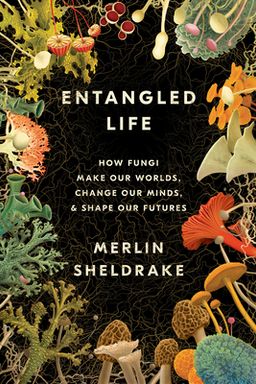
Entangled Life cover

Entangled Life

by Merlin Sheldrake

Entangled Life delves into the hidden realm of fungi, revealing their critical role in sustaining ecosystems, redefining intelligence, and offering solutions to environmental challenges. Discover how these organisms could be key to future survival, from mental health breakthroughs to ecological conservation.

Fungal Worlds and the Reimagining of Life

What if the ground beneath your feet were thinking? In Entangled Life, Merlin Sheldrake argues that fungi are not marginal organisms but central actors in the evolution, functioning, and possible futures of life on Earth. Through a blend of science, personal exploration, and philosophy, Sheldrake reveals fungi as networks of transformation — systems that connect plants, cycle nutrients, remodel ecosystems, and even shape culture and mind. The book redefines how you understand individuality, intelligence, and the boundaries of life.

The fungal fabric of life

Fungi form invisible architectures that sustain the world. Mycelium — the web of microscopic threads beneath mushrooms — orchestrates decomposition, nutrient transfer, and plant communication. These mycelial systems behave less like solitary organisms and more like distributed intelligences: they sense, explore, and adapt without central control. By learning from fungal strategies, you glimpse new ways to understand resilience, cooperation, and emergent order.

Partnerships that built the planet

Sheldrake traces how mycorrhizal fungi and plants made terrestrial life possible. Ancient algae partnered with fungi roughly 600 million years ago to survive on land — a collaboration that led to roots, forests, and the carbon-sequestering systems that regulate the atmosphere. Modern studies by researchers such as Katie Field and Toby Kiers show that these symbioses still control global carbon and mineral cycles and can determine how ecosystems respond to climate change.

Through mycelial trade networks, forests act less as isolated trees and more as connected communities — the so‑called “wood wide web.” These exchanges are not altruistic gifts but regulated markets where fungi broker resources, reward cooperative plants, and maintain their own survival strategies. This perspective, Kiers argues, pushes ecology to speak the language of negotiation rather than control.

Chemistry as conversation

For fungi, thought occurs in chemistry. They navigate and manipulate their worlds through molecules — scenting out partners, communicating with microbes, hunting prey, and even luring animals with perfumes. The truffle’s scent, co‑authored by a microbial community, is evolutionary advertising. Chemical dialogues also drive warfare and defense: nematode‑trapping fungi weaponize sticky nets or toxins; others pacify plants to secure nutrients. To understand ecology, Sheldrake suggests, you must learn to “listen chemically.”

Blurring individuality and intelligence

Lichens — composites of fungi, algae, and often bacteria — shattered 19th-century ideas of individuality. Contemporary sequencing by Toby Spribille shows lichens as many-partner assemblages, not pairs. This forces a philosophical turn: if life is collaboration all the way down, identity becomes relational. Sheldrake extends this argument to all living systems, including humans as holobionts intertwined with microbial partners. Fungi become mirrors through which you perceive your own entanglement.

Fungi, minds, and meaning

Sheldrake’s inquiry widens to behavior and consciousness. Insect‑infecting fungi like Ophiocordyceps hijack behavior with chemical precision, while psilocybin‑producing species reshape human perception and emotion. Research at Johns Hopkins and NYU confirms that small doses of psilocybin can alleviate depression and existential anxiety by disrupting rigid brain networks. Whether manipulating ants or aiding therapy, fungal molecules reveal intelligence as something distributed and chemical, not confined to brains.

Fungal futures

The book culminates in human–fungal collaborations: from mycofabrication (growing materials from mycelium) to mycoremediation (using fungi to detoxify ecosystems) and grassroots Radical Mycology movements led by figures like Peter McCoy and Paul Stamets. These efforts embody an ethic of partnership — using fungal metabolism to repair rather than exploit. Across ecological and cultural scales, Entangled Life presents fungi as guides for re‑imagining relationship, technology, and the art of living together on a crowded planet.


The Living Labyrinth

Beneath every forest, garden, or patch of soil lies a pulsating network of life: the mycelium. Sheldrake calls it a living labyrinth—a structure of microscopic tubes that branch, fuse, and adapt in real time. A gram of earth can host kilometers of these threads, and vast mycelial mats like the Oregon Armillaria have lived for millennia. But what makes them remarkable is not their size; it’s their decentralized intelligence.

Emergence without command

Mycelium grows without hierarchy or brain. Each hyphal tip explores like a miner’s probe, extending, retracting, or fusing based on environmental cues. When one segment discovers rich resources, neighboring threads shift direction and traffic intensifies along that route, mirroring network optimization algorithms. In laboratory models, fungal networks reconstruct efficient transport systems—Stefan Olsson saw bioluminescent waves and rapid electrical pulses propagate through hyphae, hinting at communication systems faster than diffusion.

Coordination and adaptation

Lynne Boddy’s wood‑block experiments show fungal behavior in action: when one block gained access to new resources, growth toward poorer blocks declined. The mycelium effectively “budgeted” effort, demonstrating adaptive feedback without neurons. These behaviors resemble slime molds’ problem‑solving abilities but grounded in a filamentous fungal architecture—an organic computer governed by growth dynamics.

Why the metaphor matters

Seeing mycelium as a network awakens insight beyond biology. It becomes a model for distributed systems—from artificial intelligence architectures to urban design and ecological restoration. The fungal labyrinth teaches that coordination doesn’t require central control; it flourishes through connection, feedback, and flexibility. When you walk on soil, you stand atop a vast thinking body whose patterns echo everything from neural circuits to social webs.


Networks That Feed Worlds

Plants didn’t colonize land alone. They arrived entwined with fungi that supplied minerals and water in exchange for sugars. These alliances, known as mycorrhizae, are as old as terrestrial ecosystems themselves and remain the engines of plant health and planetary chemistry.

Ancient partnerships, planetary effects

Fossils from ~400 million years ago display fungal filaments embedded in primitive plant tissues. Experiments by Katie Field and Benjamin Mills demonstrate that the efficiency of fungal nutrient transfer alters atmospheric CO₂ balance: when mycorrhizae perform well, plants grow, carbon buries, and climates cool. You can think of fungi as planetary engineers operating through microscopic trade.

The wood wide web

Field studies by Suzanne Simard and David Read revealed shared fungal networks connecting trees across species. Carbon moves between birch and fir; defensive signals cross roots through hyphae; entire seedlings depend on inherited links. Yet these networks are neither utopias nor centralized markets. Toby Kiers reframes them as dynamic economies: fungi allocate nutrients to reliable partners and withhold them from cheats. What looks like cooperation is often a balanced negotiation of costs and benefits.

Lessons for cultivation

Industrial agriculture often severs these links with ploughs and chemical overloads, weakening soils and plants alike. Regenerative practices—reduced tillage, diverse cropping, fungal inoculants matched to local ecology—restore the underground networks that keep ecosystems resilient. Recognizing the wood wide web teaches you to manage land not as a resource storehouse but as an intricately communicating community.


Communication Through Chemistry

If plants and animals converse through light or sound, fungi converse through molecules. Sheldrake portrays soil as a “chemical jazz club”: volatile signals, pheromones, and toxins blend into a living conversation. Each molecule is a note in the underground symphony.

Truffles and their perfumed strategies

Truffles, buried fruiting bodies of Tuber species, lure mammals with complex aromas to dig and disperse their spores. These scents arise not only from fungal metabolism but also from bacterial collaboration. Their chemistry varies by soil, microbiome, and region—proof that ecosystems, not individuals, write the perfume. Evolution tuned truffles’ odor to hijack animal behavior much as flowers attract pollinators.

Fungal weaponry and negotiation

Some fungi weaponize molecules to hunt: nematode‑trapping species detect prey pheromones and snap nooses in milliseconds; oyster mushrooms deploy paralytic toxins. Others use subtle hormones to manipulate plants, coaxing roots to branch or quieting immune defenses. Chemistry gives fungi agency without movement, allowing them to remodel entire ecological networks from below.

Key message

Fungal intelligence is chemical intelligence. When you breathe the scent of soil after rain, you inhale a message chain millions of molecules long.

Learning to read chemical languages reframes biology: it suggests behavior can arise from diffusion and reaction as much as from neurons. To understand fungi—or ecosystems—you must learn to sense with your nose, not just your eyes.


Symbiosis and the Blurring of Self

Lichens are miniature societies—composites of fungi, algae, bacteria, and often yeasts—that overturn the notion of discrete individuals. Since Simon Schwendener’s 'dual hypothesis' in the 19th century, lichens have challenged biological orthodoxy, revealing cooperation as a creative force. Modern genetic studies (notably Toby Spribille’s) reveal even greater complexity: multiple fungal partners coexist in what looks like a single organism.

Holobionts and shifting identities

The lichen paradigm now extends to all complex life. Every animal and plant—including you—is a holobiont: a host plus microbial partners shaping digestion, immunity, and adaptation. This perspective erases the sharp border between 'me' and 'environment.' As Lynn Margulis argued regarding cell evolution, individuality is a team sport. Sheldrake uses lichens as metaphors for a planetary entwining of lives.

Life beyond limits

Some lichens survive space exposure experiments, outlasting radiation and deep freeze. Their endurance redefines the possible, prompting astrobiologists to consider how life might travel or persist beyond Earth. Conceptually and ecologically, lichens prove that cooperation, not self-sufficiency, is the ultimate survival strategy—a lesson relevant to science, philosophy, and social life alike.


Minds, Molecules, and Manipulation

Sheldrake bridges the fungal and mental worlds through diverse examples, from zombie ants to psychedelic therapy. Across these cases runs a single theme: fungi act on minds—animal and human—by reshaping information flow.

Fungal puppeteers

Ophiocordyceps infects ants and compels them to climb to precise heights before dying, securing ideal spore release sites. The fungus doesn’t invade the brain but secretes compounds that modify muscle control and neurology. Similarly, Massospora infecting cicadas outputs stimulants such as cathinone, spurring hyperactivity even as the host disintegrates. These are behavior‑engineering chemists operating via molecular scripts.

Human encounters

Psilocybin mushrooms modulate human consciousness by dampening the brain’s default mode network, dissolving habitual self‑identities. Clinics at Johns Hopkins and NYU document rapid, lasting relief from depression and anxiety after guided sessions. Participants describe mystical unity and ego‑softening; neuroscientists record reintegrated connectivity patterns across the cortex—a temporary re‑entanglement of the mind.

From evolution to medicine

While such molecules may not have evolved to affect humans, they illustrate the breadth of fungal biochemistry. Dawkins’ extended phenotype concept helps interpret these manipulations: fungal genes express themselves by steering other bodies’ behavior. Whether in ants or therapy rooms, the result is the same—minds are porous, and fungi are adept at slipping through those pores.


Fungal Technologies and Human Futures

Fungi translate ancient ecological intelligence into new human tools. From environmental cleanup to renewable materials, mycological technologies embody partnership rather than domination. Sheldrake showcases innovators like Paul Stamets, Eben Bayer, and Peter McCoy, who bridge grassroots curiosity with applied science.

Mycoremediation and repair

White rot fungi such as Pleurotus and Trametes break down pollutants—hydrocarbons, dyes, even explosive residues—by the same oxidative enzymes they use to digest wood. Projects from Ecuadorian oil sites to post‑wildfire California use mycelial mats to capture toxins and pathogens. Yet Sheldrake warns: lab success rarely translates directly to field stability. Effective cleanup requires designing ecological conditions—oxygen, moisture, and microbial partners—just as brewers design fermentation.

Radical Mycology and distributed discovery

Radical Mycology movement reclaims experimentation for communities. Using low‑cost tools like 'injection‑port' jars, amateurs cultivate fungi for local remediation and food. CoRenewal and similar groups demonstrate citizen science grounded in stewardship. The movement’s ethic is democratic but cautious: avoid ecological mismatch, contamination, and techno‑hubris. True collaboration requires humility toward fungal complexity.

Mycofabrication and design

At industrial scales, companies such as Ecovative Design grow mycelial composites into packaging, textiles, and building materials. The process replaces assembly lines with guided growth. Mycelium threads bind agricultural waste into lightweight, compostable forms already used by Dell, IKEA, and fashion designers. Future visions—living architecture and bio‑circuits using fungal electrical impulses—extend the metaphor that building might mean cultivating patterns rather than coercing matter.

Applied mycology in ecosystems

Paul Stamets’ collaboration with Washington State University on bee health dramatizes translation from observation to application: fungal extracts reduced viral loads in honeybees up to forty‑five‑thousand‑fold, hinting at bio‑pharmaceutical potentials. Yet Sheldrake keeps the excitement grounded—complex diseases require multifactor solutions. Still, these cases embody the promise of fungi as allies in planetary restoration and resilience.


Stories, Metaphors, and the Culture of Yeast

Fermentation may be the most enduring dialogue between humans and fungi. Yeasts like Saccharomyces cerevisiae turned fruit and grain into civilization: bread, beer, wine, and now biotechnology. But for Sheldrake, fermentation is as much narrative as metabolism: how you describe rot determines what you make of it.

Cultural fermentations

From the Neolithic brewers Lévi‑Strauss described to Sheldrake’s own cider project with Newton’s apples, fermentation binds biology and story. Local yeasts mirror local culture: wild cider from community‑pressed apples differs from industrial versions because its microbial cast and mythic origins—the apple under Newton’s tree—shape meaning as much as taste. 'Fermentation is domesticated decomposition,' Sheldrake writes; it exemplifies creativity by embracing decay.

Metaphors that make worlds

Language about fungi steers science itself. Ecologists speak of 'biological markets' or 'wood wide webs,' each framing assumptions about cooperation or competition. Political metaphors—mutual aid, socialism, capitalism—creep into data interpretation. Sheldrake, echoing Donna Haraway and Jan Sapp, asks you to hold metaphors lightly: test them, use them, but never mistake them for truth. 'It matters which stories tell stories,' he writes, reminding you that perception is experimental literature between humanity and the more‑than‑human world.

Through yeast and metaphor alike, Sheldrake ends by urging a new relational consciousness—one that recognizes culture as fermentation, knowledge as co‑growth, and the future as an experiment in entanglement.

Dig Deeper

Get personalized prompts to apply these lessons to your life and deepen your understanding.

Go Deeper

Get the Full Experience

Download Insight Books for AI-powered reflections, quizzes, and more.