
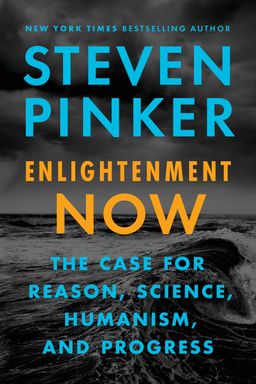
Enlightenment Now cover

Enlightenment Now

by Steven Pinker

Enlightenment Now by Steven Pinker provides a data-driven, optimistic perspective on modern progress. Highlighting the transformative power of Enlightenment values-reason, science, and humanism-Pinker reveals how these principles have drastically improved global life expectancy, reduced violence, and increased prosperity, inspiring hope for continued advancement.

The Enlightenment Vision and Its Modern Defense

What if progress, reason, and human flourishing were not myths or illusions, but real achievements built through deliberate effort? Enlightenment Now (Steven Pinker, 2018) argues that the modern world—our health, peace, wealth, and rights—rests on the legacy of the Enlightenment. Pinker contends that when societies embrace reason, science, humanism, and the methodical pursuit of progress, they systematically reduce suffering and expand freedom. The question he poses to you is simple yet radical: can this moral and intellectual project survive today’s cynicism?

The Four Pillars of Progress

Pinker frames the Enlightenment around four interlocking ideals: reason, science, humanism, and progress. Reason demands that beliefs be justified by evidence rather than authority or tradition. Science institutionalizes reason through methods that test, replicate, and refine understanding. Humanism gives those methods moral purpose: valuing every sentient being and aiming to expand well-being. And progress is the practical habit of applying reason and science to improve life step by step—what Pinker calls incremental meliorism. These ideals are not historical ornaments but living tools for action.

The Reality of Progress

Across the book’s data-rich middle chapters, Pinker demonstrates how those ideals transformed daily existence. Global life expectancy climbed from roughly 30 to over 70 years; child mortality fell from nearly half of all births to single digits. Hunger retreats thanks to the Green Revolution, while extreme poverty shrank from over a third of humanity in 1980 to less than a tenth today (Roser, Milanovic, Radelet). War between major powers has virtually disappeared, and homicide rates plunged as states extended law and safety technologies improved. These are not statistical tricks—they are lived revolutions in security, sustenance, and survival.

Why Pessimism Persists

Yet, despite these gains, people believe the world is collapsing. Pinker attributes this to progressophobia—a psychological and cultural allergy to good news. The human mind’s negativity bias, coupled with the news media’s focus on disaster, creates a distorted narrative of decline. He cites studies by Kahneman and Tversky on the Availability heuristic and by Kalev Leetaru on tone analysis of news archives showing deepening negativity. Cultural critics who sneer at optimism as naïveté, Pinker suggests, unwittingly reinforce despair that empowers demagogues and undermines rational reform.

The Counter-Enlightenment Challenge

Every age has its opponents of Enlightenment values—romantic nationalists, religious traditionalists, postmodern skeptics, and authoritarian populists. Pinker classifies these as forms of the Counter-Enlightenment: movements that elevate faith, tribe, or emotion above reason and universalism. Rousseau’s naturalism, Romantic authenticity, and contemporary backlash politics all share a suspicion of refinement and complexity. Yet, as he notes, the fruits of the Enlightenment—vaccines, rights, peace—are precisely what sustain the societies that denounce it. His defense is pragmatic: the Enlightenment is not perfect, but every viable alternative has proven worse.

Toward a Rational Humanism

Pinker defines humanism as ethics without revelation: a commitment to life, freedom, and reason grounded in our shared condition as sentient, fragile beings in a universe governed by entropy. Entropy, evolution, and information—what he calls the scientific keystones—explain why life is fragile, why order decays without knowledge and energy, and why rational minds can resist that decay. Humanism’s practical morality flows from those facts: protect life because it is rare; nurture reason because it corrects error; extend empathy because cooperative minds can push back against chaos. (Compare this to Martha Nussbaum’s capabilities approach or Spinoza’s rational compassion—both central to modern secular ethics.)

The Enlightenment Today

For Pinker, the case is empirical, not utopian. Reason can and does fail; science can be misapplied. But methods that self‑correct outperform those that worship intuition or faith. The book’s final argument is a call for responsibility: preserve the institutions—free inquiry, democratic checks, education, and rule of law—that keep reason alive. You are asked not for optimism but for courage—the courage to believe that problems yield to knowledge, that empathy scales beyond tribe, and that progress, though fragile, is real.

Core idea

Progress is not an illusion or destiny. It is the cumulative outcome of reasoning minds applying science and humanism against the world’s natural disorder and human folly. The Enlightenment is a moral project you perpetuate every time you choose knowledge over fear and reform over cynicism.


Entropy, Evolution, and Knowledge

Understanding the human story begins with understanding how we defy the universe’s drift toward disorder. Pinker unites three scientific concepts—entropy, evolution, and information—to show why intelligent life exists and why progress is possible but never easy. These ideas form the physical and biological foundation for moral urgency: order is rare, so preserving it is sacred work.

Entropy: the constant fight against decay

The Second Law of Thermodynamics states that disorder increases unless energy and knowledge oppose it. Sandcastles collapse, gardens overgrow, and institutions corrode without upkeep. Human progress thus means preventing breakdown through deliberate effort—maintenance, repair, education, and innovation. Pinker borrows Eddington’s dictum that entropy rules the universe; he adds that reason and cooperation allow temporary victory. Civilization is energy and information channeled against chaos.

Evolution: design without a designer

Darwin and Wallace revealed how life's complex forms arise from variation and selection, not supernatural plan. Pinker extends that insight to culture: moral norms, technologies, and institutions evolve by imitation and correction. Human progress—abolishing slavery, spreading vaccines—repeats the evolutionary logic of replication and refinement. But evolution also explains why we face perpetual threats: pathogens, predators, arms races. Progress is a struggle, not a steady climb.

Information: the mind’s weapon against entropy

Information turns signals into structure. Genes encode blueprints; neurons encode experience; books and digital media encode accumulated knowledge. Cybernetic systems—organisms, machines, societies—maintain order through feedback loops that compare goals to outcomes and adjust behavior. That principle, Pinker notes, unites life, technology, and civilization: all are information-processing systems built to resist entropy. Knowledge is literally the life-support system of a moral universe.

Takeaway

Entropy guarantees fragility, evolution explains complexity, and information enables resistance. When you invest in science, education, and cognitive infrastructure, you feed the only known process that pushes against the cosmic tide of disorder.


Progress and Its Measurement

Pinker devotes the book’s middle to proving that progress is measurable. It is not faith but a report card of the Enlightenment’s results. By tracing data on health, wealth, safety, peace, and rights, he shows civilization’s empirical trajectory toward improved well-being—and why perception lags reality.

Health, longevity, and sustenance

The figures are stark: global life expectancy surpasses 70 years; child mortality collapsed from over 40% in premodern societies to roughly 4% today. Smallpox was eradicated—a single past-tense verb, as Pinker says, marking billions of saved lives. The Green Revolution and Haber‑Bosch process multiplied crop yields, while sanitation, antibiotics, and vaccines remade survival itself. Famine deaths are now rare events rather than cyclical scourges.

Wealth creation and convergence

Economic progress, contrary to zero-sum myths, expanded total prosperity. World output grew exponentially since 1820, enabling the “Great Escape” from poverty. The late twentieth century’s “Great Convergence,” driven by China’s and India’s reforms and globalization, lifted hundreds of millions out of extreme poverty. Pinker revisits Smith’s and North’s insights: market institutions, trust, and property rights translate knowledge into wealth that finances public goods from health to education.

Peace and the decline of violence

Great‑power wars have nearly vanished since 1945. The outlawry of conquest—starting with the Kellogg‑Briand Pact and solidified by the UN Charter—helped transform war from normal to shameful. Civil wars and genocides still occur, but long-term slopes are downward. Homicide and accident deaths fell dramatically thanks to police reform, seat belts, workplace regulations, and public health. Violence recedes when empathy and institutions work hand in hand.

Human rights and emancipation

Equal rights advanced across the board: democracy expanded from a handful of countries in 1800 to over a hundred today; slavery, lynching, and capital punishment declined; and women, children, and sexual minorities achieved new protections. Educational access, especially for girls, increased knowledge and tolerance (Inglehart’s emancipative values). While backsliding occurs, the moral direction—anchored by the Universal Declaration of Human Rights—remains upward.

Why progress feels invisible

Pinker calls this “progressophobia.” Because you register vivid disasters faster than statistical improvements, the news cycle traps you in pessimism. Long-term gains unfold silently—one vaccine dose, one safer car crash, one famine prevented. Quantitative literacy, he argues, is the new civic virtue: learning to read graphs may be as vital as learning to read words.


Growth, Inequality, and Enlightened Economics

Material progress does not end moral debate. Pinker confronts inequality anxieties with a distinction economists often emphasize: inequality is not poverty. What matters for human welfare is the floor, not the gap.

The sources of prosperity

Wealth, he insists, is created when knowledge and trust combine—markets, science, and rule of law produce goods where superstition or tyranny suppresses them. Douglass North’s institutional economics and Deirdre McCloskey’s “bourgeois virtues” illustrate how respect for innovation and exchange turns enrichment into moral progress. Technology’s invisible dividends—like smartphones connecting fisheries or free mapping replacing costly paper—escape GDP but raise living standards dramatically.

Inequality versus poverty

Global inequality, when adjusted for population, has declined because poorer nations are catching up. The Kuznets curve predicts rising inequality in early development followed by leveling as wealth spreads. Milanovic’s “elephant curve” shows most global gains accruing to the world’s poor and upper elites, with some stagnation among lower‑middle earners in rich nations. Policy matters: social safety nets, progressive taxation, and education cushion disruption without killing growth. The moral policy target remains clear—reduce misery, not envy.

Sustainability and ecomodernism

Environmental progress demonstrates how reason and markets can reconcile prosperity with planetary health. Air and water pollution plummeted in developed countries even as GDP rose, protected land doubled, and ozone recovery began. Pinker’s ecomodernism favors decoupling—more output from less input—through technology, nuclear and renewable energy, and carbon pricing. For climate change, he advocates pragmatic decarbonization, not moral panic: dense energy, innovation, and governance can avert catastrophe if managed rationally.

Essential principle

Progress works when prosperity funds compassion: growth enables education, safety nets, and environmental protection. Shrinking the pie in the name of virtue only spreads misery evenly.


Peace, Safety, and the Decline of Violence

Violence once defined human life; now its decline defines civilization. Pinker documents dramatic long-term reductions in war, homicide, accidents, and cruelty—proof that moral reasoning, institutions, and technology can domesticate our darker instincts.

The outlawry of war and the Long Peace

Since 1945, states have almost stopped conquering neighbors. Agreements like the 1928 Kellogg–Briand Pact and the UN Charter reshaped international norms, turning conquest into taboo. Enforcement—military coalitions, sanctions, reputational costs—makes aggression costly. Though exceptions exist (e.g., Crimea), sticky annexations are rare. The Long Peace is not luck but institutional design and normative revolution.

The safety revolution

Domestically, violence fell through countless innovations: policing reforms, seat belts, airbags, smoke detectors, workplace laws, and public-health infrastructure. Homicide rates across Europe and the U.S. dropped by factors of ten or more from medieval times. Focused deterrence and engineering foresight saved millions quietly—an unsung civilizing revolution born of analysis, not miracles.

Terrorism and perception

Terrorism terrifies precisely because it’s rare. In 2015 the U.S. lost 44 people to terrorist attacks versus tens of thousands to homicide and vehicles. Pinker, citing Mueller and Abrahms, notes that fear vastly exceeds risk. Media amplification and political theater turn terrorism into spectacle. Effective counterstrategy means proportional response—resilience, intelligence, not hysteria-driven wars.

Moral lesson

Peace is not naïve; it’s a policy accomplishment. Laws, trade, democracy, and norms collectively reverse humanity’s default setting of revenge and retribution.


Democracy, Rights, and Human Dignity

Modern moral progress, Pinker contends, arises from the Enlightenment’s universalism: every person counts. The emergence of democracy, human rights, gender equality, and protection of children embodies that humanist ethic institutionalized.

Democracy and accountability

Polity data reveal an astonishing transition: from near-total monarchy in 1800 to widespread electoral regimes today. Democracy functions as Karl Popper’s “means of removing bad rulers without bloodshed.” Institutions—courts, free press, civil society—translate Enlightenment rationality into peaceful problem-solving. Despite populist retrenchments, the long arc bends toward freer governance.

Expanding moral circles

Since the 18th century, empathy extended outward: from family to nation to humanity (Peter Singer’s metaphor). Slavery was abolished; women gained suffrage; racial, LGBT, and children’s rights advanced. Inglehart and Welzel’s “emancipative values” data show rising global endorsement of equality and autonomy. Declines in child labor and corporal punishment reflect new moral norms valuing nurture over dominance.

Why backlash happens

Populist authoritarianism, from Trumpism to Brexit, feeds on perceived cultural loss. The roots are more cultural than economic—resentment of pluralism and accelerated change. Education, media literacy, and fair institutions can blunt reactionary narratives. Values often advance “funeral by funeral,” as cohorts born into tolerance replace those trained in hierarchy.

Human progress as moral progress

Rights expansions demonstrate that compassion can become policy—and that reason applied to morality gradually replaces cruelty with justice.


Reason, Science, and the Mind’s Biases

Reason is both the hero and the underdog of modern life. Pinker explores why rationality works and why it fails, urging you to treat reason as a social technology that must be protected from your own mind’s quirks.

Why irrationalism collapses

Arguments that deny reason refute themselves: if all truth is subjective, that claim is too. Every act of persuasion presupposes objective standards. Pinker, echoing Thomas Nagel, defends reason as self‑anchored: you cannot reject it without using it. The human brain is evolved for inference—flawed but improvable.

Bias and identity-protective cognition

Dan Kahan’s experiments reveal that people use intelligence to defend identities, not truth—a phenomenon Pinker calls identity‑protective cognition. Numerate individuals interpret data correctly when it’s apolitical but twist it when it threatens their tribe. Rationality must thus be institutionalized: peer review, transparency, and prediction scoring prevent motivated reasoning from dominating discourse.

Science as disciplined reason

Science’s power stems from humility: the willingness to be wrong. It contrasts with dogmatism by creating procedures—hypotheses, tests, replication—that make knowledge cumulative. Critics of “scientism” mistake these methods for hubris. Pinker insists that science and the humanities should collaborate rather than compete: quantitative tools can illuminate literature or ethics, while moral imagination guides scientific use. Consilience, not conflict, restores the Enlightenment unity of knowledge.

How to reason better

Practical reforms matter: teach probabilistic reasoning, foster adversarial collaboration, and reward accurate forecasting (as in Tetlock’s “superforecasters”). Encourage media that contextualize risk and penalize outrage. Reason needs scaffolding—habits, norms, and incentives—that make truth-seeking socially viable. Rationality, treated as a civic virtue, can rescue public discourse from tribal heat.


Humanism and the Future of Progress

In its closing movement, Enlightenment Now argues for humanism as both ethical compass and survival strategy. The book’s final chapters remind you that knowledge, education, and cooperative institutions are humanity’s defense against both entropy and nihilism.

Ethics without gods

Humanism grounds value in life itself: if suffering is bad and well-being good, that becomes sufficient moral footing. You needn’t appeal to divine command to justify compassion. Humanist ethics, akin to Nussbaum’s capabilities model, focus on health, learning, freedom, and love—the basic conditions for flourishing minds and bodies. Rights and secular institutions make those conditions sustainable across differences in creed.

Education, knowledge, and happiness

Literacy rose from single digits to over 80% globally; IQ scores climbed (the Flynn effect) as education and health improved. Knowledge reduces superstition and sharpens empathy. Studies by Stevenson and Wolfers show rising happiness tied to absolute income and freedom, revising the Easterlin paradox. Freed from drudgery by technology, people enjoy more leisure, light, and safety than any ancestors ever did.

Facing risks with rational hope

Existential threats—from nuclear war to climate change to AI—are real but solvable. Pinker warns against melodrama: imagination isn’t a probability calculator. Rational institutions, arms control, and innovation outperform despair. The same Enlightenment mindset that built vaccines and peace treaties can manage future perils—if you let evidence, not apocalypse rhetoric, lead policy.

Final insight

Humanism is Enlightenment ethics made durable: a commitment to reason, science, and compassion that keeps civilization climbing despite entropy. The world is not perfect, but the trend is measurable improvement—a case for hope disciplined by knowledge.

Dig Deeper

Get personalized prompts to apply these lessons to your life and deepen your understanding.

Go Deeper

Get the Full Experience

Download Insight Books for AI-powered reflections, quizzes, and more.