
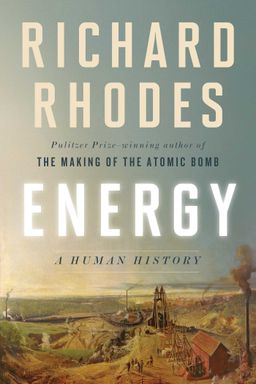
Energy cover

Energy

by Richard Rhodes

Energy: A Human History by Richard Rhodes delves into 500 years of energy evolution, exploring the scientific, financial, and social forces behind major innovations. Discover how past energy transitions inform today’s challenges and the path toward sustainable energy solutions.

Energy Transitions and the Shape of Civilization

Every civilization is built upon its energy choices. Across five centuries, you can trace humanity’s adaptive story—from England’s dwindling forests to today’s nuclear grids and renewable hopes—and see how technical innovation, political economy, and ecological consequence interlock. The book reveals that each transition follows a repeating pattern: resource limits drive technical workarounds, and those workarounds reshape societies, introducing new problems that demand further change. Energy history thus becomes a mirror for social evolution.

From scarcity to substitution

In the sixteenth century, “no wood, no kingdom” meant that England’s prosperity depended on oak forests. As naval ambitions and charcoal iron industries strained supply, coal replaced wood. Coal’s rise introduced urban smoke, child chimney sweeps, and health crises—yet it unlocked expansion. The substitution principle recurs throughout the book: constraints provoke creativity. When mine shafts flooded, Savery, Papin, and Newcomen invented steam pumps. When Newcomen’s device wasted fuel, James Watt’s separate condenser multiplied efficiency. Each step sprang from economic pressure rather than accident.

From mechanical power to mobility

Once steam solved drainage, it transformed transport. The Bridgewater Canal halved coal costs to Manchester, while Darby’s iron rails and Stephenson’s Rocket created the railway system—a corridor of industrial movement. You see a principle of system coupling: materials, motive power, and infrastructure evolve together. The result is a geography redefined by energy flow—from coalfields to cities connected by canals, then rails—and a society recalibrated around distance, speed, and supply chains.

From fuel to light and global reach

Coal’s chemistry sparked parallel revolutions in lighting. Murdoch’s gaslamps illuminate Soho in 1802; Gesner’s kerosene distillation in 1846 gives portable brilliance. Drake’s oil strike (1859) industrializes petroleum, sustained by pipelines and rail. The pattern repeats: laboratory insight—Silliman’s fractional distillation—meets entrepreneurial persistence—Drake’s drilling—and yields a new hydrocarbon economy. Within decades, whale oil and coal gas give way to kerosene and gasoline, products that light homes and soon propel engines worldwide.

From electrons to grids and beyond

The late 19th century transforms not just fuel use but the very form of energy. Volta’s pile, Faraday’s induction, and Westinghouse’s AC networks turn mechanical motion into electricity—energy freed from location. Niagara Falls becomes the model: natural flow converted to industrial current, transmitted to Buffalo by transformers. This leap introduces centralized generation and national grids—the electrical nervous system of the modern world. Later chapters follow how voltage debates (Edison’s DC vs. Westinghouse’s AC) show that scientific insight only matters when combined with infrastructure politics and material practicality.

Biological energy and urban reform

Before engines wholly displaced animals, cities ran on biological power. Horses provided traction but generated mountains of manure, driving sanitation reforms and global fertilizer trades (guano). You realize that energy transitions are also environmental hygiene stories—how pollution shifts forms. When Sprague’s electric streetcar debuted in 1887, it solved manure and fly problems yet replaced them with electricity’s smoke and new urban sprawl. Each improvement changes the pattern of risk, not eliminates it.

Modern chemistry and political consequence

The twentieth century binds technology to geopolitics. Fuel politics determine winners among steam, electric, and gasoline engines. Gasoline triumphs through convenience and infrastructure, supported by additive chemistry—Kettering and Midgley’s tetraethyl lead fix that becomes a toxic legacy. You witness invention’s moral tension: TEL solves knock but poisons workers and public air for decades. Similarly, Saudi Arabia’s Dammam No.7 (1938) turns a small exploration into global dependency, knitting oil to international strategy. Welding and wartime pipeline building extend this network across continents, proving that technical arts can both win wars and dictate peacetime economies.

Risk, regulation, and the planetary turn

From Fermi’s Chicago Pile to Rickover’s Shippingport, nuclear energy becomes both promise and peril. Smog in Donora and London, and Haagen‑Smit’s California experiments, convert pollution into a quantified public‑health issue. Rachel Carson’s Silent Spring and population fears merge environmental conscience with technological skepticism. The nuclear debate embodies modern paradox: low‑carbon potential versus risk anxiety. The 20th century reveals that every new power system generates both opportunity and political resistance, often driven by misunderstanding or selective evidence.

Patterns and future transitions

Cesare Marchetti’s logistic model teaches you patience: energy transitions take half‑centuries to mature. Wind and solar follow this slow curve, constrained by intermittency and storage. The book ends reminding you that transition is not a race but an ecosystem adjustment. True progress combines multiple systems—nuclear, renewables, efficiency—within social and policy frameworks that accept complexity. Looking across centuries, the recurring insight is clear: when you change what powers you, you inevitably change who you are.


The Coal Age and Early Steam

Coal began as a reluctant substitute for dwindling wood supplies but became the foundation of an industrial revolution. England’s transition—from timber scarcity to coal abundance—embodied economic adaptation under ecological constraint. Parliament’s efforts to preserve forests triggered coal’s adoption despite health fears. Urban chimneys evolved; coal shipments multiplied from 35,000 tons to half a million annually. The stage was set for mechanical application.

Solving the mining problem

Deeper mines flooded. Thomas Savery’s 'Miner’s Friend,' Denis Papin’s theoretical digester, and Thomas Newcomen’s atmospheric engine aimed to drain them. Newcomen’s design used steam condensation to create vacuum pressure—a low‑efficiency but effective drain for mines like those around Dudley and Cornwall. Economic need sustained inefficient machines, proving adoption does not require perfection. Early steam engines liberated coal from its watery prison and expanded supply, reinforcing industrial acceleration.

From drainage to motive power

James Watt’s breakthrough—the separate condenser—reduced fuel waste sixfold by maintaining cylinder temperature. With Boulton’s financial and manufacturing support, Watt converted reciprocating motion into rotary drive. Textiles, iron, and transportation followed. Steam’s ubiquity made urban smoke inescapable and wages dependent on power costs. (Note: Watt’s insight parallels modern efficiency revolutions, where single thermodynamic improvements cascade into broad economic change.)

Consequences and contrast

Coal’s cheapness expanded cities and worsened public health; Newcomen’s and Watt’s engines symbolized progress intertwined with pollution. From wood shortage to soot‑laden streets, you see how technological success often redefines rather than resolves environmental stress.


Transport Revolutions and Industrial Space

Industrial momentum required mobility. Canals, iron rails, and steam locomotives together transformed economics by lowering freight costs and extending market reach. The Bridgewater Canal exemplified how infrastructure could halve coal prices, functioning as energy’s circulatory system. The chapter integrates civil engineering, materials science, and business strategy to show how physical networks create industrial geography.

From canals to rails

Wooden wagonways evolved into cast‑iron and then wrought‑iron rails, allowing horses and later steam locomotives to pull massive loads. Trevithick’s high‑pressure experiments and Stephenson’s Rocket reveal engineering trial and error at national scale. The Rainhill Trials (1829) validated multi‑tube boilers—the efficiency that made trains viable. Railroads then became political arenas, facing landowner resistance and requiring parliamentary sanction (as Stephenson endured building through Chat Moss).

Systemic effects

Transport integration made coal available everywhere, triggering urban growth. Ironmasters diversified into rail production, smoothing economic volatility. Infrastructure thus became technological multiplier: better rails meant faster goods; faster goods meant more factories; more factories meant urban concentration and pollution. The interplay between mobility and material defines industrial modernity.

Insight

You learn that progress happens when materials, motion, and money align. Energy systems succeed not merely by power density but by the ability to move that power efficiently from source to use.


Carbon, Chemistry, and the Age of Light

Illumination chronicles another arc of energy innovation—from rushlights to whale oil, coal gas, kerosene, and petrol. Lighting the dark reveals chemistry’s industrial power. William Murdoch’s coal gas experiments at Soho (1790s) introduced centralized lighting, while Abraham Gesner’s kerosene distillation (1846) democratized portable light. These innovations link chemistry, corporate entrepreneurship, and urban transformation.

Gas infrastructure

Early gasworks required purification and piping, producing pollution from residues like 'blue billy.' Yet gaslight expanded urban nighttime economies—shops, theaters, streets. It was a social revolution as much as a chemical one. Entrepreneurs like George Augustus Lee and Rembrandt Peale capitalized on spectacle, turning light into advertisement and profit.

Kerosene and distributed energy

Gesner’s kerosene triumphed where pipes could not reach, suited to frontier and rural life. Its success depended on refining and transportation—linking chemistry to logistics. The later petroleum boom (Drake’s Oil Creek strike) scaled this chemistry into global commodity. Silliman’s analytical validation gave scientific legitimacy; Drake’s perseverance gave physical realization.

Socioeconomic reflections

From laboratories to street lamps, the pursuit of brighter, cheaper light embodies how incremental inventions accumulate into world‑changing networks. Light becomes infrastructure, chemistry becomes politics, and every lamp connects to deep industrial processes beneath.


Electricity and the Global Grid

Electric power illustrates how abstract physics turns into global infrastructure. Volta’s batteries provided direct current; Faraday’s induction experiments revealed how motion in magnetic fields creates electricity. Oersted’s compass deflection proves the unity of electromagnetism—the seed for dynamos. Industrial scaling required alternating current (AC), making long‑distance transmission possible.

From lab to network

Westinghouse engineers and William Stanley demonstrated transformer systems, enabling voltage regulation. The Niagara project showcased hydropower plus AC transmission—electricity generated at waterfalls carried to Buffalo industries. It marked humanity’s first regional grid—proof that electricity could separate generation from consumption in space and time.

Commercial and social implications

Edison’s DC systems failed to compete economically; transformers and higher voltages won. The grid became civilization’s backbone, defining modern rhythms. It allowed factories to run independent of rivers and gave cities illumination, communication, and automation. From Faraday’s rotating disk to Westinghouse’s Niagara turbines, you see physics transformed into social connectivity.

Lesson

Every true technological revolution arises when scientific principle meets infrastructure scale. The electrical grid accomplished precisely that fusion.


Energy, Pollution, and Public Health

Industrial achievements often shadow human health. Donora’s killer fog (1948) and London’s smog (1952) transformed pollution from inconvenience to crisis. Sulfur dioxide, particulate matter, and inversion dynamics became epidemiological data, forcing clean‑air legislation. Haagen‑Smit’s Los Angeles studies identified photochemical smog—the first recognition that automobile exhaust chemically created new pollutants. Science thus redefined responsibility from industrial stacks to everyday mobility.

Policy awakening

The UK Clean Air Act (1956) and subsequent American environmental laws arose directly from these disasters. These events also set the stage for understanding cumulative toxicity—linking TEL lead exposure and air pollution to public health frameworks. Epidemiology and chemistry merged into environmental science, converting outrage into organized measurement.

Pattern recognition

Every pollution episode in the narrative demonstrates delayed recognition: invention, mass adoption, crisis, reform. It is the lag between fun and foresight that defines our environmental history.


Atomic Power and the Fear of Growth

Nuclear power embodies modern duality—scientific mastery and moral hesitation. Fermi’s Chicago Pile No.1 (1942) achieves the controlled chain reaction; Rickover’s Shippingport reactor (1957) transitions that achievement to civilian electricity. Secrecy under the Atomic Energy Act (1946) embeds nuclear development within state control. The Cold War and 'Atoms for Peace' define political framing: progress bound to peace propaganda.

Environmental reaction

Rachel Carson’s Silent Spring reframed environmentalism as moral warning, while neo‑Malthusian arguments like Ehrlich’s Population Bomb cast human expansion as danger. Anti‑nuclear sentiment drew strength from these anxieties, merging fear of contamination with fear of growth itself. Debates over radiation limits (the LNT model by Muller) hardened perception of nuclear as inherently unsafe, despite low empirical risk in civil exposure.

Scientific and social balance

Weinberg and NASA analyses later showed nuclear avoided millions of deaths from air pollution—an ignored benefit demonstrating risk asymmetry. Yet psychological politics dominate decisions. Thus nuclear power’s fate reveals how ethics and perception can outweigh physics and data. The chapter urges cognitive sobriety: evaluate risk proportionally, not emotionally.

Continuing implications

Facing climate challenge today, the nuclear debate persists as an echo of that moral conflict—between precaution and potential, between fear and factual capacity.


The Long Transition to Renewables

Finally, the narrative turns to the modern horizon: wind, solar, and the mathematics of change. Early pioneers like James Blyth and Charles Brush built wind generators in 1887; Bell Labs produced silicon PV cells in 1954. Despite symbolic breakthroughs, adoption remained slow. Cesare Marchetti’s research explains why: energy transitions follow logistic curves spanning decades, constrained by infrastructure inertia and technological maturation.

Intermittency and engineering limits

Renewable sources face capacity factor challenges—wind averaging ~35%, solar near ~27%. Storage capacity remains minuscule compared with national demand. You learn that renewable enthusiasm must be tempered with systems thinking: grids require balancing, flexible demand, and hybridization. Optimism alone cannot overcome thermodynamic, financial, or social inertia.

Decades, not years

Marchetti’s logistic insight parallels earlier centuries’ experience—from coal’s rise to oil’s dominance. Each transition took half a century to scale. The book concludes that patience, diversity, and planning define realistic progress.

Future synthesis

To decarbonize effectively, societies must combine renewables with nuclear, gas with capture, and behavioral efficiency. History teaches you humility: every solution alters the problem, and every transition demands understanding its tradeoffs before celebration.

Dig Deeper

Get personalized prompts to apply these lessons to your life and deepen your understanding.

Go Deeper

Get the Full Experience

Download Insight Books for AI-powered reflections, quizzes, and more.