
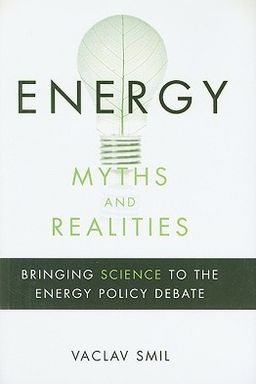
Energy Myths and Realities cover

Energy Myths and Realities

by Vaclav Smil

Energy Myths and Realities offers a critical, science-based examination of global energy policies, cutting through the rhetoric of politicians and industry leaders. It provides readers with valuable insights into the challenges and realistic solutions for transitioning to sustainable energy sources.

Science vs. Energy Myths: Smil's Challenge to Fantasy Thinking

How can you tell whether the next great energy idea is genuine progress or just hype? In Energy Myths and Realities, Vaclav Smil asks this question head-on. Smil, one of the world’s most respected energy scholars, argues that our debates about energy – from nuclear power to wind turbines to electric cars – are full of stubborn myths that distort what science actually tells us. His central claim is blunt: human societies continuously fool themselves about energy transitions, believing in salvation through technology while refusing to confront hard physical, historical, and economic constraints.

The Core of Smil's Argument

Smil contends that modern civilization has been built on the burning of fossil fuels, and replacing them is fundamentally difficult. Politicians, pundits, and even many scientists pretend that clean and cheap energy solutions are imminent, but the data tell a different story. Improvements take decades, not years; every energy transition—from wood to coal, coal to oil, and now to renewables—unfolds slowly because of infrastructure inertia and economic scale. Smil wants you to see energy as a physical system, where claims must obey thermodynamics rather than political convenience.

Why This Matters To You

His warning is not just academic—it’s personal and practical. When you hear talk of imminent hydrogen economies, cars that will run forever on electrons, or carbon technologies that will make fossil fuels guilt-free, Smil urges skepticism. Every decision you make as a voter, investor, or citizen depends on understanding what is technically possible and what isn’t. Accepting myths leads to poor policy, wasted investment, and new environmental damage disguised as clean progress.

What the Book Covers

Smil structures his book around both classic and modern energy delusions. He begins with the myths that have persisted for over a century—like the idea that electric cars would soon dominate the roads or that nuclear power would produce electricity “too cheap to meter.” Then he turns to contemporary fantasies such as biofuels saving the planet, wind power replacing all fossil fuels, and carbon sequestration erasing emissions. Each myth is dissected against data from engineering, economics, and history.

Smil’s Style: Numbers Over Ideology

Unlike ideological energy futurists, Smil insists on empiricism. He fills the book with calculations—barrel by barrel, megawatt by megawatt—to show how far reality diverges from imagination. For instance, he demonstrates that converting the entire U.S. car fleet to electricity would require an increase in power generation equal to a quarter of all electricity currently produced nationwide. He stresses that human optimism does not change the fact that physics imposes limits on every conversion.

The Larger Lesson

Smil’s goal is not cynicism but realism. He wants informed citizens to demand smarter choices: improve energy efficiency, reduce waste, and adopt renewables at a rational scale rather than through myth-driven crusades. For Smil, science should be the foundation of energy policy, not ideology or wishful thinking. He closes by noting a timeless truth: people believe what they want to believe—but without facing reality, societies risk both environmental collapse and economic ruin.


Electric Car Delusions

Smil’s deep dive into the history of electric vehicles reads like a century-long cycle of hope and disappointment. Beginning in the 1890s, electric cars were once touted as the future—they were cleaner, quieter, and simpler than steam or gasoline cars. Thomas Edison believed electrical propulsion would soon dominate. Yet even with early triumphs—like Camille Jenatzy’s 1899 speed record—their limitations quickly became obvious: low range, slow charging, and poor battery performance doomed them to niche markets.

The Repeating Electric Car Hype

Throughout the 20th century, electric car revivals followed every oil shock. California tried mandates in the 1990s. General Motors produced the EV1 but ultimately withdrew it. Again in the 2000s, amid price spikes and climate fears, Silicon Valley figures like Elon Musk resurrected the promise through Tesla Motors. Yet the physics remain. A fully electric U.S. car fleet would increase electricity demand by roughly 25 percent—equivalent to fifteen years of new power generation capacity. To Smil, this isn’t liberating innovation, it’s fantasy-driven planning.

Infrastructure and Scale

Smil emphasizes that technical feasibility isn’t the same as system transformation. Electric cars may work individually, but supporting millions requires charging infrastructure, massive battery supply chains, and expanded power generation. The needed electricity mostly comes from fossil fuels, so switching cars to electricity does not reduce overall carbon emissions unless those sources change radically. In short, “flip the switch” doesn’t mean “solve the problem.”

What Real Progress Looks Like

Smil proposes instead pursuing steady, proven advances—hybrid vehicles, lighter materials, and more efficient engines. He highlights Daimler’s “DiesOtto” engine as an innovation that achieves diesel-like efficiency using gasoline. For him, incremental practicality beats grandiose visions. The electric car’s myth, persisted by techno-optimists, stands as a warning: technological enthusiasm cannot substitute for thermodynamic honesty.


Nuclear Power: From “Too Cheap to Meter” to Stalled Reality

In 1954, Lewis Strauss of the U.S. Atomic Energy Commission proclaimed that nuclear electricity would soon be “too cheap to meter.” Smil traces how that single phrase became both the emblem of technological hubris and the ghost haunting nuclear policy ever since. Early advocates saw nuclear power as humanity’s next leap—limitless energy for peace, prosperity, and modern living. Yet history delivered far more modest results.

The Dream and Its Collapse

After World War II, optimism surged. Glenn Seaborg envisioned “nuplexes,” vast complexes combining nuclear stations with desalination plants, farms, and factories. Governments poured billions into reactor development, especially “fast breeders” meant to generate fuel as they burned it. But costs ballooned. Accidents at Three Mile Island and Chernobyl shattered public trust, while regulation slowed construction to a crawl. By the 1980s, the American nuclear boom had reversed—plants were canceled, budgets imploded, and the myth of cheap abundance was dead.

Smil’s Verdict on Nuclear Energy

Smil calls fission a “successful failure.” It still generates nearly 20 percent of global electricity, and in countries like France, as much as 70 percent. The technique works reliably, but expectations were inflated beyond reason. Nuclear expansion proved limited by cost, complexity, and perception of risk. Even so, Smil argues we cannot reasonably reject nuclear power. It remains one of the few large-scale low-carbon options capable of tempering climate change, provided safety, waste handling, and transparency improve.

The Broader Lesson

For policy and technology more broadly, nuclear history teaches humility. Promoters who promise revolutionary breakthroughs often underestimate economic and social inertia. Smil warns that similar optimism now surrounds wind and solar. Like nuclear enthusiasts decades ago, today’s renewables promoters claim imminent dominance without facing logistical reality. Science, he reminds you, rewards realism, not zealotry.


Soft Energy Dreams and the Cult of Smallness

Amory Lovins’ 1976 essay “Energy Strategy: The Road Not Taken” became a manifesto for “soft energy” thinking. It promised decentralized solar panels, wind turbines, and community-scale conversions replacing centralized systems and nuclear plants. Smil analyses this vision as one of the most enchanting yet misguided myths in energy history. Its central idea—that small and decentralized equals sustainable—proves appealing but false when examined through physics and economics.

The Origin of the Soft Path

Lovins’ model built on E.F. Schumacher’s Small Is Beautiful, celebrating simplicity and local control. He imagined suburban and village-scale power—from solar rooftops to small hydrostations—promoting democracy and ecological elegance. Yet Smil shows how the numbers never added up. By 2000, renewable sources provided less than one percent of U.S. primary energy, not the 33 percent Lovins predicted. Entire countries needed megawatt-scale infrastructures, not backyard turbines.

Reality vs. Vision

Smil details failed experiments like China’s biogas digesters and tiny hydrostations—projects that sounded local and green but collapsed under physical inefficiency and cost. Even Lovins’ later proposal for the “Hypercar”—a 200 mpg carbon-fiber dream vehicle—never materialized. Soft-energy techniques are not wrong in principle, Smil says, but the worship of smallness ignores scale. Megacities, steel plants, and global logistics require dense, reliable power that tiny renewables cannot provide.

Learning from the Illusion

Smil treats the soft energy movement as a cautionary tale: well-intentioned idealism can become ideology. Efficiency and distributed generation are valuable, but proclaiming them as total replacements reveals the “cult of smallness” rather than scientific assessment. Ultimately, civilization needs both large and small systems balanced by rational engineering—not ideological purity disguised as sustainability.


Peak Oil Panic and the Reality of Resources

Few myths stir more fear than the idea that oil is about to run out and civilization will collapse. Smil examines this “peak oil” narrative—popularized by figures like M. King Hubbert, Colin Campbell, and Richard Duncan—and separates geology from hysteria. The claim that global extraction is already peaking, he argues, misreads both data and history.

Why Hubbert Was Wrong About the World

Hubbert correctly predicted the U.S. oil peak around 1970 but wrongly projected global exhaustion by 2000. Subsequent discoveries, better drilling, and new techniques like horizontal drilling transformed reserves. Smil illustrates how oil recovery doubles over time as technology improves—energy systems evolve dynamically, not like simple bell curves. Equating resource limits with production collapse ignores these feedbacks and economic adjustments.

The Myth’s Psychology

Smil notes how emotional and apocalyptic thinking drives the peak oil narrative. Authors predict “Olduvai Gorge” scenarios, imagining humanity reverting to preindustrial living. But oil scarcity historically triggers innovation and substitution, not regression. Price spikes in the 1970s, for example, led to efficiency and market adaptation. Even if global oil decline arrives, energy transitions—not civilizational collapse—will follow.

Smil’s Realistic Outlook

The future of oil, Smil argues, is plateau, not precipitous decline. Nonconventional sources like Canada’s oil sands and new natural gas fields cushion supply for decades. The rational response is gradual diversification—not panic. As he puts it, “barring a global depression, we will not return to pre-2004 levels.” For you, the takeaway is calm realism: energy systems adjust slowly, and humanity’s ingenuity outpaces doomsday predictions.


Carbon Sequestration: A Flawed Fix

Carbon capture and storage (CCS) sounds like the perfect climate solution—keep burning fossil fuels, but hide their CO2 underground. Smil dismantles this idea with relentless logic. The physics, logistics, and scale make it almost impossible to implement meaningfully. Capturing just 15% of global emissions would require handling a gas volume larger than the entire global oil industry manages each year.

The Scale Problem

To sequester billions of tons annually, nations would need millions of kilometers of new pipelines, endless compressors, and constant monitoring of underground leaks. At $60 per ton, CCS would cost hundreds of billions annually. Smil compares it to creating a second global energy industry just to bury waste. He calls this approach an “inferior solution”—a technical fix that prolongs inefficiency instead of preventing emissions in the first place.

Better Alternatives

Smil doesn’t dismiss innovation, but he stresses that avoidance beats cure. Efficiency, rational consumption, and gradual decarbonization achieve far more than megaprojects to hide carbon underground. He also critiques the political theater surrounding CCS: governments fund symbolic experiments that cheer voters rather than alter real dynamics. For citizens and policymakers alike, his message is clear—don’t buy salvation fantasies when disciplined prevention is both cheaper and safer.


Biofuels and the Folly of Green Illusions

Corn ethanol, sugar-cane alcohol, and biodiesel are often heralded as sustainable alternatives to gasoline. Smil calls them “nonrenewable renewables”—industries masquerading as green while causing destructive ecological effects. His quantitative approach reveals how modest their real yield is compared to global fuel demand.

The Arithmetic of False Hope

Smil calculates that if the entire U.S. corn crop were converted into ethanol, it would cover only about 13% of gasoline demand. And if sugar cane covered global transport fuel, half the world’s arable land would vanish into fuel production. The power density of these crops—less than 0.25 watts per square meter—is impossibly low compared to fossil or solar alternatives. Meanwhile, corn-based ethanol consumes fossil fuels through fertilizers, irrigation, and distillation, leading to minimal net energy gain and large environmental degradation.

From Corn to Cellulose and Algae

Enthusiasts now tout cellulosic ethanol and algal fuels as the next miracle. Smil’s reply: laboratory feasibility does not equal industrial viability. Costs, logistics, and environmental side effects remain overwhelming, and even optimistic scenarios produce only a few percent of existing demand. He highlights the irony that technology meant to save nature often destroys it—deforestation for oil palm, nitrogen runoff from corn, or invasive switchgrass gone wild.

The Real Lesson

Biofuels, Smil concludes, are a moral and practical misstep. They divert food to fuel, raise global prices, and damage soil and water. Sustainable progress means reducing demand, not producing more inefficient supply. His analysis reminds you to be cautious: green marketing often hides gray realities.


Wind Power and the Limits of Renewable Scale

Wind is often portrayed as limitless, clean, and simple. Smil dissects that optimism mathematically. Global wind potential may be vast, he admits, but usable capacity—the reserves that can be economically and physically captured—is far smaller. Even in the best wind regions, practical power density averages just 2 watts per square meter, a fraction of what modern economies need.

Space and Intermittency

To supply half of global electricity, wind farms would need millions of square kilometers—larger than Mexico. Moreover, wind’s variability demands backup systems or large-scale storage that do not yet exist. Europe can tolerate wind’s intermittency due to its dense interconnections, but isolated grids like the U.S. require trillions in new high-voltage lines. Smil points out that promises of a “wind economy” ignore the thermodynamic dictates of diffusion: weak, variable energy flows demand extensive land and infrastructure.

The Honest Role of Wind

He does not dismiss wind entirely. It serves efficiently as a supplement—perhaps 15 to 30 percent of generation in advanced regions—but cannot replace dense, continuous sources like nuclear or fossil plants. Smil’s stance contrasts with evangelists like Lester Brown who claimed wind could meet all global needs. He urges readers to celebrate realistic progress rather than romantic exaggeration, reminding that every turbine still depends on minerals, labor, and fossil-fueled supply chains.


The Slow Reality of Energy Transitions

Finally, Smil synthesizes all his myth demolitions into one overarching lesson: energy transitions are inherently slow. From wood to coal, coal to oil, and oil to gas, each shift has taken half a century or more. Infrastructure inertia, cost, and human psychology ensure gradual, not revolutionary, change. When public figures like Al Gore or T. Boone Pickens promise to repower America in a decade, Smil says history and physics disagree.

Historical Evidence

He shows how even steam and internal combustion engines took generations to dominate. Oil surpassed coal only after a century of industrial build-up. Energy systems are not like computer chips—the doubling speed of Moore’s law does not apply. Massive physical infrastructures worth trillions cannot be scrapped and rebuilt overnight. The push for rapid overhaul, driven by ideology or moral urgency, often leads to waste and disappointment.

Smil’s Prescription for Real Change

Smil calls for pragmatic patience: continuous efficiency improvements, realistic renewable investments, and gradual substitution toward lower-carbon systems. He warns policymakers to avoid the seduction of quick fixes and dramatic timelines. Civilization cannot “repower” itself in years; meaningful transformation unfolds across decades. For you, his insight translates into endurance—focus on credible, long-term progress, not on visionary promises detached from measurable capability.

Dig Deeper

Get personalized prompts to apply these lessons to your life and deepen your understanding.

Go Deeper

Get the Full Experience

Download Insight Books for AI-powered reflections, quizzes, and more.