
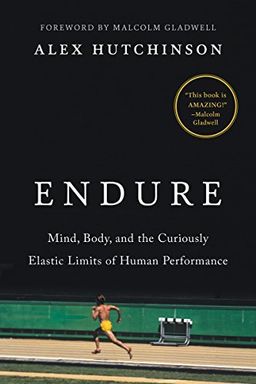
Endure cover

Endure

by Alex Hutchinson

Endure dives into the intricate relationship between mind, body, and endurance, revealing how athletes surpass physical limits. Alex Hutchinson uncovers the mental strategies and physiological insights that empower extraordinary feats, offering readers profound lessons on pushing boundaries and achieving peak performance.

The Science of Endurance and the Mind–Body Connection

Why do you sometimes shatter your limits and other days collapse well before them? The central argument of Alex Hutchinson’s exploration of endurance is that your limits are not fixed by muscles, oxygen, or willpower alone. They are shaped by an active negotiation between brain and body where perception, expectation, motivation, and physiology constantly interact. Endurance, he suggests, is the struggle to continue against the desire to stop—and that desire is mediated by the brain as much as by the body.

Across stories of runners breaking records, mountaineers pushing to death zones, and divers walking the edge of blackout, you discover that endurance science has evolved from focusing on the body’s machinery to understanding a dynamic partnership with the mind. What began as A. V. Hill’s model of the human engine—measuring oxygen uptake and lactate—has expanded into an understanding of how the brain shapes effort perception and pacing before mechanical failure ever occurs.

From Physiology to Psychology

Early physiologists like Hill and Margaria measured the heart, lungs, and muscles as if the brain were just an observer. They gave us VO2max and lactate thresholds, powerful tools for predicting performance. Yet explanations based solely on these parameters failed when people exerted sudden finishing kicks or set unexpected records. The ‘burst at the end’ implied that the body still had reserves left even near exhaustion—suggesting the brain was pacing output rather than responding passively to failure.

This realization led to new models. Tim Noakes proposed a ‘central governor’—a subconscious system that throttles muscle recruitment to preserve safety margins. Samuele Marcora countered with a ‘psychobiological model,’ emphasizing conscious perception of effort as the defining limiter. Though they debate mechanisms, both converge on a truth: you stop not when the body fails, but when the effort feels intolerable. Changing that feeling can expand your limits.

The Brain as Regulator and Negotiator

Endurance is not a static capacity but an ongoing conversation between expectations, sensory feedback, and motivation. Ross Tucker showed that pacing follows a predictive pattern—the classic ‘U-shaped’ profile where athletes start fast, stabilize, then accelerate at the end. This anticipatory regulation ensures you reach the line without catastrophic failure. When the finish appears, the brain relaxes its constraints, unleashing stored potential. Even children gradually learn this negotiation; pacing only stabilizes around age twelve when cognitive control matures.

Your own running experiences illustrate this vividly: a misheard split or a pacer out front can change what your brain deems possible. The Harvard Fatigue Lab’s wartime experiments, Nike’s Breaking2 project, and studies using deception (such as secretly slowed treadmills or underestimated distances) all confirm how belief and context reshape perceived effort—and thus performance itself.

Integrating Physiology and Perception

Physiological factors still matter profoundly—oxygen delivery, substrate availability, temperature, and muscle fatigue all feed into the system. What’s changed is the hierarchy: the brain integrates these signals, predicts future risk, and chooses safe output. Whether it’s cerebral oxygenation on Everest, pain thresholds in cycling, or temperature perception in the heat, central processing determines what you can endure. That’s why interventions that alter perception—cool water, caffeine, self-talk, or placebo effects—work even when measurable physiology barely changes.

Ultimately, endurance emerges from both sides of the partnership. Training your body builds physical capacity; training your brain reshapes expectations and tolerance. The great innovations of modern sports science—from mental resilience drills to environmental simulation—seek to optimize this full loop. Instead of viewing fatigue as mechanical failure, Hutchinson reframes it as a protective mechanism that can be nudged, educated, and occasionally tricked.

Core insight

Endurance is the art of balance between brain and body—where physiology sets the stage but perception writes the script. Your true limit is not fixed; it shifts with training, belief, and the brain’s judgment of what is worth risking.

This idea underpins every chapter that follows—from how oxygen, fuel, heat, pain, and fatigue interplay to how you can deliberately train the mental systems that shape your performance. Endurance, in the end, is less about conquering the body and more about understanding how the mind governs it.


Anticipation and the Art of Pacing

Every race you run is also a mental negotiation. Pacing, often mistaken for energy management, is actually about information—how your brain forecasts danger, adjusts effort, and releases reserves. The near-universal ‘U-shaped’ pattern of speed reveals that your brain acts as a pace manager, not a bystander. This anticipatory regulation ensures survival while maximizing performance.

The Science of the Finishing Kick

Ross Tucker and Tim Noakes dissected decades of track records and found an intriguing consistency: athletes almost always speed up as they sense the finish, even under extreme distress. The same muscles that ‘had nothing left’ respond with renewed power. Laboratory trials show the same: when cyclists are misled about how much work is left, their brains recalibrate pacing to match the new endpoint. Perception of distance, not muscle metabolites, controls throttle release.

You see this mechanism develop with age. Children only begin to distribute effort effectively once inhibitory control matures. That cognitive milestone links endurance not just to muscle conditioning but to executive function—the ability to weigh present pain against future reward.

Training Your Anticipation System

Because pacing resides in the brain, you can train it like any other skill. Race simulations, negative split workouts, and deliberate finishing sprints teach your brain what ‘safe acceleration’ feels like. Intervals reshape your expectation templates so that a given breathing pattern or muscle burn no longer signifies impending catastrophe. Conversely, poorly timed feedback—wrong lap times or inaccurate GPS—can sabotage this learning loop.

Practical insight

Train your perception of effort, not just your pace. Learning how effort should rise and what it feels like to finish fast conditions your brain to release stored potential more confidently.

Understanding pacing as psychological control reframes racing itself: you do not merely ration energy—you educate your brain’s forecast system. The finish-line kick reveals that what you perceive as your limit is often the product of neural caution, not physical exhaustion.


Heat, Thirst, and Environmental Limits

Heat, dehydration, and oxygen scarcity expose the ways your brain manages risk. From the mines of South Africa to World War II desert studies, scientists learned that fatigue in extreme conditions is governed less by raw physiology than by perception and adaptation. Your body strives to protect the brain’s integrity even if that means slowing down the rest of you.

Thermal and Fluid Regulation

Core temperature rises predictably with metabolic effort, not only water loss. Experiments found that athletes commonly stop near 104°F, implying a built-in ‘thermal circuit breaker.’ Yet perception can shift that stopping point: when researchers falsified the displayed temperature to appear lower, athletes performed longer before quitting. Heat tolerance therefore combines acclimatization, perception, and motivation. Two weeks of graded exposure expands plasma volume and sweating efficiency, but belief in safety also matters.

Hydration myths evolved the same way. Soldiers and runners in classic experiments naturally underdrank—so experts once prescribed strict drinking targets. Later findings reversed that: thirst is triggered by plasma osmolality, not total water loss, and losing up to four percent of body mass rarely hurts performance. Drinking to thirst keeps sodium balance safe; overdrinking risks hyponatremia. Even the act of swishing a carbohydrate solution can lower perceived effort before any fluid enters the bloodstream, underscoring how perception, again, rules.

Oxygen and Altitude

At high altitude or in freediving, the oxygen challenge flips direction. Freedivers exploit the mammalian dive reflex—slower heart rate, redirected blood flow—to preserve cerebral oxygen. Mountaineers face the opposite: falling oxygen supply makes the brain throttle effort to protect itself. Research on Everest climbs and cerebral oximetry shows that endurance at altitude depends more on how your brain tolerates hypoxia than on how your muscles use oxygen. Messner and Habeler’s no-oxygen summit and the ‘lactate paradox’ illustrate how central drive, not just pulmonary function, determines survival and speed.

Lesson

Respect environmental feedback loops. Acclimatization trains both your body and your perception so that effort feels safer at high heat or altitude—the key to sustainable performance under stress.

Heatstroke, dehydration fear, and hypoxia all remind you that performance limits act through the brain’s interpretation of threat. By controlling perception—cooling the skin, sipping fluids, or training at altitude—you manipulate those internal governors intelligently.


Fuel, Fatigue, and Energy Flexibility

Endurance depends on how you fuel your effort and how your brain interprets the availability of that fuel. Carbohydrates and fats offer different payoffs: carbs power high intensity efficiently, while fats sustain long, slower work. Your diet doesn’t just change metabolism; it changes the signals your brain receives about risk and sustainability.

Metabolic Tradeoffs

Bergström and Hultman’s biopsies in the 1960s showed muscles emptied glycogen right before exhaustion, establishing carbohydrate’s primacy for speed. Later, Phinney and Volek demonstrated that low-carb, high-fat (LCHF) diets can shift metabolism, enabling massive fat oxidation. Yet this comes at a cost: fat burns slower and requires more oxygen, reducing economy at race intensities. Burke’s Supernova trial with elite racewalkers confirmed the tradeoff—fat-adapted athletes raced slower despite impressive fat use.

The performance sweet spot is metabolic flexibility. Training some sessions low on carbs can foster adaptations, but racing at high intensities still requires carbohydrate availability. Thus, fueling becomes a strategic act: you can manipulate which signals your brain receives about impending energy shortage.

Mental Fatigue as an Energy Drain

Marcora’s work on mental fatigue shows that even when fuel and oxygen are plentiful, the brain itself can tire. After 90 minutes of tedious cognitive tasks, cyclists quit earlier despite identical physiology. Perceived effort spikes first in the mind. Elite performers often show superior resilience in these tests, suggesting that training enhances central endurance as well as metabolic economy. Caffeine, by blocking adenosine receptors, counteracts this central fatigue—confirming again that brain chemistry modulates endurance just like glucose or oxygen.

Actionable insight

Train your metabolism and your mind together: alternate high-intensity, carb-fed sessions with lower-intensity, cognitively demanding workouts. Both fuel systems—chemical and mental—shape how long you can go before the brain says enough.

Endurance thus depends on more than food intake or VO2max—it relies on how your brain reads the signals of energy sufficiency or depletion and decides whether to continue or conserve.


Pain, Effort, and the Central Gatekeeper

Pain is both a messenger and a motivator. You feel it as a warning, but top athletes learn to reinterpret it. Studies comparing swimmers, cyclists, and nonathletes show similar pain thresholds—when sensation begins—but dramatically higher pain tolerance among elites. That tolerance is trainable and perhaps the most critical mental aspect of performance.

Separation of Pain and Effort

Pain and perceived effort overlap but are not identical. Experiments using analgesics (Tylenol, fentanyl blocks) and electrical stimulation make this clear. When pain is dulled, athletes can often push harder, but total pain removal causes dangerous overpacing and collapse. Pain acts as a feedback system that guides pacing decisions and prevents excessive muscle damage. The smartest endurance athletes interpret pain, not ignore it.

The Brain’s Protective Role

Noakes’s central governor hypothesis and Amann’s neural blockade studies show that the brain moderates muscle recruitment based on incoming sensory cues—temperature, damage, and nociception. Mauger’s pain-relief trials support Marcora’s complementary view: by lowering perceived effort or pain, you change behavior long before physiology forces you to stop. Hence, pain perception is part of the central gatekeeping that calibrates safe performance.

Training takeaway

Expose yourself to controlled discomfort—intervals or hard tempo runs—to expand tolerance while maintaining respect for warning signals. Suppressing pain pharmacologically invites misjudgment; mastering it through familiarity develops true toughness.

Pain is not simply the enemy of performance—it is one of its most important teachers. Learning to listen but not obey every warning sharpens the central governor’s calibration and lengthens how long you can stay at the edge without breaking.


Training the Brain

If endurance depends on perception, you can train perception. Marcora’s concept of Brain Endurance Training (BET) targets cognitive fatigue directly by pairing physical activity with demanding mental tasks. The goal is to condition response inhibition—the ability to resist the impulse to stop when effort feels intolerable.

From Lab to Practice

In controlled studies, subjects who combined mental and physical sessions improved cycling endurance far more than those training physically alone. The explanation: BET strengthens neural circuits that sustain attention and reduce perceived exertion under mental load. You can mimic this with simple tools—Stroop tests, focus games, or pre-fatiguing cognitive tasks before training.

Complementary methods align with the same philosophy. Martin Paulus’s mindfulness-based mPEAK program trains interoceptive awareness so stress signals cause less panic. Self-talk strategies, validated by Marcora’s experiments and ultramarathon field studies, reduce negative interpretation of effort. Together these approaches cultivate what elite performers already show neurobiologically: calm focus in the face of distress.

Technology and Ethics

Neurostimulation (tDCS) reflects the experimental frontier: applying mild electrical currents to motor or insular regions to lower perceived effort. Results remain inconsistent and ethically gray. Red Bull’s velodrome studies and Halo’s ‘neuropriming’ headphones delivered mixed or placebo-like effects. For now, cognitive and psychological training remain more reliable and safer than brain-conditioning gadgets.

Applied insight

Add short mental-fatigue drills twice weekly, practice focused breathing or mindfulness before races, and use positive self-talk. The aim is not to make pain disappear but to reinterpret effort as manageable.

Brain training closes the circle of endurance: you began believing limits were purely physical, and end knowing they are decisions—guided by a brain that learns from experience how far it can safely and meaningfully go.


Belief and the Psychology of Breaking Barriers

Belief may be the most underrated performance enhancer. Placebo effects demonstrate that expectation changes physiology—raising endorphins, dopamine, and even immune responsiveness. In sport, belief modifies perceived effort and risk tolerance to an extent measurable in seconds and watts. Whether it’s Reid Coolsaet’s Olympic-qualifying breakthrough or Kipchoge’s sub-two-hour pursuit, confidence shapes pacing decisions that no lab metric can predict.

Placebo Physiology

Placebo-controlled studies have shown that belief alone can reduce pain or accelerate recovery, sometimes matching the effect of real interventions. Naloxone studies prove it’s biologically mediated, not imaginary. Genetic differences even influence susceptibility: high-dopamine responders experience stronger belief effects. In endurance contexts, expectation becomes an extra energy system.

Collective and Individual Belief

The 2017 Breaking2 experiment exemplified how collective belief reshapes limits. Pacers, course design, and shoe innovations mattered, but so did the structured confidence Kipchoge carried—his conviction that two hours was possible. Watching him come within 25 seconds transformed global expectations. After Monza, times across marathons improved, hinting that belief is contagious.

Coaching insight

You can ethically leverage belief by designing rituals, self-talk cues, and pre-race narratives that inspire realistic confidence. Genuine belief, grounded in preparation, shifts the brain’s interpretation of what effort is worth risking.

Belief doesn’t repeal physiology—it directs it. When you trust that you can continue, your brain widens its safety margins. That’s why belief sits alongside oxygen, fuel, and pain as one more substrate of endurance—the one only you can generate.

Dig Deeper

Get personalized prompts to apply these lessons to your life and deepen your understanding.

Go Deeper

Get the Full Experience

Download Insight Books for AI-powered reflections, quizzes, and more.