
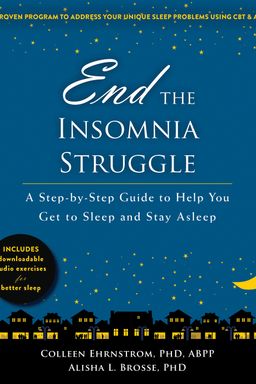
End the Insomnia Struggle cover

End the Insomnia Struggle

by Colleen Ehrnstrom, Alisha L Brosse

End the Insomnia Struggle offers a comprehensive guide to overcoming sleeplessness. By focusing on cognitive and behavioral strategies, it provides personalized solutions to help you achieve restful sleep and improve your well-being.

Ending the Insomnia Struggle: Rediscovering Rest through Willingness and Science

How can you stop fighting your sleepless nights and instead rediscover the natural rhythm of rest your body already knows? In End the Insomnia Struggle, clinical psychologists Colleen Ehrnstrom and Alisha Brosse propose a revolutionary yet elegantly simple answer: stop trying to control sleep. Through a blend of Cognitive Behavioral Therapy for Insomnia (CBT-I) and Acceptance and Commitment Therapy (ACT), they show that you can retrain your mind and body to sleep again—by letting go of the nightly battle and learning to work with, rather than against, your physiological patterns.

The authors argue that two forces keep insomnia alive: behavioral habits that disrupt natural sleep cycles, and mental struggle—the anxious obsession with sleep itself. CBT-I helps you restructure the behavioral and cognitive patterns that feed insomnia, while ACT brings emotional flexibility and mindfulness to reduce the struggle. This hybrid approach makes their book stand out in a field often divided between medical and psychological models of sleep.

Finding the “Sweet Spot” of Sleep

At the heart of Ehrnstrom and Brosse’s philosophy is the idea of a “sweet spot.” You must commit to doing the work of CBT-I rigorously enough for it to be effective—but not so rigidly that it creates anxiety or perfectionism. Some clients, they explain, fail because they never fully follow through with the protocol; others fail because they try so hard to get it right that they turn sleep into another high-pressure performance. The sweet spot lies between effort and surrender—a balanced commitment that mirrors the natural rhythms of sleep itself.

Why Willpower Doesn’t Work

The book begins by addressing a painful reality: the harder you try to sleep, the more elusive it becomes. Sleep effort, the authors note, has an ironic effect—activating the nervous system instead of calming it. Studies have shown that people who consciously try to fall asleep faster actually take longer to do so. The paradox is that sleep only comes when you stop forcing it. This is where ACT’s principle of willingness enters the picture: the willingness to feel discomfort, fatigue, or frustration without reacting to them.

The Science of Sleep Simplified

In the first section, “Laying a Foundation,” the authors present a clear, accessible explanation of sleep biology. Sleep depends on two intricate systems: the homeostatic sleep drive (the pressure that builds while you’re awake) and the circadian rhythm (the internal clock that regulates timing). When these two systems are in sync, sleep unfolds naturally. But anxiety, inconsistent schedules, stimulants, and overthinking can throw them off balance. Through engaging metaphors—like skiing between the trees rather than staring at them—they show how shifting focus from what you fear (insomnia itself) to what you want (a life fueled by rest) restores the balance.

The Role of Psychology: The 3P Model

Behavioral science explains why sleep troubles persist even when the original causes have passed. Through the 3P Model—Predisposing factors, Precipitating events, and Perpetuating habits—they help you understand “how you got stuck.” You might have a biological vulnerability (light sleeper, anxious temperament), experience a triggering event (childbirth, job stress), and then develop compensatory behaviors (napping, caffeine use, clock-watching) that maintain insomnia. The key to recovery is addressing those perpetuating factors—the things you can actually change.

Tools for Freedom: The CBT-ACT Hybrid

From there, the book unfolds into a step-by-step self-treatment program. Part 2 focuses on behavioral change—techniques like stimulus control therapy and sleep restriction therapy—to retrain your body’s association with bed and restore consolidated sleep. Part 3 dives into cognitive and acceptance-based tools that transform your relationship with your thoughts and feelings around sleep. You’ll learn specific methods such as designated worry time (training your brain to contain overthinking), mindfulness (dropping into the present moment), and cognitive defusion (separating yourself from unhelpful thoughts).

An Individualized Adventure

What makes the approach so empowering is its flexibility. The authors reject a “one-size-fits-all” prescription. Instead, they guide you to collect data through sleep logs, identify your own sleep patterns, and tailor the treatment to your life. Their mantra—“Use effectiveness as your compass”—encourages experimentation guided by results, not rules. You don’t follow the program to please an external expert; you build a relationship with your own sleep based on evidence and experience.

Ending the Battle

Ultimately, End the Insomnia Struggle isn’t just about getting you to sleep—it’s about transforming your relationship with sleep. The true victory comes not from guaranteeing perfect nights, but from ending the exhausting tug-of-war with your body and mind. As the authors stress, you sleep to live; you don’t live to sleep. By blending the structure of CBT with the compassion of ACT, they offer a new paradigm for rest: one rooted in willingness, clarity, and calm commitment.


Understanding How Sleep Works

To master sleep, you must first understand its design. Colleen Ehrnstrom and Alisha Brosse explain that sleep is not a simple switch you can flip on and off—it’s the result of a delicate dance between two biological systems: the sleep drive and the circadian rhythm. When these systems fall out of sync, even the most tired person can lie awake for hours.

The Sleep Drive: Your Body’s Pressure System

The sleep drive works much like hunger. The longer you go without sleep, the stronger your body’s craving for it becomes. Every minute you’re awake adds pressure to this internal system. When you finally rest, that pressure is released. But naps, caffeine, or long hours in bed can “vent” that pressure prematurely, making it harder to fall asleep when you actually want to. Like a safety valve, the sleep drive only resets when you’ve stayed up long enough and rested deeply enough to drain it fully.

Your Circadian Clock: The Timing Mechanism

The circadian rhythm, on the other hand, governs the timing of your sleep. Controlled by the body’s internal clock deep in the brain, it responds to environmental cues like light and temperature. In the 1960s, psychologist Rütger Wever found that when people lived in windowless rooms with no sunlight, their internal clocks lost sync with the 24-hour day. Without these cues, sleep and wake times drifted—proof that our rhythms rely heavily on external regulation. This clock releases hormones like melatonin and cortisol, which tell your body when to rest and when to rise.

The Dance Between Two Systems

Ehrnstrom and Brosse describe this interaction as a two-wave model. During the day, your circadian rhythm drives alertness while your sleep drive quietly builds. At night, your body clock winds down, and your sleep drive takes over. Problems arise when these two waves fall out of harmony—say, when you nap in the afternoon (lowering the sleep drive) or work late under bright lights (delaying your body clock’s signal). Aligning them again is the essence of behavioral sleep therapy.

Behavior as a Biological Regulator

Though sleep is biological, it can be powerfully shaped by habits. The authors liken these systems to a “well-choreographed dance” that needs your cooperation. Behavioral choices—when you eat, exercise, or expose yourself to light—can nudge the dance back in rhythm. Mental focus matters just as much: people who trust the process of sleep (and don’t overthink it) allow those systems to synchronize naturally. As they say, healthy sleepers “don’t think about sleep very much at all.”


The 3P Model: Why Insomnia Persists

Even if your body knows how to sleep, your mind can trap it in patterns that block rest. Ehrnstrom and Brosse use the 3P Model of Insomnia—Predisposing factors, Precipitating events, and Perpetuating habits—to reveal why some people recover naturally from sleep disruptions while others get stuck in chronic insomnia.

Predisposing Factors

These are your built-in vulnerabilities: traits like high energy, anxiety, or sensitivity to noise and light. Being “wired but tired” is common among those prone to sleeplessness. These factors don’t cause insomnia on their own, but they prime the system.

Precipitating Events

Then comes the trigger—the life stressor or biological event that disturbs sleep. The authors use the story of George, a driven business owner and new father. When his third child was born, nightly feedings disrupted his sleep. Even after the baby began sleeping through the night, George didn’t. His brain had learned to associate nighttime with wakefulness and worry.

Perpetuating Factors

Finally come the behaviors and thoughts that maintain insomnia—usually well-intentioned ones. George began sleeping in on weekends, skipping exercise, and drinking more caffeine to recover from fatigue. These short-term fixes backfired, weakening his sleep drive and confusing his circadian rhythm. The authors call this “the insomnia spiral”: fatigue leads to coping behaviors, which then fuel more sleeplessness.

Breaking the Spiral

The 3P model emphasizes what you can change. You can’t erase predispositions or life events, but you can transform the habits and mental reactions that perpetuate insomnia. Recognizing this shifts focus from blame to empowerment—echoing the ACT philosophy that it’s not what happens to you, it’s how you respond that matters.


Willingness: The Opposite of Struggle

If there’s one transformative principle in this book, it’s willingness. Ehrnstrom and Brosse show that surrender—not control—is the paradoxical key to better sleep. “The harder you tug on sleep,” they write, “the tighter its trap becomes.” This principle, borrowed from ACT, teaches you to lean into discomfort instead of fighting it.

Leaning into the Finger Trap

The authors use the Chinese finger trap metaphor: the more you pull, the tighter the trap grips; push inward—against your instinct—and it loosens. The same applies to insomnia. Trying to force sleep only increases arousal. Willingness means letting go of the fight, accepting wakefulness without panic, and trusting that rest will return naturally.

Willingness to Be Uncomfortable

CBT-I requires short-term discomfort—restricting time in bed, staying awake when tired, facing anxious thoughts. Many people quit because they expect relief too soon. Willingness helps you endure these growing pains. The authors remind us we tolerate physical discomfort when building muscles; why not emotional discomfort for mental strength?

The Tug-of-War with the Insomnia Monster

In one of the book’s most memorable exercises, you imagine a tug-of-war with the “Insomnia Monster.” The monster represents your fear of sleeplessness. The instinct is to pull harder—to try supplements, new routines, or mental tricks. But effort fuels struggle. What if you just dropped the rope? Letting go ends the contest. The monster stays, but so do your energy and peace.

Acceptance vs. Resignation

Ehrnstrom and Brosse clarify an important distinction: acceptance isn’t giving up. Resignation says, “I’ll never get better.” Acceptance says, “I can rest with what’s happening right now.” This flexibility reduces physiological arousal and ironically makes sleep more likely. As they put it, “Leaning into the place you don’t want to be creates space for change.”


Retraining the Brain: Behavioral Tools

The behavioral core of CBT-I is about teaching your brain that bed equals sleep—not anxiety, Netflix, or problem-solving. Two central methods—stimulus control therapy (SCT) and sleep restriction therapy (SRT)—rewire these associations through consistent, structured action.

Stimulus Control Therapy

In stimulus control, you only use your bed for sleep and sex. If you can’t fall asleep within twenty minutes, you must get out of bed and do something boring until you feel sleepy again. Over time, your brain relearns that bed means sleep, not tension. Ehrnstrom and Brosse call it “retraining the bed-brain connection.” It’s simple but surprisingly powerful: almost every chronic insomniac weakens this link through anxious tossing, late-night phone browsing, or clock-watching.

Sleep Restriction Therapy

Sleep restriction sounds counterintuitive, but it consolidates fractured sleep. You initially restrict your time in bed to match your actual sleep duration—no more “trying.” This deepens sleep pressure and strengthens circadian rhythm synchronization. When your sleep becomes consistently 90% efficient, you gradually extend time in bed by 15-minute increments. The process may make you tired at first, but it restores quality and continuity of sleep over weeks.

The Power of Consistency

Both methods hinge on consistency. You wake up at the same time daily—weekends included—and avoid naps. This regular rhythm realigns your biological clock. The book’s real-world examples show that when people stick with the discomfort, their bodies recalibrate astonishingly fast—often within six to eight weeks.


Changing How You Think About Sleep

Ehrnstrom and Brosse devote Part 3 to the cognitive half of CBT-I, teaching you to dismantle harmful beliefs and mental habits that keep you awake. These skills help you reduce the mental noise that keeps your body on high alert.

Cognitive Restructuring

Cognitive restructuring means identifying and challenging distorted or unhelpful thoughts. For instance, “If I don’t sleep tonight, tomorrow will be a disaster” becomes “I may feel uncomfortable, but I’ll survive tomorrow.” The book highlights common distortions—catastrophizing, all-or-nothing thinking, and overgeneralizing. Naming them loosens their grip. As one client, George, learns, shifting from “This insomnia is killing me” to “This is painful but temporary” changes how his body reacts at 3 a.m.

Designated Worry Time

Another cognitive innovation is Designated Worry Time (DWT). Instead of suppressing worries, you give them a scheduled slot during the day. When worries arise at night, you tell your mind, “Not now—you have a place for that tomorrow.” This technique channels worry into deliberate, contained mental practice. It even works for chronic planners or daydreamers whose minds race in bed. Over time, the mind associates night not with problem-solving but with letting go.

Acceptance-Based Skills

Drawing from ACT, the authors also teach mindfulness—present-moment awareness without judgment—and cognitive defusion, the ability to watch thoughts without getting caught in them. Exercises like “singing your worries” or imagining them scrolling across a TV ticker reduce their emotional charge. As they put it: You have thoughts, but they don’t have you.

Together, these strategies create mental spaciousness. By changing your relationship with your thoughts, you no longer need to eliminate them—just stop wrestling with them.


Maintaining Gains and Preventing Relapse

Once you’ve retrained your sleep, how do you keep the progress? Ehrnstrom and Brosse close their program with a roadmap for lifelong sleep wellness. They teach that maintaining gains requires flexibility, awareness, and a nonjudgmental relationship with sleep.

Transitioning from a Program to a Lifestyle

You don’t have to stay on a rigid CBT-I schedule forever. Instead, the goal is to internalize guiding principles: regular wake time, leaving bed when frustrated, mindful routines, and awareness of triggers. The authors recommend continuing key habits that clearly support restorative sleep—like consistent morning light exposure and stopping stimulating activities before bed.

Handling Lapses and Relapses

Life will occasionally disrupt sleep. They define a lapse as a short-term setback (a few rough nights) and a relapse as a longer regression into insomnia. The remedy? Awareness without panic. Use worksheets or logs to notice patterns, “drop the rope,” and reapply techniques early. Like stopping a slow-moving train before it gathers speed, small corrections prevent major setbacks.

Living to Sleep vs. Sleeping to Live

Their final message is philosophical: Sleep to live; don’t live to sleep. The ultimate success isn’t measured by perfect nights but by freedom—living a full life where sleep naturally follows. Flexibility is proof of mastery. Occasional variation or imperfection means your relationship with sleep is healthy, sustainable, and human.

Dig Deeper

Get personalized prompts to apply these lessons to your life and deepen your understanding.

Go Deeper

Get the Full Experience

Download Insight Books for AI-powered reflections, quizzes, and more.