
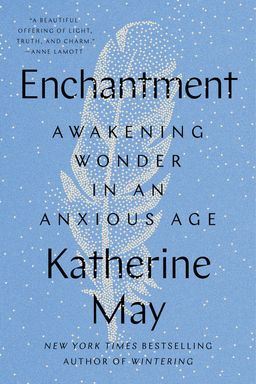
Enchantment cover

Enchantment

by Katherine May

In ''Enchantment,'' Katherine May explores how to reignite wonder in an age of anxiety. By reconnecting with nature and embracing the four elements-earth, water, fire, and air-May guides readers to rekindle magic and meaning in their lives, offering a path to profound self-discovery and connection.

Reawakening Wonder in an Anxious Age

When was the last time you truly stopped to marvel at something ordinary—a glint of light on water, the feel of soil between your fingers, or the murmur of wind through trees? In Enchantment: Reawakening Wonder in an Anxious Age, Katherine May invites you to rediscover that lost capacity for awe. Her book is part memoir, part philosophical meditation, and part cultural diagnosis, written in the wake of exhaustion, burnout, and pandemic dislocation. May argues that in our modern, hyperrational, and digitally saturated world, many of us have become estranged from meaning. The antidote, she says, is enchantment: a return to the small, sacred wonders that knit us back into relationship with nature, one another, and ourselves.

Through her lyrical and deeply reflective prose, May contends that the quest for enchantment is not about seeking grand spiritual revelations or transcendence but rather cultivating an openness to the subtle rhythms of the everyday. The book moves through the classical elements—Earth, Water, Fire, Air—and concludes in Aether, the ancient fifth essence that connects all things. Each element becomes a metaphor for states of being: grounding, flow, renewal, breath, and transcendence. They mirror our cyclical passage through disillusionment and rediscovery, inviting us not just to understand life but to inhabit it more fully.

The Crisis of Disconnection

May begins by describing a pervasive sense of unreality that many will recognize: the scrolling compulsion of news and social media, the hollow efficiency of productivity culture, the alienation that seeps even into our most intimate moments. She admits she can no longer read a book, pay attention, or find ease in stillness. The world feels too large, too threatening, too fragmented. Drawing on her own experiences of autism, motherhood, and menopause, she portrays an interior life flattened by anxiety and survivalism. Her description of waking in the night as “nobody” captures the void at the heart of modern identity—disembodied consciousness in search of orientation.

This malaise, May suggests, isn’t unique to her but emblematic of a culture that has lost its sense of depth. We have, in her words, “surrendered the rites of passage that used to take us from birth to death,” leaving grief unspeakable and community fractured. Constant stimulation has replaced meaning; constant vigilance has replaced presence. The result is what she calls a bone-deep tiredness—a spiritual depletion that no vacation can fix. It’s the exhaustion of living without wonder.

What Enchantment Really Means

So what is “enchantment”? For May, it isn’t about childish fantasy or religious conversion. It’s a disciplined kind of noticing: “small wonder magnified through meaning.” Enchantment thrives in quiet attention—watching tide patterns, touching stones, lighting fires, tasting honey. It’s both sensory and spiritual, an embodied way of knowing akin to what the poet John Keats called “negative capability”: dwelling in mystery without rushing to explain it. May draws links to Romantic thinkers like Coleridge and Rilke but translates their insights for an age that distrusts the mystical. She argues that our longing for enchantment is universal, even if we express it through secular rituals—gardening, swimming, crafting, or walking in nature.

To be enchanted again, May says, is to restore our fluency in metaphor and myth, to sense “the magic in the everyday” and to feel “sustained by it.” She reframes enchantment as a vital nutrient that keeps the psyche alive. Without it, the world becomes inert and colorless—“tap water left overnight.” With it, reality feels electric again, humming with significance. This is not escapism but a re-immersion into life’s textures. Enchantment turns the ordinary into the sacred by reminding us that everything is interconnected.

A Pilgrimage Through the Elements

The book unfolds like a pilgrimage through the natural world. In “Earth,” May learns to ground herself through touch and ritual, rediscovering presence in small acts like walking barefoot or examining stones. “Water” plunges her into unlearning and humility as she faces fear and illness, first losing and then relearning how to swim. “Fire” explores destruction and renewal—the burning away of certainties that makes space for new beginnings, including her return to reading and writing. And in “Air,” she contemplates clarity and transcendence, gazing at the stars, bees, and her son’s imagination as sources of wonder. The journey culminates in “Aether,” where she reclaims lightness—not through escape but through attention: a night spent under meteors becomes a metaphor for finding grace in impermanence.

Each elemental section balances personal narrative with cultural reflection. May invokes thinkers like Mircea Eliade, who described “hierophany” as the manifestation of the sacred in ordinary objects, and Julian Jaynes, who imagined early humans hearing the “voice of God” in their own minds. She threads these references into lived experiences—a meditation session interrupted by domestic noise, a pilgrimage to a holy well in Kent, a virtual retreat with the Zen Peacemakers—to show that enchantment is not a retreat from difficulty but a transformation of attention within it.

Why Enchantment Matters Now

Underneath May’s poetic reflections lies a quiet manifesto. Enchantment is not self-indulgence; it’s an ethical reorientation. To be enchanted is to be attuned—to one’s body, to the land, and to other beings. It invites humility instead of domination and reciprocity instead of extraction. In that sense, May’s vision aligns with authors like Robin Wall Kimmerer (Braiding Sweetgrass) and Annie Dillard (Pilgrim at Tinker Creek), who see presence as both moral practice and ecological repair. May’s chapters gesture continually toward community—congregations, pilgrimages, shared rituals—suggesting that personal awe naturally expands into collective care.

By the end, we understand that May’s recovery from burnout is really a lesson in remembering how to belong. The search for enchantment is a return to participation in life’s wider web. It doesn’t erase pain, uncertainty, or fear; it simply reframes them within a landscape of meaning. As she writes, “Take off your shoes, because you are always on holy ground.” The sacred, she reminds you, was never lost—it was only waiting for you to notice.


Grounding in Earth: Rediscovering Presence

May begins her journey in the element of Earth, where she confronts the modern crisis of disembodiment. We start at her bedside, in an anxious, wakeful night—half dream, half panic—as she feels “nobody,” untethered from selfhood. This experience epitomizes what she calls the halving and quartering of modern life: the way news overload, social polarization, and relentless digital noise have fragmented our sense of belonging. “If there were a spirit of this age,” she writes, “it would look a lot like fear.”

From this emotional disarray emerges a yearning: to “be enchanted again.” She realizes that enchantment is not grandeur but contact—a grounding in the tangible world. Childhood memories surface: finding beauty in marsh ditches, frogspawn, and the glow of London fireworks glimpsed from a far-off window. What she once dismissed as “small” or “impractical” now appears as the purest form of wonder. The adult has forgotten what the child knew—that connection comes through attention, not aesthetics. Enchantment, she concludes, “waits patiently for our return.”

The Body as Compass

To ground yourself, May says, you must start with the body. She begins taking long walks, collecting stones, and noticing sensations: the chill of air on skin, the rhythm of her breath, the weight of pebbles in her palm. These moments resist explanation; they simply remind her that she belongs to matter. Stones—dense, ancient, inscrutable—become her teachers. They recall the geological patience that endures beyond human turmoil. When she visits the standing stones newly installed above Whitstable, she expects profundity but finds only awkwardness. Yet as grass grows around them and symbols appear, she senses something changing: meaning accumulates through care and presence. “They had no answers,” she writes, “but they gave grace in return for my doubt.”

Burnout and the Need for Stillness

The Earth chapters also explore burnout—the secular saint’s condition of our time. May distinguishes it from mere fatigue: burnout is a hollowing, a decapitation of energy and attention. She identifies parallels between her autistic sensory overwhelm and society’s collective exhaustion. To recover, she literally touches ground. In doing so, she discovers rest as an active state: not torpor, but alert surrender. Sitting barefoot in grass becomes resistance against the infinite scroll of obligations. “Resting,” she writes, “is something chosen, alert, and rare.”

Her encounters with stone and soil model how you can heal by slowing down enough to feel contact again. This doesn’t promise enlightenment—it simply restores a sense of being somewhere. Earth steadies the discombobulated self by insisting on the here and now.

“Enchantment cannot be destroyed. It waits patiently for us to remember that we need it.”


Water: Learning to Flow and Unlearn

In the section devoted to Water, May turns from grounding to surrender. If Earth teaches stillness, Water teaches motion—the courage to dissolve the rigid forms of self. Here she narrates her struggle to return to wild swimming after a frightening near-drowning and the bodily vertigo caused by Ménière’s disease. Immersed in the sea’s cold indifference, she confronts her diminished strength and the humbling reality that control was always an illusion.

To regain her confidence, May starts taking swimming lessons with an instructor named Wendy. Her attempts at front crawl—“I can only manage a length before I feel like I might die”—become metaphors for unlearning. Wendy’s cheerful admonition that “in five weeks, you might remember how to swim again” speaks to a larger truth: growth requires disintegration. Whether learning a new stroke or living through a pandemic, you must allow your old rhythms to fall apart before coherence returns.

Unlearning as a Spiritual Practice

May’s lessons in the pool mirror her larger effort to “unlearn life.” During lockdown, routines, ambitions, even time itself seem to dissolve. The pool closes, and she finds herself rehearsing strokes in dreams, her unconscious continuing what her body cannot. Unlearning becomes a kind of gestation—a clearing-out that prepares the way for new forms of knowing. She draws parallels to Julian Jaynes’s theory of the bicameral mind, in which early humans heard divine voices rather than self-reflection, and imagines opening her own “window” to that forgotten mode of communication. What if burnout and disorientation are our modern versions of unmaking, opportunities to rewild the self?

The Tides and the Loss of Equilibrium

In “The Tides,” May reflects on how illness alters perception. Ménière’s floods her inner ear with too much fluid, leaving her dizzy and adrift. She recognizes that her bodily imbalance mirrors the planet’s climate anxiety and emotional turbulence. Watching the sea’s ebb and flow, she learns to read cosmic patterns—the moon’s gravity, the sun’s pull—as metaphors for surrender. The body, like the sea, is subject to unseen forces. You cannot command it; you can only float.

By submitting to water, May finds a lesson in resilience: life’s current will always carry you, even when you’ve forgotten how to swim. Healing, she suggests, isn’t mastery but buoyancy—the art of riding what moves you rather than resisting it.


Hierophany and Meaning-Making

In one of the book’s most fascinating chapters, May applies Mircea Eliade’s concept of hierophany—the manifestation of the sacred in ordinary objects—to contemporary life. How, she asks, can meaning reveal itself in an age that has forgotten ritual? The question arises from memories of her grandmother peeling an orange with meditative precision, a simple domestic act transformed into sanctity. The scent of citrus becomes, for May, “the nearest we got to prayer.”

Deep vs. Shallow Terrain

Eliade lamented that modernity flattened the world, stripping places of sacred depth. May sympathizes but reframes his idea optimistically: the sacred isn’t lost—it’s dispersed. She contrasts “shallow terrain,” the plastic, overstimulated spaces of childhood play centers, with “deep terrain,” places like forests where subtlety, time, and danger coexist. When she walks with her son, Bert, she tries in vain to spark his reverence for trees and streams. Yet through his eyes she learns another form of knowing: immersion without analysis. “I feel like my mind is growing branches,” he says, and when she interrupts, he quips, “And every time you talk, you cut one off.” The child embodies the openness she’s striving to recover.

Creating Sacred Space Anew

Later, in “Pilgrimage,” May visits the Black Prince’s Well near Canterbury—a forgotten spring once famed for healing. With a friend, she brings offerings of herbs and bread, reanimating an ancient ritual. The act feels tentative, even embarrassing, but necessary. “The well offers no instructions,” she notes. “At the bottom of those steps, you must confront your own yearning to make meaning.” Ritual, she concludes, is less about belief than about doing—a language of the hands and heart that reawakens relationship. By tending the well, she doesn’t find answers but connection. This, she realizes, is prayer without theology.

Through such gestures, May demonstrates that hierophanies still surround us—if we learn to look. Every act of care, from peeling an orange to feeding the hungry ghosts of history, can be a site of revelation.


Fire: Destruction and Transformation

The section on Fire burns through May’s narrative of collapse and renewal. Here she confronts the paradox that creation often requires destruction. Flames both terrify and purify; they’re the “shadow side of enchantment.” Fire, she writes, exposes our illusions of safety and control, reminding us that life is cyclical—burning, ash, regeneration.

This theme first appears metaphorically in “Burning Books,” where May confesses that she has lost the ability to read—a devastating admission for a writer. Her blockage symbolizes the extinguishing of her creative fire. She recalls being a student awed by professors’ walls of books, once believing knowledge could be accumulated like trophies. Now, surrounded by unread volumes, she realizes she mistook attainment for aliveness. When she finally reopens a book, stumbling over the words, she rediscovers beginner’s mind: “I had learned to be grateful for these losses, painful and disorienting as they are. They make me small again.”

The Night the Stars Fell

May then recounts the 1833 Leonid meteor storm—“the night the stars fell”—as a metaphor for cosmic awe. Witnesses thought the world was ending, yet science later revealed an ordinary celestial rhythm. For May, this paradox—terror and revelation—captures the essence of fire’s teaching. Flames, meteors, even burnout itself all demand surrender to impermanence. Her nostalgia for lost places and her fascination with literal house fires both stem from the same impulse: the desire to witness transformation. Fire consumes, but it also illuminates what endures—memory, meaning, connection.

In learning to honor fire without trying to control it, May models an attitude of creative surrender. Destruction, when accepted, becomes purification—the clearing that allows new wonder to take root.


Deep Play and the Art of Attention

If fire burns away illusion, what replaces it? In the chapter “Deep Play,” May argues that renewal comes through play—the pure, purposeless absorption that adults too often forget. Drawing on anthropologist Clifford Geertz’s idea of “deep play,” she expands it beyond Balinese cockfights to describe any act that engages our full attention and identity. Play, she says, is not frivolous—it’s a portal back to flow, creativity, and enchantment.

Recovering the Lost Play-Instinct

May traces her own estrangement from play to adolescence. As a girl who loved writing poetry, she learned that seriousness meant suppressing that impulse. Shame drove her to destroy her early notebooks, only to discover decades later that silencing play also silenced vitality. “The most beautiful reaches of your attention degrade within you,” she warns, “leaving behind bitterness and frustration.” When she finally returns to writing, tentatively sketching beside a vase of hyacinths, she feels both foolish and alive. This awkward joy signals her reconnection to the enchanted state of flow.

Play as Sacred Practice

For May, deep play isn’t just personal—it’s mythic. She recalls the Japanese fairy tale “The Boy Who Drew Cats,” in which a young monk’s obsessive art comes to life and saves him from a demon. The story encapsulates creative vocation: devotion to one’s elemental calling, heedless of approval. Similarly, when her husband helps her find a long-lost folly in the woods after she’s failed alone, she realizes that faith—believing the tower exists even when unseen—is part of play’s magic. Belief itself is imaginative participation with the world.

Deep play, then, is enchantment in action. It is how we co-create meaning with the world, shaping symbols that, in return, shape us. As she writes, “The walking is the thing. You are the walk.”


Keeping: Learning from Bees and Craft

In the penultimate chapter, Keeping, May turns to the pleasure of skill, connecting ecological care with spiritual discipline. After years of intellectual life, she learns through her hands by taking a beekeeping course. Clad in a white suit, she lifts frames from the hive and feels the hum of “fifty thousand fairly contented bees.” It’s a moment of revelation: knowledge is not only cerebral but somatic. To tend bees well, you must tune your body to their vibrations, steady your breath, and act with calm intent. “Most of what I learned,” she writes, “was not factual but reciprocal—the duty of care exchanged between human and bee.”

Reciprocity and Re-Enchantment

May aligns her insights with Robin Wall Kimmerer’s Braiding Sweetgrass, which teaches that reverence for the natural world arises through stewardship and gift exchange. Every act of keeping—gardening, sewing, cooking—binds us into reciprocity with the Earth. These skills, she argues, are not nostalgic hobbies but vital technologies of belonging. When she repairs a sweater or identifies wild mushrooms, she’s practicing enchantment through attention. Knowing with your hands, she insists, counteracts the alienation of knowing only with your head.

Community as a New Congregation

May also redefines “keeping” as community-making. From Zen Peacemaker retreats to local beekeeping groups, she finds new congregations devoted not to doctrine but to shared care. These gatherings echo the ancient guilds and pilgrim circles that once marked sacred practice. Modern enchantment, she suggests, doesn’t need a church—just people who pay attention together. “The colony hums,” she writes, “and I meet its rhythm.” So too, in keeping, we sync our lives once more with the pulsing life of the world.


Aether and the Return of Connection

In the epilogue, May ascends into the element of Aether, symbol of the unseen unity binding all existence. This final movement expands her local pilgrimages into cosmic perspective. Seeking the Lyrid meteor shower with her family, she drives through Exmoor’s dark sky reserves only to find the moon too bright for stargazing. What she finds instead is her own moon shadow—a small miracle of light and form. “I have gone looking for one thing,” she writes, “and found another.” That unexpected revelation becomes her closing metaphor: enchantment is not in the rarity of events but in the attention we bring to them.

The Work of Seeking

Aether represents synthesis—of body and soul, science and faith, effort and grace. Revisiting the ancient idea of the quintessence, May notes that medieval philosophers saw it as the substance of the stars. Modern physics may have replaced it with atoms, but the need for connection remains. Enchantment, she concludes, is an ethical stance: “The magic is of our own conjuring.” Seeking wonder is not childish escapism but a practice of attention, a way to live gently within a mysterious universe. As she tells the reader, it’s not about going far, but about noticing—the holy ground beneath your own feet.

The last sight of mother, child, and husband laughing under moonlight distills the book’s promise: that meaning is not bestowed from above but arises from relationship. The ordinary is always already sacred; it only waits for our willingness to see.

Dig Deeper

Get personalized prompts to apply these lessons to your life and deepen your understanding.

Go Deeper

Get the Full Experience

Download Insight Books for AI-powered reflections, quizzes, and more.