
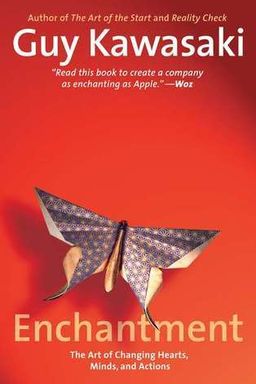
Enchantment cover

Enchantment

by Guy Kawasaki

In ''Enchantment,'' Guy Kawasaki reveals the secrets to transforming hearts, minds, and actions. Learn how to captivate others with genuine connections, trust, and compelling narratives. Discover strategies for creating irresistible products, overcoming resistance, and building loyal communities.

The Art and Ethics of Enchantment

Have you ever tried to persuade someone—only to realize that logic, data, and effort weren’t enough? In Enchantment: The Art of Changing Hearts, Minds, and Actions, former Apple evangelist Guy Kawasaki argues that true influence doesn’t come from manipulation or authority. It comes from something deeper: delight. Enchantment, as he defines it, is the process of winning hearts so people voluntarily and enthusiastically adopt your idea, product, or cause.

Kawasaki believes enchantment transforms hostility into civility and cynicism into belief. It’s the ability to make people genuinely want to join your mission—not because they’re pressured, but because they’re inspired. While salespeople, entrepreneurs, and marketers all seek persuasion, enchantment creates enduring, joyful commitment. “Manipulation is temporary,” he suggests, “but enchantment is permanent.”

Why Enchantment Matters

At its core, Enchantment addresses a universal truth: facts and features don’t change people—feelings do. In a world overflowing with information and noise, evoking trust, empathy, and awe is the key differentiator. Whether you’re launching a start-up, pitching investors, teaching students, or leading a movement, you need to enchant people who are overloaded, skeptical, and cautious. Enchantment isn’t about getting your way at any cost; it’s about building authentic enthusiasm and mutual benefit.

Kawasaki illustrates the need for ethical influence with personal stories. For example, he recalls the early days of Apple, when the Macintosh team struggled to convince businesses to adopt an unfamiliar technology. The product was revolutionary—but people didn’t understand it. Understanding what customers were thinking, rather than simply preaching innovation, became the turning point.

The Core Framework

Kawasaki builds his philosophy around twelve practical chapters that follow the journey from preparing yourself as an enchanter to resisting enchantment from others. The process starts internally—with becoming likable and trustworthy—and extends outward into how you prepare, launch, and sustain a cause. The steps can be summarized as:

  • Be likable. People don’t follow jerks, no matter how smart they are. Your smile, sincerity, and empathy lay the groundwork for influence.
  • Earn trust. People will buy into those they believe are honest and competent. Character isn’t optional—it’s magnetic.
  • Do something great. Enchantment depends on having a cause, product, or idea that truly improves lives.
  • Launch like a storyteller. People want to feel part of a narrative, not a pitch deck.
  • Overcome resistance. Understanding psychology—fear, inertia, social proof—helps ease people’s hesitation.
  • Make it endure. True enchantment lasts beyond first impressions; it becomes a relationship, not a transaction.

Later chapters explore persuasion in digital spaces (push and pull technology), within careers (enchanting your employees and your boss), and how to ethically resist the manipulative tactics of others. The book closes with a reminder that power demands integrity—you must use your influence for good, not greed.

Enchantment in Action

Kawasaki doesn’t rely on theory; he fills the book with vivid, personal examples. He describes filmmaker Karin Muller who, while in a dangerous confrontation with armed rebels in the Philippines, offered them coffee instead of hostility. Her warmth and humanity disarmed her interrogators—a raw moment of enchantment. He recalls how Zappos founder Tony Hsieh built trust with customers by offering free returns—trust first, profit second. He even shares the contentious process behind the Enchantment book cover itself, using a global crowdsourcing effort that led from controversy to creativity.

Other stories—from Disney’s magical customer recovery to Vibram’s viral barefoot running revolution—show enchantment’s universality. Whether it’s a product launch or a personal encounter, the pattern holds: inspire belief, align motives, and cultivate joy.

Why It Matters to You

Ultimately, Enchantment is both a playbook and a moral reminder. Kawasaki invites you to see persuasion as a creative act of service, not manipulation—to enchant, not ensnare. In a cynical marketplace, being authentic and generous is revolutionary. Every handshake, conversation, product, and presentation is an opportunity to make a moment of magic happen. The question isn’t “How can I get what I want?” but “How can we both win—and enjoy it?”

Through likability, trust, preparation, storytelling, and ethics, Kawasaki gives you not only the roadmap to influence but also a compass for using it responsibly. Enchantment, he insists, is the art of changing hearts while keeping your own intact.


Becoming Likable: The Foundation of Influence

According to Guy Kawasaki, no one ever enchanted another person without being likable first. Likability, he says, is the starting line—it lowers defenses, opens minds, and invites connection. People rarely follow those they dislike, no matter how impressive or persuasive their arguments sound. The path to likability begins with the basics: how you smile, dress, speak, and behave. It’s simple in principle, but revolutionary in practice.

The Power of the Genuine Smile

A real smile, Kawasaki explains, uses both the mouth and the eyes. It’s called a “Duchenne smile,” named after French neurologist Guillaume Duchenne. Unlike the forced “Pan Am” airline smile, which uses only mouth muscles, a Duchenne smile triggers genuine warmth—and people can feel the difference instantly. Think pleasant thoughts, he advises, and your smile will radiate sincerity.

Dress for a Tie, Not for Victory

Clothing sends messages before you speak. Overdressing projects superiority; underdressing signals indifference. The goal is to match your audience—to “tie.” If you’re meeting potential clients, dressing just like them shows respect and empathy. As Kawasaki quips, “Park your ego at the door; wear something that makes others comfortable, not impressed.”

The Handshake Equation

A good handshake, he reveals with humor, has been scientifically studied. Geoffrey Beattie from the University of Manchester created an actual “formula” for the perfect handshake: maintain eye contact, use moderate grip, smile naturally, keep your hands dry, and limit the shake to two or three seconds. It’s a symbolic connection—short but potent—where sincerity counts more than strength.

Language, Acceptance, and Proximity

Your words, Kawasaki insists, should be simple, active, and generous. Ditch jargon and long-windedness for clarity and energy. Beyond words, likability grows through acceptance. He urges readers to stop judging others and instead seek what they share—common passions, challenges, or humanity. Proximity also matters. People who see each other often tend to like each other more (a phenomenon supported by social psychology). Companies like Zappos even design workplaces that encourage spontaneous encounters, amplifying trust and community.

Mutual Passion and Respect

In every relationship, shared passion is a shortcut to likeability. Kawasaki encourages you to project your enthusiasm openly—about art, science, sports, or even quirky hobbies—because passion attracts passion. In one memorable story, Dominique-Charles Janssens became so enchanted by Van Gogh’s art that he bought and restored the painter’s final home, turning it into a cultural center. His devotion enchanted hundreds of visitors in turn.

Creating Win-Win and Default-to-Yes Moments

Finally, likability thrives on generosity. People love those who help them win. When you focus on creating outcomes that benefit others, you become magnetic. Kawasaki urges a “default-to-yes” attitude—start from the assumption that you can help, not avoid, a request. Some may take advantage of this openness, but the cumulative goodwill far outweighs the risk. As Darcy Rezac, author of The Frog and the Prince, once told him: “Always think, how can I help the other person when I meet them?”

To enchant people, you don’t need tricks—you need heart. Likability is contagious, and when combined with integrity, it becomes irresistible.


Building Trust: The Core of Sustainable Enchantment

If likability opens the door to someone’s heart, trust keeps it open. Kawasaki calls trustworthiness the moral backbone of enchantment—the difference between fleeting persuasion and lasting influence. You can’t fake it; it has to be embodied in every action.

From Zappos to Menschdom

He begins with a story about Tony Hsieh’s Zappos: customers were allowed to buy shoes online and return them for free, no questions asked. Zappos trusted customers not to abuse this privilege—and in return, customers trusted Zappos enough to keep buying. Trust, Kawasaki writes, is reciprocal: “If you want people to trust you, trust them first.”

He also borrows from Yiddish tradition, urging readers to become a mensch—a person of integrity, compassion, and accountability. A mensch, he writes, fulfills promises, treats enemies with civility, and helps people who can’t offer anything in return. James Garner, the late film star, embodied this; when coauthor Jon Winokur worked on Garner’s memoir, Garner unexpectedly gave him half the royalties, saying simply, “Don’t menschion it.”

Transparency and Generosity

Trust thrives in daylight. Kawasaki advises immediate disclosure of conflicts of interest—the moment you hide motives, suspicion blooms. He even posts a full list of his investments online, calling it “alignment of interests.” Transparency shows confidence, not weakness.

Generosity, too, builds credibility. When you help without expecting return—what psychologists call intrinsic reciprocity—you earn deep respect. In the 1980s, war-torn Ethiopia donated aid to earthquake-struck Mexico out of gratitude for help received fifty years earlier. True giving, Kawasaki says, “comes from joy, not calculation.”

Competence and Consistency

Competence is trust’s twin. Kawasaki points to radio host Terry Gross and quizmaster Peter Sagal as examples of professionals whose mastery earns loyalty. Their knowledge and calm convey reliability—proof that “knowing your craft is the most convincing authenticity.”

A Bigger Pie and Shared Wins

Finally, trust grows when you act abundantly instead of defensively. “There are two kinds of people,” Kawasaki writes, “bakers and eaters.” Eaters think every gain requires someone else’s loss; bakers believe the pie can always grow. Companies like Google and Southwest Airlines proved this by expanding markets instead of hoarding profits. Bake a bigger pie, and people will want to bake with you.

When you align goodwill, competence, and abundance, you stop trying to appear trustworthy—you simply are. Trust ceases to be a tactic and becomes your way of being. That’s when enchantment lasts forever.


Creating Great Causes That Inspire Action

Before you can enchant others, Kawasaki says, you must offer something worth believing in. A mediocre product or vague mission cannot win devotion. Great causes—whether a gadget, company, or campaign—share five unmistakable traits: they are deep, intelligent, complete, empowering, and elegant.

The Five Qualities of Greatness

  • Deep: They meet real, multilayered needs. Google, for instance, isn’t just a search engine—it’s an ecosystem for every online task.
  • Intelligent: They solve practical problems cleverly, like Ford’s “MyKey” feature that lets parents limit their teen’s driving speed.
  • Complete: They deliver delight from start to finish, not just at purchase. Lexus exemplifies this with superb service after the sale.
  • Empowering: They make users feel smarter and more capable. Apple doesn’t sell computers—it sells confidence and creativity.
  • Elegant: They reflect care and simplicity in design, from Eames chairs to Dyson hand dryers.

Preparing the Ground

Once you have a great cause, you need structures that make adoption easy. Kawasaki introduces tools like the premortem—imagining a project has failed and asking, “Why?” Teams that identify potential pitfalls early can prevent disaster before launch. He also champions “designing ease into behavior,” illustrated by his experiment with labeled trash bins that nudged kids at a hockey party to recycle effortlessly.

Simplicity, Defaults, and Goals

Ease breeds enchantment. Simple language—like “If you see something, say something”—spreads faster than complexity. Removing friction, whether mental (complex names like Veuve Clicquot) or literal (hidden fees and long forms), builds trust. Likewise, offering helpful defaults—such as automatic savings plans—encourages beneficial behaviors without pressure.

Finally, clarity of purpose is essential. Kawasaki highlights Etsy’s mission “to enable people to make a living making things,” as an example of enchanting simplicity. When you articulate such focused goals, people naturally align with you. “If you don’t know where you’re going,” he reminds, “why should anyone follow you?”

Great causes are the soil where trust and likability take root. They make enchantment not only possible but inevitable.


Launching with Story, Immersion, and Trust

A brilliant cause means little if it never launches memorably. Kawasaki insists that enchantment begins when you tell a story powerful enough to make people feel. Numbers rarely move hearts—but stories do. Drawing from narrative experts like Annette Simmons (Whoever Tells the Best Story Wins), he outlines how to craft a launch that captivates rather than lectures.

Tell a Story, Don’t Announce a Product

Most launches, he jokes, are “press-release funerals.” They thank everyone, describe features with acronyms, and induce yawns. Real launches invite belief. Kawasaki presents four archetypal storylines: Great Aspirations (making the world better), David vs. Goliath (the underdog fight), Profiles in Courage (overcoming hardship), and Personal Stories (simple human relatability). Apple’s early marketing embodied all four.

Immerse People in the Experience

Next comes immersion—the art of pulling people into your cause so deeply that disbelief fades. Kawasaki shares his surreal experience acting in a simulated combat at Strategic Operations, where fake RPG fire and screaming actors taught true immersion. For businesses, immersion can mean vivid demos, realistic trials, or letting people play with prototypes. “When they can touch it, they’ll believe it,” he says.

Trial, Scarcity, and First Followers

An irresistible cause invites immediate trial—it’s easy, fast, inexpensive, and reversible. Amazon’s “Look Inside!” feature or Zappos’s free returns remove risk, letting curiosity lead to conversion. Combined with priming (e.g., background music influencing wine choices) and scarcity (“invite-only” Gmail accounts), these tactics create fascination. But the real measure of success is acquiring your first follower, as entrepreneur Derek Sivers notes: the person who validates your dream and attracts the crowd behind them.

In the end, a launch isn’t a monologue—it’s an invitation to join a movement. If your story evokes belief and your experience proves it real, the world won’t just buy your cause; they’ll carry it forward.


Overcoming Resistance and Doubt

Even the best ideas meet skepticism. Kawasaki’s sixth chapter, “How to Overcome Resistance,” explores why people hesitate—and how to move them forward ethically. The antidote to resistance, he explains, is understanding psychology: humans crave safety, conformity, and proof from others.

The Roots of Reluctance

People resist because they fear mistakes, lack role models, or cling to familiar habits. Sometimes, Kawasaki admits, “your cause simply sucks”—and honest reflection is the only cure. But when reluctance comes from inertia, you can reframe perception through social signals and stories.

Social Proof, Scarcity, and Storytelling

Social proof—the idea that “if others do it, it must be right”—can alter behavior dramatically. He cites Robert Cialdini’s studies at the Petrified Forest, where merely changing signage (“few people steal wood”) cut theft rates in half. Likewise, scarcity creates allure; invite-only services like Gmail sparked frenzied demand. The key is balance: too much exclusivity alienates; too much ubiquity cheapens.

Data, Debt, and Diplomacy

Facts alone rarely sway people, but visualized data can. Kawasaki praises Hans Rosling’s animated Trendalyzer graphs for transforming global health statistics into insight. He also encourages reciprocity: ask for small favors first. As he notes from Benjamin Franklin’s autobiography, people who help you once are more likely to help again—because helping feels like consistency with past behavior. Diplomacy helps too; finding small agreements (“we both hate opera”) opens doors to bigger ones.

The Emotional Core

Kawasaki concludes with the story of Charlie Wedemeyer, a football coach paralyzed by ALS who spent decades inspiring others. When motivation flags, he says, remember people like Charlie—those who move others without voices or limbs, only purpose. Resistance yields to authenticity faster than to logic. “People don’t argue with inspiration,” Kawasaki writes—they follow it.

To overcome resistance, don’t outsmart people—outcare them. Show willpower, truth, and humanity, and you’ll turn reluctance into remarkable devotion.


Making Enchantment Endure Over Time

Enchantment that fades was never true enchantment. In the book’s middle chapters, Kawasaki explores how to transform fleeting enthusiasm into lifelong loyalty. His thesis: enduring enchantment depends on internalization, reciprocity, ecosystems, and commitment.

From Compliance to Belief

People first conform due to peer pressure, then identify with a group, and finally internalize beliefs as their own. REI’s community of outdoor lovers exemplifies this progression—customers join not just for products but because they align with its philosophy of sustainability and exploration. When people see themselves reflected in your mission, enchantment becomes identity.

Reciprocity and Memory

Lasting connection arises from reciprocity—the natural rhythm of give and take. Kawasaki revisits Cialdini’s principles with touching examples: in 2001, children from South Carolina sent $400,000 to rebuild a New York fire truck because, 134 years earlier, New York had done the same for them. “Generosity echoes through generations,” he notes. Giving early, gladly, and unexpectedly plants the seeds of unbreakable bonds.

Ecosystems and Spreadability

To make enchantment self-sustaining, you must build an ecosystem—user groups, developers, and communities that keep your ideas alive. Apple’s fan groups, Harley-Davidson’s HOG clubs, and Maker’s Mark bourbon ambassadors all transformed buyers into believers. Each member adds momentum; together, they form a culture. The Grateful Dead’s open-taping policy, for example, allowed fans to circulate concert recordings freely, ensuring the music—and its magic—lasted decades.

Kawasaki’s guiding question remains timeless: “Will people still care a year from now?” If the answer is yes, you’ve created enchantment that endures both in mind and memory.


Digital Enchantment: Using Push and Pull Technology

In an age of screens and constant notifications, Kawasaki updates his principles for the digital frontier. Technology, he argues, can amplify enchantment—if used personally and respectfully. In two complementary chapters, he explores “push” tools (presentations, e-mail, Twitter) and “pull” platforms (websites, blogs, Facebook, LinkedIn, YouTube).

Push Technology: Showing Up with Purpose

Push communication delivers your story outward. Kawasaki’s advice on presentations mirrors his live speaking career: use ten slides, twenty minutes, and thirty-point font. Customize every introduction, sell dreams not products, and dramatize with visuals, not text. In e-mail, brevity and sincerity rule—six sentences suffice. And on Twitter, he champions responsiveness, humility, and value over vanity metrics: “Engage many, often, and honestly.”

Pull Technology: Creating a Digital Magnet

Pull technology draws people in. Enchanting websites, he says, provide fast, simple, photo-rich experiences. Blogs should educate or inspire, not pontificate. Facebook pages thrive on conversation, not broadcasting. Kawasaki highlights strategist Mari Smith’s creative tactics—live chats, contests, and surprise giveaways—to sustain engagement. On LinkedIn, authenticity and helpfulness replace self-promotion. And on YouTube, brevity and brilliance spread: videos under a minute that educate, entertain, or inspire outperform long-winded monologues.

He ends with a nod to Japanese aesthetics, from kanso (simplicity) to yohaku-no-bi (beauty of the unspoken): design every interaction with balance, elegance, and quiet confidence. The same principles that make Zen gardens enchanting also make tweets, slides, and videos unforgettable.

Digital tools, used with empathy and restraint, can spread goodwill at unprecedented scale. They allow enchantment to travel at the speed of light—without losing its human warmth.


Leading and Working Through Enchantment

Two late chapters—“How to Enchant Your Employees” and “How to Enchant Your Boss”—shift the lens inward. Kawasaki argues that the same principles that win customers can revolutionize workplaces. Leaders and team members alike can use enchantment to make work meaningful and humane.

Empowering from Purpose (MAP)

Employees, he asserts, crave mastery, autonomy, and purpose (MAP), echoing Daniel Pink’s motivational research. Great leaders don’t merely pay fairly; they help people grow and give them control. At companies like Zappos or REI, autonomy fuels creativity and service. Leaders who model vulnerability—admitting flaws first—enchant their teams through humility, not fear.

Managers as Enchanters

Good bosses, Kawasaki notes via Stanford’s Bob Sutton, protect employees from bureaucracy and stupidity. They celebrate small wins, own their mistakes, and never ask employees to do what they wouldn’t. The “Good Boss Manifesto,” a 12-point creed included in the book, urges managers to fight as if right but listen as if wrong—a rare, enchanting form of strength.

Upward Enchantment

For employees, Kawasaki’s advice flips hierarchy on its head: make your boss look good. “Forget outshining them—outhelp them,” he writes. Deliver bad news early, underpromise and overdeliver, and prototype your work for feedback. Most of all, he says, build friendships across teams—relationships are your best reputation. One intern at REI, he recalls, so radiated joy that her boss reconsidered what leadership truly meant.

Whether leading or following, enchantment at work replaces fear with trust and duty with devotion. When employees and managers learn to delight rather than demand, work becomes more than survival—it becomes shared creation.


Ethical Resistance: Guarding Against Dark Persuasion

Enchantment is powerful—too powerful to be left unexamined. Kawasaki closes with a cautionary chapter: “How to Resist Enchantment.” Since not all persuaders have pure motives, you must defend yourself with the same tools that make you influential.

Avoiding Temptation and Delay

The simplest defense is prevention. Avoid tempting situations—sales, auctions, even friends urging impulsive buys—especially when tired or stressed. Delay decisions. The “Dopeler Effect,” he jokes, describes how “stupid ideas seem smarter when they come at you quickly.” Time restores clarity.

Filter Illusions and False Authority

Beware pseudo-salience—the art of highlighting irrelevant but shiny data (“Free phone!” with a two-year contract). Challenge correlation errors and celebrity anecdotes, like the MMR-autism myth championed by Jenny McCarthy against science. Not every confident expert deserves trust. Credible claims pass three tests: sequence (cause before effect), connection (functional link), and control (no hidden variable).

Remember the Crowd Isn’t Always Wise

Crowds can mislead as easily as guide—whether in 1600s Dutch tulip mania or the dot-com boom. Nobel physicist Richard Feynman once exposed NASA’s flawed consensus on shuttle safety, reminding leaders that wishful thinking doesn’t change physics. True crowd wisdom requires diversity, inclusion, and honest incentives—absent those, skepticism is sanity.

Checklists and Small Concessions

Finally, Kawasaki recommends a personal checklist for major decisions: Is it ethical? Will it still be right next year? Would I do this if no one watched—or everyone did? Embrace tiny, harmless enchantments (desserts, toys) to preserve willpower for big choices. Enchantment, used wisely, is never the problem. Unchecked persuasion is.

To resist manipulation, cultivate awareness, curiosity, and patience. The real enchanter—like the authentic hero—wields power with conscience.

Dig Deeper

Get personalized prompts to apply these lessons to your life and deepen your understanding.

Go Deeper

Get the Full Experience

Download Insight Books for AI-powered reflections, quizzes, and more.