
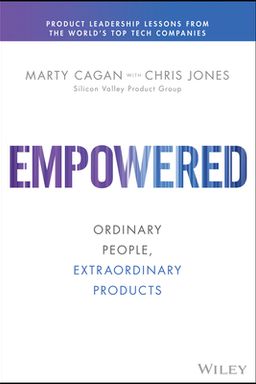
Empowered cover

Empowered

by Marty Cagan with Chris Jones

Empowered by Marty Cagan and Chris Jones is a master class in creating extraordinary products. The book guides readers on empowering teams with strong leadership, visionary strategies, and innovative thinking to develop products that customers love and businesses profit from. Learn how to align team objectives with business goals for lasting success.

Empowered: How Great Product Companies Innovate

Why do some tech companies innovate continuously while others stagnate despite adopting Agile or OKRs? In Empowered, Marty Cagan argues that lasting innovation is not about tools or process tweaks but about deep structural and leadership choices. The book reveals how great product organizations—like Amazon, Netflix, Apple, and Google—build environments where small teams can discover and deliver extraordinary products repeatedly. The secret lies in combining empowered product teams with strong product leadership and a culture that treats technology as the core of the business, not a cost center.

Cagan builds on his earlier work, Inspired, by moving beyond how to build products customers love, to how to build organizations capable of doing so consistently. He shows that transformation requires rethinking roles, strategy, and trust across every level of the company.

The Three Foundations of Product Excellence

Cagan begins by contrasting weak organizations—feature factories—with strong ones that empower teams to solve business problems. The difference comes down to three foundational choices: how you treat technology, how you exercise product leadership, and how you structure teams.

First, the role of technology. Elite companies see technology as the business itself. Tesla, for example, delivers cars that improve via software updates; Amazon’s advantage comes from engineering infrastructure that enables rapid iteration. Companies like Boeing, which outsourced core software work on the 737 MAX, serve as cautionary examples of treating technology as peripheral.

Second, product leadership is decisive. Great product leaders combine vision (the mission, principles, and North Star direction) with execution (hiring, coaching, and managing to outcomes). They transform the culture from mercenary feature work to missionary problem-solving. As Cagan reminds us through Bill Campbell’s coaching philosophy, leadership is about creating an environment where everyone’s greatness can emerge.

Third, empowered product teams. These small, cross-functional teams—product manager, designer, and tech lead—own outcomes rather than outputs. They are accountable for customer and business results, not for executing a feature roadmap. Empowered teams use discovery to test ideas rapidly before writing production code, mastering the four key risks: value, usability, feasibility, and viability.

From Feature Teams to Empowered Teams

Empowered teams require a different operating model than most companies use. Instead of being told what to build, teams are given strategic objectives—problems to solve—and trust to discover the best solutions. The book’s case studies, such as a jobs marketplace that achieved measurable outcome improvements by reorganizing into empowered teams, illustrate the transformation vividly.

Cagan warns that frameworks like SAFe or traditional Scrum often create feature teams that appear cross-functional but remain output-driven. In these environments, product people manage backlogs instead of outcomes, and innovation stalls. Empowerment means accountability for business results, not freedom without direction.

Product Vision, Strategy, and Discovery

A strong product vision provides the motivational and directional backbone for empowered teams. It describes the world you want to create for customers—three to ten years out—and serves as the primary recruiting and alignment tool. Great visions are emotional and story-driven, not lists of features. They are often expressed through vision prototypes ("visiontypes"), videos, or written narratives that vividly depict the desired future.

Product strategy then bridges vision and daily work. It focuses on a few pivotal objectives guided by insights—quantitative data, qualitative research, technological possibilities, and industry trends. Those insights fuel actionable objectives for teams, often expressed as OKRs (objectives tied to measurable key results). In strong organizations, those OKRs define customer or business outcomes rather than feature deliveries.

Discovery is where empowered teams test ideas cheaply and learn quickly. By using prototypes, A/B tests, and customer interviews, they evaluate whether a product will be valuable, usable, feasible, and viable. Discovery minimizes the risk of waste and maximizes learning velocity—the hallmark of a great product culture.

Leadership, Coaching, and Ethics

Empowerment succeeds only if leadership invests in people. Cagan dedicates major sections to coaching and staffing. Borrowing from Bill Campbell and Google’s APM program, he urges managers to treat coaching as their primary job—developing people through structured 1:1s, feedback, and written narratives that clarify thinking. Hiring focuses on competence and character, not just experience, and emphasizes diversity for better problem-solving.

Ethics and accountability also feature prominently. Teams must ask not only "can we build it?" but "should we build it?" Ethical awareness is added as a fifth risk in discovery, ensuring long-term trust and responsibility.

Transformation and the Path Forward

At the executive level, transformation depends on product leaders who are credible peers to the CEO and who anchor their authority in tangible results and talent development. Cagan’s transformation roadmap has three steps: establish strong product leaders, build and coach empowered teams, and redefine the company’s relationship with the business from service to partnership.

The message of Empowered is direct but hopeful: you can build a culture that innovates reliably if you treat technology as central, empower your teams with trust and accountability, and lead with vision, coaching, and integrity. Transformation is not a management slogan—it’s a commitment to developing extraordinary people and giving them meaningful problems to solve.


Product Leadership

Product leadership is the engine of empowerment. Cagan differentiates clearly between leadership (inspiration and vision) and management (coaching and execution). Great product leaders, such as those he profiles throughout the book, blend the two seamlessly: they craft a compelling vision, recruit and coach talented people, and hold teams accountable for outcomes.

Vision and Principles

As a product leader, you own the future story your company tells its customers. Vision is not a marketing tagline—it is the emotionally charged depiction of the customer experience you’re trying to create, three to ten years ahead. It keeps hundreds of teams aligned and excited. Product principles translate that vision into guardrails for decisions (“We prioritize simplicity over configurability,” for example). These two elements—vision and principles—anchor everything else.

Management as Coaching

Cagan makes coaching the centerpiece of management. Weekly one‑on‑ones are dedicated to developing skills and judgment, not checking status. A good manager measures success by how many people they grow into strong contributors. Structured assessments, written reflections (like Amazon’s six‑page narratives), and direct feedback create a continuous learning loop. The leader’s role is to build an environment where people can excel and then to guide them with integrity and trust.

Designing Team Topology

Empowerment depends on thoughtful team topology. Teams must have ownership of clear problems, autonomy to solve them, and alignment to business strategy and architecture. Cagan distinguishes between experience teams (customer-facing) and platform teams (infrastructure and enabling tools). He warns against organizing by technical skill (e.g., iOS vs web teams), which fragments ownership and slows innovation. As architecture and missions evolve, topology should adapt deliberately but infrequently to avoid constant disruption.

Ultimately, product leadership means getting the big things right—vision, people, and team design—then staying close enough to coach execution without micromanaging. Strong leaders evangelize continuously, clarify priorities, and ensure empowerment never drifts into chaos or apathy.


The Power of Product Vision

A clear, customer‑centric product vision is your company’s North Star. It tells everyone why their work matters by describing the future you aim to create. Cagan emphasizes that vision is not a plan or a roadmap—it is an emotional, story-driven description that recruits, aligns, and inspires. It fuels the sense of mission that turns mercenaries into missionaries.

Crafting and Validating Vision

A great vision begins with understanding the customer’s world and the problems worth solving. It should be bold yet credible and connect directly to enduring technology trends (AI, edge computing, mobile). You can test whether there’s demand for your vision—whether customers want this future—without claiming to know the final solution. Accept that discovery will take years to fulfill the promise.

Communicating the Vision

Communication is where vision lives or dies. Use storyboards, high‑fidelity “visiontype” prototypes, or videos that let people see and feel the future experience. Visual storytelling is far more persuasive than slide decks. Repeat the story constantly—new hires, executives, investors, and engineers all need regular reminders of where you’re headed and why.

Protecting the Vision

Resist pressure to turn vision into roadmaps. Customers and sales teams often want detailed feature schedules, but those commitments destroy agility. Instead, share the vision and make only high‑integrity commitments—clear, evidence‑based promises you know you can deliver (for example, for contractual or regulatory reasons). Ensure engineering architecture evolves toward the vision rather than reacting to short‑term expedience.

The vision must be co‑owned by the head of product, design, engineering, and the CEO. When this shared ownership exists, the organization’s long‑term view aligns business strategy, recruiting, and architecture around a coherent story of the future—and keeps innovation moving forward with purpose.


Strategy into Action

Strong product strategy is about focus and insight. Without strategy, even empowered teams drift; with it, they channel autonomy toward the right problems. Cagan follows Richard Rumelt’s principle: good strategy concentrates scarce resources on a few pivotal objectives that change outcomes decisively.

Focus on the Vital Few

Many companies sabotage themselves by pursuing dozens of conflicting initiatives. Strategy demands saying no. In the jobs marketplace case study, leadership concentrated on two big goals—improving core marketplace performance and proving enterprise product‑market fit—which produced measurable revenue and engagement gains.

Generating Insights

Good strategy starts with insights from four sources: quantitative data (conversion and retention), qualitative research (unmet needs), technology trends (new feasible solutions), and industry patterns (competitor gaps). These insights reveal leverage points where focused effort will matter most. For example, discovering that applications within 48 hours of registration predicted long‑term success led to critical roadmap priorities.

Converting Insights into Objectives

Once you have insight, turn it into actionable objectives expressed through OKRs. Objectives describe the problem (“increase seeker success”), while key results define measurable outcomes (percent improvement). Teams propose their own KRs, ensuring ownership and creativity. Guardrail metrics prevent optimizing one metric at the expense of others (for example, delivery accuracy versus cost).

Active Management

Empowerment requires strong management, not abdication. Leaders should hold weekly one‑on‑ones, aggregate insights across teams, and maintain clear communication. Informed ambition is key: distinguish “roof shots” (incremental gains) from “moon shots” (transformational goals). Some commitments—launches tied to contracts or dependencies—are treated as high‑integrity commitments and tracked separately from aspirational OKRs.

A living strategy is insight‑driven, focused, and continuously clarified. It connects discovery and delivery so that empowered teams work not just efficiently, but on the right problems.


Building Empowered Teams

Empowered product teams are the centerpiece of Cagan’s philosophy. They transform organizations from feature factories to innovation engines. Each team includes a product manager, designer, and engineers led by a tech lead, collectively owning outcomes instead of projects. Their job: solve a customer or business problem, not execute a prescribed list of features.

Accountability to Outcomes

An empowered team measures success through results—customer adoption, retention, engagement, or revenue—not releases or story points. They experiment, run prototypes, and learn quickly. They test four key risks: value (will customers buy it?), usability (can they use it?), feasibility (can engineering build it?), and viability (does it work for the business?).

Discovery as Daily Practice

Discovery replaces guesswork and top‑down roadmaps. Every idea is treated as a hypothesis to validate through evidence. Lightweight prototypes and A/B tests precede engineering work. Teams that learn fast build better, cheaper products. Product managers become connectors—linking customer understanding, business strategy, and technical feasibility instead of managing tickets.

Collaboration and Trust

Stakeholder engagement shifts from “management” to “collaboration.” Sales, marketing, and legal are partners in shaping viable solutions, not clients ordering features. Teams earn trust by delivering outcomes and communicating transparently. Evangelism—showing prototypes, sharing user pain, broadcasting learnings—is constant and essential for internal alignment.

Well-staffed, coached, and trusted teams turn strategy into innovation. The manager’s role is to ensure conditions for empowerment exist: right people, clear problems, and psychological safety to experiment. The result is a culture where people act like missionaries with purpose, not mercenaries chasing checkboxes.


Integrity, Ethics, and Transformation

Empowerment without accountability leads to chaos. Cagan closes by tying together integrity, ethical judgment, and long‑term transformation. High‑integrity commitments—clear promises based on validated discovery—form the backbone of trust. When teams over‑promise or leaders manipulate data, empowerment collapses into distrust.

Decision‑Making and Accountability

Effective decisions are collaborative and transparent. Defer to expertise (design on UX, tech leads on architecture), resolve debates with experiments, and practice “disagree and commit.” Kill snakes fast, as Jim Barksdale said—make the call and move forward. Integrity means making promises only after discovery and then delivering results.

Ethical Risk: Should We Build It?

Cagan adds ethics as a fifth risk alongside value, usability, feasibility, and viability. Each team should ask, “Should we build it?” and consider broader stakeholders—users, employees, communities—before pursuing an idea. Drawing on Rob Chesnut’s work at Airbnb, he argues that ethical foresight protects both brand trust and long‑term sustainability.

Transformation Through Leadership

Sustainable transformation happens in three stages: install strong product leaders who can recruit and coach; empower capable teams with authority and accountability; and redefine the relationship between product and the rest of the business as partnership, not subordination. Transformation is leadership‑intensive but yields organizations that innovate more reliably and waste less effort than traditional structures.

In the end, Empowered is a manifesto for putting human talent and integrity at the center of technology organizations. Build teams you can trust with the company’s hardest problems, coach them relentlessly, and align them with purpose—that’s how you build enduring innovation.

Dig Deeper

Get personalized prompts to apply these lessons to your life and deepen your understanding.

Go Deeper

Get the Full Experience

Download Insight Books for AI-powered reflections, quizzes, and more.