
Idea 1
Earning Your Freedom Through Entrepreneurship
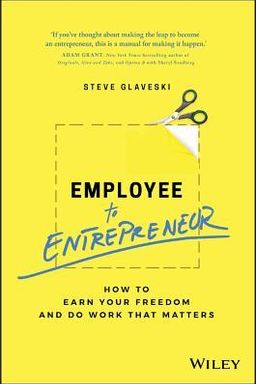
Have you ever felt miserably comfortable in your job—secure but uninspired, well-paid but yearning to do something that matters? In Employee to Entrepreneur: How to Earn Your Freedom and Do Work That Matters, Steve Glaveski argues that the path to true fulfillment and freedom lies in transforming your mindset from that of an employee to an entrepreneur. He contends that while technology is radically reshaping the nature of work—automating jobs, disrupting industries, and creating new opportunities—the key isn’t to hide from these waves of change, but to surf them by thinking and acting like an entrepreneur.
Glaveski’s story begins with his own leap from the stability of Macquarie Bank to the risky world of startups. Through failures, pivots, and ultimate success with ventures like Collective Campus and Lemonade Stand, he learned that entrepreneurship is not about chasing unicorns but about building autonomy, experimenting boldly, and finding fulfillment through meaningful work. His experiences frame a practical and psychological roadmap for transitioning from employee mindset to entrepreneurial action.
The Age of Disruption
Glaveski opens with a reality check: technological change is exponential, not linear. Using Moore’s Law—computing power doubles every 18–24 months—he reveals how industries shrink, jobs disappear, and productivity grows without increasing income. The gap between automation and employment is widening, meaning future success demands adaptability. Entrepreneurs, he argues, aren’t victims of disruption—they’re its drivers.
To underline this, Glaveski contrasts old corporate giants like Blockbuster, once employing 60,000 people, with Netflix—a billion-dollar company with one-tenth the workforce. The lesson: companies and individuals must learn to create more impact with fewer resources. You can no longer rely on governments or employers to safeguard your future; you must take ownership of your career and purpose.
From Employee to Entrepreneur
Making the leap involves more than quitting a job—it’s about changing how you think, decide, and act. Employees mitigate risk by planning, analyzing, and waiting for certainty. Entrepreneurs mitigate risk by experimenting, failing fast, and learning forward. Glaveski highlights the shift from talking to doing, from avoiding mistakes to using them as guides toward innovation. He urges readers to embrace what psychologists call a growth mindset—viewing challenges not as threats but as learning opportunities.
This mindset shift means accepting discomfort, uncertainty, and even loneliness. As Nathan Chan of Foundr told him, “None of my friends or family are entrepreneurs… they thought I was an idiot.” But entrepreneurship, Glaveski insists, is a discipline of resilience rather than luck—learning to make friends with failure and pushing forward anyway.
The Framework for Transformation
Glaveski structures his journey through three powerful questions: Why (your purpose), What (your mission, work, or direction), and How (your method and execution). Finding your why means escaping the trap of being miserably comfortable and creating work that aligns with your highest values—freedom, fulfillment, and contribution. Your what connects these values to a concrete venture. And your how is about execution—testing ideas, iterating fast, outsourcing what doesn’t matter, and applying principles like lean startup and 80/20 thinking.
He encourages you to “collect dots” through diverse experiences (learning, travel, podcasts, books) and then “connect them” creatively to find purpose, echoing Steve Jobs’ philosophy that you can only connect dots looking backward. The book’s essence is a call to design your own life, not outsource it to an employer.
Why This Transformation Matters Now
Throughout, Glaveski warns that automation and AI are obliterating structured career paths. Mechanized intelligence is outpacing human adaptability, transforming jobs from law and journalism to accounting and design. Yet instead of despair, he offers optimism: entrepreneurship is the antidote to technological unemployment because it empowers creativity, adaptability, and meaning. He reminds readers that the future doesn’t care about seniority—it rewards those who innovate, experiment, and contribute.
As one reviewer put it, Glaveski’s book is “an antidote to the paralysis by analysis of dying corporations.” It’s not about overnight success—it’s about changing the operating system of your mind. Whether you leave your company or rebuild it from within, learning to think like an entrepreneur will help you thrive in the 21st century workplace.
In Summary
Glaveski’s message is simple but profound: action beats aspiration. The book uses his own failures, learnings, and frameworks to help readers go from comfort to creativity, from employee to entrepreneur, and from idle dreaming to impact. You’ll walk away understanding how to identify your “why,” build around your “what,” and execute your “how” so that your work becomes not just profitable but purposeful. In doing so, you earn not just a living—but your freedom.