
Idea 1
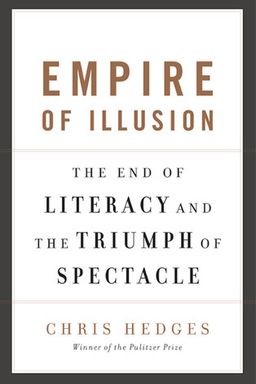
Empire of Illusion: The Triumph of Spectacle Over Reality
What happens when a society can no longer tell the difference between truth and fantasy? In Empire of Illusion: The End of Literacy and the Triumph of Spectacle, Pulitzer Prize–winning journalist Chris Hedges argues that America has become a culture of illusions — one where appearances, entertainment, and spectacle have replaced thought, morality, and reality itself. The book paints a portrait of a nation in collapse, addicted to the comforting glow of distraction while its civic, moral, and economic foundations crumble beneath it.
Hedges’ core argument is as searing as it is sobering: illusions now define American life. From celebrity worship to corporate propaganda, from pornography’s commodification of intimacy to the erosion of intellectual inquiry, citizens have retreated into self-delusion. Unable to confront the hard truths of moral decay, social inequality, imperial overreach, and ecological collapse, Americans choose instead to inhabit simulated worlds — televised stages, screens, and consumer lifestyles that promise perpetual happiness while concealing systemic rot.
The Five Illusions
Hedges structures his critique around five illusions that, together, expose the anatomy of a culture in decline: the illusion of literacy, the illusion of love, the illusion of wisdom, the illusion of happiness, and the illusion of America itself. Each illusion examines a key arena of modern life — media, intimacy, education, psychology, and politics — revealing how spectacle and deception have hollowed out substance.
The Illusion of Literacy begins with a world mediated by screens, where celebrity culture, professional wrestling, and reality television have replaced civic discourse. People mistake notoriety for meaning and public entertainment for truth. In this new “Empire of Illusion,” the boundary between the real and the performative collapses. The public’s hunger for spectacle makes it complicit in its own manipulation, echoing Neil Postman’s warning in Amusing Ourselves to Death that people will surrender freedom not through oppression but through distraction.
The Illusion of Love exposes pornography not as sexual liberation but as industrialized degradation — a billion-dollar industry that mirrors the power hierarchies and sadism of corporate and imperial America. The bodies on screen embody domination, control, and humiliation, just as the powerless are exploited by the powerful off screen. What masquerades as intimacy, Hedges argues, is actually the death of connection and empathy.
The Illusion of Wisdom dismantles the myth of elite education. The Ivy League, once meant to cultivate civic virtue and conscience, now trains technocrats and opportunists to serve the corporate state. Intelligence has been replaced with cunning; knowledge with credentialism. The result is an expert class capable of managing systems but incapable of moral reflection — the very kind of “learned idiocy” that led to the 2008 financial meltdown.
The Illusion of Happiness critiques America’s cult of positivity and self-help. Borrowing from the corporate appropriation of “Positive Psychology,” Hedges reveals how mandatory optimism is used to enforce compliance and silence dissent. Workers are told to smile through exploitation; citizens are instructed to think happy thoughts while corporations plunder the common good. Happiness becomes an industry that pathologizes realism as negativity.
The Illusion of America serves as Hedges’ culminating argument — a political obituary. He posits that democratic institutions have been captured by corporations, transforming the United States into what political philosopher Sheldon Wolin called an “inverted totalitarianism.” The trappings of democracy remain — elections, campaigns, media coverage — but the substance is gone. Economy, media, and politics merge into a single corporate machine fueled by militarism, nationalism, and profit.
Why It Matters
Hedges’ warning is not simply political but existential. A culture living inside illusions, he says, loses the capacity for empathy, beauty, and love — the very essence of what makes us human. Like the dying empires of Rome or the Habsburgs, America’s decline is marked not just by overreach and decadence but by a willful detachment from reality. The illusions make collapse psychologically bearable, even as they accelerate it.
And yet, amid the gloom, Hedges identifies a stubborn seed of resistance: love. Not sentimental or romantic love, but the moral courage to recognize the sacredness of others, to serve truth even when it leads to exile. This “dumb, blind love,” as novelist Vasily Grossman described it, is the last subversive act in an empire of lies. It is what allows meaning — and ultimately, civilization itself — to endure.
"People who shut their eyes to reality simply invite their own destruction."
– James Baldwin, quoted by Hedges to open his book
Throughout Empire of Illusion, what emerges is a call to awaken. The choice, Hedges insists, is stark: continue clinging to illusions until collapse, or rediscover the moral and intellectual courage to face reality. Each chapter is a mirror, asking you to look beyond the haze of spectacle — and to decide whether your life is rooted in truth or in illusion.