
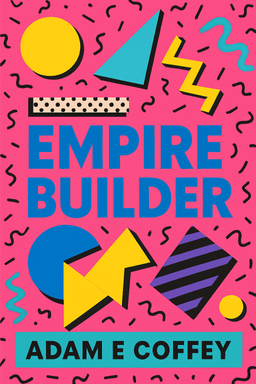
Empire Builder cover

Empire Builder

by Adam E Coffey

Empire Builder is a definitive guide for entrepreneurs seeking exponential growth in their businesses. Through real-world strategies and practical advice, Adam E Coffey offers a blueprint for constructing a robust business foundation, implementing strategic growth tactics, and planning effective exit strategies to achieve a billion-dollar valuation.

Building a Billion-Dollar Empire

What does it actually take to turn a simple idea into a billion-dollar enterprise? In Empire Builder: The Road to a Billion, Adam E. Coffey—a former CEO who led multiple companies to billions in successful exits—argues that empire building isn’t a game of luck or genius. It’s a repeatable process grounded in disciplined planning, servant leadership, private equity strategy, and relentless operational execution. He contends that any entrepreneur, regardless of industry, can build an empire if they follow the right formula and learn to think like elite CEOs rather than small business owners.

Coffey’s approach demystifies the path from startup to scale, teaching leaders how to go from $0 revenue to $1 billion and beyond. The book blends his lessons from building companies for nine private equity sponsors with the mindset and systems that actually drive exponential growth. He shares what he learned in the U.S. Army, as a pilot and engineer, and later at General Electric under legendary CEO Jack Welch—all experiences that shaped his philosophy that leadership, culture, and planning are the bedrock of any lasting empire.

From Dreamer to Builder

Coffey begins with a truth many entrepreneurs overlook: everyone starts with a dream, but most never turn that dream into a sustainable reality. His mission is to equip you to beat the odds—especially since 65% of small businesses fail within ten years. He believes the difference between failure and scaling lies in learning how to plan strategically and manage growth methodically. Drawing from his decades of experience and fifty-eight acquisitions, Coffey builds the argument that empire builders don’t shoot from the hip—they chart their course before takeoff.

The Empire-Building Roadmap

He outlines a structured roadmap that spans four sections, each building logically upon the last. First, you lay the foundation—learning to build what you know, manage for culture instead of just revenue, and understand private equity. Second, you master the basic tools—bending the growth curve upward, leveraging organic growth levers like price, volume, and pivoting, and driving margins higher through technology and smarter operations. Third, you unlock advanced tools like mergers and acquisitions and create a system of strategy and management that connects people and initiatives to measurable outcomes. And finally, you monetize your asset, selling strategically for maximum value, not once but multiple times.

Why Mindset Matters

Underlying every concept is Coffey’s belief that success begins in the mind. He challenges readers to drop limiting beliefs and adopt a mindset of urgency and continuous improvement. Empire building isn’t about volume—it’s about intention. He teaches that a 10% growth rate may sound fine, but it’s not empire-building material; instead, you should aim for a 30% compound annual growth rate (CAGR), which can double your business in under three years. That kind of growth requires discipline, not magic—learning to systematize discovery, create measurable initiatives, and empower teams to act with precision.

Learning from the Trenches

The book does not read like an academic manual—it’s a field guide full of war stories. Coffey recounts how serving in the military taught him servant leadership; being a pilot ingrained in him the necessity of planning before flight; and working under Jack Welch taught him the power of measurement systems and strategic initiatives. His transition to private equity-backed CEO work showed him how empires are truly built—with disciplined acquisitions, strong culture, and relentless implementation of operating levers that scale results.

A Blueprint for Any Entrepreneur

Coffey’s message is simple but profound: empire building isn’t just for Silicon Valley unicorns or Wall Street titans. It’s for the entrepreneur mowing lawns, the leader running a local service company, or the founder buying their first small business. Using tools like private equity partnerships, buy-and-build strategies, and data-driven decision-making, any determined business owner can climb from startup to empire status. By the end of the book, you’ll see that building a billion-dollar company is less about genius and more about mastering systems of growth, leadership, and monetization—all while cultivating a culture that makes both employees and customers proud to belong.

In a world where most small businesses get stuck and few reach the extraordinary, Coffey’s Empire Builder stands as a detailed, actionable manual for those brave enough to scale boldly and sell wisely. It’s about learning how to build an empire one decision, one acquisition, and one cultural foundation at a time—and then knowing exactly when to cash in your chips and rebuild bigger than ever.


Build What You Know

Coffey’s first principle of empire building is stunningly simple: build what you know—and what people truly need. Drawing from Warren Buffett’s famous advice to “never invest in something you don’t understand,” Coffey reinterprets it for entrepreneurs as “build what you know people need.” The idea isn’t just about comfort zones; it’s about aligning your business with enduring demand instead of fleeting trends. Empires rise on fundamentals, not fads.

Needs vs. Wants: The Stability Principle

Coffey emphasizes the critical distinction between needs and wants. Needs—like clean water, healthcare, or insurance—sustain demand even during downturns. Wants—like luxury goods or trendy apps—can evaporate with the next economic dip. He illustrates this through his time as CEO of Wash Multifamily Laundry Systems, a company operating 600,000 washing machines in 70,000 locations. During the 2008 recession, people lost jobs but still did laundry; revenue fell only 8%, and recovery was swift. That resilience proves the business served a need, not a want.

Choosing the Right Industry

To apply this principle, Coffey tells readers to seek service industries that meet persistent needs and are highly fragmented—places where thousands of small players compete locally. He calls this the “phonebook test”: open a phonebook to a category (like landscaping or plumbing) and see endless small names—proof of fragmentation. Fragmented markets offer rich opportunity for the buy-and-build strategy later in the book. You can roll up smaller competitors, expand regionally, and capture economies of scale.

The Four Criteria of Empire Businesses

  • They serve essential needs rather than consumer wants.
  • They operate in fragmented industries with high acquisition potential.
  • They generate recurrent revenue streams—like subscriptions or contracts.
  • They rely on low or medium complexity that scales through repeatable systems.

Examples include landscaping, janitorial services, and property maintenance—industries where work recurs regularly and skill requirements are moderate, allowing fast replication.

Build, Buy, or Both

Coffey gives entrepreneurs two paths to start the empire: build from scratch or buy an existing business. Building allows control, but buying reduces risk since you can analyze performance, customers, and financials upfront. He shares tools like Grata, PrivSource, and PitchBook for researching potential acquisitions and stresses the value of developing a clear investment thesis to guide your hunt. Real success comes from proprietary deals—finding and directly negotiating with businesses before competitors do.

Creative Financing and Leverage

Financing is where empire builders separate from dreamers. Coffey shares a personal example: buying an insurance agency for $4 million using a mix of seller notes, private equity, and borrowed funds. He and his brother only invested $1 million in equity but repaid debt in four years and sold for $12 million. The key lesson: smart capital structure creates outsized returns. Empires rise not just on what you build, but on how you fund.

In essence, “build what you know” is less a slogan than a survival manual. Align your business with essential human needs, pick industries ripe for consolidation, secure steady revenue through contracts, and scale intelligently with borrowed resources. Do that, and you’ll have laid the foundation for a business that not only endures recessions but commands premium valuation when it’s time to sell.


Culture: The Foundation of Growth

Every empire stands or falls on culture. Coffey insists that revenue is just a symptom; culture is the cause. Entrepreneurs often obsess over top-line numbers, but he argues that revenue is unmanageable from the top—it emerges from engaged people executing passionately at the bottom. As he puts it, “manage for culture, not revenue.”

The Correlation Between Culture and Revenue

Coffey’s formula is straightforward: engaged employees lead to better customer service; happy customers lead to repeat business; repeat business leads to growth. Toxic organizations invert this relationship—unhappy employees neglect clients, driving customer churn. His experiences turning around companies with 3,000 employees prove that leadership’s job is not to chase numbers but nurture the soil so growth happens naturally.

The Four-Legged Stool of Magnet Employers

  • Fair wages that make employees feel valued.
  • Excellent benefits shared across all levels of the organization.
  • Robust retirement options that show long-term care.
  • Opportunities for growth so ambition has room to rise.

Forget perks—these four legs build stability that keeps talent from wandering. Coffey’s most dramatic turnaround dropped annual turnover from 42% to the low teens within 18 months by implementing these principles.

Transparency and Leadership Discipline

Coffey borrows from military leadership, insisting that leaders “don’t get to have a bad day.” Emotions ripple downward; negativity poisons culture. He advocates for transparency—holding town halls where CEOs share revenue, EBITDA, and goals with all employees. This openness transforms workers from spectators into participants in the company’s mission. (Simon Sinek’s Leaders Eat Last echoes this sentiment: people thrive when they trust leadership.)

Data-Driven Accountability

To sustain a culture that drives revenue, Coffey pairs compassion with measurement. Every employee should know their metrics and how hitting their targets benefits them personally—whether through better tools, training, or advancement. Data becomes a mirror for personal accountability, not punishment.

Empires are magnetic ecosystems. When employees feel safe, valued, and inspired, they attract more talent and customers naturally. Coffey’s “four-legged stool” is far more than an HR concept—it’s the scaffolding that lets you scale to a billion with stability instead of burnout.


Scaling Through Stages of Growth

How does a business evolve from startup to empire? Coffey delineates four stages every company must pass—each demanding different leadership behaviors, capital structures, and mindset shifts. His rule: get small right before you get big. Scale chaos only compounds chaos.

Stage 1: $0–$1 Million – Master Unit Economics

Most small businesses fail here because they ignore the math. Coffey walks through a landscaping example where each two-person crew costs $126,000 per year and earns $198,000 revenue—creating a viable profit margin of 16%. The lesson: before scaling, prove profitability at the smallest unit level. Perfect one truck, one crew, one product before multiplying.

Stage 2: $1–$10 Million – Replicate Success

Once you nail the formula, replication—not reinvention—drives scale. Simply multiplying the proven economic unit expands margin predictably. Coffey highlights introducing ancillary services (like sprinkler repair or lighting) to upsell existing customers and leverage operating scale—an idea akin to Peter Drucker’s principle of “innovate systematically.”

Stage 3: $10–$100 Million – Expand Geography

Here, you extend into new markets. Expansion isn’t random; it must be adjacent and manageable—like moving from Dallas to Houston, not Dallas to London. Coffey recommends promoting a trusted lieutenant to lead each branch—a “duplicate of early you”—ensuring operational DNA is transplanted intact.

Stage 4: $100 Million–$1 Billion – From Player to Conductor

The final phase demands letting go of micromanagement. Coffey calls this the shift from first-chair player to conductor. Growth past $30 million overwhelms personal bandwidth; now you must orchestrate through empowered executives and robust processes. Bringing in private equity partners accelerates expansion and gives access to near-unlimited capital. He humorously adds: “Why sell once when you can sell five times?”—the hallmark of serial empire builders who profit repeatedly via structured exits.

Each stage builds on the previous with military precision. Understanding your current level prevents overreach and ensures you’re scaling structure, not chaos—a disciplined evolution from entrepreneur to empire architect.


Private Equity: The Empire’s Accelerator

Private equity (PE) is Coffey’s secret weapon—the financial engine that accelerates growth beyond the limits of personal capital. He calls PE the world’s largest source of non-bank money, with over $5 trillion under management and controlling half of all business transactions globally. Understanding how it works lets you harness institutional power to scale faster and sell smarter.

The Private Equity Pyramid

Coffey introduces the PE Pyramid: small funds (under $1 billion) buy companies earning $0–$15 million EBITDA; mid-size funds buy $15–$50 million EBITDA companies; and only a few mega funds chase billion-dollar enterprises. As companies grow, larger funds pay higher multiples because big, stable assets are rarer. Smart empire builders climb this pyramid one sale at a time—selling upstream, cashing out partially, reinvesting, and using PE money to fuel bigger growth.

The Flow of Money

PE firms collect money from institutional investors (limited partners) and invest through fund managers (general partners). Investors commit funds to a ten-year lifecycle. The firm calls capital to buy businesses, improves them, sells them, and returns profits—charging a “2 and 20” fee (2% annual management, 20% of profits). Understanding these mechanics reveals how PE builds wealth through leverage, time, and scale rather than direct ownership.

Leveraging PE Relationships

The true magic of PE isn’t money—it’s access. Coffey shows how partnerships with PE firms unlock lender networks, acquisition pipelines, and professional boards. He emphasizes that riding PE’s coattails can yield far better outcomes than clinging to 100% control. In his career, partial exits allowed him repeated paydays with each resale, multiplying wealth by compounding capital rather than effort.

PE turns entrepreneurs into empire owners. By understanding its pyramid, fees, and flow, you can time exits strategically, attract capital intelligently, and ensure your empire keeps climbing through successive buyouts rather than hitting a growth ceiling.


Supercharging Growth and Margins

To build a billion-dollar business, Coffey reveals two core levers: organic growth and margin enhancement. Growth bends the curve upward; margin keeps you profitable enough to keep climbing. Together, they form the mechanics of scalability.

Four Organic Levers

1. Price: Raising prices puts pure profit on the bottom line. Yet few companies manage pricing intentionally. Coffey’s turnaround at Wash showed how detailed price models based on data—polynomial regressions considering fuel costs, unemployment, and geography—boosted growth dramatically. Make someone responsible for price, test constantly, and let metrics guide adjustments.

2. Volume: Sell more at the better price. Audit your sales strategy, enhance online presence, and distinguish “hunters” (new customer acquisition) from “farmers” (customer retention) in your salesforce.

3. Pivoting: Expand into adjacent products or services. When Coffey led CoolSys, a refrigeration firm dependent on grocery chains (a red ocean), he pivoted into blood banks and data centers (blue oceans) by acquiring HVAC and engineering firms—growing in less price-sensitive markets.

4. Tiering: Offer multiple versions (good-better-best), just like Mercedes’ S-, E-, and C-classes. Tiering expands your total addressable market while defending premium pricing.

Five Margin Enhancement Strategies

  • Use operating leverage: buy in volume to lower unit costs.
  • Apply technology to automate low-value tasks and maximize productivity.
  • Challenge the status quo—question outdated procedures (“Why 500 keys when one will do?”).
  • Adopt a flatter structure with no more than five management layers and a 30:1 employee-manager ratio.
  • Work on the business, not in it—create teams dedicated to process improvement.

Each tactic compounds efficiency, ensuring that every extra dollar of sales translates into stronger net results. Coffey stresses continuous improvement—a mindset mirrored by Toyota’s kaizen or GE’s Six Sigma culture.

Mastering these tools transforms marginal companies into unstoppable growth machines. If chapter one is about starting smart, this chapter is about scaling relentlessly—one lever, one margin gain at a time.


M&A: The Buy-and-Build Machine

When organic growth plateaus, Coffey unveils the empire builder’s next weapon: mergers and acquisitions (M&A), known as “buy-and-build.” It’s how mature companies leap from millions to billions—combining many smaller firms into one integrated powerhouse.

The Power of Arbitrage

He explains multiple arbitrage: when you buy small companies at low valuation multiples (say 5x EBITDA) and merge them into a larger entity valued at higher multiples (say 13x). Coffey’s personal example—buying 23 businesses at 5x and selling the combined company for 13x—created $368 million in profit, fully financed through debt. That’s the math behind empire-level wealth.

Eight Stages of M&A

  • Sourcing – Identify all potential targets.
  • Outreach – Contact owners to gauge interest.
  • Filter – Apply strict criteria to avoid “Shiny Penny Syndrome.”
  • LOI – Offer a Letter of Intent defining terms.
  • Diligence – Verify financials and compliance (“the proctology exam”).
  • Contracts – Finalize legally binding agreements.
  • Funding – Arrange financing via banks, equity, or sellers.
  • Integration – Combine operations and optimize efficiencies.

Convincing Founders to Sell

Empire builders must master persuasion. Coffey frames acquisitions as opportunities for founders to diversify wealth, not surrender autonomy. By rolling over 30% of proceeds back into equity, sellers get a “second bite of the apple” when the merged company sells again. His case study of an insurance agency founder who sold for $16 million but earned a second $17 million later dramatizes that power.

Buy-and-build requires discipline, strategy, and empathy—but done right, it lets you climb the valuation pyramid in leaps instead of steps. It’s the difference between running a firm and commanding an empire.


Strategy and Management Systems

Jack Welch taught Coffey that business demands systems: strategy, measurable initiatives, and disciplined management. Sandy Ogg later expanded that model by connecting talent directly to value creation. Together, their frameworks form Coffey’s empire-level management playbook.

Connecting Talent to Value

Traditional planning focuses on goals, but Coffey argues every goal needs the right people executing it. Assigning a star performer with proven situational experience beats generic leadership. For instance, hiring a VP of Sales with experience integrating different company cultures after M&A drives results unmatched by hiring any sales veteran.

The Conference Table System

Picture your key initiatives as conference tables—organic growth, margin improvement, acquisitions, new market entry. At each table sit the people most instrumental to that initiative. Only five or six initiatives should run at once. Identify who bends the growth curve—usually a small subset of your workforce (Coffey found only 22 out of 3,000 employees truly drove change). Empower them, give them executive sponsors, and treat them as strategic assets to retain long-term.

Using the Bridge Tool

To visualize progress, Coffey relies on the “bridge tool”—an Excel-based visual showing how each initiative contributes to EBITDA or enterprise value over time. An example five-year bridge shows growth from $70 million to $259 million EBITDA through organic levers, M&A, and margin gains. Scaling this model to any size (even an $84,000 business) helps leaders quantify forward progress.

Cadence and Scorekeeping

Every table must adopt a cadence—weekly or monthly reviews—with key performance indicators measured consistently. Coffey uses a traffic-light scorecard: green for high performance, yellow for watch, red for urgent action. A yellow dock means reduce target by 25%, red by 50%. This accountability loop guarantees continuous improvement.

By systematizing strategy and connecting people to measurable outcomes, Coffey transforms complex operations into predictable machines for scaling. This disciplined structure turns ambition into architecture—the invisible framework behind every true empire.


Monetizing and Selling the Empire

After you’ve built and scaled, Coffey closes with the empire builder’s final test: selling smart. This isn’t retirement—it’s replication. Selling turns value into cash, resets risk, and fuels your next empire. The secret lies in timing, preparation, and presentation.

Branding for Premium Value

Buyers pay more for sizzle. Coffey likens great branding to the Apple box—beautiful, magnetic, and emotionally resonant. He recounts rebranding every company he led, including changing “Web Service Co.” to “Wash Multifamily Laundry Systems.” Customers didn’t notice the name change, but buyers did—the refreshed identity added an extra 1x multiple at sale, equating to $100 million on a $100 million EBITDA company. Rebrand when your name confuses, your reputation suffers, or your growth stagnates.

Choosing the Right Exit Path

Coffey’s “Rule of 130” determines timing: your age plus the percent of net worth tied to the company equals 130 or more? Time to sell—or risk losing everything. Decide between strategic buyers (other companies executing synergy plays) and financial buyers (private equity firms seeking ROI). Strategic buyers may “turn the lights off” and absorb your business; financial buyers usually “keep the lights on,” retaining you to grow the platform. Each offers different paydays and roles.

Preparing for Sale

Getting maximum value requires impeccable preparation. Clean your financials and use a “sell-side quality of earnings” report to show true profitability. Separate real estate holdings—they complicate deals. Craft a compelling growth story that highlights scalability, resilient performance, and acquisition potential. Buyers pay more for runway than mere history.

Assembling the Professional Team

No one sells alone. Coffey insists on hiring four key experts: a skilled accountant, a tax advisor, specialized legal counsel, and an investment banker or broker. The banker orchestrates every step—from teaser documents and fireside chats to negotiations—maintaining competitive tension among bidders for top price. He warns founders to stay sharp during dinners with buyers: one careless remark after a few drinks can leak weakness and cost millions.

Selling well isn’t an end—it’s acceleration. Coffey’s own record proves serial exits compound wealth faster than steady ownership. Each sale funds new growth, new acquisitions, and new empires. When you sell smart, the journey doesn’t stop—it scales exponentially.

Dig Deeper

Get personalized prompts to apply these lessons to your life and deepen your understanding.

Go Deeper

Get the Full Experience

Download Insight Books for AI-powered reflections, quizzes, and more.