
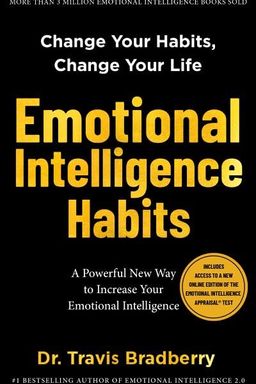
Emotional Intelligence Habits cover

Emotional Intelligence Habits

by Travis Bradberry

Emotional Intelligence Habits by Travis Bradberry is your essential guide to mastering the EQ skills that lead to personal and professional triumph. Discover 35 transformative habits and practical exercises that elevate your emotional intelligence, paving the way for a balanced, successful life.

Emotional Intelligence as the Foundation of Human Effectiveness

How can you manage your emotions, connect with others, and perform at your best under pressure? In Emotional Intelligence 2.0, Travis Bradberry argues that emotional intelligence (EQ) — the ability to recognize, understand, and manage emotions — predicts success more accurately than IQ or technical skill. He presents EQ not as a fixed trait but as a set of habits that reshape the brain’s emotional circuitry through practice.

The Biology Behind EQ

Bradberry begins with the story of Phineas Gage, whose accident destroyed parts of his prefrontal cortex and turned a calm leader into an impulsive, unreliable man. The case shows how emotion and reason must communicate across the brain’s limbic system and cortex. All sensory data enters through the emotional centers before reaching the rational centers, meaning you feel before you think. EQ measures how smoothly these systems communicate. Repeated practice in managing emotion actually strengthens neural connections — the brain’s plasticity lets you build new 'lanes' between emotional and rational functions.

Four Core Skills

EQ unfolds in four interlocking skills. Two focus on yourself: Self-Awareness (recognizing emotions as they arise and understanding their triggers) and Self-Management (choosing rational, goal-oriented responses). Two focus on others: Social Awareness (reading emotions and social dynamics) and Relationship Management (using all three previous skills to communicate, resolve conflicts, and sustain connection). These are not abstract concepts — they appear every time you pause before reacting or empathize with a colleague before replying.

EQ Habits: How Practice Builds Pathways

You learn EQ through repetition, not theory. The author frames habits as practice loops: 1) Notice and label emotions, 2) Pause, 3) Choose an alternative action, and 4) Repeat until it becomes reflex. Because neurons can grow thousands of new connections, every cycle of self-regulation or empathy physically reinforces emotional circuits. Over time, labeling anger before speaking, reframing stress positively, or listening instead of interrupting becomes automatic. EQ is learned behavior encoded into the brain’s wiring.

Stress, Happiness, and Resilience

Stress erodes EQ if chronic but strengthens it when intermittent. Short bursts can trigger growth and focus, while continuous stress shrinks self-control regions. Bradberry’s advice is biological: protect sleep, use breathing and gratitude to lower cortisol, and design recovery routines. Happiness also functions as a trainable habit, not luck — only 40% of well-being depends on controllable habits. Gratitude, social connection, savoring experiences, and limiting comparison all raise your emotional 'set point.'

EQ in Life and Leadership

EQ governs more than mood — it drives leadership, communication, productivity, and resilience. Leaders who blend empathy with accountability cultivate loyal, high-performing teams. Mindfulness rewires brain regions that improve focus and creativity. Productive routines protect attention from overload. Even decision quality and intuition rest on emotional clarity. The book’s claim is radical yet practical: if you can manage emotion at all levels — personal, social, and organizational — you reshape how you think, work, and lead.


Mastering the Four Core EQ Skills

Bradberry frames EQ as a system of four teachable abilities: self-awareness, self-management, social awareness, and relationship management. Each builds on the previous. Personal competence begins with recognizing your own emotions; social competence extends that recognition to others.

Self-Awareness

You develop self-awareness by naming feelings as they occur. Only about one-third of people can reliably do this. Pausing to ask, “What am I feeling?” before reacting activates the prefrontal cortex, the part responsible for reasoning. Over time, you learn how patterns of frustration, fear, or excitement influence your choices. (Note: Daniel Goleman’s work complements this, arguing awareness precedes regulation.)

Self-Management

Once you know your emotions, you decide how to act. Self-management is the ability to align reactions with your long-term goals. Common tactics include breathing, reframing, delaying responses, and grounding yourself in values. High self-management shows as composure under stress and consistency under pressure.

Social Awareness

Social awareness means tuning your attention outward. You watch facial expressions, posture, tone, and emotional subtext instead of your own inner narrative. Like an anthropologist, you gather cues without judgment. This is empathy in practice — not projecting your feelings but understanding theirs.

Relationship Management

The final stage combines all three previous skills. When tension rises, you identify your reaction, manage it, see the other person’s state, and then respond to improve connection. Conflicts become opportunities for learning rather than battlefields. Bradberry’s example of workplace conflict—pausing, naming emotions, then asking clarifying questions—illustrates EQ in motion. These four skills together define how effectively you lead, collaborate, and maintain trust.


Building Habits That Strengthen Emotional Intelligence

Emotional intelligence grows through practice. Bradberry suggests treating EQ as a set of micro-habits that, through repetition, become neural defaults. Consistent action builds mental muscle—the same principle that underlies physical training.

The Neural Highway Metaphor

Emotion and reason travel a two-way road across the brain. Early in training, traffic jams—impulsive reactions—are common. But every time you pause to reframe anger or listen before speaking, the road widens. Neurons form new connections, making it easier next time. You literally build lanes for better regulation.

Small Repetitions, Large Results

Small daily practices—naming emotions, breathing before responding, reframing stress—create measurable change. These form feedback loops: trigger → awareness → alternative action → reinforcement. Bradberry cautions that progress is gradual; the first five seconds of awareness can be powerful enough to change outcomes when repeated hundreds of times.

Choosing Where to Start

Focus on one limiting area first, whether stress, confidence, or toxic relationships. Use EQ appraisal tests to measure improvement and track habit growth. Bradberry insists that you start small—daily repetition outperforms sporadic intensity. EQ mastery isn’t instant—it’s the cumulative outcome of thousands of mindful behaviors.


Stress, Resilience, and Happiness as EQ Outcomes

Bradberry structures emotional strength as the ability to thrive under pressure and maintain happiness independent of circumstance. He distinguishes between intermittent stress—short bursts that build resilience—and chronic stress, which corrodes self-control regions of the brain.

Managing Stress Biologically

Simple habits have measurable effects: gratitude reduces cortisol; sleep restores cognitive control; breathing slows the amygdala’s panic signals. Exercise increases GABA and endorphins, creating sustainable calm. Even weekend routines matter—structured downtime renews attention and energizes creativity.

Training Resilience and Recovery

Resilience develops when you deliberately loop between stress and recovery. Overwork breaks that cycle. Bradberry urges intentional pauses—tech breaks, outdoor activity, time off. This isn’t indulgence but maintenance of EQ capacity itself.

Happiness as Habit

Drawing from Sonja Lyubomirsky’s research, Bradberry notes that 40% of happiness is habit-controlled. Practices like gratitude journaling, surrounding yourself with positive people, savoring moments, and spending on experiences—not possessions—generate sustained well-being. EQ enables those habits because awareness and self-management redirect attention from scarcity to appreciation. Happiness, he concludes, is a skill of focus, not luck.


Self-Control, Anger, and Mental Strength

Emotional control underpins every EQ skill. Bradberry blends neuroscience and psychology to show how impulse control, anger regulation, and mental toughness improve when you practice self-restraint and constructive thought.

Habits That Build Control

Five core habits nurture discipline: meditation (enhances attention), steady nutrition (stabilizes glucose for impulse control), proper sleep (restores executive function), “riding the wave” (waiting before acting), and self-forgiveness (prevents relapse). These practical tools convert emotional surges into deliberate responses.

Understanding Anger’s Funnel

Bradberry explains that anger often masks deeper emotions like fear or shame. When you label the root emotion, anger dissipates. For example, fear when cut off in traffic transforms quick fury into understanding. Identifying hidden triggers turns reactive behavior into insight.

Cultivating Grit and Mental Strength

Drawing on Angela Duckworth’s grit research, he reframes mental toughness as persistence through imperfection. You grow stronger by repeatedly doing difficult things—making hard calls, accepting mistakes, and practicing humility. Mental strength is less about armor and more about adaptability built through conscious effort.


EQ in Decisions, Leadership, and Communication

At higher levels of responsibility, EQ governs decisions, leadership, and communication. Bradberry extends EQ from personal management to organizational influence, showing how it reduces error and enhances persuasion.

Making Better Decisions

Decision fatigue and bias erode judgment. Routine small choices free bandwidth for major ones. Emotionally intelligent decision-makers balance intuition and evidence—trusting gut signals but validating them with data. Awareness of biases like confirmation or planning fallacy prevents distortion.

Leading with EQ

Leadership emerges through habits, not hierarchy. Great leaders like Eugene Kranz in Apollo 13 modeled calm conviction; their teams mirrored that emotional steadiness. Daily leadership habits—sharing context, balancing people and results, removing bureaucracy—turn influence into trust. EQ transforms managers into mentors.

Communicating and Resolving Conflict

Communication is where EQ lives. You listen actively, avoid defensiveness, ask clarifying questions, and use stories plus data to persuade. Virtual messages require tone awareness: cool drafts before sending, avoid sarcasm, maintain clarity. Mastering conflict means being assertive without aggression—speaking truth with empathy. These skills align emotion with expression.


Mindfulness and Purposeful Growth

Mindfulness underwrites all EQ growth. Bradberry integrates neuroscience findings: regular mindfulness strengthens the anterior cingulate cortex and hippocampus—regions tied to attention and stress resilience. You gain self-control and clarity by practicing intentional presence.

Practical Techniques

Simple behaviors—two minutes of breath focus, walking meditation, body scans, or affirmations—interrupt stress loops. These micro-pauses recalibrate reactions. The paradox holds true: the busier you are, the more you need to slow down.

Motivation and Growth Mindset

Motivation follows awareness and purpose. Success redefined as growth and relationships, not possessions, removes chronic frustration. Stepping outside comfort zones builds courage. Asking reflective questions—'What would I do if I weren’t fearful?'—turns hesitation into momentum. (In Carol Dweck’s research, this parallels the growth mindset principle.)

Designing Workplaces That Support EQ

Organizations thrive when leaders replace micromanagement with autonomy. Netflix’s and Semco’s trust-driven cultures prove that flexibility plus accountability boosts loyalty and creativity. Humane workplace design—fair rules, recognition, honest communication—amplifies individual EQ across the system. In the end, mindfulness and purpose connect daily action to long-term emotional success.

Dig Deeper

Get personalized prompts to apply these lessons to your life and deepen your understanding.

Go Deeper

Get the Full Experience

Download Insight Books for AI-powered reflections, quizzes, and more.