
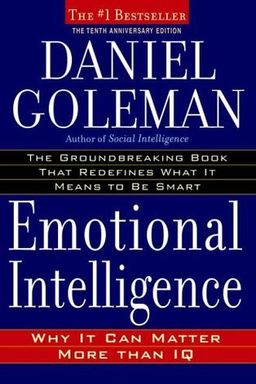
Emotional Intelligence cover

Emotional Intelligence

by Daniel Goleman

Emotional Intelligence by Daniel Goleman unveils the power of emotions in shaping our lives. It challenges the traditional focus on IQ by highlighting emotional intelligence as a key factor for success, health, and fulfilling relationships. Discover strategies to enhance your emotional skills and transform your life.

Emotional Intelligence: The Missing Key to Success

You may have been taught that success depends mostly on intellect—IQ, grades, or technical skill. Daniel Goleman’s Emotional Intelligence argues otherwise. He shows that how you understand, manage, and express emotions determines whether your intellect truly serves you. Emotional intelligence (EI) is not mere sentiment; it is a set of learned competencies—including self-awareness, self-regulation, empathy, motivation, and social skill—that shape life outcomes in families, workplaces, schools, and even national health statistics.

Why emotions matter beyond IQ

IQ contributes only about twenty percent to success on average; the rest depends on emotional skills that translate inner stability into outer performance. Goleman tells vivid stories—a frantic father shooting his daughter after mistaking her for an intruder, and parents pushing their wheelchair-bound daughter to safety during a flood—to reveal that emotion drives action. Whether love or fear, anger or empathy, these forces steer behavior faster than rational thought. Emotional intelligence teaches you to harness those impulses wisely rather than be ruled by them.

The emotional brain: two minds in one

Your brain runs two parallel systems: the ancient emotional brain and the recently evolved rational brain. The limbic system reacts instantly, while the neocortex reflects slowly. That architecture explains why “amygdala hijacks” occur—moments when raw emotion overwhelms reason. Neuroscientist Joseph LeDoux discovered a fast neural path from the thalamus to the amygdala, allowing fear and rage to flare before the cortex finishes processing. Emotional intelligence therefore requires activating the “cortical brake”—the prefrontal regions that manage impulse and reappraise meaning.

The five skills that make emotion work for you

Psychologists Peter Salovey and John Mayer originally modeled EI as five domains: knowing your emotions, managing them, motivating yourself, recognizing emotions in others, and handling relationships effectively. Goleman’s expansion of this model made it actionable. Self-awareness lets you identify what you feel; self-regulation keeps destructive urges in check; motivation transforms emotion into sustained effort; empathy allows connection; and social skill lets you influence and repair relationships. Together, these shape character and competence.

Emotion, ethics, and education

Goleman insists that EI can be taught—and should be. Emotional competence predicts not just personal success but civic well-being. Impulse control underlies moral behavior; empathy sustains compassion. Schools that teach children to manage frustration and read others’ feelings report lower aggression and higher achievement. In families, emotionally coaching parents help kids develop resilience, while neglect or abuse blunts empathy and fosters aggression. Emotion, far from being private, is a social force shaping collective health.

Health, relationships, and survival

Emotional habits also reach into medicine. Chronic stress, anger, or depression measurably harm immunity and cardiovascular function, while supportive relationships lengthen survival for heart patients and cancer patients alike. Anger spikes blood pressure and damages arteries; despair shortens recovery; social isolation doubles mortality risk. Emotional self-regulation, empathy, and connection thus become literal healthcare tools—what Goleman calls “social support as medicine.”

Plasticity and change: you are not stuck

Although temperament sets early tendencies—some children are timid, some bold—experience and learning can rewire emotional circuits. Jerome Kagan’s work shows shy infants can grow confident if parents gently encourage mastery. Richard Davidson’s EEG studies show left-frontal activity (linked to positive mood) can expand through mindfulness or therapy. Childhood offers powerful windows for emotional education, yet adults retain plasticity: focused practice and relationship repair can change even ingrained patterns.

Core message

Thinking alone is not enough. Success in life, health, leadership, and love depends on knowing what you feel, managing what you feel, sensing what others feel, and acting wisely in that shared emotional space.

In synthesis, Goleman’s evidence—from brain scans to classroom programs—makes emotional intelligence a scientifically grounded framework for thriving. You can strengthen it like any skill, and doing so reshapes both your private experience and the social fabric around you.


The Emotional Brain in Action

Goleman builds his case on a simple neuropsychological truth: you have two operating systems—the emotional and the rational mind—constantly negotiating control. The emotional mind evolved first, running fast and automatically to preserve survival. The rational mind evolved later, capable of language, planning, and abstraction. Though they cooperate most of the time, emotion can quickly override reason through the amygdala’s shortcuts.

Amygdala hijack: when emotions overrun thought

LeDoux’s experiments revealed that sensory data reach the amygdala milliseconds before the neocortex interprets them. That means you can fear, rage, or act before you understand. During an amygdala hijack, hormones surge, attention narrows, and memory stamps the event vividly. Whether it is a parent reacting to a noise with tragic consequences or a citizen in panic, unchecked emotion usurps rational control. Building EI means noticing bodily cues—tight chest, racing pulse—and using techniques like deep breathing or pause rituals to reactivate the prefrontal brake.

Emotion as evolutionary guidance

Each emotion is an urge to act: fear mobilizes flight, anger mobilizes attack, love motivates bonding. Our ancestors survived by following these hardwired signals. In modern life, however, these automatic patterns demand reinterpretation. Emotional intelligence trains the brain’s higher layers to translate ancient impulses into appropriate modern responses—turning fear into preparation rather than avoidance, and anger into assertive communication instead of aggression.

Reeducating emotional circuitry

Repeated practice—through therapy, mindfulness, or feedback—rewires these circuits. Neuroplasticity means deliberate emotional training changes actual neural pathways. For instance, trauma victims relearn safety by pacing exposure and narrative reconstruction; therapists help them engage the cortex to suppress the amygdala’s hijack reflex. Over time, rational control strengthens, reducing flashbacks and intrusive emotions. You learn not to erase past feelings but to manage their intensity and duration.

Practical takeaway

Emotional mastery begins with awareness of which mind is at the wheel. When upset, step back and target the body first—calm breathing and muscle relaxation signal the cortex to reengage reasoning. Only then can meaning shift and emotion transform.

Understanding the emotional brain empowers you to choose responses rather than react blindly. It also explains why teaching EI to children or teams succeeds: it literally trains the brain to integrate feeling and thought, the essence of adult maturity.


Self-Awareness and the Language of Feeling

To cultivate emotional intelligence, you must start with awareness—knowing what you feel and why. Goleman calls this “metamood”: the ability to notice emotions as they happen. Without that awareness, you are either engulfed (flooded by emotion) or detached (passively observing without change). Self-awareness creates the observing ego that allows freedom to choose responses instead of repeating patterns.

Why naming feelings matters

People who cannot articulate their emotions suffer alexithymia—literally “no words for feelings.” Goleman’s example of Gary, the brilliant surgeon who couldn’t empathize, shows intellectual competence without emotional connection. Antonio Damasio’s case of Elliot proves the same principle neurologically: despite intact logic, Elliot made disastrous life choices after losing his ability to feel “gut” signals. Somatic markers—bodily sensations guiding judgment—are essential for sound decisions.

Building emotional vocabulary

Language expands awareness. Journaling, therapy, or mindful reflection help translate vague moods into precise words—frustration, disappointment, fear—turning sensations into information. Once labeled, emotions lose their tyranny. You learn patterns (“I act rashly when anxious” or “I withdraw when sad”) and can intervene earlier. Emotional literacy therefore precedes emotional mastery.

Practical development

  • Pause periodically and ask: What am I feeling? Why? What bodily signals accompany it?
  • Label emotions specifically rather than vaguely (“irritated” versus “bad”).
  • Record recurring emotions to track triggers and progress over time.

Core lesson

Self-awareness opens the door to self-regulation. Without naming what you feel, every choice remains unconscious reaction.

In sum, emotional understanding begins with introspection. Knowing thyself is not ancient philosophy alone—it is a modern skill with measurable effects on success, relationships, and mental health.


Impulse Control, Motivation, and Flow

Goleman calls self-management—the regulation of impulse and motivation—the “master aptitude.” It underpins persistence, creativity, and achievement. Studies from Walter Mischel, Martin Seligman, and Mihaly Csikszentmihalyi reveal how emotional discipline and positive mood shape lifelong success.

Impulse control: learning patience

The marshmallow test showed that children who could wait for rewards were more competent years later. They had better social adjustment and even higher SAT scores. Teaching delay of gratification—waiting before reacting, saving before spending—is emotional muscle-building. It strengthens the prefrontal circuits that inhibit impulsive drives.

Motivation and optimism

Optimism and hope, studied by C. R. Snyder and Seligman, keep effort alive through setback. Hope adds strategy to desire; optimism frames obstacles as temporary. These emotional orientations directly enhance performance. Pessimism, conversely, drains focus and energy. Emotional intelligence training therefore boosts not only stability but productivity.

Flow: the peak performance state

Csikszentmihalyi’s “flow” describes absorption in a task where challenge matches skill and time disappears. Emotional focus makes flow possible; anxiety or boredom disrupts it. You can design work and learning to invite flow—clear goals, instant feedback, and calibrated challenge—turning emotion from distraction into propulsion.

  • Practice small delays to strengthen impulse control.
  • Cultivate hopeful thinking: review setbacks for lessons rather than defeats.
  • Seek flow through challenging but meaningful tasks.

Key message

Self-management transforms emotion from turbulence into fuel. Control, hope, and focus together create sustained excellence.

Emotional mastery is less about suppressing feeling than about redirecting it—using emotion to motivate long-term purpose and creativity rather than immediate gratification.


Empathy and the Social Arts

The outer face of emotional intelligence is empathy—the ability to read and respond to others’ feelings. Goleman traces empathy’s roots to infancy, when parents attune to a baby’s cues. Over time, this social resonance becomes the foundation for cooperation, relationship repair, and trust in adult life.

Reading nonverbal signals

Most communication is nonverbal. Robert Rosenthal’s studies show that accuracy in reading tone, face, and posture predicts popularity and effectiveness. Emotional contagion occurs subtly—your body syncs with others through mimicry and rhythm. A cheerful bus driver can uplift a crowd; a tense leader can infect a team with anxiety. Empathy therefore begins with paying attention.

Relationship repair and conflict

John Gottman’s marriage research identifies “four horsemen”—criticism, contempt, defensiveness, and stonewalling—as emotional poisons. When flooding occurs (physiological overwhelm), reasoning fails. EI skills like calming, validating, and reframing restore connection. Saying “When you do X, I feel Y, and I’d prefer Z” replaces attack with clarity. Repair attempts interrupt escalation and rebuild trust.

Compassion versus cruelty

Lack of empathy underlies violence and psychopathy—offenders who cannot feel another’s pain rationalize cruelty. Rehabilitation programs that teach perspective-taking reduce reoffense, illustrating empathy’s moral force. In families, empathetic parenting guards against that emotional blindness developing early.

Everyday application

Before solving a problem, validate emotion. People calm when they feel understood, and understanding precedes influence.

Empathy and social skill convert private emotional intelligence into public effectiveness—the difference between command and connection, between friction and belonging.


Emotions, Health, and Healing

Emotional life and physical health are deeply intertwined. Goleman compiles evidence from psychoneuroimmunology showing that chronic distress impairs immunity and increases vulnerability to disease. Simply put: the body reads emotion as physiology.

Anger and the heart

Studies at Stanford and Duke demonstrate that anger episodes reduce heart efficiency and predict future cardiac events. Hostility—a cynical, distrustful mindset—triples or quintupled mortality rates among heart patients and physicians alike. It creates arterial turbulence that fosters plaque formation. Anger management programs at Stanford lowered recurrent heart attacks by nearly half, showing that emotional retraining can literally save lives.

Stress and immunity

Sheldon Cohen’s cold-virus studies proved that stressed volunteers were twice as likely to fall ill after exposure. Caregivers and students under pressure show weakened immune resistance and slower wound healing. Stress hormones like cortisol suppress cellular defenses; relaxation and mindfulness reverse these effects.

Depression and disease outcome

Depressed patients—whether cardiac, dialysis, or cancer—show higher mortality and longer hospital stays. Behavioral neglect (missed medications) and biological changes (reduced heart-rate variability) contribute. Treating depressive symptoms improves survival and reduces healthcare costs.

Social support as medicine

Isolation doubles risk of death, while emotional support extends survival. In bone-marrow transplants, support predicted 54% versus 20% survival rates. In breast cancer, weekly support groups doubled average survival time. Social ties buffer stress pathways and promote healing, proving that relationships are physiological interventions.

Bottom line

Emotion is integral to medicine. Managing anger, anxiety, and depression—and fostering connection—is as crucial as controlling blood pressure or diet.

The fusion of emotional and physical well-being reframes healthcare: every conversation, stress level, and social bond becomes part of healing physiology.


Family and Learning Emotional Habits

Your first classroom for emotional intelligence is home. Goleman shows that children learn emotional habits—comfort, empathy, or disregard—from how adults respond in daily moments. When parents notice, label, and guide feelings, children gain self-control and compassion. When they ignore or punish emotion, children internalize confusion and aggression.

Parenting patterns that shape EI

John Gottman’s research distinguishes three damaging parenting styles: dismissive (ignore feelings), laissez-faire (no guidance), and contemptuous (mock or punish). The opposite—the coaching style—uses emotion episodes to teach. Parents help kids name the feeling, understand triggers, and find alternatives (“I know you’re angry; let’s solve it differently”). Such lessons build empathy and executive function.

Consequences of neglect and abuse

Abused toddlers often respond to peers’ distress with aggression, not care. Early cruelty extinguishes empathy and predicts later delinquency. Yet interventions that train emotional coaching break cycles of violence—parents and children alike learn regulated compassion.

Temperament and plasticity

Jerome Kagan and Richard Davidson show that temperament interacts with parenting. Shy children with overactive amygdalas grow bolder when exposed gently to novelty and boundaries. Emotional development during childhood represents a “critical period” when circuits are most malleable. Still, adults can change too—therapy can normalize brain activity just as pharmaceuticals can.

Essential takeaway

Family emotion coaching is an investment with lifelong dividends. It builds moral character, cognitive competence, and the ability to love.

Families are micro-societies teaching how to feel. Reforming emotional education at home effectively reshapes the emotional chemistry of future generations.

Dig Deeper

Get personalized prompts to apply these lessons to your life and deepen your understanding.

Go Deeper

Get the Full Experience

Download Insight Books for AI-powered reflections, quizzes, and more.