
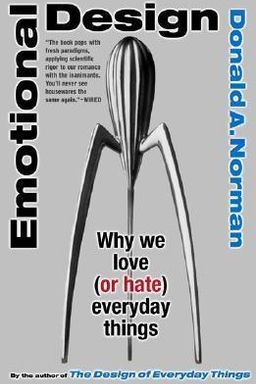
Emotional Design cover

Emotional Design

by Donald A Norman

Emotional Design by Donald A Norman explores the profound influence of design on our emotional responses to everyday objects. By examining the visceral, behavioral, and reflective levels, this book uncovers how design shapes our perceptions and memories, creating products that resonate deeply with users. It''s a must-read for anyone interested in creating meaningful, user-centered designs.

The Emotional Side of Design

Why do some objects make you smile even when they're impractical? Why do you feel frustrated with devices that work poorly, or fall in love with your car, your phone, or even your coffee mug? In Emotional Design, cognitive scientist and design thinker Donald A. Norman argues that our connection to objects—and the success of those objects in our lives—depends as much on emotion as it does on logic or utility. Norman’s central contention is simple but revolutionary: products that evoke good feelings work better.

In his earlier book, The Design of Everyday Things, Norman focused on usability—how things should be functional, intuitive, and error-free. Here, he builds on that foundation to reveal that joy, beauty, and emotion aren’t frivolous—they’re essential to good design. He challenges the old engineering mindset that treats emotion as irrational. Through examples ranging from teapots and automobiles to robots and video games, Norman shows how feelings shape our perceptions, decisions, creativity, and willingness to engage with technology.

Why Emotions Matter

Norman explains that emotion is not the opposite of reason—it’s its partner. When we interact with objects, our minds process information on three levels: visceral (immediate sensory reaction), behavioral (practical usability), and reflective (deeper meaning and self-image). An attractive coffee pot may make you smile; a well-balanced knife makes cooking pleasurable; and a gift watch may remind you of who you are. All three levels, woven together, form the full emotional experience of design. Emotions don’t simply decorate cognition—they guide it.

He begins with his own collection of teapots—a trio that represents function, beauty, and reflectiveness. One is unusable but witty, one is charmingly designed by architect Michael Graves, and one is cleverly engineered for brewing perfection. He admits he rarely uses any for his morning tea, preferring efficiency over aesthetics. But he loves what the teapots represent: stories, memories, moods, and meaning. These objects, he writes, “lighten up my day.”

The Science Behind the Smile

Behind Norman’s argument lies cutting-edge psychological and neurological research. Emotions trigger neurochemical changes that alter brain function—they affect creativity, problem-solving, and even performance. Psychologist Alice Isen found that small positive experiences (like receiving candy or watching a comedy clip) expanded people’s thinking and made them more inventive. Norman connects this research to product design: attractive things literally make people think better. When you feel good, you’re more open, tolerant, and resourceful; when anxious or frustrated, your focus narrows, and your creativity stalls. So aesthetically pleasing objects don’t just delight—they help you function more effectively.

He cites experiments showing that ATMs designed beautifully were rated easier to use than identical versions with unattractive layouts. Beauty feeds usability through emotion, not logic. When you wash and polish your car, don’t you feel it drives better? When you dress up, don’t you feel sharper? Norman insists these aren’t illusions but reflections of how emotion and cognition work together.

Design’s Three Dimensions

The heart of Emotional Design lies in its model of the three processing levels—visceral, behavioral, and reflective—which Norman intertwines throughout the book. Each level produces different pleasures and requires distinct design attention:

  • Visceral design delights the senses—it’s about immediate reactions, beauty, and form. It’s the “I want it” feeling sparked by an iMac’s colors or a Jaguar’s curves.
  • Behavioral design is about performance and usability—the pleasure of smooth function. Think of a chef’s knife that feels balanced or software that works effortlessly.
  • Reflective design speaks to meaning, culture, and self-image—why you choose a brand, cherish a keepsake, or tell stories about your belongings.

Norman’s insight is that these levels aren’t separate—they constantly interact. A gorgeous car that’s terrible to drive won’t satisfy you; a functional tool that’s ugly might frustrate you. Every design decision must balance all three.

Beyond Beauty: Ethics and Emotion

Later in the book, Norman extends emotional design into new territory—the world of robotics and intelligent machines. He predicts that future robots will need emotions to act intelligently. Just as humans rely on feelings to make decisions, robots will require emotional systems to adapt socially, avoid danger, and communicate naturally. He envisions emotional machines that sense human moods and respond empathically—making technology more humane rather than more mechanical.

Ultimately, Emotional Design is not just about products; it’s about how we live with them. Norman invites you to see yourself as a designer—whether arranging furniture, personalizing a website, or choosing a coffee mug. We shape our spaces to reflect emotion. The best design, he concludes, “is not necessarily an object—it’s a process.” And in that process, emotion is the unseen engineer.


Attractive Things Work Better

Norman opens the first major section by tackling a seemingly illogical claim: that beautiful things actually function better. This idea arose from surprising experiments in Japan, where researchers Masaaki Kurosu and Kaori Kashimura found that people rated aesthetically pleasing ATM interfaces as easier to use—even when their functionality was identical to less attractive ones. Israeli scientist Noam Tractinsky replicated the study and found the same result. The implication was startling: appearance can influence perceived usability, and maybe performance too.

The Science of Positive Emotions

To explain the phenomenon, Norman draws on the psychology of emotion and cognition. He cites researcher Alice Isen, who demonstrated that happiness broadens our cognitive scope. When you’re in a good mood, you think more creatively and handle problems more flexibly. Anxiety and stress, by contrast, narrow focus—an evolutionary trait for survival but not for innovation. So, people using attractive objects feel more relaxed, open-minded, and capable. Their brains literally work differently.

Norman translates this into design terms: when you’re frustrated with a product, you zero in on details—the cause of the problem—and become less likely to explore alternative solutions. When you feel good, you calmly look for different ways to achieve your goal. This difference means that aesthetics and emotion directly influence usability.

Three Levels of the Mind

Norman and his colleagues map the brain’s operation into three interacting levels—visceral, behavioral, and reflective. At the visceral level, reactions are fast and automatic: fear at a sudden noise, delight at a bright color. Behavioral processing controls learned skills and routine actions—like driving a car or typing. Reflective processing happens at the conscious, deliberate level, where reasoning and storytelling occur. These levels together govern how we perceive, act, and interpret design.

He uses vivid examples—such as walking across a narrow plank. On the ground, you can do it easily; raise it 30 meters high, and fear paralyzes you. The reflective brain knows the risk is the same, but the visceral brain dominates. Designers must respect this hierarchy. They can’t assume people behave rationally—they behave emotionally, first and foremost.

Mood Shapes Creativity

Designers themselves oscillate between moods of creativity and focus. Norman explains that positive affect fuels brainstorming, while mild anxiety aids refinement. When a design team jokes and plays, ideas flow freely; criticism kills that creativity. But once ideas exist, introducing deadlines and pressure can sharpen detail work. Great products, like elegant user interfaces or balanced tools, require both phases—playful ideation and disciplined execution.

The Prepared Brain

Finally, Norman describes the prepared brain—our evolutionary wiring for certain emotional triggers. Humans inherently prefer bright, symmetrical, rounded shapes, warm light, rhythmic sounds, and smiling faces. Conversely, we instinctively avoid harsh sounds, heights, darkness, and asymmetry. These reactions evolved as survival cues. Designers can harness them: make environments safe, attractive, and emotionally engaging by reflecting these deeply rooted preferences. Yet he warns that cultural variation and personality mean no single design can please everyone.

“Attractive things make people feel good, and feeling good makes people think better.”

Norman’s insight reframes beauty from luxury into necessity. Good design begins with usability, but it succeeds only when it touches our emotions.


Objects That Evoke Emotion

Beyond beauty lies memory. In part two, Norman explores how our attachment to everyday objects comes not from their looks or utility but from the stories they hold. He cites research from psychologist Mihaly Csikszentmihalyi and sociologist Eugene Rochberg-Halton showing that people’s “special possessions” evoke memories, identity, and continuity. A chair isn’t just furniture—it’s where someone held their baby, read, or lived through happy years. Emotional design therefore involves time, experience, and meaning.

Memory as Design Material

Norman looks at keepsakes and souvenirs—what the snobs call “kitsch.” Souvenirs like miniature Eiffel Towers are dismissed as cheap, but they serve a powerful emotional role. They anchor memory. He reminds readers that sentimentality isn’t a design flaw—it’s a feature. “Nobody likes kitsch—it’s too popular,” he jokes, paraphrasing Yogi Berra. When people love something because of what it represents, designers should respect that emotion rather than deride it.

He also discusses the power of photographs. While technically imperfect—blurred or faded—photos connect us to people and moments. Their appeal is emotional, not aesthetic. Norman describes digital photography’s new barrier: the complexity of storing and sharing. The challenge of emotional design here is to restore immediacy—to make technology preserve memory as easily as flipping a paper photo.

The Feelings of Self

Objects also project the self. Norman explores how culture shapes self-identity: Western societies celebrate individuality; Eastern ones emphasize harmony and group belonging. Our possessions—cars, clothes, logos—communicate who we think we are. Even minimalists, who reject status objects, use their simplicity to express self-image. Advertisers exploit this instinct, associating products with heroes, values, and lifestyles.

Norman recounts the tale of Betty Crocker’s cake mix, which failed because it was “too easy”—it removed emotional engagement. When the recipe was altered to require adding an egg, sales soared. The act restored pride. Similarly, the old maker culture of Heathkit electronics produced joy from the sense of accomplishment in building something by hand. Emotional attachment, he argues, springs from participation and agency.

The Personality of Products

Products have personalities shaped by design choices and marketing. Norman compares Swatch watches—colorful fashion statements—to Casio’s functional engineering watches. Swatch aims for charm and identity; Casio emphasizes efficiency. Both succeed by resonating with different emotional needs. The designer’s job, he insists, is to give products coherent personalities. A playful video game console shouldn’t behave like a stern teacher; a cooking assistant should exude warmth.

By the end of this section, Norman crystallizes emotional design’s deeper truth: emotion equals relationship. We love things that participate in our narratives. The best designs spark personal meaning over time, not just admiration at first sight.


Three Levels of Design in Practice

Moving from theory to practice, Norman brings his model of visceral, behavioral, and reflective design to life with vivid case studies. He opens with a scene in a Chicago hotel bar where water bottles are displayed like art—green, blue, and amber glass glowing under light. This spectacle illustrates how ordinary necessities—like packaged water—can succeed emotionally through design. Brands like Perrier and TyNant sell not the water but the feeling their bottles create: elegance, pleasure, sophistication. As one designer puts it, the goal is to forge “an emotional link between consumers and brands.”

Visceral Design: The “WOW” Factor

Visceral design operates at first glance. Norman calls it “eye candy” for the brain. Our biology predisposes us to favor bright colors, symmetry, smooth surfaces, and organic curves—traits linked to food, safety, and reproduction. For example, the sleek 1961 Jaguar roadster in the Museum of Modern Art excites not just car enthusiasts but anyone attuned to beauty. Apple’s colorful iMacs revived the company because they looked fun and approachable—proof that design can seduce before utility even enters the picture.

Behavioral Design: Delight in Use

Behavioral design, by contrast, is about usability and feel. Norman revisits his earlier concerns from The Design of Everyday Things: good feedback, accurate conceptual models, and satisfying physical interaction. He highlights Mercedes-Benz’s seat controls, shaped like a seat so users intuitively know how to adjust it, and IDEO’s “Tech Box”—a cabinet of tactile experiments proving how touch, smoothness, and texture influence emotion. Designers, he says, often ignore feel for visual aesthetics. Yet the joy of turning a silky knob or feeling a balanced tool can be as emotionally satisfying as beauty.

Reflective Design: Meaning and Identity

Reflective design speaks to our intellect and pride. Norman compares a playful "Pie" watch by Time by Design—cleverly showing time as pie slices—with a pragmatic Casio digital watch that offers precision but no glamour. Reflective pleasure comes not from ease but from meaning: how an object fits your identity, your taste, your story. He recounts a visit to Swatch headquarters, where executives boldly declared, “We’re not a watch company; we’re an emotions company.” Their watches became wearable art—proof that emotional resonance can redefine industries.

Case Study: The NFL Headset

Norman’s example of Motorola’s National Football League headset brings all three levels together. The headset had to survive heat, noise, and abuse, yet also project strength and authority—the coach’s self-image. Herbst LaZar Bell designers balanced visceral appeal (rugged beauty), behavioral reliability (durability and clarity), and reflective impact (symbol of leadership). The result became a design icon—usable, meaningful, and emotionally charged. Norman calls it a triumph of integration: “Cool,” in every sense.


Fun, Games, and the Joy of Play

Design isn’t all efficiency—it’s also play. Norman devotes an entire chapter to the role of fun and pleasure in human experience. He visits Professor Hiroshi Ishii’s lab at MIT, where ordinary objects become interactive art—bottles play harmonized melodies when lifted, ping pong balls ripple projected water filled with virtual fish. Such designs, he says, prove that joy and curiosity are as vital as function.

The Psychology of Pleasure

Norman builds on psychologist Patrick Jordan’s framework from Designing Pleasurable Products, which defines four types of pleasure: physio-pleasure (sensory), socio-pleasure (social), psycho-pleasure (behavioral success), and ideo-pleasure (reflective values). He connects these to his own three levels of design to show how pleasure can be scientifically understood yet artistically applied.

Norman describes Kanji Ekuan’s Japanese Lunchbox as a metaphor for design—compact, colorful, and full of varied delights. It’s about “packing numerous functions into limited space without compromise.” The joy of discovering surprises and beauty in everyday objects, he argues, makes life meaningful.

The Power of Surprise and Seduction

He then examines the art of seductive design. The Teò tea strainer by Stefano Pirovano looks cute at first—but becomes delightful once used, its playful arms gripping the cup like a tiny person. Norman contrasts this with Philippe Starck’s Juicy Salif citrus juicer—a gold-plated sculpture that’s intentionally impractical. “It’s meant to start conversations, not squeeze lemons,” Starck quipped. This illustrates Norman’s rule that enduring pleasure comes from surprise, storytelling, and depth—not mere novelty.

Music, Sounds, and Emotional Resonance

Music and sound, Norman argues, are powerful emotional tools in design. From Richard Sapper’s Alessi kettle that whistles melodically to cell phones replacing irritating beeps with personalized tunes, sound design evokes visceral emotion. He condemns modern noise pollution—phones, alarms, and computers beeping meaninglessly—and calls for harmonious auditory aesthetics.

Aesthetic sound “should inform and delight, not disturb,” Norman insists. When design engages the senses playfully, it transforms interaction into art.

He concludes with video games—not mere entertainment but modern interactive art forms. Games like The Sims simulate life; players nurture digital families and learn self-reflection through play. Norman predicts that such immersive experiences will shape future learning and creativity. Fun, he reminds us, is not distraction—it’s emotional design at its purest.


People, Trust, and Emotional Communication

In this section, Norman explores how emotion drives relationships between people and technology. He begins with a whimsical chair sculpture that appears to stretch to retrieve a lost ball. Even a chair, he says, evokes empathy—we instinctively assign human emotions to inanimate objects. This tendency, known as anthropomorphism, guides how we interact with machines, pets, and even computers. It’s why we yell at screens and thank coffee makers.

Blaming Machines, Building Trust

When a computer crashes, we feel rage. Norman explains that anger arises from violated trust—our reflective brain interprets failure as betrayal. Trust, he writes, is emotional reliance formed through consistent experience. A well-made knife or tool earns loyalty because it never fails; a buggy computer breeds resentment. Emotional design must therefore convey reliability, clarity, and honesty. Machines that communicate feedback and context—like a clear progress bar or a responsive interface—foster trust and calm.

He adds vivid stories: maintenance workers requested cup holders for cleaning machines because they drank coffee while working. This trivial detail revealed designers’ neglect of real emotional needs. True trust grows from empathy.

Always Connected, Always Distracted

Norman dives into modern communication: cell phones, email, and instant messaging. These tools emotionally bind us, but also fragment attention. Messages like “wru?” or “cul8r” might seem meaningless, yet they act as constant reminders of connection—digital handshakes preserving friendship. Phones elevate intimacy but destroy boundaries. He describes a surreal scene at the Vatican, where priests’ cell phones rang during an audience with the Pope: “Scusi, I’m listening to the Pope,” someone whispered into one. Emotional technology blurs sacred and mundane.

Trust and Security

Discussing trust’s darker side, Norman introduces the concept of social engineering—how criminals exploit human helpfulness and techno-confusion to break security. He warns that increasing security complexity backfires: people forget passwords and post them on monitors. Technology must balance safety with usability, recognizing the emotional need for simplicity and control. Designing trustworthy systems means designing for human nature, not against it.

In the end, Norman urges designers to see communication devices as emotional interfaces. They must enable connection while respecting our attention. The goal isn’t constant availability but meaningful presence—technology that listens rather than interrupts.


Emotional Machines and the Future of Robots

In his most forward-looking sections, Norman explores how future machines will not only think but feel. He begins with science fiction—from HAL in 2001 to Star Trek’s Data—to illustrate how intelligence without emotion is dangerous. Without empathy, HAL calculates but lacks conscience. Real emotions, Norman explains, are biological signals that guide choice and survival. Robots will need similar mechanisms to operate autonomously in unpredictable worlds.

The Case for Emotional Robots

He argues that emotions are essential for intelligent action. Fear prevents humans from danger; pleasure promotes learning. Future robots will require machine equivalents: caution near hazards, satisfaction after success, curiosity for exploration. Norman envisions domestic robots that understand frustration, pride, and happiness—helping them adapt and cooperate. Emotions, he says, are survival software.

Feeling Machines and Their Design

Norman introduces examples like Rosalind Picard’s Affective Computing project at MIT, which teaches computers to read human emotion through facial cues and skin sensors, and Cynthia Breazeal’s sociable robot Kismet, which expresses feelings via eye, ear, and mouth movements. When spoken to with affection, Kismet perks up; when scolded, it droops—eliciting empathy from its human users. Norman calls this the beginning of emotional interaction design.

Ethics and the Laws of Robotics

Drawing from Isaac Asimov’s classic I, Robot, Norman revisits the Three Laws of Robotics (plus the Zeroth Law): robots must never harm humans, must obey orders, and must preserve themselves. He examines how safety sensors, automatic braking, and power management in current machines echo these principles. But real ethical robots require judgment—the ability to weigh conflicting values. That, he warns, is humanity’s next design challenge.

The Emotional Future

Finally, he imagines emotional robots as companions and teachers. They could help children learn, assist in medicine, or drive cars more safely. Yet they will also raise moral dilemmas about attachment and responsibility. Who owns a robot’s actions? Who loves whom? Norman ends optimistically: technology, when infused with emotion, can make life not just easier but richer. “Emotion makes you smart,” he writes—and someday, our machines may need hearts as much as brains.


We Are All Designers

In his epilogue, Norman turns the lens back on you. Whether adjusting furniture or customizing a smartphone, you are continuously designing your world. He argues that emotional design isn’t confined to professionals—it’s the act of shaping spaces, objects, and experiences to fit emotional needs. “We are all designers,” he says, because we instinctively adapt our environment for comfort, identity, and beauty.

Personalization and Meaning

Norman differentiates mass customization—choosing colors or accessories—from true personalization, which comes through life and use. Scratches on a cooking pot, notes in a well-loved book, or dents in a tool transform generic designs into personal stories. He cites designer Paul Bradley’s idea of materials that age gracefully—objects that reveal history, not hide it. Emotional design succeeds when it lets people imprint their experiences upon things.

Norman’s informal survey of real users revealed passionate attachments to simple tools (OXO peelers, guitars, espresso machines) and even love-hate relationships with technology. These emotions prove his thesis: meaning grows from experience, not perfection. The things we love often challenge us—“Usable but ugly” might become “difficult but beloved.”

Design as a Personal Activity

Everyday design, Norman says, evolves through small adjustments: moving chairs, arranging photographs, creating comfort zones. Over time, spaces adapt to inhabitants, becoming extensions of identity. He quotes William Morris’s timeless advice, “Have nothing in your houses that you do not know to be useful or believe to be beautiful.” The heart of emotional design lies here—balancing beauty and usefulness through personal engagement.

Design, Norman concludes, is about making life more humane. Whether you’re designing a robot, a website, or a living room, the goal is the same: create emotion that endures through love, trust, and joy.

Dig Deeper

Get personalized prompts to apply these lessons to your life and deepen your understanding.

Go Deeper

Get the Full Experience

Download Insight Books for AI-powered reflections, quizzes, and more.