
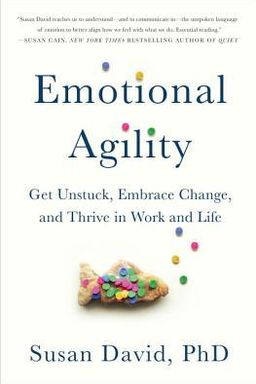
Emotional Agility cover

Emotional Agility

by Susan David

Emotional Agility by Susan David provides transformative strategies to manage your emotions, unhook from negative patterns, and embrace change. Learn to thrive in work and life by fostering self-compassion, mindfulness, and emotional awareness for personal and professional growth.

Emotional Agility: The Art of Facing, Feeling, and Moving Forward

Have you ever felt stuck in your own thoughts or emotions—cycling endlessly between anxiety, guilt, and self-doubt, unable to break free? In Emotional Agility: Get Unstuck, Embrace Change, and Thrive in Work and Life, psychologist Susan David argues that your ability to thrive, both personally and professionally, depends not on the absence of difficult emotions but on your flexibility with them. She contends that becoming emotionally agile means learning to engage with your inner world—thoughts, emotions, and stories—with courage, curiosity, and compassion rather than denial or rigidity.

David’s core claim is that emotional agility allows you to face your feelings without being dominated by them. You don’t have to suppress anger or sugarcoat pain. Instead, you learn to recognize emotions as data—not directives—to help guide you toward choices aligned with your deepest values. This, she argues, is the true foundation for genuine happiness, success, and meaning. Emotional agility empowers you not to control emotions but to navigate them wisely—creating space between stimulus and response, just as Victor Frankl described: “In that space is our power to choose our response.”

From Rigidity to Flexibility

Modern life often traps us in rigid patterns of thought and behavior. We multitask obsessively, suppress emotions, or chase a forced positivity that disconnects us from reality. David compares this rigidity to being the captain of a ship who refuses to alter course—headed unwaveringly toward a lighthouse, mistaking it for another vessel. Emotional agility is the opposite of this: it’s the willingness to adjust your sails based on what life presents, remaining open, aware, and purposeful.

Emotions as Navigational Tools

David explains that emotions evolved over millions of years as a neurochemical compass to help us survive—signals alerting us to danger, opportunity, or connection. Yet, our modern tendency is to distrust these emotions. We treat them as problems to fix or banish, which paradoxically leaves us off course. Learning to recognize emotions as valuable information helps us understand what matters and how we might live in alignment with our values.

The Four Essential Movements

David structures emotional agility around four core movements that unfold when we engage mindfully with our experiences:

  • Showing Up: Turning toward your thoughts and emotions rather than avoiding them. It’s about naming feelings honestly without judgment.
  • Stepping Out: Creating distance from overwhelming emotions so you can see them objectively—much like observing a storm rather than being caught inside it.
  • Walking Your Why: Using your core values as a compass to make deliberate, meaningful choices instead of reacting on autopilot.
  • Moving On: Making small, intentional tweaks to your behavior to stay balanced and creative amid life’s challenges.

These steps move you from emotional entanglement to clarity, resilience, and purpose. Each chapter in David’s book unpacks these movements with stories—from her experiences growing up under apartheid to coaching executives—and shows how real flexibility enables creativity, success, and connection.

Why This Matters More Than Ever

In a world overloaded with stress and contradiction, emotional agility becomes survival gear. Our culture rewards busyness and perfectionism while stigmatizing vulnerability and failure. Susan David challenges this, showing that so-called negative emotions—anger, sadness, guilt, fear—often hold the keys to growth. They are “messengers” pointing toward what is meaningful.

By developing emotional agility, you stop being “hooked” by old stories and rigid patterns (“I’m a failure,” “People can’t be trusted”) and instead act from conscious choice. Emotional agility doesn’t promise you’ll never feel pain—it teaches you to move through pain with grace and adaptability. Ultimately, this is about becoming real—able to embrace both joy and sorrow, both love and loss, and still keep walking your Why.


Getting Hooked: When Thoughts Take Over

You get hooked when your mind traps you inside self-defeating cycles of emotion and narrative. David uses vivid examples to show how easily we accept thoughts—often false or outdated—as facts. These ‘hooks’ can be thought-blaming (“I didn’t speak up because I thought I’d sound stupid”) or emotional loops where past pain colors present choices.

The Stories We Tell Ourselves

Our internal narrator never stops talking, crafting stories to make sense of the world. But it’s often unreliable—biased, scared, or self-justifying. David likens it to literary unreliable narrators such as Amy Dunne in Gone Girl. One moment you think, “I’m slow at writing,” which quickly spirals into “I’m a failure.” A simple observation becomes judgment, leading to paralysis or avoidance. These stories are often decades old—scripts we learned as children—and we still act them out.

The Brain’s Role in Getting Hooked

We’re wired for meaning-making. David cites psychologist Daniel Kahneman’s “System 1” thinking—fast, emotional, automatic. System 2, our slower reflective processing, allows objectivity but demands effort. Emotional agility means using System 2 to create space between feeling and response. She connects this to Viktor Frankl’s insight: freedom lies in the space between stimulus and response.

The Four Common Hooks

  • Thought-Blaming: We treat thoughts as commands instead of mere ideas, cutting off choice.
  • Monkey Mindedness: Racing thoughts jump from branch to branch, exhausting us with imaginary conversations and worries.
  • Outgrown Ideas: Beliefs that once protected us (“Don’t trust anyone”) now suffocate growth.
  • Wrongheaded Righteousness: The obsession with being right—destroying relationships just to win arguments.

Over time, these hooks limit our freedom. We react based on old conditioning rather than present reality. Emotional agility helps you notice hooks quickly, name them, and choose differently.

“Are you managing your own life according to your values, or are you simply being carried along by the tide?”

David reminds us: being hooked is the opposite of being agile. You can’t see new possibilities when you’re glued to old habits. The challenge is not to stop feeling but to stop confusing your feelings for commands. Once you can say, “I am having the thought that I am inadequate,” you begin to unhook and lead yourself with clarity and intention.


Unhooking: Bottlers and Brooders

When faced with tough emotions, most people fall into two camps: Bottlers, who suppress feelings, and Brooders, who overthink and stew. David’s research shows that both responses trap us rather than free us. Bottlers chase control by pushing emotions away, while brooders drown in analysis and guilt. Neither approach works—they only deepen distress.

The Bottler’s Trap

Ignoring emotions doesn’t erase them—it amplifies them. David references Daniel Wegner’s famous “white bear” experiment: try not thinking of a white bear, and you’ll think of it even more. Bottled emotions leak out as irritability, addictive behaviors, or unexpected meltdowns. One study even found that suppressing feelings raised other people’s blood pressure, showing that repression affects not just you but those around you.

The Brooder’s Spiral

Brooders ruminate endlessly—“Why am I like this?” “What’s wrong with me?”—creating a feedback loop of misery. David recounts psychologist Brad Bushman’s experiment where angry participants who brooded became the most aggressive compared to those who relaxed. Rumination doesn’t solve problems; it magnifies them. Eventually, brooding leads to “misery-about-misery”—guilt for feeling bad and stress about being stressed.

The Illusion of Happiness

Our culture’s obsession with positivity adds another layer of distortion. According to David, chasing constant happiness is counterproductive. Studies show that people who value happiness excessively end up lonelier and less happy. True happiness coexists with discomfort and honesty. Emotions like anger, envy, and guilt have important functions: anger exposes injustice; envy motivates growth; guilt reminds us of values.

The Way Out

Emotional agility teaches a third way: presence. Instead of bottling or brooding, you acknowledge emotions openly, learn from them, and let them pass. It’s not about denial but discernment. As David writes, “It’s like holding books close enough to connect with them, but not so tightly that your arms can’t move.”

By standing at the crossroads between bottling and brooding, you can choose curiosity over judgment. You no longer fight emotions—you partner with them to guide wiser action.


Showing Up: Courage and Self-Compassion

Showing up means facing your emotions—even the dark and scary ones—with openness and kindness. David draws on myth and history, comparing emotional courage to a hero’s journey: you must enter the cave, meet the dragons, and face what you fear. Avoidance only deepens suffering; acknowledgment invites healing.

Naming the Monsters

Like the mother in the film The Babadook, who learns to live with her grief by feeding—rather than fighting—her monster, we must make peace with discomfort. By naming our demons, we strip them of power. David reminds us that no heroic growth happens without vulnerability. Acceptance is the prerequisite for transformation.

Self-Compassion Over Self-Criticism

Self-compassion is central to showing up. Research cited by David shows that people who forgive themselves after failure are more motivated to improve than those who shame themselves. She contrasts guilt (“I did something wrong”) with shame (“I am wrong”), noting that guilt can guide growth while shame paralyzes. Facing yourself gently, as you would comfort a child, builds resilience.

Breaking Free from Comparison

Modern life constantly invites comparison—with colleagues, influencers, and friends. David references studies showing how self-esteem based on comparison leads to unhappiness. Instead, she urges you to keep your eyes on your own work: measure yourself by your values, not others’ standards. Comparing your progress to prodigies or perfectionists is futile. You must be “you-shaped,” not an imitation of someone else.

Willingness and Acceptance

Showing up also means willingness—the readiness to experience life as it is, without constant control or denial. In studies of smokers, those who accepted cravings without fighting them were twice as likely to quit. Acceptance doesn’t mean approval; it means releasing the struggle. Through self-compassion, you invite calm and clarity, turning painful emotions into teachers, not enemies.


Stepping Out: Mindfulness and Perspective

Once you’ve shown up to your emotions, the next step is creating healthy distance—what David calls stepping out. This movement lets you see thoughts as passing weather, not fixed reality. It’s about observation, not fusion.

Writing Your Way to Clarity

David shares the work of psychologist James Pennebaker, who discovered that expressive writing about emotional experiences—just twenty minutes a day for three days—improves health, lowers stress, and speeds recovery from trauma. Writing helps you step out, turning raw pain into insight. Pennebaker’s study of laid-off engineers showed that those who wrote about their fears found new jobs three times faster than those who didn’t.

Mindfulness Without Mysticism

Stepping out also draws on mindfulness. It’s not about sitting cross-legged all day—it’s about paying attention with curiosity. Studies from Harvard show that mindfulness changes brain regions linked to focus and empathy. David connects this to Ellen Langer’s research: mindfulness makes you adaptive and creative because you tune into context instead of autopilot responses.

Letting Go

The ultimate goal of stepping out is letting go—holding thoughts lightly. David uses charming exercises: repeat a negative thought (“I’m a fraud”) out loud until it sounds silly, or attach it to a sticky note and wear it proudly at a gathering. These playful acts dissolve the illusion that your thoughts define you. As she puts it, “Thoughts and emotions contain information, not directions.”

When you step out, you become agile enough to choose value-based action. You stop reacting and start responding. That space of awareness—your chessboard between stimulus and response—becomes freedom.


Walking Your Why: Living with Purpose

To walk your why is to let your values—not emotions—be your compass. Susan David describes using your deepest beliefs to guide behavior when life pulls in competing directions. Whether you’re deciding between job offers or managing family conflict, clarity comes from knowing what truly matters.

Values in Action

David shares the story of film director Tom Shadyac (director of Bruce Almighty), who sold his mansion and gave away luxuries after realizing success didn’t equal happiness. His redefined values—community, kindness, simplicity—made him freer. Walking your why means making choices consistent with your moral compass, not social expectations.

Choice Points

Every day presents “choice points”—moments to act toward or away from your values. Do you snap at your partner or pause to reconnect? Do you chase prestige or prioritize family? Emotional agility helps you choose toward moves, small consistent actions aligned with your Why. These tiny decisions build integrity and joy.

Courage Is Fear Walking

Real courage isn’t fearlessness—it’s “fear walking.” David spotlights Irena Sendler, who risked her life in WWII to rescue Jewish children from the Warsaw Ghetto. Courageous choices rooted in values define our character. On a smaller scale, it might mean speaking up at work for what you believe or setting firm boundaries with loved ones.

Walking your why transforms life into deliberate living. Your values become anchors amid chaos, helping you say yes to what matters and gracefully no to what doesn’t.


Moving On: Balance and Tiny Tweaks

Emotional agility ultimately asks: how can you translate inner awareness into outer change? David introduces two practical principles—the Tiny Tweaks and the See-Saw Principles—to help you move forward sustainably. Transformation isn’t about radical overhaul; it’s about small, meaningful adjustments infused with your values.

Tiny Tweaks

Big resolutions fail because they’re too ambitious. Small tweaks work because they’re manageable and rooted in identity. Psychologist Alia Crum’s research showed that hotel cleaners who reframed their daily labor as exercise saw health improvements without changing routines. Likewise, shifting from “I have to” to “I want to” reframes motivation around autonomy. These minor mindset shifts accumulate into powerful momentum.

The See-Saw of Challenge and Comfort

Life thrives on balance between competence and challenge. Too much comfort leads to stagnation; too much challenge leads to burnout. David compares this dynamic to a playground see-saw—our goal is equilibrium at the edge of our ability. Being “whelmed,” not overwhelmed or underwhelmed, builds resilience. Growth happens just beyond your comfort zone.

Grit and Grace

David distinguishes between grit—the passion to persist—and the wisdom to quit when goals no longer serve us. Emotional agility means knowing when to adjust your sails rather than crash against the rocks. Grit without self-awareness becomes stubbornness; flexibility ensures sustainable growth.

Through tiny tweaks and balanced effort, you shift from coping to thriving—transforming insight into daily practice while maintaining emotional balance and authenticity.


Emotional Agility in Work and Parenting

Emotional agility extends beyond self-awareness—it revolutionizes how you lead and raise others. At work and home, flexibility replaces perfection, and compassion replaces control.

Agility in the Workplace

David recounts stories of executives like Erin, who hid in her closet to take work calls during maternity leave, trapped by perfectionism. Emotional agility helped her face discomfort and speak honestly to her boss, establishing boundaries rooted in her values. Another manager, Al, mistook detachment for efficiency and lost a promotion because he neglected empathy. Both learned that agility means showing up authentically, not rigidly.

All workplaces contain hooks: ego, fear, and false positivity. Emotional agility enables leaders to model humanity, communicate openly, and balance task with purpose. Team performance improves when employees feel safe to share emotions and innovate. Flexibility replaces burnout with engagement.

Agility in Parenthood

Raising emotionally agile children means teaching presence, resilience, and authenticity. David’s stories of her son Noah illustrate this beautifully. Paralyzed by fear at the diving board, Noah learned to face his emotions, examine his values (wanting fun and friendship), and take small steps until courage emerged. His mother’s role wasn’t to push him but to help him recognize fear as normal and process it.

Whether at work or home, emotionally agile people replace control with curiosity. They teach others to see emotions not as threats but as teachers guiding growth. This mindset builds empathy, accountability, and genuine connection—qualities of a thriving culture and family.


Becoming Real: Living Authentically

In her closing parable of The Velveteen Rabbit, David reminds us that emotional agility culminates in authenticity. Becoming real means accepting your imperfections, your scuffed edges, and still being loved. It’s not performance—it’s presence.

Life Beyond Pretence

Realness requires facing pain and fragility: “We’re young, until we’re not. We’re healthy, until we’re not.” Emotional agility doesn’t promise immunity from suffering—it offers grace within it. When you show up, step out, walk your why, and move on, you embody emotional maturity. You’re able to bend without breaking.

Authentic Living in Practice

Becoming real means living by your values, not by fear. Choosing courage over comfort, love over perfection. Accept that hurt and heartbreak coexist with joy and growth. As David’s friend Linda wrote while dying of ALS, “Dance if you can.” Life’s beauty is inseparable from its fragility. Emotional agility helps you dance through both.

Ultimately, emotional agility restores your freedom to choose how you live—not as a puppet of your emotions, but as their compassionate witness. In doing so, you become resilient, wholehearted, and undeniably real.

Dig Deeper

Get personalized prompts to apply these lessons to your life and deepen your understanding.

Go Deeper

Get the Full Experience

Download Insight Books for AI-powered reflections, quizzes, and more.