
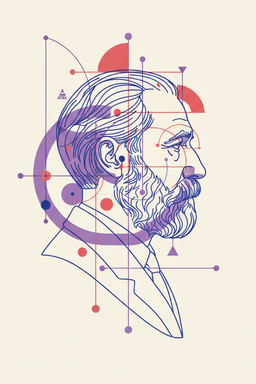
Émile Durkheim cover

Émile Durkheim

by Émile Durkheim

Émile Durkheim, born in 1858 in France, was an influential philosopher who questioned the psychological costs of capitalism. Though he recognized its ability to create wealth, he focused on its effects on people''s mental health, noting increased suicide rates in industrialized nations. Using his insight, Durkheim explored the reasons behind modern society''s unhappiness despite material abundance.

Durkheim and the Paradox of Modern Happiness

Why do modern societies, despite being richer and freer than ever before, struggle so deeply with unhappiness—and even despair? Émile Durkheim, the French sociologist and philosopher born in 1858, devoted his life to investigating this paradox. Living through France’s rapid transformation from a rural, traditional world to an industrial capitalist one, he saw both extraordinary wealth creation and a troubling rise in psychological distress. His major insight was startling: as societies grow more advanced, they often become more miserable.

Durkheim’s most famous work, Suicide (1897), is not just about those who take their own lives but about what their actions reveal about society’s underlying moral and emotional climate. He observed that suicide rates rose alongside industrialization. Richer nations, more educated individuals, and Protestant populations—all supposedly more advanced—had higher suicide rates. This told Durkheim that something about modernity itself was making people feel disconnected, anxious, and lost.

The Broken Promise of Progress

Durkheim saw capitalism as both a liberating and destabilizing force. It freed people from rigid traditions and created space for individual choice. But precisely this freedom—unchecked by strong community norms or shared purposes—brought new anxieties. People could now define themselves, but without clear guidance or belonging, this freedom often morphed into isolation.

Traditional societies told people exactly who they were: a farmer, a daughter, a church member, a respected craftsperson. Capitalism replaced these anchors with choices—where to live, what to believe, who to love. It promised self-determination but delivered loneliness. The collapse of communal authority meant many individuals lacked moral and emotional frameworks to navigate life’s meaning. Durkheim framed this condition as “anomie”—a state of normlessness that leaves people adrift.

Modernity’s Costs: From Freedom to Disconnection

Durkheim’s message remains hauntingly relevant. He argued that social change, no matter how materially beneficial, always comes with psychological costs. Capitalism inflates hope while weakening the bonds that give hope meaning. It encourages ambition but downplays interdependence. It glorifies freedom while eroding shared direction.

The breakdown of religion, for example, left people without the rituals, myths, and communities that helped them process suffering. The weakening of the family and the nation removed other key sources of belonging. As modern life became more individualistic, the “we” that had once grounded human experience vanished—leaving a lonely, competitive “I” in its place.

A Conversation Between Faith and Society

Durkheim was fascinated by religion not for its supernatural claims but because it provided moral cohesion. Even though he was an atheist, he felt a deep nostalgia for what religion achieved socially. It made life’s inequalities tolerable, gave meaning to suffering, and connected individuals to something beyond personal desire. In his view, science and individual reason were poor substitutes for the sense of shared purpose that religion had nurtured.

Durkheim’s contemporary, Karl Marx, famously called religion “the opium of the people,” accusing it of dulling revolutionary fervor. But Durkheim saw religion’s ‘opiate’ as medicine, not poison. Without shared illusions or sacred symbols, he thought, human beings might find it unbearable to live together at all.

Why Durkheim Still Matters

Durkheim’s insights resonate even more in our digital, hyper-capitalist age. Today, we are more connected yet more isolated, more free yet less grounded. Social media amplifies comparison and envy, while collective institutions—from religion to unions to local communities—have weakened. We face precisely what Durkheim warned about: an epidemic of meaninglessness amid plenty.

Durkheim’s vision suggests that happiness is less about personal success and more about belonging. The antidote to despair is not greater autonomy, but stronger community. He implores us to rebuild moral ties—to rediscover rituals, norms, and collective values that remind us we are part of something larger than ourselves. The real challenge of modernity is not material scarcity but moral disconnection.

Durkheim’s Enduring Message

As societies modernize, they must rebuild meaning on new terms—or risk social and psychological collapse. The ultimate task is to create secular forms of solidarity that can sustain our hearts as well as our minds.

The following key ideas unpack the themes Durkheim explored—the burdens of individualism, the dangers of excessive hope, the chaos of unbounded freedom, and the loss of communal belonging through religion, nation, and family. Together, they outline a profound diagnosis of why modern life is so often rich in things but poor in meaning.


The Burden of Individualism

For Durkheim, modern individualism is both a triumph and a trap. In traditional societies, people didn’t have to choose their identity—it was given. You were a member of a clan, a farmer’s son, a Catholic. Life’s roles were prewritten. Capitalism shattered this system, inviting everyone to become the author of their own destiny. You could pick your job, your beliefs, your life partner. No longer bound by your class or your birth, you seemed truly free.

But this freedom came with a great cost: the burden of total responsibility. When you’re told you can be anything, failure starts to feel like a personal moral flaw rather than bad luck. If you don’t make it, there’s no one to blame but yourself. This psychological shift, Durkheim argued, lies at the heart of modern misery.

Freedom Without Guidance

Traditional societies offered security, even if they restricted choice. You belonged to something larger than yourself. Under capitalism, success became self-authored—but so did failure. Durkheim believed this made individuals fragile, prone to harsh self-judgment. Comparison worsened the pain: in a system that celebrates merit and effort, it’s difficult to admit that chance or social circumstance still drive outcomes.

This relentless individualism created a new moral universe where humility and dependence were replaced by self-reliance and self-blame. Durkheim saw that this would have deep emotional consequences, intensifying isolation even as people gained autonomy.

“Individualism forces us to take all the credit—and all the blame.”

Durkheim didn’t call for a return to traditional hierarchies, but he did suggest that societies need shared moral frameworks to help individuals carry the weight of freedom. Without them, people drown in self-responsibility, cut off from the sense that they belong to something greater than themselves.


The Tragedy of Excessive Hope

Modern capitalism, Durkheim observed, doesn’t just make us more prosperous—it inflates our expectations to unbearable levels. It teaches us that with enough effort, we can have anything: wealth, love, power, perfect health, happiness. Advertising, culture, and even education conspire to convince us that no dream is too big. When everyone is told to reach for the stars, disappointment becomes not just common—but inevitable.

Durkheim saw excessive hope as a subtle but destructive psychological force. In earlier societies, people accepted limits as part of life’s order. Misfortune was shared and contextualized; people didn’t assume infinite possibility. Capitalism, however, removes those limits and normalizes ambition. The dark side of limitless aspiration is envy and despair when outcomes fall short.

Discontent as a Social Condition

Durkheim’s genius was to recognize that unhappiness in a capitalist society is not just personal—it’s structural. When everyone believes they’re individually responsible for their fate, a collective sadness takes form. A manager who misses an executive promotion, a graduate who fails to break into elite circles, a parent frustrated by stagnation—all experience their suffering as private failure, when in reality it’s part of a shared cultural illusion of boundless potential.

Our society punishes grief and normal struggle as weakness. Durkheim countered that sadness and limitation are part of being human. In denying this, capitalism robs us of the chance to find dignity in imperfection. (Philosophers like Alain de Botton later echoed this view, arguing that modern unhappiness is intensified by comparison rather than deprivation.)

Durkheim urges us to re-learn modesty in our aspirations—because happiness depends not on having everything, but on making peace with what can’t be had.

By recognizing hope’s double-edged nature, we can approach ambition more realistically: to dream deeply but without the illusion that life will spare us disappointment.


When Freedom Becomes Overload

Durkheim was sympathetic to the Romantic call for freedom but warned that too much freedom—without moral structure—can be paralyzing. In traditional societies, norms provided stability. You didn’t have to decide everything; your role, customs, and duties were clear. Capitalism, in contrast, tells us to make it all up ourselves. Should you marry? Where should you live? What career should define you? The answers, we’re told, are entirely up to us.

The Tyranny of Choice

At first, this freedom feels exhilarating. But faced with endless options and no shared compass, most people grow anxious. When everything is possible, nothing feels certain. Durkheim called this condition anomie—a dangerous lack of guiding norms. Without boundaries, desires spiral infinitely, and so does dissatisfaction. The result isn’t joy but exhaustion, a sense that life has lost coherence and direction.

In the modern world, social mores have largely turned into the advice “do what works for you.” It sounds liberating, but Durkheim saw it as a sign of collective disinterest. Society no longer tells people what’s meaningful because it no longer knows itself. That vacuum leaves individuals feeling unseen and unsupported.

Freedom, Durkheim reminds us, is not the absence of rules—but the presence of shared meanings.

We need freedoms anchored in moral community. Without shared norms, every person becomes a solitary moral legislator—a job too heavy for any one individual to bear.


Atheism and the Need for Sacred Bonds

Durkheim was an atheist, but one who mourned the social loss that came when religion declined. He admired religion not for its theology but for its sociology—for its power to unite people around shared rituals, values, and hopes. In ancient communities, religion linked peasants and kings, uniting them through common worship and moral codes. This intimacy of shared belief was, for Durkheim, irreplaceable.

The Social Function of Religion

Religion gave people a way to interpret suffering, to soften injustice with the idea that balance would come in another world. Marx saw this as a narcotic that placated the oppressed. Durkheim saw it as an emotional lifeline, one that kept society cohesive even in inequality. The rituals and shared myths were not lies but essential social glue. Without them, people would lose their sense of being part of something enduring and sacred.

Science, rationalism, or secular progress—Durkheim noted—cannot evoke the same emotional solidarity. You can appreciate the periodic table’s beauty, but it won’t make you feel morally bonded to your neighbor. What societies needed, he said, were new secular religions—forms of community life that could inspire shared reverence and belonging without supernatural belief.

Even a society without gods must find something sacred—or it will fall apart.

Durkheim’s challenge still stands: to build shared meaning in a godless world. Whether through civic rituals, cultural institutions, or mutual care, he believed we must consciously create modern forms of the sacred to prevent social fragmentation.


Losing the Nation and the Family

Durkheim saw that religion’s decline left a void—and asked whether the nation or the family could fill it. In moments of crisis, like wars for the Fatherland, national unity sometimes burned brightly. But in peaceful times, he argued, patriotism lacked the emotional warmth and shared ritual necessary to be a lasting moral foundation. The nation’s capacity to inspire collective devotion was episodic, not sustaining.

The family, too, seemed to offer potential. But the modern family had grown smaller and more fragile. Once family meant an extended network of kinship and shared labor; now it had shrunk to a household unit—two parents and one or two children. These bonds, while intimate, were not large enough to provide the broader sense of purpose people once gained from religion or community.

The Crisis of Belonging

Durkheim worried that people were left belonging to no one but themselves. We invest intensely in our immediate families, but adulthood often dissolves even those ties. As children leave home and build separate lives, the sense of being part of an enduring social fabric fades. Modern family life, centered on private comfort and emotional self-expression, simply cannot replace the moral ballast of collective belonging.

The decline of both family and nation underlines Durkheim’s thesis: people cannot be happy without moral interdependence. Belonging is a psychological necessity, not a luxury. Without it, freedom becomes isolation, and individual success loses meaning.

To live well, Durkheim teaches, is to belong well—to find ourselves mirrored in the lives of others and sustained by shared purpose.

Durkheim’s vision challenges us to rebuild communal life beyond blood and borders—to invent institutions and traditions that restore that crucial sense of belonging the modern world has let slip away.

Dig Deeper

Get personalized prompts to apply these lessons to your life and deepen your understanding.

Go Deeper

Get the Full Experience

Download Insight Books for AI-powered reflections, quizzes, and more.