
Idea 1
Expanding Consciousness to Transform Life
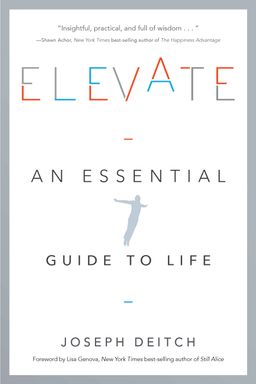
What if everything you experience—from success and frustration to love and loss—depends less on external events than on how clearly you perceive and respond to them? In Elevate, Joseph Deitch argues that awareness is not a passive state but an active practice that enlarges everything you touch: perception, choice, and growth. The book unfolds a progression from inner understanding to outer mastery, moving through awareness, perspective, self-programming, universal skills, structure, energy, leverage, and love. Taken together, these form a unified system for living consciously and effectively.
From awareness to mastery
Deitch begins with awareness—the ability to recognize both what you see and how you see it. He illustrates with a simple story about his jeans, which appear beige to him but gray to others. The anecdote reveals an essential truth: perception arrives filtered through assumptions and conditioning. To grow, you must notice those filters. Awareness lets you pause between stimulus and response, transforming automatic reactions into choice. This foundational insight echoes mindfulness teachings (compare Eckhart Tolle’s The Power of Now) but anchors them in everyday practice: notice irritation, treat it as data, and ask why it occurs.
Perspective and distortion
The next layer concerns how your limited perspective distorts reality. You live at one point in space and time, conditioned by culture and memory, which means your understanding is partial. Deitch examines biases like confirmation bias and cognitive dissonance, showing how even intelligent people misread data. His advice parallels Daniel Kahneman’s research in Thinking, Fast and Slow: to see more clearly, you must accept that you see imperfectly. Humility becomes a powerful lens cleaner. Tools like honest feedback, therapy, and experimentation ('looking at the fish,' as Harvard’s Louis Agassiz taught) reduce distortion through repeated observation.
Your mind shapes your world
From awareness and perspective flows the insight that your world mirrors your mind. Deitch’s rediscovery of his teenage diary—showing grief he had forgotten—illustrates how the brain rewrites history. You can intentionally reframe such stories, choosing interpretations that heal rather than harm. This principle gives you agency over meaning itself: reframing frustration as fascination converts drain into discovery. The same pattern applies externally. A blocked restaurant reservation can ruin your evening or spark an unexpected adventure; the difference is meaning. Change your internal narrative and your external circumstances change accordingly.
Programming your supercomputer
Deitch then compares you to a programmable supercomputer. Through visualization, calm, and repetition, you install mental routines that govern performance. His mind control course and later mastery of memory techniques demonstrate that programming works: what you mentally rehearse rewires your brain. Neuroscience confirms neuroplasticity, and Tai Chi adds the concept of 'transmission of mind'—learning by proximity to masters. The practical takeaway: treat each thought as code. Replace destructive scripts ('I can’t') with calibrated, realistic affirmations and behaviors that your nervous system can accept and implement.
The multiplier effect in growth
Awareness and programming generate compound benefits. At Commonwealth Financial, Deitch discovered why top performers outpaced peers by twenty times: their skills multiplied, not added. When competence in several domains improves simultaneously—communication, planning, technology—the gains explode exponentially. Weaknesses multiply downward, too, producing dramatic deficits. The insight parallels James Clear’s Atomic Habits: small gains across many interlocking systems produce big outcomes. Your challenge is to identify which fundamentals yield multiplicative power and invest there first.
Universal and transferable skills
Deitch identifies universal skills—asking, listening, programming, motivating—that transfer across contexts. Tai Chi’s energy redirection mirrors leadership and negotiation. Practice and feedback work the same in sports, business, and love. He quotes Steve Martin’s career expansions as evidence that once you master fundamentals, application becomes endless. Real education should teach emotional regulation, curiosity, and listening as core curricula, because these skills generate lifelong adaptability.
Action through structure and energy
Inner readiness demands outer architecture. Deitch introduces structural principles—clarity of purpose, documented procedures, teamwork, flexibility, and risk management—to convert insight into performance. Strong but adaptable structures resemble bamboo: resilient under pressure. Paired with optimized energy—sleep, movement, nutrition, breathing, and emotional openness—structure becomes sustainable. Energy maintenance is treated not as luxury but as fuel: posture, rest, hydration, and compassionate relationships replenish your personal circuit.
Leverage and love
Finally, Deitch teaches leverage and love as ultimate amplifiers. Leverage multiplies force through alignment, timing, and ethical influence: adding mass (resources) and acceleration (commitment) equates to exponential impact (F = ma). Love supplies limitless motivation—Mother Teresa’s hospice work and Deitch’s own 'Chemo Parties' reveal that love turns suffering into joy. Service and gratitude complete the cycle, feeding awareness and energy anew. Appreciation practices, daily gratitude rituals, and treating problems as puzzles sustain elevation indefinitely.
The book as a whole is a manual for conscious living: see clearly, choose wisely, act skillfully, build resilient systems, energize mind and body, leverage compassion and influence, and refine continuously. Awareness begins the climb; love crowns it. Deitch’s message is both scientific and spiritual—when you elevate inner perception, you reshape outer reality.