
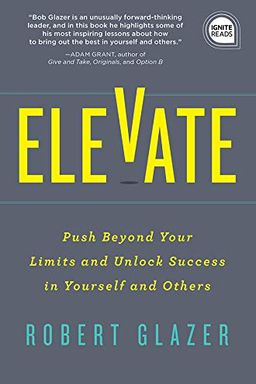
Elevate cover

Elevate

by Robert Glazer

Elevate by Robert Glazer offers a transformative journey through four core capacities-spiritual, intellectual, physical, and emotional. This guide equips readers with actionable strategies to enhance personal and professional success by aligning their actions with core values and fostering a growth mindset.

Elevating Your Life Through Capacity Building

Have you ever looked at people who seem to accomplish twice as much with half the effort, and wondered—what's their secret? In Elevate, entrepreneur and author Robert Glazer argues that these high achievers have learned a crucial skill that separates them from the rest: they consistently build and align their capacity across four interconnected dimensions of life—spiritual, intellectual, physical, and emotional. This isn’t about working harder or hustling endlessly; it’s about developing the inner and outer systems that allow you to perform better, live more intentionally, and fulfill your potential.

Glazer contends that most people don’t fail because they lack talent or opportunity. They struggle because they’re out of alignment—running hard in directions that don’t lead to fulfillment. Elevate introduces a framework to help you rise above that chaos. By building these four capacities, you learn to live with purpose, think strategically, stay physically resilient, and nurture emotionally healthy relationships that sustain lasting achievement. This is how you “elevate”—how you raise yourself and others to new heights of performance and meaning.

The Four Elements of Capacity

At the heart of Elevate is what Glazer calls the capacity-building model, made up of four elements. Spiritual capacity is knowing who you are and what you truly want; intellectual capacity is improving your ability to think, learn, and plan; physical capacity is optimizing health and energy; and emotional capacity is managing relationships and mental resilience. Each one interacts with the others. Glazer compares this system to a four-chambered ball—it rolls smoothly only when all chambers are equally inflated. If one is deflated, your overall progress wobbles.

Building these capacities isn’t an overnight change, nor is it merely inspirational talk. Glazer’s approach is pragmatic—he learned it through experiments in his own life and leadership. The framework emerged from his “Friday Forward” weekly messages, a simple email of motivational stories to his employees that unexpectedly reached over a hundred thousand people across fifty countries. Writing those messages each week not only inspired others but forced Glazer to grow, examine his own habits, and elevate himself. The Friday Forward philosophy became the foundation of Elevate’s practical roadmap for growth.

Why Capacity Matters

Glazer’s premise builds on a timeless truth echoed by thinkers from Gandhi to Warren Bennis: the distance between what we do and what we’re capable of doing could solve most problems—personal and global. Yet many of us waste energy moving fast but without direction. We take pride in efficiency but often do the wrong things efficiently. Glazer quotes management expert Peter Drucker: “There is nothing so useless as doing efficiently what should not be done at all.” Capacity building fixes this misalignment by ensuring that you devote energy only to what serves your values and larger purpose.

If you imagine achievement as a marathon rather than a sprint, capacity is the training that enables you to run farther and faster without burnout. It’s not about adding more to your to-do list but about clearing away what drains you, clarifying what matters most, and creating habits and systems that multiply your effectiveness. By applying his framework across life and business, Glazer has built not just a successful company—Acceleration Partners—but also a culture that encourages people to grow holistically. It’s a model of leadership that lifts others while you climb.

From Inspiration to Execution

The inspirational stories in Elevate underscore that capacity building is not abstract theory. Glazer draws examples from leaders like Tim Ferriss, Ray Dalio, Sheryl Sandberg, and Warren Buffett—individuals who systematically improve themselves and operate with high clarity. Each story distills a message: greatness is built through disciplined growth and self-awareness, not luck or raw talent. Glazer also emphasizes action steps—whether identifying core values, crafting morning routines, joining mastermind groups, or setting goals with ruthless focus. These steps turn wisdom into daily practice.

By the end of the book, you come to understand that elevating your life is both an inner and outer journey. You build spiritual clarity to define your “why”; intellectual rigor to plan and learn; physical vitality to sustain effort; and emotional intelligence to handle relationships and setbacks. Each chapter supports the others, creating feedback loops that push you beyond what you thought possible. This is the blueprint for continual growth—for becoming not just more productive or successful, but more authentic, healthy, and fulfilled.

Why This Approach Works Today

Modern life overwhelms us with distractions, obligations, and false markers of success. Glazer’s model offers a remedy: a structured but human way to recalibrate your direction and develop harmony across personal and professional spheres. The idea resonates because it acknowledges how achievement today demands integration—not compartmentalized success in work or fitness or relationships, but holistic capacity across all domains. As Stewart Friedman of Wharton notes in the foreword, leadership today is about integrating life, not separating business from the self.

Each element of capacity equips you to make better decisions, lead more effectively, and align your daily actions with long-term purpose. When you strengthen all four, you gain momentum—the kind that transforms effort into fulfillment. Ultimately, Elevate isn’t just about being more successful; it’s about becoming the kind of person who constantly expands their potential and helps others do the same. That’s what it means to elevate.


Discovering Your Spiritual Center

Spiritual capacity, Glazer explains, is not about religion—it's about self-understanding. It is knowing who you are, what matters most to you, and the principles that anchor your decisions. Think of it as your internal compass, pointing toward your personal North Star. Without it, you’re like a sailor without a map—moving fast but never sure where you’re headed.

Clarifying Core Values

Your core values are the guiding lines that define your character and choices. Glazer encourages readers to identify the four or five values that feel non-negotiable. To find them, reflect on moments when you’ve felt energized versus drained, fulfilled versus frustrated. Ask friends and family what they notice about you. Study the patterns in your past—report cards, performance reviews, even childhood memories. In those clues, your authentic self emerges.

When Glazer discovered his own core purpose—“find a better way and share it”—through a workshop with Ridgely Goldsborough, everything clicked. He saw that his entire life’s patterns, from rearranging his room at age six to building Friday Forward, pointed to his innate drive to improve systems and inspire others. Once you align your daily choices with your true values, your energy multiplies. If not, you stagnate or burn out chasing goals that don’t fit.

Finding Purpose and Why

Glazer draws on Simon Sinek’s concept of “Start With Why.” Your purpose—the reason you exist—connects all aspects of life and work. For many people, purpose emerges from pain or experience: the child who struggled with reading might become an advocate for literacy; someone who faced injustice may dedicate their life to human rights. The point is to understand what drives you so your effort has direction.

Not everyone discovers purpose easily, but once you do, everything you pursue can align with that clarity. Glazer decided to spend 80% of his time on things that matched his purpose and values, cutting away commitments that didn’t. That decision, though uncomfortable, changed his life. It’s proof that clarity is power: when you know your why, you stop running hard in the wrong direction.

Living in Alignment

Building spiritual capacity is an ongoing process—it evolves as you do. You’ll need to revisit and refine your values and purpose as life brings new experiences and insights. Entrepreneurs like Ray Dalio, author of Principles, show how living by consistent values across both business and personal spheres creates integrity and fulfillment. As Dalio says, connecting your personal and professional principles creates seamless authenticity.

To start your journey, Glazer offers practical steps: reflect deeply on your happiest and hardest moments; take personal assessments like StrengthsFinder or DISC to understand your wiring; and even write your own obituary to determine what legacy you want to leave. These tools help surface the themes that define your identity. Once your spiritual center is strong, every other type of capacity grows more naturally and effectively.


Sharpening Your Intellectual Edge

Intellectual capacity is the ability to think, learn, plan, and execute with discipline. It’s about upgrading your mental operating system—learning not just more things, but learning how to learn better. Glazer likens it to improving your brain’s processor so it can perform complex tasks faster and smarter.

Cultivating a Growth Mindset

Drawing on psychologist Carol Dweck’s concept, Glazer contrasts fixed and growth mindsets. Those with a fixed mindset believe intelligence or talent is static; those with a growth mindset see it as expandable through effort. High achievers embody growth—they seek feedback, take risks, and view failure as learning. The story of MIT student Drew Houston illustrates this: hungry to learn business, he read three top marketing books on a rooftop one weekend. That intellectual curiosity eventually led him to found Dropbox.

Setting Smart Goals and Habits

Glazer integrates spiritual and intellectual capacity through goal setting. Achievement means aligning short-term goals with long-term values. He references Warren Buffett’s 25-to-5 principle: list your 25 goals, circle the top 5, and avoid the rest until those are achieved. This exercise prevents distraction and keeps focus on priorities. SMART goals—specific, measurable, attainable, realistic, and timely—keep progress visible.

Daily habits turn ideas into action. Glazer’s ritual of drafting his weekly Friday Forward email became a keystone habit that strengthened consistency in other areas—writing, discipline, and leadership. Like James Clear describes in Atomic Habits, small 1% daily improvements compound into exponential results. Habits make structure automatic, freeing mental energy for creativity and growth.

Accountability and Continuous Learning

The intellectually strong don’t stop learning—and they surround themselves with feedback. Glazer encourages joining mastermind groups, where peers support mutual learning and challenge comfort zones. Napoleon Hill first defined such groups as coordinated knowledge shared in harmony. Whether through mentors, coaches, or personal boards of advisors, accountability closes blind spots. Sheryl Sandberg’s candid feedback to Kim Scott at Google—telling her that her speaking habits made her sound “stupid”—is cited as an example of radical candor that fuels growth.

Routine also matters. Glazer’s morning ritual, adapted from Hal Elrod’s Miracle Morning, starts with silence, affirmations, visualization, exercise, reading, and journaling. These habits align thought with intention before distractions strike. The takeaway: sharpen your mind through discipline, focus, and feedback loops. The more you expand your intellectual capacity, the more energy you’ll have to achieve without overwhelming yourself.


Strengthening Your Physical Foundation

Physical capacity might seem obvious—eat well, sleep, exercise—but Glazer redefines it as a holistic system that powers every other part of your life. Your physical health is either an accelerant or a drag on your capacity. Without it, mental clarity, emotional stability, and spiritual growth suffer.

Health as Fuel

Glazer’s own wake-up call came in 2009 when stress and exhaustion triggered a severe panic attack. Believing he was having a heart attack, he realized that neglecting his health had consequences. From that point, he prioritized movement, yoga, and nutrition. He cites writer Michael Pollan’s simple rule: “Don’t eat anything your great-grandmother wouldn’t recognize as food.” Real food—not processed fuel—keeps body and brain functioning optimally. A diet of whole, natural foods affects not only energy but also cognition and emotional stability.

Rest and Stress Management

Sleep and stress management are twin pillars of physical capacity. Studies at Harvard and Washington State University show that poor sleep and chronic stress sabotage decision-making. Glazer calls for intentional recharging—regular meditation or gratitude pauses that lower cortisol and raise focus. He quotes Dr. Heidi Hanna, noting that today’s constant connectivity overstimulates our brains far beyond their natural design. Disconnecting from technology, taking deep breaths, or practicing mindfulness helps you regain calm and control.

Competition and Resilience

Healthy competition builds physical and emotional resilience. Glazer rejects the modern “everyone gets a trophy” culture. Real growth happens through striving—competing with yourself and others to raise your standard. He mentions that the word “compete” comes from the Latin competere, meaning “strive together.” Great rivalries—like Magic Johnson vs. Larry Bird or Gates vs. Jobs—push both sides to excellence. When teams embrace competition properly, they build capability and avoid complacency.

Resilience, the ability to recover after setbacks, is the ultimate measure of physical capacity. As Glazer tells his son’s story of completing a ropes course despite fear, overcoming physical challenges translates into mental strength. In the end, resilience requires clarity about what’s worth fighting for—your spiritual why. When aligned with purpose, physical challenges become fuel for growth, not pain. That’s how you elevate your physical foundation into a source of long-term endurance and confidence.


Mastering Emotional Intelligence

Emotional capacity may be the hardest yet most transformative of all. It’s how you handle your inner critic, respond to others, and cultivate relationships that energize instead of drain you. Your emotions are the steering system of your life—without mastery, success will feel hollow.

Breaking Self-Limiting Beliefs

The first barrier to emotional growth is doubt. Glazer quotes Marianne Williamson: “Our deepest fear is not that we are inadequate, but that we are powerful beyond measure.” Many people hold themselves back because comfort feels safer than uncertainty. Glazer changed his approach when he told himself not “I want to write a book,” but “I am going to write a book.” That shift from desire to decision created momentum. The same principle applies to any goal—you must decide and then commit emotionally, intellectually, and physically.

Embracing Discomfort and Vulnerability

Growth lives outside comfort zones. Glazer cites Dr. Abdul-Malik Muhammad’s formula for change: challenge plus connection leads to transformation. You can’t grow without discomfort, and discomfort is most powerful when someone you trust pushes you. He urges readers to embrace vulnerability—sharing struggles openly, as author JT McCormick did in his talk about rising from poverty and abuse to CEO leadership. Vulnerability builds authenticity, and authenticity builds connection.

Social media and helicopter parenting, Glazer warns, erode resilience by fabricating perfection and shielding young people from failure. Real emotional maturity develops through trial and setback. Encourage independence, take risks, and allow yourself to fail—that’s how inner strength forms.

Attitude, Gratitude, and Relationships

Your attitude shapes your emotional capacity. Optimism isn’t naïve—it’s strategic. Angela Duckworth’s research on grit shows it’s attitude, not aptitude, that distinguishes achievers. Gratitude enhances that mindset by shifting focus outward. You can’t be fearful and grateful simultaneously—gratitude dissolves self-centered suffering and builds presence.

Glazer also highlights the power of relationships. Relationships are exponential, he says—the formula for success is what you know raised to the power of who you know. Surround yourself with people who raise your standards, not drain your energy. As Jim Rohn said, “You are the average of the five people you spend the most time with.” Family and friends who align with your values multiply your growth. Those who don’t must be gently de-emphasized to protect your emotional health. Elevation demands making tough choices but always with integrity and kindness.


Creating a Better Path Forward

In the closing chapter, Glazer returns to a deeply personal mission: be the person you needed when you were younger. He reflects on his own journey from underachieving student to inspired leader, revealing that true elevation isn’t about status—it’s about self-awareness and contribution. The process of building capacity gave him the tools to transform not only his own life but also the lives of others through mentorship and opportunity.

From Underachiever to Elevater

As a child, Glazer’s teachers described him as capable but uninterested—someone who “would rather be doing something else.” The system rewarded conformity rather than curiosity, labeling his strengths as weaknesses. He later discovered that entrepreneurship thrives precisely on those traits schools often discourage—independence, creativity, nonconformity. Many future leaders, as Seth Godin notes, suffer from “the curse of the cog,” trained to fit into systems instead of innovate. Glazer’s story is a call to challenge that conditioning and embrace uniqueness.

Building Others While You Build Yourself

Glazer champions organizations like BUILD, which mentor underserved youth in entrepreneurship, helping them unlock their potential through capacity-building principles. Students in these programs have double the graduation rate of their peers, demonstrating how spiritual clarity, intellectual growth, physical wellness, and emotional resilience change trajectories. Glazer donates a portion of the book’s proceeds to BUILD, practicing what he preaches—lifting others as he climbs.

He reminds readers that leadership isn’t about creating followers; it’s about creating more leaders. Hold yourself and others accountable to live to your full potential. Stop underachieving, he urges, and start elevating. As Tom Peters says, “Great leaders don’t create followers. They create more leaders.”

Your Commitment to Elevation

Glazer’s message concludes with optimism: everyone has far more capacity than they believe. The journey requires courage, discipline, and alignment—but the rewards ripple outward, transforming families, workplaces, and communities. His challenge is simple yet profound: set high expectations for yourself and model constant growth. When you build capacity in yourself, you spark it in others. That’s the essence of living an elevated life—and the legacy of Elevate.

Dig Deeper

Get personalized prompts to apply these lessons to your life and deepen your understanding.

Go Deeper

Get the Full Experience

Download Insight Books for AI-powered reflections, quizzes, and more.