
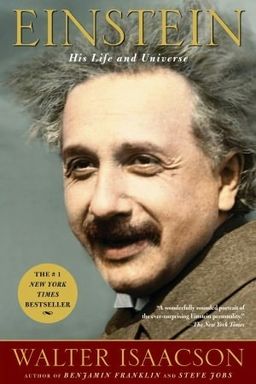
Einstein cover

Einstein

by Walter Isaacson

Walter Isaacson''s ''Einstein: His Life and Universe'' delves into the factors that shaped one of history''s greatest minds. Through a narrative that explores Einstein''s personal and professional life, readers gain insight into his revolutionary scientific achievements, his complex relationships, and his enduring influence on the world.

Einstein’s Life of Curiosity and Revolution

How does a child’s wonder grow into a revolution that reshapes reality itself? In this synthesis of Einstein's life and work, you see a portrait of genius not as divine gift but as cultivated curiosity. The book traces the transformation of an imaginative boy enthralled by a compass into a thinker who overturned Newton’s clockwork universe and struggled for a unification of nature and morality. Einstein’s story is the fusion of visual imagination, intellectual courage, and moral conviction. To understand him, you must bridge science, emotion, and ethics—the three strands that guided his life.

From childlike wonder to scientific revolution

Einstein’s fascination with unseen forces began with a compass that suggested invisible order beneath the visible world. From music lessons that trained his patience to school experiences that punished inquiry, he learned early that true understanding came from questioning authority. His later devotion to thought experiments—imagining riding a beam of light or free-falling in an elevator—emerged from that visual, intuitive style. These habitual mental games created the foundation for the special and general relativity theories that redefined time, space, and gravity.

The patent clerk who rewrote physics

In 1905, while working at the Bern Patent Office, Einstein published four papers that revolutionized physics. Within months, he clarified atomic theory through the explanation of Brownian motion, proposed light as quantized particles explaining the photoelectric effect, formulated special relativity, and revealed mass-energy equivalence (E=mc2). These works rescued physics from crisis and set the course for the quantum and relativistic revolutions that defined twentieth-century science. His method—blending imagination with logical precision—proved that clarity of principle can rival entire laboratories.

Moral and emotional dimensions

What makes Einstein compelling is not only his intellect but his humanity. His personal life—his partnership with Mileva Mari, his strained fatherhood, his later marriage to Elsa, and his hidden sorrow over his lost daughter Lieserl—reveals the costs of concentration and ambition. Professionally, his pacifism and opposition to militarism made him an outlier in wartime Germany, yet he stood by his conviction that universal laws demanded universal ethics. His fame after the 1919 eclipse experiments turned him into a global icon—simultaneously a scientific prophet and target of nationalist hostility.

From field theory to human responsibility

Einstein’s transition from special to general relativity was more than mathematical—it redefined gravity as the geometry of spacetime. Light bends around massive bodies; time runs differently near stars. Yet his thinking extended beyond equations: he saw moral gravity in the relations among nations. His later advocacy for a supranational authority, born from remorse over his role in alerting Roosevelt about nuclear weapons, transformed his cosmological sense of unity into a political ideal of world governance.

A mind seeking unity

For decades after relativity, Einstein sought a unified field theory—a single mathematical structure binding electromagnetism and gravity. Though he never succeeded, this pursuit symbolized his temperament: an insistence on coherence, beauty, and moral responsibility. His distrust of quantum randomness ('God does not play dice') reflects his lifelong faith that reality is orderly and knowable. Even his final years, filled with public activism and quiet walks with Gödel in Princeton, reveal an unbroken devotion to the idea that both science and politics must aspire to harmony. When he died in 1955, leaving unfinished equations beside his bed, his legacy was not only scientific but spiritual: a call to unite truth, beauty, and conscience into one continuous quest.


Imagination and the Making of a Scientist

Einstein’s formative years teach you how curiosity and resistance to convention create originality. His earliest influences—the mysterious compass, the disciplined violin, and the rebellion against rote schooling—formed the habits of imagination that guided his scientific life. He did not memorize; he visualized. His power lay in seeing abstract ideas as mental pictures rather than algebraic formulae. This visual reasoning, nurtured by play and persistence, later became the tool that restructured physics itself.

The education of a nonconformist

Einstein chafed against military-style instruction in Munich’s schools. Only when he entered Aarau, with its Pestalozzi-inspired visual pedagogy, did he thrive. There he conceived a mental image that would define his career: chasing a ray of light. From that imaginative leap emerged special relativity. Unlike peers who accepted authority, Einstein trusted his inner sense of coherence more than professors’ pronouncements. His intellectual rebellion was disciplined by patience—he could spend days adjusting a proof or practicing violin until perfection emerged.

The role of music and visualization

Music offered Einstein more than relaxation; it was a parallel mode of thought. He solved problems by alternating between auditory intuition and mathematical expression. Declaring he rarely thought in words, he revealed an approach that modern neuroscience confirms: multimodal reasoning enhances creativity. The violin and compass thus symbolize two poles of his mind—the aesthetic and the analytic—whose interaction powered his breakthroughs.

Seeds of the thought experiment

Einstein’s greatest conceptual tool, the thought experiment (Gedankenexperiment), arose from childhood play turned method. Whether imagining a person riding a lightning beam or free-falling inside an elevator, he used visualization to test the consistency of physical laws. Each scenario converted philosophy into physics without a laboratory. His later triumphs—the 1905 miracles and the 1915 field equations—can be seen as the adult flowering of a child’s curiosity made methodical.


The 1905 Revolution in Physics

Einstein’s “Annus Mirabilis” of 1905 displays how a single mind, working in obscurity, can realign the foundations of science. Balancing patent-office drudgery with relentless inquiry, he produced four papers that explained atomic reality, light quanta, Brownian motion, and relativity. Each reshaped a different corner of physics, but together they established a new worldview rooted in field theory, symmetry, and operational definitions.

Revealing the quantum and atomic worlds

Einstein’s light-quantum paper proposed that radiation behaves as discrete packets of energy, explaining the photoelectric effect. His Brownian-motion analysis offered proof of the atom’s reality. These works converted philosophical speculation into measurable predictions, bridging thermodynamics with molecular science. When Millikan later confirmed the photoelectric relation experimentally, even skeptics had to grant the correctness of Einstein’s reasoning.

The relativity paper and a new conception of time

Einstein’s “Electrodynamics of Moving Bodies” replaced absolute space and time with relational quantities tied to the speed of light. His logic was disarmingly simple: all inertial observers should measure the same laws of physics, including a constant light speed. From these statements flowed consequences that defied everyday intuition—time dilation, length contraction, and mass-energy equivalence. The world became a four-dimensional continuum in which simultaneity was relative and energy interchangeable with mass.

The method: principles, not piles of data

Working without experiments, Einstein used pure reasoning. He tested the internal logic of concepts through thought experiments—imagining synchronized clocks or lightning strikes on a train—and then expressed the outcome mathematically. His success demonstrated that conceptual clarity could precede empirical confirmation. (Note: this contrasted with the laboratory empiricism of his era, echoing Galileo’s blend of idealization and logic.)

Impact and philosophical resonance

At first few noticed him, but within years Planck and others recognized that Einstein had unified electromagnetism, thermodynamics, and mechanics under new rules. His 1905 papers seeded quantum mechanics and relativity, which together shattered classical determinism. They reveal the power of thinking from first principles—and remind you that revolutions often start in quiet, solitary rooms rather than grand laboratories.


From Special to General Relativity

General relativity transformed a theory of motion into a theory of the universe. Building from his 1905 framework, Einstein realized that gravity could not be a force acting at a distance but a property of curved spacetime. The path from the falling elevator to the 1915 field equations is one of the most creative journeys in the history of thought—guided by physical intuition and deep mathematics.

Equivalence and geometry

Einstein’s key insight was that acceleration and gravity are locally indistinguishable. In a freely falling elevator you feel weightless; in an accelerating one you feel heavier. This equivalence suggested gravity might be an effect of geometry rather than a separate force. With the help of his mathematician friend Marcel Grossmann, he learned Riemannian geometry and tensor calculus, finding tools to express curvature and connection. The field equations he completed in 1915 linked matter (energy-momentum) to spacetime curvature—gravity became geometry.

Testing the theory

Einstein derived predictions: the anomalous advance of Mercury’s perihelion, gravitational redshift, and the bending of light by gravity. When Arthur Eddington’s 1919 eclipse measurements confirmed the predicted deflection, relativity moved from speculation to validation, and Einstein’s fame exploded worldwide. Newspapers declared “Newton Overthrown,” turning subtle tensor calculus into cultural myth.

Broader consequences and cosmology

Relativity soon extended beyond local gravity to the cosmos itself. Karl Schwarzschild’s wartime solution implied possible black holes; Einstein’s own cosmological model of 1917 introduced the cosmological constant λ to produce a static, finite universe. When Hubble later discovered cosmic expansion, Einstein dropped λ as his “greatest blunder”—though modern dark-energy research resurrected it. Through these shifts, you see Einstein’s ability to modify cherished ideas when evidence demanded. The result: a cosmos that is finite, dynamic, and curved by matter—one of humanity’s grandest conceptual leaps.


Einstein and the Quantum Divide

No part of Einstein’s legacy is more paradoxical than his relationship with quantum mechanics. He helped launch it in 1905 by proposing light quanta, extended it through his 1916 theory of radiation, and inspired statistical mechanics breakthroughs with Bose. Yet he became its most persistent critic, unable to accept that chance and observation could be the bedrock of reality. The resulting debates—especially with Niels Bohr—defined modern philosophy of science.

From photons to probabilities

Einstein’s early quantum work earned him the Nobel Prize and led directly to technologies from solar cells to lasers. However, as Schrödinger, Born, and Heisenberg developed quantum mechanics, its probabilistic interpretations unsettled him. He believed physical laws should describe objective reality independently of observation. Born’s probability waves seemed to abandon that ideal.

The EPR argument and entanglement

In 1935, with Podolsky and Rosen, Einstein formulated the EPR paper, arguing that quantum theory is incomplete since it allows instant correlations (“spooky action at a distance”) violating locality. Schrödinger coined “entanglement” and dramatized the issue with his cat thought experiment. Einstein’s insistence on realism forced physicists to confront the interpretive depths of their own theory. Later Bell inequalities and experiments by Aspect and others confirmed that entanglement is real—fulfilling Einstein’s challenge in unexpected ways.

The philosophical divide

Einstein’s stance represented a moral as much as scientific conviction: the universe, he believed, is lawful and comprehensible. “God does not play dice” was shorthand for his faith in order. The Copenhagen school saw his quest for deterministic completeness as outdated, but history vindicated his rigor: foundational debates inspired quantum information science. His discomfort became modern physics’ conscience, reminding you that theory demands not only success but meaning.


Fame, Politics, and the Ethical Scientist

Einstein’s post-1919 life transformed him from reclusive theorist to international symbol. He became both scientific hero and political conscience, navigating fame, antisemitism, and moral complexity. This period shows you how intellect interacts with public life and how science can become both a refuge and a weapon.

Celebrity and backlash

Newspapers canonized him as 'the Newton of a new age,' yet fame also provoked antisemitic and nationalist attacks in Germany. His cosmopolitan, pacifist demeanor angered militarists; Lenard and Weyland led propaganda campaigns against relativity. Einstein responded with humor and moral firmness. Fame became a burden he endured gracefully, turning it into a platform for internationalism and Jewish renewal rather than self-glorification.

Private struggles and moral negotiations

Amid the spotlight, Einstein’s family life fractured. His divorce from Mileva included the promise to give her future Nobel Prize money, while his sons bore the emotional costs of distance. His later marriage to Elsa provided domestic stability but lacked intellectual intimacy. These ordinary conflicts humanize the global icon and illustrate how creative concentration exacts emotional prices.

From pacifism to political realism

During World War I Einstein opposed nationalism, co-authoring pacifist manifestos while colleagues like Haber militarized science. The Nazi rise forced a tragic pivot: he abandoned absolute pacifism, arguing that aggression must be resisted collectively. His support for Zionism and public rejection of German militarism led to exile. Princeton provided refuge but also isolation from the Europe he loved. Through exile, Einstein’s patriotism evolved into planetary citizenship.

Science, war, and conscience

Einstein’s 1939 letter to Roosevelt warning of uranium chain reactions linked pure theory to global policy. He later lamented this act as a moral error—proof that knowledge itself carries consequences. After Hiroshima, he championed world government and arms control through the Emergency Committee of Atomic Scientists. The same man who imagined cosmic unity now preached political unity as the only defense against self-destruction. His integrity amid McCarthy-era suspicion—he advised witnesses to defy coerced testimony—made him a rare example of scientific conscience balanced against power.


The Final Quest and Enduring Legacy

Einstein’s late years reveal the solitude of genius confronting the limits of knowledge. In Princeton he pursued a unified field theory—an ambitious synthesis of gravity and electromagnetism—while engaging publicly in moral advocacy. Though his theoretical unification failed, his example of intellectual integrity endured. His final decade mirrors his lifelong values: a search for coherence, compassion, and simplicity amid complexity.

The eternal search for unity

Einstein explored affine connections, higher dimensions, and nonsymmetric metrics, convinced that beauty and mathematics could reveal nature’s oneness. Collaborations with Weyl, Kaluza, and Schrödinger kept the quest alive, though each approach stalled. While contemporaries turned toward quantum field theory, Einstein stayed faithful to geometry—an aesthetic commitment more philosophical than practical. His words capture the ethos: “Nature is the realization of the simplest conceivable mathematical ideas.”

Activism and global ethics

From the atomic age onward, Einstein saw scientific unity mirrored in moral responsibility. He argued for supranational governance, warning that sovereign nations with nuclear power risk mutual annihilation. As chair of the Emergency Committee of Atomic Scientists, he used lectures and essays to urge disarmament and global cooperation. His pleas were idealistic but prophetic; later disarmament movements traced roots to his advocacy.

The closing chapter

Einstein’s death in 1955 was as serene as his reasoning. He declined surgical intervention, saying it was “tasteless to prolong life artificially.” His brain, later removed without permission, symbolized society’s fixation on physical origins of genius—a contrast to Einstein’s belief that curiosity, not anatomy, makes creativity. In his walks with Gödel and letters to friends, he displayed quiet humor and stoic acceptance, embodying the unity of mind and morals he sought scientifically.

Legacy and lessons for you

Einstein’s life teaches that imagination yields science, conscience shapes politics, and wonder sustains humanity. His equations redefined space and time, his activism warned against moral inertia, and his curiosity modeled how to think freely. To study Einstein is to learn how a mind can turn personal wonder into universal law—and how integrity can anchor intellect in turbulent times.

Dig Deeper

Get personalized prompts to apply these lessons to your life and deepen your understanding.

Go Deeper

Get the Full Experience

Download Insight Books for AI-powered reflections, quizzes, and more.