
Idea 1
Making Life Effortless: The Art of Doing What Matters with Ease
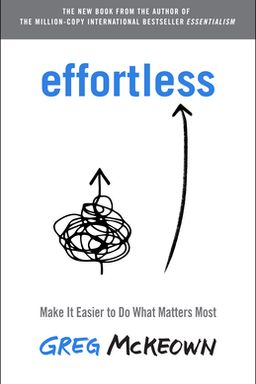
Have you ever felt like you’re running faster but accomplishing less? In Effortless: Make It Easier to Do What Matters Most, Greg McKeown challenges the deeply ingrained belief that success must always demand exhaustion, struggle, and sacrifice. Building on the foundation set by his earlier work Essentialism, McKeown argues that doing what matters most doesn’t have to be hard—it can, and should, be effortless.
The author’s premise is simple but profound: Hard work is not the same as valuable work. When we assume that anything meaningful must be difficult, we make life harder than it needs to be—cluttering our days with unnecessary steps, unrealistic expectations, and self-imposed pressure. Instead, McKeown invites us to transform our approach: to stop trying harder and start finding the easier path to the same result. “What if this could be easy?” becomes the central question of the book.
The Core Argument: The Paradox of Hard Work
McKeown opens with the story of Patrick McGinnis, a Harvard-educated professional who pursued success through eighty-hour work weeks—until burnout landed him on the edge of collapse. McKeown asks: What if working harder isn’t the solution, but the problem? This story reminds us of an uncomfortable truth—our modern obsession with productivity often equates difficulty with virtue. Yet research and experience show that “working harder” often yields diminishing returns, while the smarter, simpler path produces more sustainable outcomes. (In Deep Work, Cal Newport similarly argues for intensity of focus over mere quantity of effort.)
The Effortless Framework
To reverse the cycle of overexertion, McKeown introduces the Effortless Framework, a three-part approach to reimagining how we work, create, and live:
- Effortless State: Clearing the mental and emotional clutter that makes everything feel heavier than it is. This involves rest, gratitude, focus, and letting go of unnecessary burdens.
- Effortless Action: Learning to take simple, focused, and sustainable steps toward completion—defining what “done” looks like, starting small, simplifying processes, and setting the right pace.
- Effortless Results: Designing systems and habits that continue to produce results with minimal ongoing effort, through automation, trust, teaching, and prevention.
These three pillars echo the book’s subtitle: it’s about doing what matters most, but in a way that is enjoyable and sustainable. Each part builds on the last so that life’s essential work flows—not grinds.
Why This Matters Now
Few cultural illusions are as powerful as the glorification of exhaustion. McKeown likens our current climate to hiking at high altitude: the air is thin, our brains are foggy, and every step feels harder than it should. Between technological overload, 24/7 connectivity, and the fear of falling behind, many people feel they must “earn” rest and simplicity. But McKeown asserts the opposite: the easier we make essential work, the more energy we have for creativity, family, and contribution.
At the book’s emotional core is a personal story. When McKeown’s young daughter, Eve, fell gravely ill, he realized that doing more—researching endlessly, worrying constantly—wasn’t helping. Instead, his family learned to choose the lighter path: to focus on joy, gratitude, and the small acts within their control. This crucible experience gave birth to Effortless, showing what it means to live lightly even during profound difficulty.
From Essentialism to Effortlessness
Essentialism taught readers to eliminate the nonessential; Effortless teaches you to make what remains easier. Once you’ve stripped away trivial tasks and distractions, you face a new challenge: what if even the essentials are still too heavy? McKeown’s answer is to redesign our mental and physical systems so that doing the right thing requires less willpower and more flow. He encourages us to replace self-judgment with curiosity: if something feels hard, it’s often a sign not of weakness, but of inefficiency.
A Roadmap Toward Ease
Over the book’s fifteen chapters, McKeown illustrates how effortlessness arises when we align our state, actions, and results. He introduces central practices like asking “What if this could be fun?”, defining “done,” simplifying by subtraction, and trusting others through clear agreements. He urges readers to rest before they burn out, notice what truly matters, start with small, obvious steps, and embrace imperfection as the gateway to progress. By the final chapters, his focus shifts toward sustainability: automating recurring tasks, teaching others, and building systems of trust and prevention that yield residual (not just linear) results.
McKeown’s core message: Life doesn’t have to be as hard as we make it. Every burden—personal, professional, or emotional—can be lightened by rethinking how we approach it. True productivity isn’t measured by struggle but by sustainability.
Ultimately, Effortless is more than a manual for productivity—it’s a philosophy for living. It invites you to shed needless friction, to align joy with purpose, and to step into a flow where you achieve more not because you push harder, but because you move smarter, lighter, and freer. In a world that equates burnout with success, McKeown offers a radical, refreshing alternative: ease as a discipline, and grace as a strategy.