
Idea 1
Mastering Decisions Under Pressure and Uncertainty
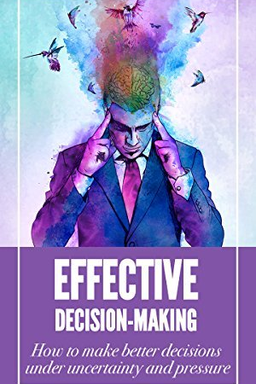
Have you ever found yourself frozen when facing a big decision—one where the stakes feel high, time is short, and the information feels incomplete? That uncomfortable mix of uncertainty and urgency is the crucible of decision-making in modern life. In Effective Decision-Making: How to Make Better Decisions Under Uncertainty and Pressure, Edoardo Binda Zane argues that while human judgment is flawed, you can dramatically improve your decisions by combining awareness of cognitive biases with practical, easy-to-use frameworks. His mission is clear: help you make faster, more reliable, and better decisions, even when your brain and circumstances are working against you.
The Core Problem: Your Brain vs. Reality
Binda Zane starts by dismantling the comforting illusion that our thoughts are rational and objective. He introduces two powerful psychological traps that shape poor decision-making. The first is confirmation bias, the tendency to favor information that confirms our beliefs and dismiss evidence that contradicts them. You’ve likely seen it play out in arguments over politics or business strategy, where everyone clings to data that supports their view. The second is the Dunning-Kruger effect, where unskilled people overestimate their competence while experts often doubt their own ability. Together, these biases make every decision harder—they cloud judgment, warp perception, and inflate or deflate confidence at the worst possible times.
You may be skilled and experienced, but that doesn’t exempt you. Biases are baked into how the brain processes information. Binda Zane’s solution isn’t perfection—it’s awareness. Recognize that your mind cheats, and then use structured tools to keep it accountable.
Why Simplicity Wins: The Ockham’s Razor Principle
Before introducing his toolbox, Binda Zane invokes an age-old philosophical rule: Ockham’s Razor. In its simplest form, it means that the simplest plausible explanation—or in this case, the simplest decision framework—usually works best. Modern managers love complex models and data-heavy spreadsheets, but according to Binda Zane, complexity is often noise masquerading as intelligence. A decision that adds unnecessary information or variables only multiplies confusion. So he challenges you to ask: “Do I have the necessary amount of information I need? What adds clarity, and what adds clutter?” In his world, efficiency beats sophistication.
From Bias to System: Frameworks That Rewire How You Decide
The book is less academic treatise and more practical manual. It introduces dozens of frameworks—logical structures that guide your thought process from observation to action. They range from military-derived models like OODA loops (Observe, Orient, Decide, Act) to coaching-inspired methods like GROW (Goal, Reality, Options, Will), iterative planning tools such as PDSA (Plan, Do, Study, Act), and corporate analysis classics like SWOT, Porter’s Five Forces, and Pareto Analysis.
Each model illuminates a different stage of decision-making—understanding context, diagnosing cause, generating ideas, weighing alternatives, and finally, assessing impact. These frameworks act as mental guardrails: they replace gut feeling with structure and transform chaos into clarity.
Beyond the Individual: Deciding with Teams
Decision-making isn't a solo sport. Binda Zane devotes significant space to group dynamics—examining when to involve your team and how to do it effectively. He critiques the widespread reliance on brainstorming, calling it “possibly the most overrated and harmful decision-making technique of all times.” By contrast, he champions alternatives like the Nominal Group Technique and Vroom-Yetton-Jago Model, which handle team input systematically without letting extroverts dominate or introverts retreat. These methods respect creativity while mitigating social bias—because the loudest voice often isn’t the wisest.
Decision-Making as Continuous Learning
One of the book’s most compelling ideas is that decision-making isn’t a one-off cognitive event—it’s a cycle. The OODA loop and PDSA cycle emphasize iteration, feedback, and adaptation. Every decision improves your mental model of reality. Action becomes a learning experiment: you observe, orient, decide, act, and then feed results back into observation. In times of uncertainty, this rhythmic loop helps you outpace competitors, because speed and adaptability become strategic advantages.
Strategic Depth: From Daily Choices to Corporate Vision
While the first half of the book focuses on personal and team-level decisions, the later chapters scale up to corporate strategy. Tools like the BCG Matrix, GE Matrix, and Advantage Matrix help leaders allocate resources, assess product portfolios, and determine competitive positioning. These frameworks may sound technical, but their essence is intuitive: know your strengths, understand the market, and adapt before others do. Whether you’re an entrepreneur or executive, these tools convert analysis into actionable direction.
Why It All Matters
Ultimately, Binda Zane’s argument isn’t about mastering models—it’s about thinking better under pressure. You can’t eliminate uncertainty or control every variable, but you can control the process you use to make sense of it. By combining awareness of bias, structured thinking, and disciplined iteration, you build a decision-making mindset that’s both rational and human. Life, after all, is a series of decisions—from hiring an employee to choosing a strategy or even deciding to pivot your career. This book gives you not just the tools to choose wisely, but the wisdom to understand why good decisions feel simple, not complicated.