
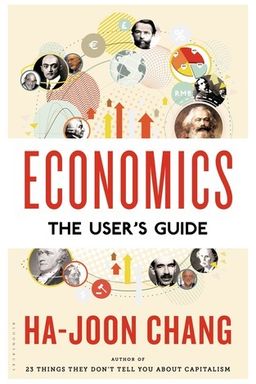
Economics The User’s Guide cover

Economics The User’s Guide

by Ha-Joon Chang

Economics: The User’s Guide by Ha-Joon Chang offers a comprehensive overview of economic principles and their impact on daily life. By examining historical shifts and modern economic institutions, it provides readers with essential insights into how economies operate today, making complex ideas accessible and engaging.

Economics as a Human System

Why does economics matter to you? In Economics: The User’s Guide, Ha-Joon Chang argues that economics isn’t a detached science of rational choice but a practical study of how societies organize production, distribute income, and make collective decisions. He reminds you that economics is not a model of everything; it is about the economy—how human institutions, technologies, and policies interact to shape money, work, and wellbeing.

Chang’s central claim is that economic thinking has become too narrow. Neoclassical theory turned economics into a universal logic of rational behavior, but that definition strips away history, power, and institutions. If you instead define economics by its subject—the economy—you regain focus on jobs, production, firms, trade, and policy choices. You stop asking “what is the optimal outcome?” and start asking “under what assumptions, for whom, and in which context does this outcome hold?”

Economics as an Evolving Conversation

Chang describes economics as an evolving conversation among competing schools: Classical, Neoclassical, Marxist, Developmentalist, Austrian, Schumpeterian, Keynesian, Institutionalist, and Behaviouralist. Each emphasizes different realities—production, exchange, innovation, social structure, or psychology. No single school can explain everything, but together they form a pluralist toolkit. You use different lenses depending on whether you’re studying market allocation, financial crisis, or industrial policy.

(Parenthetical note: Chang’s pluralism contrasts sharply with economists like Milton Friedman, who promoted a single model of efficient markets. Chang’s approach is closer to Amartya Sen’s or John Kenneth Galbraith’s—context matters, and values are inseparable from analysis.)

Economics and Context: History and Institutions

You can’t understand today’s economy without its history. Capitalism evolved through centuries of technological, institutional and political change—division of labour in Smith’s pin factory, mechanization, colonialism, and welfare state expansion. The Golden Age (1950–73) proved that mixing markets with state intervention can produce fast, inclusive growth. The neoliberal turn afterward—Thatcher, Reagan, deregulation—led to financial booms and crises. Chang’s historical method lets you ask better questions about why certain policies succeed or fail in a given time and place.

Economics as a Moral and Political Discipline

Economic choices are never value-free. When experts say, “free trade increases welfare,” you must ask: whose welfare? Chang insists economics is political—it determines how resources and power are distributed. Recognizing this moral dimension helps you think beyond technical efficiency toward questions of justice, democracy, and sustainability. Numbers like GDP, unemployment or poverty are tools, not truths. They reflect definitions and exclusions—especially of unpaid labour, informal work, or environmental loss.

Learning to Use Economics

Ultimately, Chang wants you to become an active user of economics, not a passive consumer of expert claims. You learn how to interrogate assumptions, contextualize data, and use multiple theories critically. Economics becomes a civic skill: a way to weigh policies, challenge ideology, and participate in democratic choices about what kind of economy you want.

Key takeaway

Economics, properly defined, studies how societies organize production and distribute life chances. Understanding this equips you not only to grasp markets but to question power, rethink policies, and act as an informed citizen in shaping your economy.

You finish the book not with “the” economic truth but with a set of lenses and habits of inquiry—historical, institutional, moral and empirical—that help you interpret the world around you with greater clarity and skepticism.


The Evolution of Capitalism

Chang traces capitalism’s long transformation from small owner-managed workshops to massive multinational corporations and global finance. This journey matters because institutions and technologies evolve together, shaping what markets can do. He begins with Adam Smith’s pin factory and ends with Lehman Brothers.

From Craft Production to Global Firms

Division of labour boosted productivity dramatically—from tens of pins per worker in Smith’s time to hundreds of thousands a day in modern mechanized plants. That growth required machines, capital and property rights—the institutional foundations of capitalism. Over time, limited liability turned ownership into tradable shares and separated control from ownership. Giant corporations like Boeing and Walmart emerged, operating across borders and economies.

Protection versus Free Trade

Contrary to free-market mythology, early capitalist success depended on protection. Henry VII’s textile subsidies and Hamilton’s infant-industry argument show how industrialization was state driven. Britain championed free trade only after it dominated global manufacturing. Colonialism, not laissez-faire, locked many nations into raw-material roles. Understanding that history helps you see why developing economies often prospered when they used targeted protection and industrial policy.

The Golden Age and After

After WWII, mixed economies—combining state guidance and market incentives—delivered unprecedented prosperity. Japan, West Germany and South Korea flourished under development states. The neoliberal era that followed sought deregulation and privatization, but its financial excesses led to repeated crises: Mexico 1995, Asia 1997, global 2008. The lesson for you is clear: capitalism’s robustness depends on institutional balance, not dogmatic markets.

Historical insight

Capitalism adapts through cycles of innovation and crisis. To understand today’s system, you must view it as a historical evolution shaped by policy, technology and power—not as a fixed set of market laws.

When you grasp this historical dynamism, you can evaluate current reforms—industrial strategy, financial regulation, trade policy—with the realism that context makes or breaks success.


Production and Innovation

Chang opens the “black box” of production—the engine of real economic growth. He argues that productivity and development hinge on how societies organize work and innovate, not only on market efficiency. You learn to look inside the firm, where technology, skills and management decisions shape national progress.

Industrial Learning and Policy

Manufacturing, historically the learning centre, generates spillovers that spread knowledge to other sectors. Countries that industrialized—Britain, the U.S., Japan, South Korea—did so through deliberate policies: protection, infrastructure, and training. High investment ratios and R&D spending drive long-term growth (note: China’s investment above 30% of GDP and Korea’s 3% R&D share exemplify productive commitment).

Technological Systems and Collective Innovation

Innovations rarely occur in isolation. Corporate labs, public research agencies and defense projects co-create technology. Toyota’s lean production, DARPA-sponsored computing and joint university-industry ventures illustrate that innovation is institutional, not just entrepreneurial. Policies that sustain collaboration across public and private spheres build lasting national advantage.

Beyond Post-Industrial Illusions

Chang cautions you against believing in a “post-industrial” utopia. Falling manufacturing shares don’t mean production lost importance—statistical effects and outsourcing inflate services. Real deindustrialization, as in the UK, erodes capabilities; by contrast, Germany retains industrial excellence through investment and apprenticeship. Development needs production depth, not just digital services.

Key takeaway

If you want sustainable prosperity, focus on production capacity and innovation systems—not on short-term output statistics. Industrial learning determines how economies evolve and how they can adapt to global competition.

You’ll start judging growth by whether it builds capabilities, diversifies industry, and generates technologies that benefit society rather than simply yield profits.


Finance and Fragility

Modern finance both empowers and imperils the economy. Chang dedicates multiple chapters to explaining how banking, securitization and derivatives magnify liquidity and risk. You learn to see finance as a system built on confidence—a managed instability that requires constant oversight.

Banking as a Confidence Game

Banks promise liquidity they cannot fully deliver. The Mary Poppins example—depositors demanding their money back—shows how trust sustains banking. Central banks act as lenders of last resort when runs threaten liquidity but not solvency. Deposit insurance and prudential regulation defend confidence, yet excessive leverage still breeds collapse (Northern Rock, Icesave).

Securitization and Derivatives

Financial innovation pooled and repackaged loans into asset-backed securities and CDOs. While intended to spread risk, opacity and leverage created systemic fragility. CDO2 structures were so complex even professionals couldn’t read them (Andy Haldane joked one required a billion pages). The 2008 global crisis revealed that securitization had redistributed—not eliminated—risk, linking institutions worldwide.

Financialization and Short-Termism

Finance invaded non-financial corporations. GE and GM derived much profit from financial arms; average shareholding periods shrank from years to months; retained profits for investment collapsed below 10%. Firms prioritized dividends and buybacks over innovation and skill building. This short-term culture drained industrial momentum and skewed incentives toward speculation.

Core insight

Finance is indispensable but dangerous when detached from production. Sustained prosperity requires channeling capital toward long-term innovation, not short-term gains.

Understanding finance this way helps you see why regulation, transparency and institutional design—lender-of-last-resort roles, capital rules, accountability—are essential for healthy capitalism.


Markets, States, and Democracy

Markets fail. Governments fail. The challenge is designing institutions that balance efficiency with democratic accountability. Chang shows how both sides of the debate—market fundamentalism and state skepticism—miss that economic governance is a political choice about values, power and inclusion.

Understanding Market and Government Failures

Markets misallocate resources when public goods or externalities exist. States mismanage resources when captured by elites or corrupted. The neoliberal remedy—depoliticizing economic policy—often undermines democracy. Independent central banks and deregulated finance substitute “one dollar, one vote” for “one person, one vote.” Chang argues regulation must remain publicly accountable.

A Pragmatic Middle Path

You should aim for transparent regulation that prevents capture while upholding democratic oversight. Key steps include giving regulators public scrutiny, balancing independence with accountability, and rejecting one-size-fits-all solutions. Finance, environmental protection and monopoly control are areas where state intervention is not ideological but practical.

Key insight

Depoliticizing the economy weakens democracy. Effective governance requires both competent regulation and citizen participation to align policy with shared social goals.

Chang’s approach reminds you that economics is part of democratic life, not a technocratic exercise. Balancing market dynamism with democratic control keeps capitalism socially legitimate and stable.


Growth, Poverty, and Inequality

Economic success means more than rising GDP. Chang distinguishes between growth—output expansion—and development—building sustained productive capabilities and equitable societies. He explores poverty and inequality to show why social justice is central to economic health.

Growth without Development

Equatorial Guinea’s oil boom produced 18.6% annual growth but left the economy hollow. Foreign firms extracted resources while domestic capacity stayed stagnant. True development is inclusive, diversified and skill-based. It demands investment in education, R&D and infrastructure, not mere resource rents.

Inequality and Poverty as Economic Issues

Using Gini and Palma measures, you see inequality as an economic toxin that harms health, reduces stability and limits growth. High inequality (South Africa >0.6 Gini) breeds distrust and obstructs mobility. Poverty persists even in middle-income nations because growth often concentrates gains. Absolute poverty—under $1.25/day—remains widespread, but relative and multidimensional poverty reveal deeper exclusion.

Policy Remedies

Redistribution, universal services and fair labour rules reduce inequality without killing growth. Progressive taxation, active social investment and anti-corruption policies transform outcomes (Scandinavian experience proves the point). Eliminating poverty sustainably still requires growth—but growth built on capabilities and fair institutions.

Key message

When wealth concentrates and capabilities stagnate, economies become fragile. Development requires not just production but justice—reducing inequality and enabling everyone to participate productively.

You learn to judge economies by whether growth improves lives broadly and empowers future development rather than enriching a few.


Work and Human Dignity

Work is more than income—it’s identity and dignity. Chang restores labour to the centre of economics, showing how jobs shape wellbeing and social cohesion. Unemployment, exploitation, and insecurity are not inevitable; they result from policy and institutional design.

Jobs Beyond Pay

Stable jobs cultivate skills and purpose. Insecure and low-quality work damages health and productivity. Global data from the ILO—over 120 million child labourers and 21 million forced workers—show how far we still are from dignified employment. Economic success should therefore be judged by job quality, not just quantity.

Understanding Unemployment

Chang identifies frictional, structural, cyclical, political and systemic unemployment. Each type needs different solutions—from training programs to fiscal stimulus. The post-war “Golden Age” achieved near full employment, proving that institutional coordination can overcome systemic joblessness.

Policy for Decent Work

Strong labour laws, collective bargaining and social safety nets make employment secure and fair. Nordic models and cooperative enterprises like Spain’s Mondragon show how democracy at work can balance efficiency and humanity.

Key insight

Work's value extends beyond money. Economies that treat labour as disposable neglect the social and innovative power of people—their most important resource.

For you as a citizen, good economics means policies that protect dignity at work and ensure everyone can contribute productively to collective welfare.


Globalization and Strategic Openness

Chang teaches you to separate rhetoric from reality in global economic integration. Trade, foreign direct investment and migration can enrich nations—but only with deliberate management. Historical examples and current data show why openness must be strategic, not ideological.

Trade and Technology

Free trade can boost efficiency, yet blind liberalization can stunt development. Infant-industry protection helped Japan and Korea catch up. Ricardo’s comparative advantage assumes instantaneous adaptation, which rarely happens. You should support openness when it builds capabilities and manage it when it threatens nascent industries.

Managing FDI and Multinationals

FDI brings technology and jobs but also risks domination. From United Fruit’s colonial power to modern tax-avoidance giants like Google, multinationals can distort local economies. Policies such as local content rules and joint-venture requirements maximize benefits while safeguarding autonomy.

Migration and Remittances

Migration enriches both sending and receiving countries. Migrants contribute taxes and expertise, while remittances exceed $300 billion globally. Yet brain drain can weaken poor nations. Sensible immigration and diaspora strategies convert mobility into shared gain.

Practical lesson

Globalization works best when managed. Smart openness protects learning and sovereignty while engaging productively with the world.

By seeing trade and investment as tools, not doctrines, you gain perspective on how countries like China, Finland and Korea built prosperity by calibrating rather than surrendering openness.


Measuring and Using Economics Wisely

Economics relies on numbers—but numbers are constructed. Chang shows you how GDP, inequality indices and poverty lines encode choices and value judgments. To use economics wisely, you must interrogate data and theory alike.

Understanding Measures

GDP totals market value but ignores depreciation, unpaid labour and environmental cost. GNI measures national income globally; PPP adjusts for local prices. Each tells a partial story. Household work worth ~30% of GDP never appears in official accounts, undervaluing care and gendered labour.

Numbers and Values

Statistics always involve choices—what to count and what to omit. Happiness and wellbeing indices try to fix this but raise philosophical questions about adaptive preferences. Recognizing these limits won’t make you cynical; it will make you critical.

Using Economics Democratically

Chang concludes that economics belongs to everyone. Ask “Cui bono?”—who benefits—whenever a claim is made. Learn multiple frameworks, challenge experts, read footnotes, and stay engaged in public debate. The economy is too important to be left to economists alone.

Final message

Economics is a shared language of power. When you learn to read its numbers critically and interpret its theories pluralistically, you claim your role as an informed citizen shaping the economy’s future.

Using economics well means knowing its tools and biases, questioning its claims, and engaging with it as a living, democratic discipline.

Dig Deeper

Get personalized prompts to apply these lessons to your life and deepen your understanding.

Go Deeper

Get the Full Experience

Download Insight Books for AI-powered reflections, quizzes, and more.