
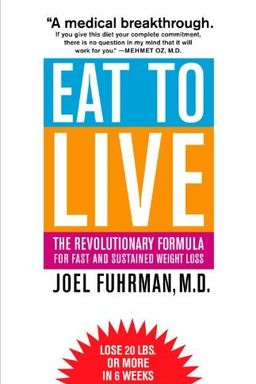
Eat to Live cover

Eat to Live

by Joel Fuhrman

Eat to Live by Joel Fuhrman presents a revolutionary approach to nutrition, advocating for a nutrient-rich, plant-based diet that promises rapid and sustained weight loss, improved health, and increased longevity. This transformative guide challenges conventional dieting wisdom, offering practical advice and recipes to help readers embrace a healthier lifestyle.

The Nutrient-Density Revolution

How can you eat more while weighing less, heal chronic disease, and still feel satisfied? In Eat to Live, Dr. Joel Fuhrman argues that health is determined not by restriction or calorie counting but by the nutrient density of your diet. His central formula—H = N/C (Health equals Nutrients divided by Calories)—condenses decades of nutrition science into a single actionable principle. You become healthier by raising the nutrients (the numerator) while lowering empty calories (the denominator).

Fuhrman challenges the cultural belief that weight loss must involve hunger or deprivation. Instead, he proposes the nutritarian approach—maximizing vitamins, minerals, fiber, and phytochemicals per calorie consumed. When you center your meals on greens, beans, fruits, nuts, and seeds, your body naturally regulates appetite and weight without willpower battles. At the same time, chronic diseases like diabetes and hypertension begin to reverse because your cells finally receive the molecular tools to heal and detoxify.

From Caloric Density to Nutrient Density

Fuhrman explains why the calorie-heavy, nutrient-poor modern diet fuels obesity. Foods like soda, refined grains, oils, and animal products deliver high calories with few protective compounds. Fiber and micronutrients signal fullness and optimize metabolism—attributes refined foods lack. A plate of vegetables contains only a fraction of the calories of an equal weight of fried foods yet fills your stomach mechanically and biochemically, suppressing appetite naturally. Case studies such as Rosalee and Charlotte show rapid medical improvement when individuals replace empty calories with high-N/C meals—weight loss, normalized lipids, better glucose control, and medication reduction.

Phytochemicals: Nature’s Healing Arsenal

Nutrients are only part of the picture. Fuhrman highlights phytochemicals—natural plant compounds found in cruciferous vegetables, berries, onions, and tomatoes—that protect DNA, detoxify carcinogens, neutralize free radicals, and modulate inflammation. He warns that supplements cannot reproduce this complex synergy. Julia’s recovery from severe heart disease (losing 90 pounds and regaining mobility) demonstrates how phytochemical-rich diets often outperform medication alone. The lesson: disease prevention lies not in pills but in the color and variety on your plate.

The Behavioral and Biological Reset

Fuhrman distinguishes toxic hunger—withdrawal symptoms caused by poor diets—from true hunger, the gentle physiological need for fuel. Most modern eaters live in addiction to processed foods; when they switch to nutrient-rich meals, they experience short-lived withdrawal but then rediscover normal appetite control. Isabel’s transformation—dropping 80 pounds and eliminating migraines—illustrates that recovery comes once cravings subside and fiber-rich foods stabilize energy.

A Framework for Reversal and Longevity

The book progresses from theory to structured practice. The Six-Week Plan provides aggressive, measurable targets: one pound of raw vegetables, one pound of cooked greens, one cup of beans, and at least four fruits daily while excluding all animal products, refined grains, oils, and sweets. succeeding patients—John Pawlikowski reversing coronary blockages, Gerardo Petito stopping insulin within weeks—prove that nutrient density can reverse disease. Afterward, the Life Plan and 90 Percent Rule sustain results: keep at least 90% of calories from whole plant foods and treat processed or animal items as rare condiments.

The Broader Philosophical Shift

Fuhrman’s argument is more than dietary advice—it’s a rejection of pharmacologic dependency and a call to self-care through food. He asks you to flip the standard metric: don’t ask how many calories are in a food; ask how many nutrients you get per calorie. Through practical, empirically supported examples and behavioral strategies, Eat to Live shows that your fork can be your most powerful medicine—one that heals from within and sustains vitality across a lifetime.


The Science of Nutrient Density

Fuhrman’s Health Equation, H = N/C, reframes nutrition from calories to chemistry. It quantifies what most diets ignore: the quality of calories. Every bite either raises or lowers your health score. The more nutrients—vitamins, minerals, antioxidants, fiber, and phytochemicals—you pack into each calorie, the stronger your body’s capacity to repair tissue, prevent oxidative damage, and regulate hormones.

Why Nutrient Density Works

High-N/C foods trigger satiety without excess calories. Fiber and water volume stretch the stomach, while micronutrients calm hunger centers in the brain. You eat until you’re truly full but ingest fewer calories overall. For example, 100 calories of broccoli provides more protein per calorie than 100 calories of steak, plus fiber and protective compounds impossible to find in meat. This biochemical advantage explains why patients report reduced cravings within weeks on Fuhrman’s program.

Empty Calories and Their Consequences

Empty calories—refined grains, oils, and sugary drinks—deliver energy without protection. They raise insulin, cholesterol, and inflammation. Fuhrman cites Charlotte’s transformation—263 pounds to 130, diabetes reversed—to demonstrate the metabolic turnaround that follows abandoning those foods. He insists that the problem isn’t overeating but undernutrition hidden within high-energy diets. The solution is to replace caloric density with nutrient density.

Core Insight

When you maximize nutrient density, your body naturally regulates weight, appetite, and disease risk without conscious restriction.

Fuhrman’s mathematical framing unites nutritional science and practicality. Think of the N/C ratio as a compass: each meal either builds health or subtracts from it. Once you orient your food choices by this metric, weight loss and disease reversal become predictable physiological consequences—not hopes based on willpower.


Plants, Phytochemicals, and Cellular Defense

Beyond macronutrients lies the hidden orchestra of phytochemicals—natural defensive compounds that make plant foods medicinal. Fuhrman teaches that these agents work synergistically, performing antioxidant, detoxifying, and anti-inflammatory roles that drugs or isolated supplements rarely mimic. He urges you to think of your daily salad as an immune therapy, not just a meal.

What They Do and Why Variety Matters

Cruciferous vegetables offer isothiocyanates that induce detox enzymes. Berries provide anthocyanins that reduce oxidative stress. Tomatoes contribute thousands of carotenoids and flavonoids that guard DNA. Each plant family adds unique protective molecules—hence Fuhrman’s rule: the more colors and textures you eat, the broader your defense network against aging and disease. Over ten thousand phytochemicals are known, yet most remain unnamed; supplements capture only fragments of this complexity.

Evidence Through Recovery

Real-world transformations ground this theory. Julia, once dependent on ten cardiac medications, regained her ability to walk within months of eating a phytochemical-rich diet. Her case reinforces Fuhrman’s claim that food can reverse disease at the cellular level by modulating inflammatory pathways and encouraging tissue repair.

Why Supplements Fail

Fuhrman cautions that isolating nutrients may backfire. The Finnish trials showed that beta-carotene pills increased lung-cancer risk in smokers, while naturally occurring carotenoids in vegetables correlate with protection. He summarizes the lesson bluntly: “You cannot buy your health in a bottle—you must earn it.” The way forward is a diverse plant-based plate that leverages nature’s biochemistry rather than synthetic shortcuts.


Rethinking Animal Protein

Fuhrman devotes significant attention to the biological consequences of animal products. Drawing on T. Colin Campbell’s China Project and other research, he connects meat, dairy, and eggs with elevated risk of cancer, heart disease, and metabolic disorders. The culprit is not only saturated fat but also animal protein itself, which alters hormone and enzyme regulation.

Hormones and Growth Signals

Animal foods raise levels of insulin-like growth factor 1 (IGF-1), a hormone that accelerates cell proliferation and is linked to breast and prostate cancers. Dairy particularly raises IGF-1, undermining its reputation as a “health staple.” Even lean poultry, long considered safe, can generate carcinogenic compounds when grilled or charred. Fuhrman recommends limiting animal calories to below ten percent if disease reversal is your goal.

Clinical and Practical Lessons

Patients like ReBecca—who lost over 300 pounds after abandoning animal foods—demonstrate that reducing these products helps normalize cholesterol and inflammatory markers quickly. Every substitution of beans or greens for animal protein moves you toward improved hormonal balance and longevity.

Key Message

To minimize cancer and heart disease risk, shift animal foods from the center to the margin of your diet—and let plants provide your primary protein sources.

Fuhrman’s perspective challenges conventional moderation advice: the health benefits of drastically reducing animal intake far exceed those of modest limitation. For long-term vitality, he urges a plant-predominant nutritional foundation, where beans and greens replace meat on both biological and cultural grounds.


Fiber, Hunger, and Freedom from Addiction

In Fuhrman’s framework, fiber does far more than regulate digestion—it restores appetite control and breaks addictive patterns. Modern eaters mistake withdrawal from processed food as hunger, perpetuating overeating cycles. Fuhrman introduces two key concepts: toxic hunger versus true hunger.

Understanding Toxic Hunger

Toxic hunger manifests as irritability, headaches, and stomach discomfort—symptoms of detoxification rather than genuine nutrient need. You experience this when the body depends on high-fat, high-caffeine diets and reacts to the absence of stimulation. Fuhrman reassures you that these symptoms diminish as your tissues adapt to clean eating, leading to effortless appetite control.

Fiber’s Metabolic Magic

Natural fiber from beans, fruits, and vegetables slows glucose absorption, supports gut flora, and binds carcinogens. Fuhrman aims for 50–100 grams per day from whole foods. Isabel’s case shows how increasing fiber relieved migraines and stabilized weight after her detox transition.

Practical Application

Commit six weeks to high-fiber, nutrient-rich foods, tolerate initial withdrawal, and watch cravings fade—appetite becomes your ally rather than your enemy.

Fuhrman turns what looks like restriction into liberation: when you eat foods that nourish rather than stimulate, hunger loses its toxicity, and eating regains its natural rhythm. You stop counting calories because your body finally counts nutrients correctly.


Fat Myths and Whole-Food Fats

Fuhrman makes a sharp distinction between extracted oils and whole-food fats. Oils—even olive oil—are concentrated calories stripped of fiber and phytochemicals. One tablespoon contains about 120 calories that convert almost directly into body fat. Conversely, raw nuts, seeds, and avocados provide essential fats along with nutrients that enhance satiety and cardiovascular protection.

The Fattening Effect of Oils

Fuhrman uses biopsy evidence showing dietary fat stored nearly unchanged: “from lips to hips.” He dismantles marketing tricks behind “fat-free” labels and cautions that even the Mediterranean Diet’s success owes more to vegetables than to olive oil. For overweight individuals, eliminating added oils is critical for metabolic reset.

Essential Fats the Right Way

Omega-3s are vital, but Fuhrman guides you toward plant sources—flaxseed, chia, walnuts. He recommends 1–2 grams of ALA daily and optional algal DHA supplementation for consistent conversion. Fish oils, he notes, risk contamination, making purified plant-derived alternatives safer for long-term use.

Takeaway

Choose fats embedded in whole plants—nuts, seeds, and avocados—rather than in bottles. These provide energy, essential fatty acids, and disease protection without sabotaging weight loss.

Fuhrman positions fat not as an enemy but as a nutrient that must remain in its natural package. Treat oil as empty calories and nuts as nutritious calories—the distinction shapes your body composition and longevity trajectory.


Reversing Disease with Nutritional Medicine

Fuhrman’s strongest claim is that you can reverse—not just manage—many chronic diseases. His diet-first strategy targets biochemical repair through nutrient saturation. Patients routinely reduce medication within weeks as glucose, blood pressure, and cholesterol normalize.

Diabetes Reversal

In the Gerardo Petito case, insulin was stopped within days after initiating the program, and blood sugar fell from 175 to 80 mg/dL in a month. Fuhrman warns that insulin dependency perpetuates obesity—a vicious cycle avoided by reversing insulin resistance through weight normalization and plant nutrients.

Heart and Lipid Recovery

Cardiac patients like John Pawlikowski and Cliff Johnston achieved dramatic improvements: LDL reduced below 100, total cholesterol from 401 to 170, triglycerides from 1,985 to 97. Fuhrman asserts that aggressive nutrient density can halt or regress atherosclerosis—something conventional dietary advice rarely achieves.

Autoimmune and Inflammatory Illness

For autoimmune disease, Fuhrman combines plant-based nutrition with gluten elimination and occasional supervised fasting. Many rheumatoid and lupus patients achieved remission when inflammatory triggers were removed. His premise: when nutrient density rises, immune balance returns—a physiological recalibration made possible through food rather than pharmaceuticals.


The Six-Week and Life Plans

Fuhrman provides structure through two stages: the Six-Week Plan for detox and rapid improvement, and the Life Plan for lifelong sustainability. The first is strict—no animal products, no oils or refined carbs, unlimited greens, beans, and fruits. The second allows moderate flexibility while preserving nutrient density as the foundation.

The Six-Week Phase

Eat one pound of raw vegetables, one pound of cooked greens, and a cup of beans daily. Fruits are unlimited (except juices). You may include up to one serving of whole grains or starchy vegetables. It’s a biochemical reboot—patients regularly lose 15–20 pounds per month as inflammation subsides and energy returns.

The Life Plan and 90 Percent Rule

After six weeks, shift to maintenance: at least 90% of calories from unrefined plant foods. The remaining 10%—roughly 150–200 calories daily—permits occasional flexibility. Treat animal or processed foods as condiments, not staples. Emily and Anthony exemplify long-term success: both lost around 100–160 pounds and sustained health improvements for years by maintaining the rule.

Behavioral Principle

Results beget results—seeing change fuels commitment. Strict early action creates momentum for a lifetime of healthy eating.

The progression from Six-Week rigor to Life Plan balance mirrors Fuhrman’s philosophy: health transformation starts with discipline and matures into freedom. Once your body experiences true wellness, moderation becomes intuitive.


Mindset, Support, and Lasting Change

Fuhrman closes by reminding readers that transformation requires environment and mindset. Knowledge alone won’t sustain change; habits and social support will. He presents behavior modification tools drawn from psychology and patient success stories to help you make clean eating habitual rather than heroic.

Environmental Control

Remove temptations. Debra Caruso managed family resistance by isolating junk foods to a separate space, reducing exposure without confrontation. Stimulus control is the first line of defense against relapse.

Self-Monitoring and Community

Track progress—labs, weight, and emotional well-being—and join support groups or online communities for accountability. Consistent evaluation transforms motivation into momentum.

Movement and Joy

Exercise is prescribed like medicine: walk stairs twice daily or build up to jogging as weight falls. Anthony’s example—losing 160 pounds and completing a half marathon—illustrates how physical activity compounds nutritarian benefits. Fuhrman’s final message: health is not a temporary condition but a practiced way of living supported by structure, compassion, and self-awareness.

Dig Deeper

Get personalized prompts to apply these lessons to your life and deepen your understanding.

Go Deeper

Get the Full Experience

Download Insight Books for AI-powered reflections, quizzes, and more.