
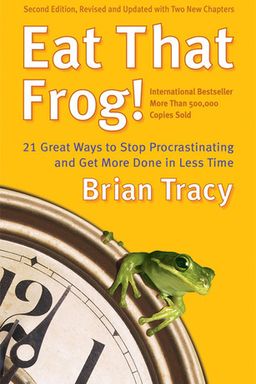
Eat That Frog! cover

Eat That Frog!

by Brian Tracy

Eat That Frog! offers 21 proven strategies to defeat procrastination and enhance productivity. By focusing on your most important tasks first, you can efficiently manage time, reduce stress, and achieve higher levels of success and satisfaction.

The Habit That Changes Everything: Eat Your Biggest Frog First

What if the key to transforming your productivity—and your sense of accomplishment—was as simple as eating a frog every morning? Of course, not a real frog, but in Eat That Frog!, Brian Tracy uses this vivid metaphor to describe the one essential habit that separates top performers from everyone else: tackling your most important, most unpleasant task first. By doing so, you break procrastination’s grip and unlock a cascade of motivation, momentum, and confidence that powers you through the day.

Tracy argues that in today’s world of endless possibilities and overflowing to-do lists, success doesn't come from doing more—it comes from doing what matters most. We're not suffering from a lack of opportunity or talent, he says, but from an inability to focus amid so many choices. This is where his deceptively simple rule makes the difference: identify the task with the greatest potential impact on your life or work—the big, ugly frog—and eat it first thing in the morning.

Why Frogs and Focus Matter

The frog you dread represents your biggest challenge or most important goal—the one you are most likely to delay even though it offers the most reward. By confronting it immediately, you redefine your mental patterns. You teach yourself to act rather than delay, to focus on results instead of activity. Tracy emphasizes that this habit is not innate; it's learnable through decision, discipline, and determination—the “three Ds” of habit formation. The more you practice, the more automatic it becomes, until productivity is no longer effortful but instinctive.

He compares developing this habit to physical conditioning: your mind is like a muscle that strengthens with use. Eating your frog triggers endorphins, the brain’s pleasure chemicals, creating a “positive addiction” to completion. Over time, you crave that satisfying rush of finishing important work. Each success fuels the next, compounding into unstoppable momentum.

Why Clarity Beats Effort

Tracy begins with “setting the table.” Clarity, he insists, is the foundation of productivity. Most procrastination arises not from laziness but from vagueness—uncertainty about what truly matters. When you write down your goals, specify deadlines, and map the necessary steps, you transform abstract dreams into concrete projects. It’s impossible to prioritize when you don’t know what you’re aiming for.

He describes a simple seven-step process for defining and pursuing goals: decide exactly what you want, write it down, set deadlines, make lists, organize the lists by priorities, take immediate action, and do something every day that moves you toward your goal. These steps act like a flight plan—another analogy Tracy uses in his other book Flight Plan—guiding you through turbulence toward your destination.

The Power of Action Orientation

A recurring theme across the book is action orientation. Studies show that people who act quickly and persistently toward major goals outperform those who spend their energy planning or talking about what they will do. Tracy cites corporate research where “failure to execute” is identified as the number one organizational problem. He urges you to distinguish motion from progress—to do what matters, not just look busy. High achievers, he writes, launch directly into key tasks and sustain focus until completion, while others drown in distractions and meetings.

The frog metaphor also harnesses psychological insight: people naturally prefer completing small, easy tasks, which leads to low return activities dominating the day. By purposely choosing the hardest task, you invert this pattern and rewire your motivation. This concept mirrors Charles Duhigg’s discussion of “keystone habits” in The Power of Habit: one small behavioral change that triggers improvements across multiple areas.

The Broader System Behind the Frog

Beyond the central metaphor, Tracy provides twenty-one practices for sustaining productivity and focus. These range from timeless methods like the 80/20 Rule and daily planning to modern challenges such as technology addiction. Each principle builds on the frog concept—helping you identify what matters most, organize your time around those priorities, and execute efficiently.

For instance, creative procrastination teaches you to intentionally delay or eliminate trivial tasks so you have more time for high-impact actions. The ABCDE Method helps you sort tasks by importance before the day starts. The Law of Three narrows your focus to the handful of tasks that create 90 percent of your value. And cultivating a sense of urgency fuels the momentum that carries you into flow—the euphoric state of complete concentration and effortless action described by psychologist Mihaly Csikszentmihalyi.

Why This Matters in a Distracted World

Tracy’s message feels even more urgent today. In a digital age where multitasking and notifications fragment our attention, his advice to “single handle every task” is revolutionary. Modern neuroscience confirms his conclusions: sustained focus increases learning, reduces stress, and strengthens intrinsic motivation. Each frog you eat builds your discipline muscles and reclaim your agency from distraction.

“The ability to concentrate single-mindedly on your most important task, to do it well and finish it completely, is the key to success, achievement, respect, status, and happiness.” —Brian Tracy

Ultimately, Eat That Frog! is about reclaiming control of your time, career, and inner life. Tracy doesn’t promise shortcuts; he promises direction—a set of simple, proven behaviors that, when practiced consistently, make success predictable. When you wake up tomorrow, he challenges, don’t wait for motivation. Find your frog, and eat it. Because everything—clarity, momentum, happiness—follows from that first deliberate bite.


Clarity Before Action: Setting the Table

Tracy’s first principle, “Set the table,” lays the foundation for every other productivity technique. Before diving into any task, you must get crystal clear about what you want and why. This clarity creates focus, energy, and direction—the antidotes to procrastination.

The Seven-Step Goal Formula

Tracy’s seven-step goal process is deceptively simple: decide exactly what you want, write it down, set a deadline, make a list of everything required, organize the list by priority and sequence, take action immediately, and do something every single day toward your goal. It’s not just about defining the end, but about creating momentum through consistent movement.

He tells stories of professionals who revolutionized their results simply by writing down concrete goals. One of his clients doubled her income within a year by listing targets and daily steps. The act of writing, Tracy insists, transforms vague hopes into precise intentions. As motivational expert Napoleon Hill (who Tracy frequently quotes) observed, turning thoughts into words and deadlines into commitments makes achievement inevitable.

The Psychology of Clarity

Clarity produces confidence. Ambiguity breeds anxiety. When you know precisely what the “frog” is, you gain control over your attention. Instead of reacting to the day, you guide it. Tracy compares working on undefined goals to climbing a ladder leaning against the wrong wall—it may feel productive, but you’re moving fast in the wrong direction. The cure is thinking on paper—externalizing ideas so they can be analyzed, sorted, and acted upon.

This approach anticipates modern productivity systems like bullet journaling or David Allen’s Getting Things Done methodology, which also emphasize capturing and organizing tasks to relieve mental clutter. Both rely on the cognitive principle that writing externalizes thought, freeing mental bandwidth for executing decisions.

“Only 3 percent of adults have clear, written goals. These people accomplish five to ten times as much as people of equal or better ability who don’t write them down.” —Brian Tracy

In practice, setting the table means defining your biggest frog for the day, week, and year. Once you know what matters most, every decision becomes simpler. Saying “no” to distractions is easier when you have already said “yes” to your purpose. This clarity of intention is the first step toward peak performance—and a calmer, more focused life.


The 80/20 Rule: Focus on High-Value Tasks

You’ve heard of the Pareto Principle—that 20 percent of your efforts generate 80 percent of your results. Tracy transforms this into a personal productivity mantra: focus relentlessly on the few tasks that matter most, and eliminate or delay the trivial many.

Separating the Vital Few from the Trivial Many

In business, this principle applies to customers, products, and time; in life, it applies to goals and habits. Most people spend their days feeling “busy,” but busyness is a trap. Activity is not accomplishment. Tracy warns that when you start your day by clearing small tasks, you train your brain to prioritize low-value work. Instead, you must deliberately begin with the hardest, most consequential task—the frog in the 20 percent.

How To Practice Productive Selectivity

Tracy suggests reviewing your entire list of responsibilities and asking: which two tasks contribute the most? Which would, if completed well, make the biggest difference? Those are your frogs. Everything else is a tadpole—a distraction disguised as productivity. This disciplined selectivity mirrors Greg McKeown’s concept of “Essentialism,” which argues that success is about saying no to almost everything so you can say yes to the most important few.

Tracy emphasizes repetition: ask yourself each morning, “Is this task in the top 20 percent or the bottom 80 percent?” Over time, your intuition strengthens, and prioritization becomes automatic. The power of this rule lies in compounding. By continually investing energy in the high-value 20 percent, you multiply results exponentially—achieving more while doing less.

“Resist the temptation to clear up small things first. If you start your day on low-value tasks, you’ll develop the habit of always starting with low-value tasks.” —Brian Tracy

The 80/20 principle forces a sobering realization: you will never finish everything. But as Tracy points out, there is always time for the most important thing. Progress comes from quality of attention, not quantity of hours. By focusing your effort on the tasks that deliver the greatest impact, you stop chasing frogs that don’t matter and start eating the ones that will transform your work and your life.


Creative Procrastination: The Art of Saying No

In an ironic twist, Tracy teaches not how to avoid procrastination altogether, but how to use it strategically. “Creative procrastination,” he writes, means consciously deciding which tasks you will delay or ignore to reserve your time for higher priorities.

Posteriorities, Not Just Priorities

Setting priorities is half the battle; setting “posteriorities”—things you will not do—is equally critical. You must let some things fail so others can succeed. Tracy’s rule is clear: to control your time, you must discontinue lower-value activities. Warren Buffett exemplifies this mindset when he says, “The difference between successful people and really successful people is that really successful people say no to almost everything.”

Zero-Based Thinking

Tracy introduces zero-based thinking: “If I weren’t already doing this, knowing what I now know, would I start again today?” If not, stop it. This powerful question reveals tasks, habits, and commitments that have outlived their usefulness. His anecdote about a businessman cutting back his golf from four times a week to once exemplifies how abandoning a low-return routine can reclaim life balance and reduce stress.

Time management isn’t about speeding up—it’s about choosing better. Deliberate procrastination becomes a tool of wisdom. You can’t do everything; wisely decide what frogs you won’t eat at all. Saying no isn't failure—it’s strategy.

“You can get your time under control only to the degree to which you discontinue lower-value activities.” —Brian Tracy


Mastering Momentum: Developing a Sense of Urgency

If procrastination is the enemy, urgency is its cure. In chapter 20, Tracy describes urgency as an inner drive to act swiftly and continuously on key tasks. This “bias for action” is the distinguishing trait of high performers.

Entering Flow State

When you act with urgency, you trigger flow—a state of absorbed, effortless productivity described by psychologist Mihaly Csikszentmihalyi. In flow, work feels fluid and exhilarating. Tracy explains that action orientation—moving decisively and persistently—helps you reach this state more often. He encourages repeating mantras like “Do it now!” and “Back to work!” whenever distractions arise. These simple cues reinforce momentum and keep your brain focused on completion.

The Momentum Principle

Tracy details the Momentum Principle: starting a task requires the most energy, but once in motion, continuing requires far less. Like pushing a car, initial inertia is tough, but momentum carries you forward easily afterward. The faster you move, the more energized you become—the paradox that activity creates its own energy. Urgency and momentum create emotional rewards: confidence, self-respect, and pride in accomplishment.

He also notes that a reputation for fast, reliable completion is priceless. People who “get things done quickly and well” rise faster, earn respect, and attract opportunity. Developing this tempo can transform a career almost overnight.

“Develop a bias for action. Move rapidly on your key tasks. Nothing will help you more than gaining a reputation for urgency.” —Brian Tracy

By building urgency into your everyday behavior, you condition your mind to overcome hesitation. You stop waiting for perfect conditions. As Tracy quotes Napoleon Hill, “Do not wait; the time will never be ‘just right.’” Start where you stand, and move fast—because motion itself is the miracle.


One Thing at a Time: The Power of Single Handling

Tracy closes his book with one decisive principle: single handling. Once you start a task, work on it without interruption until it’s 100 percent complete. This practice multiplies productivity and builds character—a test of discipline and focus.

The Efficiency Curve

Every time you stop and restart a task, you lose time to refamiliarize yourself and rebuild momentum. Tracy estimates that frequent stops can increase task time by up to 500 percent. Conversely, single handling can cut completion time by half or more. It’s the difference between sprinting straight to the finish line versus wandering in circles mid-race.

Self-Discipline and Character

Single-minded persistence requires self-discipline—the ability to make yourself do what you should, when you should, whether you feel like it or not. Each completed task strengthens your self-esteem, making discipline easier next time. Tracy calls persistence “self-discipline in action.” It’s the bridge between potential and performance.

He quotes Elbert Hubbard to summarize the ethos: “Self-discipline is the ability to make yourself do what you should do, when you should do it, whether you feel like it or not.” Practicing single handling is how you train this muscle. The more you do it, the stronger your character becomes—and the more predictable your success.

“Starting a high-priority task and persisting until it’s complete is the true test of character, willpower, and resolve.” —Brian Tracy

Ultimately, Tracy’s philosophy reduces to one repeating pattern: clarity, focus, action, completion. The discipline of finishing what you start becomes not just a productivity method but a personal creed. You become the kind of person who always eats the frog—and finishes the meal.

Dig Deeper

Get personalized prompts to apply these lessons to your life and deepen your understanding.

Go Deeper

Get the Full Experience

Download Insight Books for AI-powered reflections, quizzes, and more.