
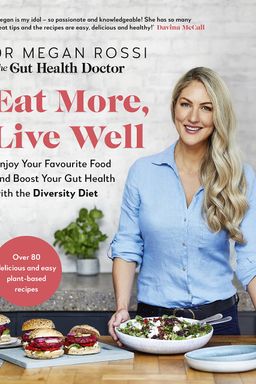
Eat More, Live Well cover

Eat More, Live Well

by Megan Rossi

Eat More, Live Well offers an innovative approach to health by prioritizing a diverse, plant-based diet for a thriving gut microbiome. Learn how to enhance your well-being with delicious, minimally processed foods that boost energy and vitality.

Eat More to Live Well: The Diversity Diet and the Power of Plants

What if better health didn’t come from restriction but from abundance? In Eat More, Live Well, Dr. Megan Rossi — known as The Gut Health Doctor — flips the usual diet narrative on its head. Instead of telling you to “cut out” foods, she challenges you to add in more of what truly nourishes your body and your gut: plants. Her central claim is simple yet profound: eating a diverse range of plant-based foods is the easiest, most sustainable way to enhance your health, happiness, and longevity.

Rossi, a scientist and clinician at King’s College London, introduces what she calls the Diversity Diet. This isn’t a vegan manifesto or a fleeting wellness trend. It’s a flexible, inclusive framework rooted in solid science and real-world results. Her message is both liberating and surprisingly practical: “eat more, not less,” and your gut — and life — will flourish.

Rethinking ‘Plant-Based’: From Restriction to Inclusion

Rossi begins by redefining the overused term “plant-based.” For many, it conjures up visions of strict veganism, bland salads, or joyless diet plans. But in Rossi’s world, being plant-based doesn’t mean giving up animal foods altogether. It means making plants the foundation of your meals rather than the afterthought. It celebrates everything from lentils and legumes to herbs, nuts, wholegrains, and vegetables. In other words, you don’t need to become vegan to reap the benefits — you just need to diversify what’s on your plate.

She places all forms of plant-based eating on a spectrum — from full vegan to flexitarian — giving you the freedom to find what works for you. As she writes, “Wherever you sit on the spectrum is absolutely fine.” This inclusive philosophy distinguishes her from more doctrinaire approaches. It’s less about labels and more about variety, pleasure, and curiosity.

Your Inner Ecosystem: The Role of the Gut Microbiota

At the heart of Rossi’s argument lies a world within us: the gut microbiota (or GM). These trillions of microbes that inhabit our digestive tract influence almost every aspect of our health — from our immune system and hormones to mood and metabolism. A key discovery fueling modern nutrition science is that the diversity of these microbes matters more than the sheer number. The more varied your diet, particularly in plant fibers, the more diverse and resilient your microbial community will be.

Long-width studies in the U.S. (notably from the American Gut Project) found that people who ate thirty or more types of plant foods per week had far greater microbial diversity than those who ate fewer than ten. Rossi uses this as a benchmark and introduces her signature challenge: “30 plant points a week.” Every fruit, vegetable, wholegrain, legume, nut, and even herb counts as one point toward your microbial goals.

She compares our gut microbes to a rainforest — a dynamic ecosystem that thrives on variety. A single nutrient won’t sustain it, but a symphony of fibers and phytochemicals will. And that, she insists, is where genuine health begins.

The Science-Backed Simplicity of Fiber and Diversity

“Where do your gut microbes get their favorite food?” Rossi asks rhetorically. The answer: fiber. Fiber, the indigestible part of plant foods, fuels gut bacteria and triggers them to produce beneficial compounds known as short-chain fatty acids (SCFAs). These substances help regulate inflammation, strengthen the gut lining, and even support mental health by signaling through the gut–brain axis. Yet most people consume far less than the recommended 30 grams daily — often under 20 grams — while our ancestors got closer to 100 grams.

Rather than chasing numbers, Rossi encourages you to rediscover fiber-rich foods through abundance and creativity. Her recipes aren’t about deprivation — they’re comforting and family-friendly: spaghetti made creamy with tofu and cashews, “crispy bacon-shrooms” with butter bean hummus, and prebiotic rocky road. She shows you how the smallest tweaks — like blending chickpeas into hummus or swapping white rice for quinoa — can transform your microbiome and meals alike.

From Gut to Globe: Why It Matters

Rossi’s argument extends beyond personal health. By eating more plants, you don’t just nurture your own internal ecosystem; you help sustain the planet’s. Animal-based foods account for over half of agricultural greenhouse gas emissions, while plants require fewer resources and often contribute to soil health. Thus, the Diversity Diet doubles as a blueprint for environmental resilience — an idea echoed by the EAT–Lancet Commission’s “Planetary Health Plate.”

But above all, Rossi’s tone is optimistic, even playful. She doesn’t shame anyone into change. Instead, she invites readers to experiment and enjoy. “Forget calorie counting,” she writes. “Forget exclusion lists. The only rule is diversity.” Her approach blends rigorous science with compassion and humor — qualities that make complex nutrition science feel deeply human.

Across the chapters that follow, Rossi explains what qualifies as a plant-based food, why diversity outperforms monotony, how to cultivate a resilient microbiome, and how small, joyful habits — from mindful eating to relaxing your nervous system — can amplify the benefits. She backs it all up with clinical stories, from a stressed A&E doctor who learned to enjoy vegetables again to a vegan client who swapped ultra-processed “plant” foods for simple, whole ones and regained her energy. By the time you reach the final sections, you realize her message isn’t just about diet — it’s about reconnecting with your body, your food, and your microbial world. And that’s how you eat more to live well.


Redefining Plant-Based Eating

Megan Rossi begins by clearing up one major misconception: plant-based eating doesn’t mean living exclusively on kale and tofu. Instead, she reframes it as eating that’s based around plants, not limited to them. The key is flexibility, inclusion, and joy. Whether you’re vegan, vegetarian, pescatarian, or flexitarian, what matters is making plants the starring role in your meals.

The Spectrum of Eating Styles

Rossi places plant-based diets on a spectrum — vegan at one end, flexitarian at the other. Somewhere in between exist vegetarians, pescatarians, and those who simply reduce meat consumption. She emphasizes that all of these options can be healthy. “Wherever you sit on the spectrum is absolutely fine,” she says. This inclusive approach contrasts with the moral rigidity often associated with food movements (echoing Michael Pollan’s famous advice, “Eat food, not too much, mostly plants”).

At the same time, she dismantles the assumption that meat-free automatically means healthy. A vegan who relies on chips and sugary snacks isn’t necessarily nourishing their body. Instead, quality, variety, and minimal processing are the true markers of healthful eating.

The Six Principles of the Diversity Diet

To make her philosophy practical, Rossi outlines six simple guiding principles that align food choices with gut science:

  • Mostly plants: Make plant foods the base of your diet, layering on eggs, fish, or dairy as desired.
  • Diversity all the way: Aim for at least 30 plant points per week across all six “Super Six” food groups.
  • Go for whole, not refined: Choose foods close to their natural state — wholegrains over white flour, whole fruit over juice.
  • Inclusion, not exclusion: Focus on adding in nourishment instead of cutting things out.
  • Taste, pause, and enjoy: How you eat matters as much as what you eat — mindful eating supports digestion.
  • Cultivate community: Share meals; eating is social and cultural nourishment, not just fuel.

Together, these principles create a lifestyle that’s joyful, evidence-based, and deeply sustainable. They make “diet” feel like liberation, not punishment.

Changing Taste, Changing Habits

Rossi introduces the story of David, a young doctor who loved fast food. After gradually adding more plant-based meals, something surprising happened — his taste buds changed. When he returned to his old burger, it no longer tasted as good. This, Rossi explains, isn’t magic; it’s biology. Taste buds renew every ten days, meaning that your palate literally rewires itself based on what you eat. By repeatedly exposing yourself to new flavours, you can train your preferences toward healthier foods — a principle backed by behavioral nutrition research.

For anyone who’s ever wished they could crave vegetables the way they crave crisps, this is empowering news. You don’t have to change overnight; your body will evolve with you. As Rossi concludes, “This isn’t about perfection — it’s about diversity.”


What Counts as a Plant-Based Food?

Once you redefine plant-based eating, the next question is: what exactly qualifies as a plant food? Rossi broadens the definition to include all edible parts of plants — from roots and stems to seeds, nuts, fruits, and grains. She classifies them into six core categories she calls the Super Six: wholegrains, fruits, vegetables, nuts and seeds, legumes, and herbs and spices. Together, they cover every macronutrient and micronutrient your gut microbes crave.

The Super Six and Plant Points

Each unique type of plant food earns you one plant point; herbs and spices earn a quarter. So, ten strawberries equal one point, not ten. The goal is variety, not volume. Rossi provides clever hacks to track your progress—like a fridge chart or a “Plant Points Planner”—turning diversity into a fun, gamified process for families. Even tea and coffee count, thanks to their polyphenol content!

However, not all plants are created equal. Rossi references the “Plant-Based Diet Index” (developed by Harvard researchers), which distinguishes between healthy plant-based foods—like fruits, legumes, and wholegrains—and unhealthy ones such as fruit juices, refined flours, and processed vegan meats. The findings were stark: participants eating whole, minimally processed plants had a 25% lower risk of heart disease, while those relying on ultra-processed plant foods had a 32% higher risk. The takeaway? Processing level matters as much as the plant itself.

Beyond Macronutrients: The Power of Phytochemicals

Beyond carbs, fats, and protein, plants provide thousands of phytochemicals—natural compounds that protect your cells, regulate hormones, and reduce inflammation. Rossi highlights five major functions of these phytochemicals: antioxidant defense (berries and teas), hormone regulation (soy and broccoli), antimicrobial protection (cranberries), immune support (kidney beans and peaches), and brain communication (bananas, tomatoes, avocados). She calls plants “nature’s pharmacy,” a view echoed by nutritional scientists like Michael Greger and Valter Longo.

Her favorite metaphor is the apple. Each one contains over 300 phytochemicals and up to 100 million bacteria — a potent microbiome handshake between you and nature. Rossi even cites research showing that imperfect, “wonky” fruits contain more phytochemicals because they’ve fought off more environmental stress. Just like us, resilience breeds strength.


Why Plant-Based Diversity Matters for Health

Rossi argues that modern humans face an epidemic of chronic disease not because we eat too much fat or sugar, but because we eat too narrowly. Out of roughly 300,000 edible plant species, half of global food energy comes from just four: wheat, rice, maize, and potatoes. This monoculture—both in agriculture and diet—has starved our gut diversity and fueled inflammation, disease, and fatigue.

Reclaiming Nutritional Variety

By diversifying plant intake, Rossi says you bolster every system of your body. A wider range of plants means a lower risk of deficiencies in essential nutrients like magnesium, iron, and folate, all of which she details in tables comparing the nutrient profiles of different food groups. Variety also increases pleasure—the more colors and textures on your plate, the more engaged your senses become. Research even links eating enjoyment with longer life span and improved digestion.

Gut Microbes and Chronic Disease

The book presents blunt statistics: poor diet now contributes to about 11 million deaths yearly worldwide. Yet Rossi reassures readers that fewer than 20% of chronic diseases are determined by genes; the other 80% relate to environment and lifestyle—particularly to gut health. A well-fed, diverse microbiome, she says, protects you from over 70 chronic and autoimmune conditions, from diabetes and arthritis to depression.

To illustrate how the microbiome affects tolerance, she uses the example of food sensitivities. Many people who cut out gluten or FODMAP foods end up with even more gut issues, because removing these fibers starves fiber-digesting microbes. When you later reintroduce them, your body protests, lacking the enzymes it needs. The cure is gradual reintroduction, not permanent elimination — a principle many IBS sufferers overlook.

Plants as Preventive Medicine

Rossi reminds us that even modern pharmaceuticals often originate from plants — aspirin from willow bark, digoxin from the foxglove, and quinine from tree bark. She stops short of saying “food is medicine,” but strongly endorses plants as preventive medicine. As gut science matures, she believes “the Diversity Diet” could prove one of medicine’s most powerful non-prescription therapies for modern ills—an idea supported by emerging microbiome research worldwide.


The Far-Reaching Benefits of a Healthy Gut

Rossi’s fourth chapter serves as the scientific heart of the book. Here she maps out how a healthy gut microbiome communicates with nearly every organ via what scientists call “gut axes.” Each axis—gut-brain, gut-skin, gut-immune, gut-hormone, and gut-metabolism—reveals how what’s on your plate can affect your mood, complexion, immunity, hormones, and body weight. Each pathway reads like a story of internal conversation, reminding you that every meal sends messages throughout your body.

The Gut–Brain Axis

Our “second brain,” the gut’s enteric nervous system, communicates with the brain via chemical messengers produced by microbes. Rossi cites the SMILES trial, a groundbreaking study showing that patients with depression who adopted a Mediterranean-style, plant-diverse diet were four times more likely to recover than those receiving only support therapy. Her conclusion: food can’t replace antidepressants, but it can amplify their effects and help prevent relapse.

The Gut–Skin Axis

Our skin and gut are fellow ecosystems, each with their own microbiota. Rossi connects imbalances in the gut with acne, eczema, and premature aging. When the GM produces anti-inflammatory molecules such as SCFAs, it reduces systemic inflammation that affects the skin. She highlights dark chocolate, citrus, and walnuts as top foods for a “gut-skin glow.”

The Gut–Immune and Gut–Hormone Axes

Around 70% of your immune cells live in your gut, so supporting gut diversity directly strengthens resistance to viruses and moderates autoimmune reactions. Rossi recounts how during the COVID-19 pandemic, her husband—a GP—followed her microbial immunity plan (a high-fiber, polyphenol-rich diet, stress management, and adequate sleep) and later tested positive but asymptomatic for the virus. While anecdotal, the case reinforces emerging findings that better gut health improves immune resilience.

Hormonal communication is another vital pathway. Rossi describes how gut microbes activate and regulate estrogen, helping balance menstruation, fertility, and menopause symptoms. They even produce neurotransmitters such as dopamine and GABA, influencing emotion and sleep. For women navigating hormonal changes, she suggests a mix of soy, flaxseed, and leafy greens to support this “gut–hormone harmony.”

The Gut–Metabolism Axis

Weight control and metabolism, too, are influenced by microbes. They affect hunger hormones like ghrelin and leptin, determine how calories are absorbed, and even influence taste preferences. Rossi’s client Jackie, who’d spent decades yo-yo dieting, finally lost weight and reversed pre-diabetes after focusing on plant-based diversity instead of calories. By switching white grains for wholegrains, meat for legumes, and practicing mindful eating, she found lasting satisfaction—a result backed by the 2019 POUNDS study linking fiber intake to easier weight loss. The moral, Rossi says, is simple: “Step off the scales and feed your microbes.”


Overcoming Barriers to Change

Despite the evidence, adopting a diverse, plant-rich diet still feels daunting to many. Rossi tackles each common fear or misconception with empathy and humor. Her message: the only thing standing in your way is misinformation — not ability, not budget, not taste.

Myth 1: 'If I don’t count calories, I’ll gain weight.'

Rossi calls calorie counting the “great calorie con.” Laboratory-calculated numbers don’t account for digestion. A calorie from almonds is not the same as a calorie from a pastry; fiber-rich foods require more energy to digest, leaving fewer calories absorbed and more satisfaction achieved. In one cited study, people eating ultra-processed foods gained weight despite identical calorie counts to those eating whole foods. The reason? Lower “thermic effect” and less fiber-induced fullness. Variety trumps mathematics.

Myth 2: 'Plant-based diets are expensive or inconvenient'

She shows that diversity can be cheap: buy fruits and vegetables in season, use tins and frozen produce, and cook in bulk. Her recipes emphasize simplicity (“Most can be made in under 20 minutes”). Her “fridge raid” and zero-waste icons encourage creativity with leftovers — transforming scraps into soups and dips.

Myth 3: 'I’ll be protein deficient'

Contrary to popular fear, even vegan diets easily meet protein needs if diversity is emphasized. The combination of legumes and grains supplies all nine essential amino acids. Rossi laughs off stereotypes of “weak vegans,” pointing out growing numbers of plant-based athletes. She does caution that vegans should supplement vitamin B12 and omega-3s from algae oil — but insists omnivorous diversity can often cover the rest naturally.

Myth 4: 'More fiber equals more bloating'

Another major barrier: fear of digestive discomfort. Rossi normalizes bloating as a sign of microbial activity — “your gut party.” Still, she advises increasing fiber gradually while maintaining hydration, chewing well, and moving daily. If symptoms persist, she offers a FODMAP-lite approach — temporarily moderating fermentable foods, then reintroducing them slowly to rebuild tolerance. Her clinical insight bridges science and sensitivity: it’s not about avoidance, it’s about adaptation.


Building Your Diversity Diet Toolkit

In the final section, Rossi equips readers with practical tools to make diversity second nature. She calls it a “toolkit,” not a plan — flexible, creative, and 100% habit-friendly. Her goal is to turn knowledge into easy daily action.

The Diversity Hacks

Quick switches include adding seeds to breakfast, mixing beans into sauces, or swapping refined snacks for nuts. Habit formers—like trying one new plant weekly or browsing a new aisle—help keep curiosity alive. Easy adds like sprinkling herbs on meals can quickly push you past thirty plant points without effort. Rossi gamifies the process with trackers and meal plans for families, busy people, and sensitive guts — each providing over 30 daily grams of fiber and up to 80 plants weekly.

Mindful Eating and Stress Relief

Rossi goes beyond food to lifestyle. Stress and poor sleep, she explains, are gut disruptors equal to junk food. Her mindfulness exercise — the ten-step “Eating With All Your Senses” ritual — helps readers slow down, savor flavors, and activate the body’s “rest and digest” mode. She combines this with relaxation practices like box breathing, gratitude journaling, yoga poses for bloating, and even “forest bathing.” Each one lowers cortisol, improving microbial balance.

De-Stressing the Gut

She offers seven evidence-backed stress tips, from oxytocin-boosting hugs to scheduled self-care and positive body dialogue. In her words, “Your microbes feel your emotions—treat yourself kindly, and they’ll thrive.” These emotional tools turn gut care into a form of self-compassion.

By the end, “The Gut Health Doctor” proves that plant-based eating is more than a nutrition strategy—it’s a philosophy of abundance, curiosity, and connection. You don’t need restrictions or spreadsheets; you need a diverse plate and an open mind. The Diversity Diet isn’t a challenge to eat differently—it’s an invitation to rediscover joy, one plant at a time.

Dig Deeper

Get personalized prompts to apply these lessons to your life and deepen your understanding.

Go Deeper

Get the Full Experience

Download Insight Books for AI-powered reflections, quizzes, and more.