
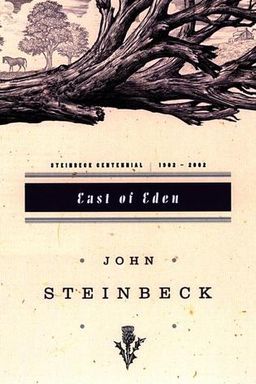
East of Eden cover

East of Eden

by John Steinbeck

East of Eden is a captivating epic exploring the lives of the Trask family, delving into themes of love, jealousy, and free will. Set against the backdrop of the American West, this timeless tale intertwines the struggles of three generations, echoing the biblical story of Cain and Abel. John Steinbeck''s incisive commentary on human nature remains relevant and thought-provoking.

The Battle Between Love, Jealousy, and Choice in East of Eden

Have you ever felt torn between doing what you know is right and what your darker impulses urge you to do? John Steinbeck’s East of Eden invites you to explore that tension by asking a timeless question: are we doomed by our nature, or do we have the power to choose our path? Steinbeck argues that human beings are shaped not by destiny or inheritance but by the choices they make—the constant struggle between love and jealousy, good and evil, compassion and cruelty. Through generations of intertwined families, he examines how the flame of free will burns even in the darkest corners of the human heart.

Set across the sweeping landscapes of 19th- and early 20th-century America—from Connecticut farms to California valleys—the novel explores two central families: the Trasks and the Hamiltons. The Trasks, torn by rivalry and betrayal, reenact an eternal drama of moral choice echoing the biblical story of Cain and Abel. The Hamiltons, spearheaded by the wise patriarch Samuel, serve as the moral compass and intellectual foil to the Trasks’ chaos. At the center is Adam Trask, whose journey from naïve idealism to moral awakening shapes much of the novel’s heart. And through characters like Cathy (also known as Kate), who embodies malice and manipulation, Steinbeck personifies evil as both inherited and chosen.

The Cycle of Rivalry and Desire

From the beginning, the novel immerses you in sibling jealousy. Adam and Charles Trask, sons of the domineering war hero Cyrus Trask, compete for their father’s affection much like Cain and Abel competed for God’s favor. Charles’ rage, born from feeling unloved, leads to violence—a wound that never heals. Steinbeck shows how love withheld can curdle into hate, turning brothers into enemies. By drawing parallels to Genesis, he builds the novel’s core allegory: jealousy is humanity’s oldest wound, and every generation must confront its pain anew.

This pattern resurfaces with Adam’s own sons, Aron and Cal. Aron is the golden child—pure, gentle, loved. Cal is troubled, intelligent, and hungers for the affection he can’t seem to earn. The cycle repeats: favoritism breeds resentment, resentment breeds guilt, and guilt drives the search for redemption. The difference, though, is that Cal is given a chance that Cain never had—the chance to choose. That power of choice becomes the heart of Steinbeck’s moral philosophy.

The Power and Peril of Sexuality

One of the most striking aspects of Steinbeck’s story is how sexuality is both destructive and revealing. Cathy Ames, Adam’s wife, represents sex without love, control without empathy. She uses desire as a weapon, bending men’s weaknesses to her will. Her abuse of power destroys lives—she murders her parents, manipulates her patrons, and corrupts others for sport. To Steinbeck, Cathy’s sexuality is a cautionary tale: a symbol of how power, detached from love or morality, breeds desolation instead of freedom. Meanwhile, Adam’s tenderness and naïveté expose his flaw—he idealizes love so much that he’s blind to evil until it devastates him.

Steinbeck portrays this confusion as deeply human. Beneath lust and repression lies a craving not for pleasure, but connection. That’s why even in scenes of moral decay—brothels, betrayal, and adultery—the ache for love never fades. Readers see this in Cal’s torment: he fears he has inherited his mother’s darkness, yet he keeps yearning to be good. Sex, like power or love, becomes a mirror reflecting what people most fear about themselves.

Timshel: Thou Mayest

At the novel’s spiritual core lies a single word: Timshel, meaning “thou mayest.” When the wise servant Lee discusses its meaning with Samuel and Adam, the book takes a philosophical turn. If God says “thou mayest,” then sin and virtue are not preordained—they are choices. This transforms the human struggle into a story of moral agency. It’s not about being permanently good or evil, but about taking responsibility for your actions, moment by moment. Steinbeck suggests that this awareness—our capacity to choose—is what redeems us.

“Timshel means that the way is open. That word says the choice is yours.”

Good and Evil as Lifelong Companions

Unlike moral systems that view good and evil as separate forces, Steinbeck sees them as neighbors within each person. Cal’s anguish over his impulses, Cathy’s deliberate cruelty, and Adam’s moral blindness reveal that no one is purely one or the other. Evil tempts through jealousy, pride, and the hunger for love. Good answers quietly through compassion, forgiveness, and courage. The choice between them defines who we become. When Adam forgives Cal and whispers “Timshel” before dying, he breaks the generational curse—affirming that redemption is possible even after great sin.

By the end of East of Eden, Steinbeck delivers a profound truth about being human: we are not fated by our past or our bloodline. Our freedom lies in choosing again and again, despite our flaws. Through the Trasks' tragedies, Steinbeck calls on you to look inward and ask, “What choices will I make when love and jealousy call my name?” The answer to that, as he reminds us, is Timshel—you may.


Brotherhood, Rivalry, and the Search for Love

In East of Eden, Steinbeck reimagines one of humanity’s oldest stories—the fraternal feud of Cain and Abel—through the lives of Adam and Charles Trask. Their rivalry is not just about inheritance; it’s about the raw desire for love and recognition. Cyrus Trask’s favoritism ignites a deep wound that shapes both brothers in opposite ways. Charles’ jealous violence leaves him scarred physically and spiritually, while Adam channels his pain into a search for meaning beyond his father’s grasp.

The Pain of Parental Favoritism

Every child wants to be seen. When Charles gives his father a knife for his birthday and Adam brings a stray puppy, Cyrus praises Adam and ignores Charles. That single moment crystallizes their lifelong dynamic. In Steinbeck’s world, love denied is love distorted. Charles’ resentment grows poisonous; he beats Adam until his face is unrecognizable. His wound mirrors the mark of Cain—the outward manifestation of inward guilt.

This dynamic extends across generations. Aron and Cal Trask face the same test. Adam, still idealistic, unconsciously favors Aron’s angelic innocence over Cal’s complexity. The repetition suggests that inherited trauma—emotional patterns passed through generations—can take root unless broken by awareness and choice.

Love as a Scar and a Mirror

Steinbeck shows how yearning for love can turn into violence when it’s mixed with insecurity. Yet love also awakens self-knowledge. Adam’s tenderness toward others makes him vulnerable but also capable of empathy. Cal’s need for affection mirrors his mother Cathy’s manipulative hunger for power, yet it ultimately drives him toward self-understanding. The more he wrestles with his darker impulses, the more he learns what real love requires—humility, forgiveness, and courage.

By tracing these cycles, Steinbeck invites you to reflect on your own. When have you mistaken approval for love? When have you hurt someone because you felt unseen? The novel suggests that healing begins when you choose to love even when it’s not reciprocated. That is the only way to end the pattern of Cain and Abel.


Cathy Ames: Evil as Choice, Not Inheritance

Few characters in modern literature embody pure evil as convincingly as Cathy Ames, later known as Kate. Yet Steinbeck’s portrayal of her goes beyond villainy; she becomes a study of what happens when free will turns entirely toward destruction. From burning her parents alive to manipulating Adam and murdering her benefactor Faye, Cathy’s path reveals evil not as supernatural but as a human possibility—an extreme born of shame, detachment, and control.

Sex, Control, and Fear

Cathy’s story is steeped in sexual power. She learns early that desire manipulates men more effectively than violence. This makes her both feared and free, yet profoundly empty. When she seduces Charles, shoots Adam, and later poisons Faye to inherit her brothel, she demonstrates that power without empathy always consumes itself. Her brothel becomes a metaphor for spiritual decay—a place where people pay to pretend at intimacy but only find loneliness.

The Absence of Remorse

Steinbeck refuses to psychologize Cathy entirely. She isn’t evil because she was abused; she’s evil because she continually chooses to be. This makes her terrifying precisely because she is human. Evil, Steinbeck implies, doesn’t emerge from demons or destiny—it emerges when people reject the possibility of love and empathy. That rejection leaves Cathy spiritually hollow. Her eventual suicide, brought on by illness and paranoia, marks the self-annihilation of someone who could never forgive or trust.

Through Cathy, Steinbeck challenges you to think about the choices that define your integrity. Every small act of deceit or cruelty moves you closer to her path. Yet her existence also makes the novel’s redemptive message more powerful: if Cathy symbolizes hell, then the word “Timshel” signifies that even she—had she chosen differently—could have been saved.


Samuel Hamilton and the Wisdom of Honest Living

Samuel Hamilton might not have wealth, but he possesses something far richer: integrity, humor, and a deep philosophical heart. A farmer and inventor who never strikes gold, Samuel embodies moral steadiness amid chaos. His home becomes a beacon of warmth and reflection, balancing the Trasks’ turmoil with perspective and grace. Through Samuel, Steinbeck celebrates the quiet heroism of those who live truthfully, even when life offers no reward.

The Practical Philosopher

Samuel reads like a man out of a parable—hands in the soil, head in the heavens. He approaches life’s mysteries with curiosity rather than fear. His friendship with Adam anchors Adam’s moral recovery after Cathy’s betrayal. When Samuel helps deliver Adam’s twins and later urges him to name them, he restores not just order but meaning to Adam’s world. Names, Samuel reminds us, carry stories; through naming, we reclaim responsibility for what we love.

The Mentor and the Messenger

Perhaps Samuel’s greatest gift is passing wisdom to others. His conversation with Lee about the Hebrew word “Timshel” transforms the book’s message from theology into philosophy. While he dies before he can see its impact, his lessons echo through Lee and Adam, influencing the next generation. Samuel’s life suggests that moral influence doesn’t require power—just authenticity. His legacy survives because he lived in truth.

Steinbeck’s reverence for Samuel reflects his own love for his grandfather’s generation of pioneers—imperfect, humorous, tough, and full of wonder. In a world of ambition and corruption, Samuel’s honesty reminds you that value isn’t earned through success but through sincerity.


Lee and the Philosophy of Timshel

Lee, Adam’s Chinese-American servant, is one of the wisest voices in East of Eden. Initially dismissed as a quiet domestic help, he reveals a profound depth of intellect and compassion. His exploration of the word “Timshel”—meaning “thou mayest”—marks the novel’s philosophical peak. Lee represents the bridge between East and West, intellect and empathy, action and contemplation.

The Power of Interpretation

Lee’s discovery that “Timshel” means “thou mayest” rather than “thou shalt” or “thou wilt” changes everything. It reframes human morality not as a command or promise but as an invitation. God doesn’t dictate righteousness; He allows it. This gives every person autonomy and dignity. In an age obsessed with heredity and fate, Steinbeck’s vision through Lee is radically hopeful: you may rule over sin—not you must or you will, but you may.

Philosophy as Compassion

Lee’s insight isn’t abstract; it’s deeply human. He comforts Adam through grief, mentors Cal through guilt, and honors Samuel through memory. To him, “Timshel” is both an idea and a practice: the daily choice to meet darkness with mercy. His teachings influence the novel’s emotional resolution when Adam forgives Cal. When Adam utters “Timshel” with his dying breath, it’s Lee’s philosophy given life.

Through Lee, Steinbeck reminds you that wisdom isn’t in denying sin but in facing it. Life’s meaning unfolds not in certainty but in the courage to choose rightly, over and over again.


Cal Trask and the Struggle to Choose Good

Cal Trask stands as one of Steinbeck’s most psychologically complex creations—a young man capable of both cruelty and compassion. His story embodies the struggle central to East of Eden: the lifelong battle to overcome the darkness within. Born from a mother he never knows and a father who doesn’t understand him, Cal’s journey is one of self-discovery through guilt, jealousy, and forgiveness.

The Weight of Inheritance

Cal believes he inherits evil from Cathy, his mother, whose cruelty defines everything he fears in himself. When he learns who she is—a brothel owner known for corruption—he spirals into self-loathing. His father Adam’s rejection, after Cal earns money during wartime to win his love, deepens that fear. Feeling unworthy, Cal lashes out by revealing Aron’s true parentage, an act that leads to Aron’s tragic death.

From Guilt to Redemption

What separates Cal from his biblical counterpart Cain is his remorse. He longs to make amends, yet doesn’t know how until Adam, in his final moment, grants him the word “Timshel.” That single utterance—“thou mayest”—tells Cal he is free to rise above his guilt. Redemption, Steinbeck shows, is not granted by others but accepted by oneself.

Cal’s story transforms tragedy into moral awakening. It reminds you that being good doesn’t mean being flawless; it means choosing love even when self-hatred threatens to win. His final act of forgiveness, both given and received, suggests that the greatest victory lies not in purity but in perseverance.

Dig Deeper

Get personalized prompts to apply these lessons to your life and deepen your understanding.

Go Deeper

Get the Full Experience

Download Insight Books for AI-powered reflections, quizzes, and more.