
Idea 1
Building a Thriving Civilization within Planetary Boundaries
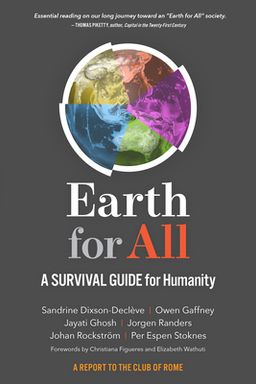
Have you ever wondered what it would take for humanity to truly thrive without destroying the planet that sustains us? Earth for All: A Survival Guide for Humanity by Sandrine Dixson-Declève, Owen Gaffney, Jayati Ghosh, Jorgen Randers, Johan Rockström, and Per Espen Stoknes challenges you to imagine a future where wellbeing for all and ecological balance coexist. This is not another book predicting doom—it’s a bold, evidence-based plan to avoid it. The authors, known for their systems modeling and ecological economics expertise, argue that civilization teeters on the brink of a planetary emergency, yet we still have the power—and the knowledge—to change course.
Fifty years after the landmark 1972 report The Limits to Growth, this new Report to the Club of Rome envisions two possible futures: Too Little Too Late, where rising inequality and ecological collapse sabotage progress, and Giant Leap, where humanity works together across nations and sectors to transform economies in a single generation. The difference between the two? Whether we make five extraordinary turnarounds—on poverty, inequality, empowerment, food, and energy—before the middle of the century.
The Metacrisis: A Web of Interconnected Emergencies
The book opens with a concept that helps you connect the dots between the crises of our time. Climate change, inequality, food insecurity, technological disruption, political instability—these aren’t separate problems but symptoms of a global metacrisis. Former UN climate chief Christiana Figueres calls it both an outer and inner challenge: we must fix our relationship with nature while recalibrating our values around compassion, collaboration, and long-term thinking. It’s humanity’s ultimate systems challenge—and personal challenge.
Rather than despair, the authors advocate what Figueres describes as “stubborn optimism.” This isn’t blind hope but a disciplined mindset grounded in reality and courage. When each citizen and leader chooses collective wellbeing over short-term profit, large-scale change becomes possible—just as the Paris Agreement once did.
Why We Must Value Our Shared Future
Much of modern civilization, the authors warn, fails to value the future beyond an election cycle or quarterly report. Despite wealth and technology, we remain vulnerable to pandemics, social unrest, and ecological collapse. Economic systems funnel rewards to the few while degrading the Earth’s life-support systems for the many. In the last century, industrial growth propelled billions out of poverty—but at the expense of climate stability and global trust.
To reverse that trend, Earth for All calls for investments that don’t “cost the Earth” but rather secure our long-term prosperity. The authors estimate that shifting just 2–4% of global income annually toward sustainable energy, food, and equity could avert collapse and build resilience. That small slice of wealth could create what they call an “Earth for All” society—a civilizational upgrade where prosperity does not depend on endless consumption.
The Foundation: Systems Thinking and Modeling
At the heart of this blueprint lies the Earth4All systems model, an intellectual descendant of MIT’s World3 model from The Limits to Growth. It synthesizes economic, social, and ecological data to simulate future trajectories under different policy decisions. Using feedback loops, it can illustrate how poverty affects social tensions, how inequality erodes trust, and how both limit our capacity to respond to ecological crises.
Crucially, two new indices—the Average Wellbeing Index and the Social Tension Index—measure how societal health and trust shift under various scenarios. If wellbeing rises and trust grows, societies can adapt and innovate. If tension climbs, polarization and instability lock us into Too Little Too Late.
Five Extraordinary Turnarounds
The book’s transformative “five turnarounds” are its beating heart:
- Ending Poverty: Expanding policy space and transforming global finance to enable low-income nations to grow sustainably.
- Addressing Inequality: Implementing progressive taxation, strengthening labor rights, and introducing universal dividends from shared resources.
- Empowering Women: Achieving gender parity in education, health, and leadership to stabilize population and promote societal wellbeing.
- Transforming Food Systems: Rewiring agriculture toward regenerative, local, and healthy production within ecological limits.
- Electrifying Everything: Accelerating clean energy revolutions while ensuring fairness and access for all.
Together, these turnarounds form an integrated web; success in one amplifies progress in the others. Empowering women reduces fertility and improves health; fairness strengthens democracy and lowers social tension; clean energy and regenerative farming preserve planetary boundaries.
Two Futures, One Choice
In Too Little Too Late, technological progress and weak policy tinkering fail to address inequality and climate breakdown. Trust declines, polarization rises, and Earth’s temperature surpasses 2.5°C by 2100. In Giant Leap, nations and citizens synchronize action across systems—redistributing wealth, supporting green innovation, and empowering all genders. Poverty disappears by 2050, populations stabilize, and temperature stays below 2°C. This isn’t utopia—it’s achievable physics and economics.
From Personal Reflection to Global Collaboration
The authors insist that large-scale systems change begins within you. When each person values the wellbeing of others and the planet, that mindset reshapes culture, policy, and investment. As Christiana Figueres reminds us, systemic transformation is deeply personal. You can start by asking: What would a future that’s livable for everyone look like—and what can I do today to help create it?
The book ends with a call to action. Rebuilding the economic system to serve wellbeing and planetary health may be the greatest project in human history. The question isn’t whether we have the tools—it’s whether we have the courage to use them. Earth for All makes a compelling case that if we take the Giant Leap together, prosperity, peace, and trust are not only possible—they’re our next chapter.