
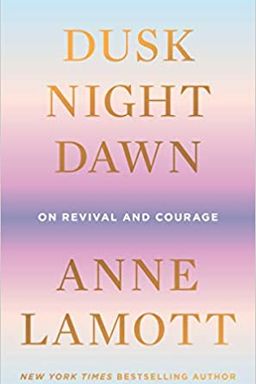
Dusk, Night, Dawn cover

Dusk, Night, Dawn

by Anne Lamott

In ''Dusk, Night, Dawn,'' Anne Lamott explores the anxieties that haunt us during dark times and offers guidance towards hope and self-acceptance. Through personal stories and wisdom, the book encourages readers to embrace imperfections, live in the present, and find beauty in both light and darkness.

Rising Up: Finding Courage and Grace in the Dark

When the world feels stuck in endless dusk—when despair over politics, climate crisis, and personal loss clouds your faith in humanity—how do you rise again? In Dusk, Night, Dawn: On Revival and Courage, Anne Lamott turns that question inward and outward, offering her characteristic blend of humor, faith, self-deprecation, and stubborn hope. She contends that courage and revival aren’t grand transformations but small, ordinary acts of honesty, forgiveness, service, and love. They happen in airports, marriages, Sunday schools, and quiet grief. The book is Lamott’s invitation to reinhabit life after darkness—personal, cultural, and spiritual.

Lamott’s argument unfolds through essays that weave memoir, theology, and social observation. She examines the ways humans endure collective despair—pandemics, injustice, aging—and still find beauty in cracked hearts and cluttered kitchens. She believes that revival starts where you are: in your messy mind, your marriage, your church basement, your backyard garden. Dusk, Night, Dawn insists that the brokenhearted can learn again to “stand on the side of light,” not by pretending the dark isn’t real, but by walking through it with grace, laughter, and service.

The Book’s Pulse: Darkness and the Practice of Rising

Each part of the title—dusk, night, and dawn—marks a movement. Dusk is the descent: the personal and collective disillusionment many feel after years of societal strain. Night is the bewildering middle, when you’ve lost trust, direction, or faith. Dawn is the faint light of revival—never guaranteed, but possible through kindness, humility, and laughter in the absurd. Lamott anchors her reflections in the warmth of relationships, from her patient new husband Neal to her Sunday school students who keep her honest and laughing. She returns to spiritual fundamentals: forgiveness, humor, and attention as forms of prayer. Each essay, filled with storytelling, becomes a parable of redemption in miniature.

How Lamott Writes Resurrection Through the Ordinary

Lamott’s worldview is rooted in paradox. She is both aging cynic and spiritual optimist. Life’s absurdities—delayed planes, marital squabbles, lost kittens—become sources of wisdom. In the prologue, after a long, graceless fight with her husband, she finds herself preaching to a thousand women about love and kindness. Her story turns from exasperation to connection: exhaustion lifted by laughter, resentment transformed by service. This rhythm—self-pity yielding to empathy—mirrors Lamott’s lifelong recovery and her Christian practice of renewal. She reminds you that humor is a sacrament. The act of telling the truth, however mortifying, can free others and yourself.

(For context: readers of Traveling Mercies and Plan B will recognize this signature tone—self-lacerating but tender, irreverent yet reverent. She resembles a postmodern Augustine crossed with a stand-up comic.)

Faith as Attention and Forgiveness

Lamott redefines faith not as certainty but as the decision to pay attention—to beauty, to suffering, to other people. Her essays on sobriety and Sunday school teaching describe spirituality as something done with your hands: washing dishes, comforting a child, sending a note. In one moving story, she teaches children about redemption through the tale of a woman in prison learning self-forgiveness; this becomes an allegory for every adult trying to return to wholeness after shame. Forgiveness, she insists, grows in spirals—slowly, imperfectly, one chamber at a time, like a nautilus shell.

Why the Message Matters Now

Lamott’s call to revival may feel small—“start where your butt and feet are”—but it’s quietly radical in an age of online outrage and doomscrolling. She doesn’t promise political restoration or mystical escape; she promises community, tea, naps, honesty, and the courage to keep showing up. The book’s timing, emerging from pandemic disconnection, speaks to those who have forgotten what hope feels like. Throughout, Lamott models something rare: laughter that coexists with grief, spiritual confidence born from doubt, and love that persists even as you roll your eyes at humanity. Her answer to despair is deceptively simple: stay awake to beauty, forgive what you can, serve someone every day, and trust that dawn always follows night—even if it arrives slowly.


Soul Lather: Cleansing the Spirit’s Dust

Lamott opens the body of her book with a metaphor that captures both her humor and depth: "soul lather." After years of recovery and heartbreak, she writes about cleaning the fog and fingerprints off the human spirit. To Lavott, defeat is the portal to soul; you must crash, surrender, and then start wiping off the grime. In her Sunday school classes, she teaches children about what clouds the soul—shame, perfectionism, obsession—and what restores it—connection and forgiveness. Through the story of Ali, a young woman in prison for killing a man while driving drunk, Lamott confronts the hardest truth of her theology: nothing and no one is beyond redemption.

The Prisoner and the Children

Ali's story begins in horror and ends in quiet grace. She kills a pedestrian, flees, is imprisoned, and then, through unexpected friendship, finds sobriety and service. Lamott uses this real story to teach her kids—and us—that forgiveness begins not after punishment but within it. When Ali befriends another inmate and begins helping in conservation work, she experiences what Lamott calls “redemption as love in service.” The younger students, initially skeptical that Ali could forgive herself, learn by story’s end that everyone’s soul can be “degreased” by compassion and time. As Lamott puts it: Time takes time.

The Soul’s Qualities

The soul, Lamott argues, is both fragile and indestructible—a lighthouse, a snow globe, a friendly ghost. She quotes Plato and Bukowski to remind us that even when clouded, the soul remains intact. For Lamott, soulful living requires curiosity, presence, and deep goodness. You see it when kids watch butterflies, or in yourself when you stop to feel awe at cherry trees or small acts of mercy. The soul is not moral purity but awareness, something that “tugs on your pant leg to slow down.” And when we forget, stories and community remind us who we are.

Recovery as Spiritual Education

Lamott’s own sobriety story underpins all of this. She writes that her decades without alcohol began when “defeat was the portal to soul.” Recovery offered her friends who told the truth with humor and humility; they convinced her that her mind was not always reliable. Soul lather, then, is not a mystic practice but the daily discipline of staying awake—through laughter, forgiveness, and helping those still lost in grief or addiction. Like a mirror cleaned of dust, your soul allows the image of the divine—love, curiosity, mercy—to shine back out.


The Kitten: Learning to Trust What Returns

The Kitten is one of Lamott’s most charming and revealing parables. A missing cat becomes an essay on fear, control, and faith. When the kitten Rosalie disappears days before her wedding, Lamott spirals into panic. She imagines disaster, guilt, and cosmic punishment. Her husband Neal, calm and methodical, contrasts her frantic mind. Their search for the kitten—eventually found alive, nibbling Lamott’s toes—becomes a miniature version of Lamott’s theology: everything terrifying will eventually reveal its hidden mercy if you don’t give up too soon.

Fear as the Family Inheritance

Lamott traces her panic to her childhood in an alcoholic, perfectionist household. Children of chaos, she writes, live by bracing for catastrophe. Losing the kitten activates that old dread: the sense that she’s doomed to fail the people she loves. Neal’s gentle steadiness—his bringing her a glass of water, waiting without blame—models the compassion she is still learning to offer herself. The kitten’s return is both comic and sacred, proof that dread is not prophecy.

Light, Water, and Kindness

In Rosalie’s story, Lamott identifies four elements that save her again and again: light, water, kindness, and not giving up. She literally turns on the lamp, drinks water, and softens toward herself and Neal. These modest acts become metaphors for faith. Hope doesn’t arrive as revelation—it enters like a kitten, quietly, brushing your ankle. Lamott declares that her new mantra is what she now tells anxious friends: “The kitten isn’t dead. The kitten is in the living room.” Hope, she reminds readers, is less a mood than a habit of looking closer.

The story’s humor—the self-scolding, the marital banter—keeps it lit with joy. Lamott transforms domestic failure into a spiritual practice. Her faith is not tidy; it’s a survival mechanism for nervous, self-doubting people. And it works. If love keeps showing up—even in furball form—you might start to believe that resurrection is real.


Repentability: Turning Without Shame

In the chapter “Repentability,” Lamott faces her own tendency toward fear and moral tripping. After an encounter with a well-meaning religious man who warns her that her father and husband are in hell, she begins to reflect on what repentance actually means. For Lamott, it’s not groveling but changing direction—“to change your mind in the deepest center of yourself.” With her characteristic humor, she describes realizing her toenail polish could hide melanoma (echoing her father’s death from skin cancer) and coping by eating a slab of carrot cake frosting in her car. These comedic confessions anchor her deeper lesson: repentance begins not in punishment but awareness.

Tripping, Thinking, and Rubber Bands

Lamott names her anxious mental spiraling “tripping.” The mind loops through imagined disasters—the loved one’s illness, the dog’s death, the apocalypse. Her practice is to wear a rubber band on her wrist: whenever she notices herself spiraling, she snaps it lightly to return to the present. This small ritual mirrors the spiritual disciplines of mindfulness and contemplation found in Buddhism and Stoicism (echoing Marcus Aurelius’s reminder that “we are little souls carrying around corpses”). For Lamott, awareness itself is repentance—stepping out of illusion and into the body, into now.

Forgiveness as Daily Repentance

Recovery taught Lamott that we can’t “get over much here.” Life’s wounds linger. But experiencing repentance as presence makes it possible to forgive others and oneself repeatedly. She links this to the biblical story of the paralytic healed at the pool of Bethesda: transformation starts not in the miracle but in admitting powerlessness. Repentability, then, is not purity but willingness—the humility to stop insisting on your own way. Lamott’s humor (“Help me not be such an asshole”) is both prayer and theology. Joy, she writes, sneaks in through laughter at yourself.

The message is disarming and liberating: you’ll never finish repenting, so you might as well do it kindly. Each small return to grace—a rubber band snap, a phone call to a friend, a laugh instead of a judgment—is a tiny resurrection from the dead end of ego.


Snail Hymn: Forgiveness in Spirals

If forgiveness, Lamott admits, is the “advanced practice,” then the nautilus shell becomes her metaphor for how it grows—slowly, chamber by chamber. In “Snail Hymn,” she explores the geometry of grace. Teaching children about sin and ecology, she takes them to the beach to collect trash and shells, showing that even damage belongs in the larger story. The nautilus, she explains, is sacred because it expands without breaking: each chamber builds on the last. Forgiveness works the same way—it spirals outward, creating new room for breath and life.

The Lesson of the Beach

At the littered beach, Lamott invites her class to feel sorrow and disgust before they begin cleaning. Bringing the garbage into church to lay beneath the cross transforms it into offering. This image captures her theology of imperfection: we live with sin by holding it within love rather than hiding it. It’s not denial, but integration. The divine, she says, is big enough to hold all our pollution—personal and planetary.

The Long Arc of Self-Forgiveness

Lamott tells of writing a long apology to Esther, a woman whose husband she’d had an affair with decades earlier. To her astonishment, Esther forgave her, explaining that forgiveness, in Judaism, is a mitzvah and a duty. Thirty years later, they meet again—Esther now older, kind, bearing gifts. The spiral between them has widened into friendship. Lamott calls this “forgiveness as spiritual evolution”: what begins as humiliation becomes maturity. Each turning of the spiral creates more spaciousness inside for mercy.

“Snail Hymn” distills Lamott’s lifelong sermon: sin, guilt, and grace are not linear but cyclical. Growth happens in loops. You never graduate from your mistakes; you grow around them. Her humor—describing herself as the “Mary Lou Retton of mercy”—hides a fierce discipline: every day, set the mechanism to Receive. Even partial forgiveness, she says, is a miracle.


Lunch-Money Faith: Hope for the Burned-Out

By mid-book, Lamott turns from confession to companionship. Everyone she loves, she notes, is exhausted—by aging, crisis, politics, and grief. “Lunch-money faith” is her phrase for the minimal, practical hope that keeps you going when belief feels impossible: just enough to buy lunch, not a mansion. Borrowing from Elijah’s biblical burnout story, Lamott explores how spiritual survival always begins with rest, food, and honesty. If you want to experience revival, she suggests, start with a nap and some peanut butter.

The Prophet of Exhaustion

Lamott recounts Elijah’s despair in the wilderness, praying for death until an angel feeds him hearth cakes. The implication: divine nourishment is literal and local. You need bread before you need theology. Likewise, Lamott describes her own breakdown during a retreat in Maui, when she briefly fantasized about swimming out to sea. Her salvation arrived, as always, through honesty—telling Neal, crying, then eating shortcake. Small kindnesses reconstitute faith.

Listening for Whispers

Lamott interprets Elijah’s encounter with God—found not in wind or fire but in a still, small voice—as a lesson in presence. Amid our digital “casino” lives, you must consciously choose to listen. Attention, she writes, is “spiritual caffeine.” Her Sunday school teaching becomes an antidote to despair: teenagers who check their phones at night are really asking, “Are you still my friend?” Lamott’s reply, and God’s, is yes.

Lunch-money faith, then, is not optimism but stubborn trust that there’s enough goodness to get you through this hour. It’s a faith of snacks and naps, laughter and phone calls, the whisper that says, “You’re not alone.” Against burnout, Lamott prescribes gentleness—and music, and activism, and gratitude for the ordinary day that holds you still.


Light Breezes: Standing Up to Dread

In “Light Breezes,” Lamott introduces Dread as a lifelong companion—a Greek goddess of anxiety who used to keep her alive but now mostly exhausts her. The chapter is comedic medicine for catastrophic thinkers. Through a chain of mishaps (mistaking her dog’s pills for her own, thinking she’s dying, then realizing she’d just had too much espresso), Lamott reframes dread as an outdated operating system. “Every time I bust the governess,” she writes, “I get free.” Freedom begins with laughter at your own melodrama.

Anxiety, Aging, and Comic Grace

Lamott’s humor is both confessional and pedagogical. Her misadventures—dog medication incidents, imagined heart attacks—mirror how fear hijacks our perception. She calls her old anxious self “the governess,” a rigid inner authority obsessed with control. You can’t kill her, but you can distract her with tennis balls, she jokes, recalling her friend’s trick to calm an aggressive dog. The two tennis balls become Lamott’s metaphor for spiritual focus: tasks and kindness.

When You Carry Too Much

Her anecdote about swallowing dog pills while multitasking becomes a parable on modern life: we’re all “carrying too much and going too fast.” The cure isn’t ascetic stillness but playful awareness. When she finally laughs at her panic, she calls laughter “the breeziest breeze of them all—a holy exhale.” Even facing the climate crisis and her dog’s possible illness, she decides to trust life’s small mercies. Hope, again, enters as a gust of humor and gratitude.

Lamott reminds readers that dread pretends to protect us from death but actually prevents us from living. You counter it by serving others, telling the truth, and watching for cool breezes—small reprieves of love and laughter that prove fear isn’t the only air we breathe.


Can You Love Me Now?: Being Seen at Your Worst

In this painfully funny chapter, Lamott describes a near-breakdown during a Berkeley storytelling event. Trapped in a theater with bad performers and a too-chipper host, she spirals into panic and bitterness. Her husband Neal notices; she is mortified by her own hostility and fragility. “Can you love me now?” becomes the central question of marriage, friendship, and faith: can we be loved when we’ve lost the plot? Through embarrassment, Lamott uncovers compassion—for herself first, and then for others equally afraid.

The Breakdown as Revelation

As the storytellers ramble on, Lamott’s anxiety hits physical panic. She starts tapping pressure points to keep from imploding. Then grace arrives disguised as coincidence: she meets a fellow recovering alcoholic who is also an acupuncturist and starts tapping her hand. That simple human touch pulls Lamott back to presence. It’s the book’s emotional climax—proof that connection, not performance, saves us from madness. Lamott calls her helper a Sherpa of grace.

Love Past the Persona

The incident reveals what she calls “the bodyguard”—the charming persona we send out to interact with the world, protecting our fragile core. Her husband sees both. Being loved when you’re not behaving well—during exhaustion, fear, or cruelty—is the ultimate spiritual curriculum. For Lamott, this is how our shell of judgment cracks open into empathy. You realize everyone is as scared and absurd as you are. At that point, love stops being a transaction and becomes presence.

“Can you love me now?” reframes faith itself. God, Lamott suggests, answers that question daily with a laugh and a yes. Our work is to do the same—for our partners, friends, and fragile selves—again and again, until compassion feels natural as breath.


One-Winged Love: Imperfect Redemption

Lamott ends her essays by looking back on her parents’ broken love and forward to the messy redemptions of her own life. Using the Brothers Grimm story “The Six Swans,” she sees herself as the youngest sibling who recovers from enchantment with only one arm and one wing. To her, love is never symmetrical or complete—it flies with a limp. Yet it’s enough to carry hope. Family, community, and creation persist in imperfect beauty.

Finding Home in Fracture

Tracing her family history—from her father’s missionary roots in Japan to her mother’s lonely English upbringing—Lamott asks how love survives amid betrayal and emotional scarcity. Her father’s ivory elephant and her mother’s cornhusk angel become emblems of two kinds of love: grounded intellect and fragile tenderness. Holding them now, Lamott feels the continuity of grace through generations. She admits her parents’ wounds but honors the legacies they left: hiking, service, humor, rebellion. These were their “bells that could still ring.”

Love’s Asymmetry

Lamott presents love as the spiritual practice of staying—especially when people are flawed and annoying. To her, love is hospitality and ridiculous persistence: saying yes to life’s cracked angels and missing feathers. “You’ll never fly with one arm and one wing,” she writes, “but the wing can wrap around you when life gets cold.” The image binds the book’s title themes—dusk, night, and dawn—into a promise that imperfection is not failure; it’s how God shows up.

For Lamott, this is the revelation that replaces all lost grails: there are no ultimate answers, just love returning again and again, limping but luminous. In the end, that is enough.


Big Heart: The Center Holds

Lamott closes Dusk, Night, Dawn with a coda that circles back to the core question: can the center hold amid chaos? Her answer is yes—but only if you redefine the center as love, curiosity, and sober attention. The epilogue recounts a memory from her drinking years at Esalen, when she almost fell off a cliff while drunk. The humiliating survival that followed—crawling into the wrong cabin, facing embarrassed strangers—becomes the seed of her transformation. To be saved, she argues, isn’t to be perfect but to be met with unearned kindness when you least deserve it.

The Cliff and the Woman Who Saw Her

After her near-fall, a woman she had disturbed comes to breakfast and, instead of judging, gently takes Lamott’s hand. That gaze—honest, kind, unshockable—marks the beginning of her sobriety. “To be looked at that way can change you molecularly,” Lamott writes. The moment echoes every grace story in the book: salvation arrives through an embodied glance, a touch, a shared laugh. It’s interpersonal, not abstract.

Holding the Center Through Small Things

In the book’s final image, Lamott sits at Esalen’s cliffs decades later, watching otters nurse their pups against the wind. Each creature in the scene—the ocean, the otters, herself—beats with one heart. “Maybe the center can hold,” she decides, “because it contains everything.” Her closing litany—sober, loved, wearing dry pants—is her theology compressed. The divine manifests not in ecstasy but in resilience, friendship, and gratitude for small mercies.

Lamott’s big heart is not naive. It includes terror, loss, and laughter. It believes that after every dusk and night, there is still dawn—not perfect, but bright enough to see your way forward. And that’s all the light you need.

Dig Deeper

Get personalized prompts to apply these lessons to your life and deepen your understanding.

Go Deeper

Get the Full Experience

Download Insight Books for AI-powered reflections, quizzes, and more.