
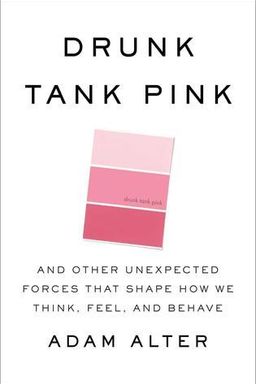
Drunk Tank Pink cover

Drunk Tank Pink

by Adam Alter

Drunk Tank Pink uncovers the hidden psychological forces that quietly influence our behaviors and thoughts. From color psychology to cultural impacts, Adam Alter''s exploration offers readers a fascinating insight into the unseen elements shaping our decisions and interactions every day.

How Subtle Cues Quietly Shape Who You Are

How much of what you do is really your own choice? In Drunk Tank Pink: And Other Unexpected Forces That Shape How We Think, Feel, and Behave, psychologist Adam Alter argues that the hidden forces surrounding you—colors, names, social signals, smells, symbols, and even the weather—quietly mold your thoughts and actions every day. You may believe your decisions are deliberate, but Alter shows that subtle cues in your environment can shape whether you cheat, buy, love, or even recover from illness.

Alter calls these subtle influences psychological cues: tiny bits of information in your surroundings that send signals to your brain before you consciously realize it. Just as a butterfly’s wingbeat can trigger a storm, these micro-forces ripple across your life to determine moods, relationships, and success. The book explores how these cues operate in three intertwined worlds: the world within us (our minds and perceptions), the world between us (our social interactions), and the world around us (our physical environment).

The World Within Us: The Hidden Psychology of Labels, Names, and Symbols

The book begins inside the mind itself—the invisible architecture of language and symbolism. Alter shows that even your name predicts your future. People gravitate toward professions or cities that mirror their names (for instance, dentists named Dennis or people named Louis moving to St. Louis)—a phenomenon psychologists call nominative determinism. Similarly, fluent, easy-to-pronounce names create subconscious trust, helping lawyers or CEOs rise faster, while complex foreign-sounding names can subtly bias others against their owners.

The same holds true for labels and language. Describing a child as a “Blooming Student” can lift their IQ; calling them “slow” can crush it—a reflection of the Pygmalion effect. Language itself shapes seeing: Russians, with separate words for light and dark blue, perceive these shades as distinctly as English speakers distinguish blue from green. Alter revives Benjamin Whorf’s idea that language molds perception—your words literally teach your brain what to notice.

Then there are symbols, those seemingly harmless images that hijack your emotions and behavior. A cross can trigger honesty, a lightbulb can spark creativity, and exposure to a peace sign may calm aggression. Even money—another symbol—can subtly make you selfish, less helpful, and physically less sensitive to pain. Alter’s message is clear: meaning lives in everything you see, whether you notice it or not.

The World Between Us: How People Shape People

The second part turns to human connection, exploring how the presence and behavior of others change us in profound, often invisible ways. We mimic, mirror, and modify ourselves endlessly—a reflection of the chameleon effect. A simple image of watchful eyes triples honesty-box donations, showing that even imagined social scrutiny strengthens morality. The flip side of social connection, Alter notes, is isolation. From feral children to prisoners in solitary confinement, when people are cut off from others, they lose language, empathy, and even their sense of reality.

We also perform better—or worse—when we’re watched. Inspired by Usain Bolt’s Olympic speed, Alter explains social facilitation: being observed can unlock your “latent energy” for simple tasks but overwhelm you during complex ones. And in crowds, responsibilities diffuse. Classic bystander studies by John Darley and Bibb Latané reveal that as the number of onlookers rises, the likelihood that anyone helps plummets—a paradox of safety-in-numbers that leaves victims like Kitty Genovese dying as others watch.

The World Around Us: The Physical Universe of Influence

Finally, Alter explores how environmental cues—colors, places, weather, and architecture—quietly steer our decisions and emotions. Blue streetlights soothe potential criminals. The hue red fuels love, risk-taking, and dominance on Olympic podiums but also anxiety in classrooms. Views of trees help hospital patients heal faster; crowding and noise sap generosity and IQ. Even temperature plays a metaphorical role—coldness breeds loneliness, while a warm cup of coffee can make a stranger seem kinder.

Culture adds a global lens: Westerners see objects apart from their contexts; Easterners see wholes. Collectivist societies nurture harmony; individualist ones celebrate uniqueness. Yet, as Alter notes, mass media and migration are blending these lenses—creating bicultural and multicultural minds that switch between frames, adapting to subtle cultural symbols like yin-yang logos or even a stroll through Chinatown.

“Your mind,” Alter concludes, “is the endpoint of a billion tiny butterfly effects.” Every name, color, crowd, and climate acts as a wingbeat nudging your thoughts. Recognizing these cues doesn’t make you perfectly rational—it makes you more aware, a little freer from their silent choreography.

Across nine chapters, Drunk Tank Pink teaches you that the environment isn’t background—it’s the script your behavior follows. Understanding how these cues operate lets you reshape that script: to harness the helpful ones (like nurturing environments, positive labeling, or nature’s healing power) and to defend yourself against the harmful ones (like prejudice, crowd apathy, or manipulative design). This insight, Alter suggests, is the first step toward a more conscious, intentional life in a world constantly writing on your mind.


Names, Labels, and Symbols Shape Perception

Names reach further into your psyche than you realize. Alter shows that something as personal as your signature—your own name—guides choices, biases, and even geography. The idea of nominative determinism, once a curiosity (like Dr. Splatt the urologist), now forms solid psychological evidence: people gravitate toward jobs, cities, and partners that echo their names.

Labels That Create Reality

From the classroom to the courtroom, labels aren’t neutral—they create self-fulfilling prophecies. The famous Pygmalion in the Classroom study revealed that when teachers expected certain kids to “bloom,” those children’s IQ scores genuinely rose. Expectation becomes destiny. Language itself filters the world (echoing Whorf’s linguistic relativity): Russians, who name light and dark blue separately, literally see two colors where English speakers see one.

Symbols That Bypass Logic

Symbols function even faster than words. Alter and colleagues found that flashing an Apple logo subliminally made people more creative, while the sight of money made them colder and less helpful. National symbols like flags can unite citizens (Israel’s flag primed consensus) or divide them (the U.S. flag increased aggression in hyper-patriotic news watchers). Religious icons work the same dual way: a cross can inspire honesty, yet the Pope’s image can trigger moral self-doubt.

Money, a “supersymbol,” captures all these paradoxes at once. It frees you but isolates you; it dulls pain but erodes empathy. When people handle cash, they wait longer to ask for help, feel fewer physical or social hurts, and act more independently—a reminder that anything representing power also distances you from others.

Alter’s insight: symbols and labels are mental shortcuts that speed understanding but distort truth. The more vividly you name something, the more it names you back.


The Power and Peril of Human Presence

We like to think of ourselves as individuals, but Alter’s research shows that human presence—real or imagined—rewires behavior instantly. The famous Newcastle University coffee-room experiment proved it: a picture of staring eyes tripled honesty-box donations compared to a picture of flowers. Even a hint of surveillance activates our moral conscience because we behave better when we think we’re being watched.

Loneliness and the Social Brain

Isolation, however, deconstructs humanity itself. From Genie, the neglected Los Angeles girl who lost speech after 13 years in confinement, to the cave scientist Michel Siffre whose voluntary solitude led to suicidal despair, social deprivation erodes everything from reality perception to lifespan. Alter likens chronic isolation to slow-acting venom—it first agitates, then hallucinates, and finally kills hope.

The Energy of an Audience

But connection fuels excellence too. Drawing from the first social psychology study in 1898, Alter revisits cyclist Norman Triplett’s finding that riders go faster when others are present—a principle seen in Usain Bolt’s record-breaking runs before jubilant crowds. Psychologist Robert Zajonc later proved that audiences amplify instinctive, well-learned performances but hinder complex or unfamiliar ones, creating either social facilitation or social inhibition.

Too Many Witnesses, Too Little Help

Yet crowds also dilute responsibility. In real tragedies—from Kitty Genovese’s 1964 murder to Queens’ 2010 Hugo Tale-Yax case—bystanders froze precisely because “someone else would act.” Darley and Latané’s experiments proved it in the lab: when a person thought others were listening to a seizure victim, their willingness to help plummeted from 85% to 31%. Public morality, Alter warns, depends not just on compassion but on numbers small enough to feel personal.


How Culture Rewrites Reality

Why do some societies prize harmony while others worship independence? Alter dissects the cultural lenses that shape perception itself. Westerners, steeped in Greek analytical traditions, focus on objects in isolation; East Asians, inheriting Confucian holism, see relationships and context. The Muller-Lyer illusion—two equal lines that look unequal—tricks Western eyes accustomed to straight architecture, but leaves non-Western observers unfazed. Even our metaphors reveal bias: American ads celebrate uniqueness (“You’re not everybody”), while Korean ads praise harmony (“Seven out of ten people use this”).

Individualism vs. Collectivism

Culture defines selfhood. Collectivist minds emphasize interdependence and conformity, shown when Japanese participants’ judgments of emotion change depending on others’ expressions. Individualists resist conformity—except, as Solomon Asch proved, when group pressure fractures their certainty. Intriguingly, collectivism flourishes in pathogen-rich regions where tight-knit groups once protected against disease, while individualism thrives where risk and creativity are rewarded.

Cultural Mirrors in Art, Math, and Honor

Art, math, and moral values all mirror these lenses. Brazilian child street vendors outperform schooled peers in practical arithmetic learned through selling candy—proof that culture teaches cognition. East Asian art fills canvases with context while Western portraits center the face. In America’s South and West, a culture of honor justifies aggressive defense of one’s reputation; northern cultures, born of settled farming and strong law, prize restraint.

When Culture Affects Illness

Culture even molds mental illness. The West breeds eating disorders; West Africa sees “koro,” a panic that genitals are shrinking; Japan fears offending others by blushing (sekimen-kyofu). Such syndromes make perfect sense within their cultural logics. As global mobility rises, bicultural minds switch frames like Necker cubes—seeing the same world through alternating lenses, adapting identity to context.


Color Psychology: When Hue Meets Human Biology

One of Alter’s most colorful lessons is literal: color changes how you think, act, and feel. From the discovery of Drunk Tank Pink—a hue that calmed violent inmates—to blue lights that reduce crime in Japan, colors engage physiology and culture simultaneously.

The Science and Myth of Color

Early color “therapy” was pseudoscience (think 1940s Auroratone films for trauma patients), yet decades later rigorous research validated links between hue and body. Blue-green light corrects circadian rhythms, boosting alertness among shift workers. Red light increases arousal and aggression, even altering perception and handwriting. These effects stem both from biology (how eyes process wavelength) and association (red = blood and danger, blue = calm sky).

The Double Life of Red

Red seduces in love but sabotages in learning. Hitchhikers wearing red attract more male drivers; women in red shirts on dating profiles get 21% more messages. Yet red also signals failure—students who see it before a test perform up to 37% worse because it triggers avoidance motivation. Alter calls red “the color of passion and peril,” amplifying emotion in opposite directions depending on context.

Blue and Green: Nature’s Restoratives

Color therapy works beyond romance. Blue and green scenes—echoes of nature—restore the brain’s worn cognitive circuits. Hence blue bedrooms relax, green hospital walls heal, and blue lighting in cities deters vandalism. Our bodies evolved to find safety in these hues, linking them to open skies and fertile fields.


Places, Spaces, and the Architecture of Behavior

Where you are changes who you are. Alter’s chapter on location reveals that overcrowding, noise, and built environments aren’t just uncomfortable—they dismantle empathy and focus. In Oxford hospital studies, children in packed playrooms fought more; adults in high-density dorms posted fewer lost letters and donated less to neighbors. The more crowded the space, the smaller the heart.

Nature as Medicine

Environment can also heal. Roger Ulrich’s landmark hospital study showed patients with window views of trees recovered a full day faster than those facing brick walls. Later work confirmed that nature strengthens attention, lowers cortisol, even improves recovery from cancer. Walking through forests (shinrin-yoku) balances blood pressure more effectively than medication for some.

Design Cues That Guide Morality

Spaces also whisper moral cues. Dim lights invite dishonesty—students inflated scores 50% more in darker rooms. Broken windows invite crime, proving Wilson and Kelling’s theory that visible disorder normalizes misconduct. Even urban signage fonts or Chinese decorations in a New York neighborhood can make passersby think and behave like locals, showing how place primes cognition.

The lesson: architecture isn’t inert; it’s moral infrastructure. Clean spaces elevate civic behavior; chaotic ones corrode it.


Heat, Cold, and the Psychology of Weather

Weather, Alter shows, is more than background—it’s a biological script. Hot days invite aggression; cold ones kindle intimacy. Baseball pitchers hit more batters as temperature rises, and domestic violence surges in the heat. Across decades and continents, conflict frequency doubles during El Niño’s warming cycles. The cause: heat stirs physiological arousal, which the brain mislabels as anger.

The Warmth of Connection

Physical temperature mirrors emotional temperature. Holding a warm cup of coffee makes you rate strangers as friendlier; cold packs or chilly air heighten loneliness and the desire for romance. This stems from the insula, a brain region that processes both thermal and social warmth. Romantic films, Alter notes, sell best in winter precisely because they promise emotional heat when our bodies feel cold.

Seasonal Moods and Sunlight

Light governs hormones. Lack of sunlight triggers seasonal affective disorder (SAD)—once noted by Arctic explorers whose crews fell into depression during polar nights. Blue-light therapy can lift mood; nature’s cycles also drive creativity—Van Gogh painted brighter during long summer days, darker under winter gloom. Even sunlight can dull reason: shoppers remember fewer details on sunny days, and stock markets rise with bright mornings as traders grow overconfident.

Weather’s paradox teaches a gorgeous truth: your mind forecasts inner climate by borrowing cues from the outer one.

Dig Deeper

Get personalized prompts to apply these lessons to your life and deepen your understanding.

Go Deeper

Get the Full Experience

Download Insight Books for AI-powered reflections, quizzes, and more.