
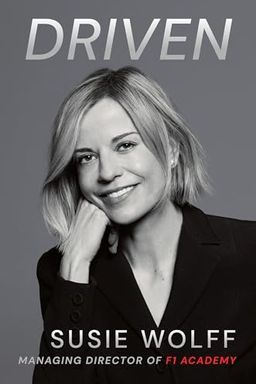
Driven cover

Driven

by Susie Wolff

The managing director of F1 Academy and former professional racing driver chronicles her time in the sport.

Driven: Turning Performance Into Power and Pathways

What do you do when your dream lives in a world that wasn’t built with you in mind? In Driven, Susie Wolff argues that elite performance can be your passport into any closed room—but that once inside, your real responsibility is to leave the door open for others. She contends that talent and meticulous preparation can disarm gatekeepers, but lasting change arrives when you move from being a lone exception to becoming a builder of systems and pathways (from front-row driver to Formula E team principal to Managing Director of F1 Academy).

Across three decades—from a Scottish childhood of engines and grit to a Williams F1 cockpit, then a boardroom seat transforming an all-electric race team, and finally a sport-wide push to grow female participation—Wolff shows you how to turn every narrow opening into a platform. Her proposition is practical and demanding: first, be undeniably good; second, learn how high-performance ecosystems actually work; third, convert your hard-earned standing into structures that outlast you. That sequence—performance, politics, pathways—anchors this memoir’s deepest lessons.

The Core Argument: Performance Is Power

Wolff insists that “performance is power.” When she arrived at Williams for her first Formula One run at Silverstone, she’d rehearsed every steering-wheel function at home, committed brake-balance dials to muscle memory, and trained her neck on Michael Schumacher’s infamous rig. She even checked that her race suit matched the exact seat-mold sessions from the factory. That day, she wasn’t trying to be impressive; she was refusing to leave anything to chance. The effect was transformative: initial curiosity in the garage turned to respect once the data validated her feel. You see this refrain throughout the book—from a forensic defense after being punted off at a British karting round, to a Mercedes DTM test in Barcelona where she correctly diagnosed a braking pull later confirmed by four-time DTM champion Bernd Schneider.

Why This Matters Now

If you operate in any field where there’s a gate—finance, tech, academia, media—Wolff’s playbook translates. Elite arenas tend to confuse tradition with truth. Her path shows you how to puncture that illusion without self-erasure: lead with excellence; master the culture’s tacit rules; and then use your credibility to re-architect the system so talent—not stereotypes or legacy budgets—wins. It’s a thread that runs from her earliest race craft (learning to counter wet-weather slides on Scottish circuits) to organizational craft (rebuilding Venturi’s operations, sponsorship pipeline, and technical depth in Formula E), and finally to ecosystem craft (aligning all ten F1 teams and major sponsors to back F1 Academy and its karting pipeline, Discover Your Drive).

What You’ll Learn in This Summary

We’ll start with craft: how Wolff turns detail-obsession, simulation, and feedback loops into race-day consistency—and how you can import that into your preparation habits (think James Clear’s Atomic Habits, but in a pit lane). Then we’ll look at identity: how she navigates tokenism, image-making, and the pink car saga without ceding authorship of her story (a lived counterpoint to the themes in Sheryl Sandberg’s Lean In and Carol Dweck’s Mindset). Next comes adaptation under duress—from glandular fever and a shattered ankle, to rebuilding confidence and capacity after public setbacks—an applied case in grit (Angela Duckworth), range (David Epstein), and decision-making under uncertainty (Ray Dalio).

From there, we’ll shift to leadership: transforming Venturi from also-ran to race winners by hiring proven winners, codifying standards, negotiating critical technical fixes (hello, Pankl driveshaft), and landing commercial lifelines. You’ll see how she makes diversity functional—by designing for performance and flexibility—rather than cosmetic. Finally, we’ll unpack Wolff’s biggest system play: F1 Academy. You’ll see how she secured all ten F1 teams, placed races alongside Grands Prix, drew in sponsors like Charlotte Tilbury, Tommy Hilfiger, and Puma, and built a grassroots-to-grid pipeline that puts visibility and opportunity on the same calendar. You also meet her most important ally and foil—Toto Wolff—and learn how a high-performance marriage can be both sounding board and accelerant when honesty is the house style (“Don’t be shit,” before her F1 FP1 at Silverstone—and yes, that helped).

The Stakes: From Exception to Infrastructure

Wolff’s arc matters beyond motorsport because it moves from “me” to “we.” As a driver, she had to be the proof point. As a leader, she had to become the bridge. In her words and choices—walking away from comfortable roles, defending her integrity when an FIA leak implied conflicts, and pressing on to put F1 Academy on Netflix—you see the shift from symbolic inclusion to structural inclusion. If you’ve ever felt like the only one in the room, this distinction is oxygen: your greatest contribution isn’t only to win; it’s to make sure the next person shows up already seen. That’s the heart of Driven.

Key Takeaway

Be excellent first, then be expansive. Use excellence to earn trust in the system, then use that trust to change the system—so the next generation needs less luck and more runway.


Performance Is Power (And Preparation)

Wolff returns again and again to a simple thesis: your power in elite environments starts with performance. She shows you what that looks like up close—from agonizing neck training inspired by Michael Schumacher’s regimen to practicing every steering-wheel function at home until each button press is second nature. Her first Formula One outing at Silverstone is the textbook: custom-molded earplugs, bone-dry soles before stepping in, belts cinched so tight she feels welded to the chassis, and a mental checklist primed by hundreds of simulator laps that would be rendered useless by rain—so she builds feel, not just memory.

Make Detail Your Default

Detail is how you turn nerves into agency. Before Silverstone, Wolff ensured her race suit matched the exact one used in her factory seat mold. She rehearsed on the steering wheel like a Rubik’s Cube: pink-left for neutral, pink-right for reverse, yellow-right for pit limiter, white for brake balance, plus differential and torque maps. It’s not obsessive for obsession’s sake; it compresses reaction time under G-load and media glare. When engineers can read your data traces and hear your calm feedback, skepticism gives way to support. In your world, that’s the difference between “optics” and “ownership.”

Data + Feel = Trust

One reason her mantra works is that modern performance is measured. At Williams, engineer Dom reads her telemetry; at Mercedes DTM, the dash flashes ‘+’ or ‘–’ against a hidden benchmark. Wolff leans into this: she wants the truth in the traces. In Barcelona, when the DTM car pulls left on the brakes, she reports it; four-time DTM champion Bernd Schneider confirms the fault. That sequence—feel, report, verify—earns instant credibility. (Compare with Carol Dweck’s Mindset: growth hinges on feedback loops; Wolff shows you how to invite and withstand them.)

Build Capacity Before You Need It

Capacity shows up as competence under load. In Estoril’s punishing test, her neck fails in a long right-hander. She adapts with temporary headrest pads and boxer-style hand taping, then grinds through 300 laps and 9,000+ gearshifts. That’s not heroics; it’s capacity-building. At your desk, capacity looks like scenario-planning and pre-mortems; in the pit lane, it’s hot-lap simulation, pit-stop inch-perfect braking, and strength maintenance so you’re not bracing at the limit—you’re executing.

Turn Rituals Into Reliability

Rituals are your personal operating system. Wolff’s are humble and relentless: belts tight, soles dry, wheel map rehearsed, hair plaited out of the way, seat exactly matched to mold. At PalmerSport, she uses the instructor kill switch to puncture a cocky guest’s bravado, then delivers a 99-percent demo lap. At Hockenheim DTM, she arrives early because she has the recurring nightmare of missing a start with undone gloves. These are not quirks; they’re reliability habits (see James Clear’s Atomic Habits—environment design beats willpower).

Speak the Language of Engineers

Performance power compounds when you can brief and debrief like an engineer. Wolff learns this in karting with Duncan White—describing understeer and seat-rod stiffness—and later in F3/F1 where feedback becomes a currency. When the Venturi driveshaft crisis emerges in Rome, she’s not a designer—but she can convene the right people (Pankl), set urgency, and ask the right questions. In any high-skill field, fluency builds trust, and trust unlocks resources.

Own the Standard, Then Raise It

The final element is psychological: when you set the standard, others follow. Post-Silverstone, the Williams garage shifts from curiosity to backing; in DTM, fitness week ends with a mountain climb her teammates waited to finish together because she refused to quit, then a pool session where she quietly out-swims the lot. Once colleagues believe you’ll meet the day’s demand, they design with you in mind instead of around you.

Try This

Pick one “steering wheel” in your job (the complex tool you underuse). Map every function, build a two-minute drill you can run before high-stakes moments, and create a post-event telemetry ritual: what did the traces (KPIs, logs, feedback) say—what will you adjust and re-run?

(Context: Bill Walsh’s The Score Takes Care of Itself argues that standards precede scoreboard; Wolff shows you the motorsport edition—where standards are literally strapped to your body.)


Navigating Tokenism Without Losing Yourself

Being the only woman in a male-coded arena can make you both visible and invisible at once. Wolff shows you how to carry that paradox without letting it carry you. Early in karting, a rival’s dad says, “I can’t believe you let a girl beat you.” The next lap gets harder. In the European Championship’s flag parade, a fellow Brit tells her she doesn’t belong. At the Karting Worlds, she’s summoned on stage as “Top Female Driver,” a category she never entered. Throughout, she refuses two traps: shrinking to fit or performing a caricature to be allowed in.

Choose Signal Over Costume

Wolff starts in a pink race suit she loves, then ditches it when she realizes it’s become a target calling card. Later, she reintroduces a subtle pink lapel at Peter de Bruijn and—a decade on—embraces a full pink DTM livery she initially hates because it attracts young girls to the fence. What changed? She moved from being labeled by color to using it as a signal for representation. You don’t have to reject femininity to be respected; you have to own how it’s read. (Compare with Herminia Ibarra’s research on identity play at work.)

Find Allies Who’ve Done the Miles

Enter Lotta Hellberg—fourth in the World Karting Championship and a team boss. She doesn’t offer slogans; she offers armor: a custom Tillett rib protector designed for a female torso. Later, she has a suit made with that single pink lapel. The message is subtle and exact: keep your edge, keep your self. Mentors like Lotta don’t write your narrative—they hand you a better pen.

Control the Camera Without Playing to It

Marketing agencies want “sexy female driver” shots; Wolff pushes back, agreeing to step outside her comfort zone but not outside her values. For a Sunday Times “One to Watch,” she rejects leather shorts and crop tops and chooses her race suit. When a grid boy is assigned as a stunt at DTM, she says stop. This isn’t moral grandstanding; it’s brand stewardship. If you become content, you’ll get clicked; if you remain a competitor, you’ll get backing.

Polite, Firm Boundaries Save Careers

Wolff’s hotel-phone story—fending off a drunk, powerful man who insists on coming to her room—captures the emotional calculus women still face. She wedges a chair under the handle and doesn’t sleep. He later apologizes; she accepts but doesn’t excuse. Years on, when an unfounded FIA “conflict of interest” inquiry against her leaks to the press, she takes legal action. Boundary-setting isn’t anger; it’s hygiene.

Let Representation Be Multiplied, Not Consumed

The pink car became a bridge: dads brought daughters because the car looked like something they’d love. She leaned into the “Hello Kitty in disguise” quip, then channeled that attention into pathways: Dare to be Different (later FIA Girls on Track) and, ultimately, F1 Academy. Visibility without velocity can feel hollow; visibility linked to vehicles (scholarships, team seats, Netflix coverage) compounds.

Rule of Thumb

If a moment makes you more memorable but not more mobile, think twice. If it opens doors for you and the next woman, lean in.

(Context: Compare with Michelle Obama’s Becoming on handling the gaze without becoming the performance; Wolff’s version is told in split seconds wrapped in Nomex.)


Turning Setbacks Into Strategic Pivots

The middle of Wolff’s journey is a crash course in crisis-to-pivot management. She leaves university mid-lecture, moves to Silverstone with everything in a Golf TDI, and juggles three jobs (PalmerSport instructor, karting marshal, retail at Grand Prix Racewear). Then glandular fever floors her. Then, at home in Oban, she shatters her ankle and fibula slipping on ice. Plates and twelve pins. The season vaporizes. Sponsors fade. Night after night, she crawls the stairs on her backside, pain thudding with her heartbeat. And still, she repositions.

Let Go Fast—But Land With a Plan

Quitting Edinburgh wasn’t reckless; it was decisive. Her dad’s condition is simple: have a plan by morning. She chooses Silverstone, the racing capital, not because it’s glamorous but because it’s where opportunity density lives. She locates a bungalow, then a racer house with Adam Carroll and Tim Mullen—proximity to possibility. When fever and injury arrive, she switches goals: regain race license (stand on the left leg for 10 seconds), then chase testing miles. The first win back is administrative, not athletic—and it matters.

Rebuild Capacity in Public

Her first World Series by Renault tests are sobering. At Paul Ricard, a bump in a fast right-hander overpowers her arms. She cries in a bathroom stall, then returns with a mechanical hack—locking her left elbow against the cockpit wall to survive the bump. It isn’t pretty, but it buys laps, and laps buy speed. Your version could be a script, a template, an aid—anything that lets you contribute while you’re regaining full strength.

Create Space for Serendipity

Right after she’s told to find £200,000 or lose her World Series seat, a +49 number flashes. It’s Mercedes: “What do you think of DTM?” She’s on a flight to Barcelona within 24 hours. There, Mika Häkkinen drives her around, and she does enough in the test to earn a one-year Mercedes works deal. Read that again: a career that seemed over yesterday now has a factory logo on the chest. Serendipity favors the still-moving. (See Nassim Taleb on optionality; David Epstein on range.)

Use Allies—But Own the Ask

Throughout, people help: Wayne Douglas opens a Formula Ford test; Duncan White demystifies kart setups; Jonathan Lewis and Pierre invest in test days; Norbert Haug says “Welcome to the Mercedes-Benz family.” Yet none of these moments arrive uninvited. Wolff keeps dialing, keeps showing up, keeps handing engineers a clean, accurate debrief. She’s not waiting to be discovered; she’s making it easy to say yes.

Convert Adversity Into Identity

Post-recovery, she’s harder to knock off-center. When Jean Alesi radios “Get this girl out of my way,” the garage replies, “Jean, we can’t. You’ll have to race her.” When Mercedes’ Doc Schmidt—the team doctor with chain-smoked credibility—says, “You’re doing well. Keep it up,” she locks that small vote of confidence deep. Later, when a leaked FIA “conflict” story spirals to 600 headlines in 24 hours, she fights back legally. The muscle you build crawling upstairs shows up years later at a board table.

Pivot Playbook

1) Name the constraint. 2) Set a smallest possible win (license, test, call). 3) Design a temporary hack to contribute. 4) Stay in the river of luck (rooms, calls, tests). 5) Bank every signal of progress; you’ll need the receipt later.

(Context: Angela Duckworth’s Grit says perseverance matters; Wolff shows its mechanics—less inspirational quote, more torque map.)


From Driver To Team Builder

Wolff’s most instructive chapter for leaders starts when she swaps overalls for org charts. In 2018 she becomes Team Principal (and 30% shareholder) of Venturi Formula E, a Monaco-based outfit stuck at the back of the grid and losing ~$11 million a year. She can’t relocate from Switzerland, so she designs a hybrid leadership model: frequent Monaco visits, every test and race attended, and a remote culture built on trust, high standards, and radical clarity about outcomes.

Hire People Who Already Win

Her first lever is talent. She targets a French engineer fresh off a championship and wins him over with vision plus autonomy. That hire becomes a magnet for more. She then adds a chief engineer she rated from F3. For drivers, she retains Swiss ace Edo Mortara (fast, skeptical) and welcomes Felipe Massa (F1 pedigree plus market pull). The pattern is clear: seed the room with winners, then let the culture comp you forward.

Make Diversity Operational, Not Ornamental

Within a year, Venturi is one-third female—the most diverse team in Formula E—but this isn’t a headline play; it’s a performance design. Her team manager, Delphine, considers resigning due to divorce and childcare; Wolff redesigns travel to keep her. PR and partnerships roles flex for working parents. The standard doesn’t drop; the system flexes so the standard can be met. That approach—outcomes over optics—is why the mix works.

Set Non-Negotiables

Venturi’s race-day tent becomes a masterclass in standards: no half-empty water bottles in briefings, no clutter on benches, ski thermals under the team kit in freezing 4:30 a.m. call times. These are symbolic and functional. In a one-day format, losing 15 minutes in shakedown can sink your race. The message: clear space, clear minds, clear laps. (Bill Walsh would nod.)

Solve the One Problem That Can Kill You

At Rome, Venturi suffers multiple driveshaft failures (the Achilles’ heel of bumpy street circuits). Hans Werner Aufrecht—AMG’s godfather—calls and unloads. Wolff absorbs it, then phones Pankl, the supplier’s CEO, on a Sunday. She spends Monday reading everything she can about driveshafts, then sits in a Tuesday room with a dozen engineers. A full redesign would take six months; they co-create a reinforced interim within six weeks. Monaco home race: podium. Crisis converted to credibility.

Fix the P&L Like You Fix Lap Time

No sponsors, red ink everywhere—so she targets brands already in motorsport. A cold outreach leads to a Farnborough airport meeting; their key ask is color control. Easy: “Paint our car whatever you want.” That title deal breaks the dam; three more partners follow. Result: a financially sustainable team with a fresh red–black–white identity, competitive Mercedes powertrain, and a winning driver lineup. The scoreboard confirms it: two wins, four podiums, and a title fight that misses by only 24 points—to Mercedes.

Lead the Room You’re In

In Team Principals’ meetings, she speaks sparingly but precisely, tracking alliances, incentives, and the politics behind proposed rule tweaks. This is sports governance as chess, not checkers—exactly the mindset she later uses to align all 10 F1 teams for F1 Academy. When everything lands, she steps up from Team Principal to CEO, then exits on a high when Venturi’s sale is complete. Build, stabilize, hand over—that’s a leader’s hat trick.

Leadership Checklist

Hire winners; operationalize inclusion; declare standards; solve the critical failure mode; monetize momentum; read the politics; leave on purpose.

(Context: Kim Scott’s Radical Candor favors care + directness. Wolff’s version adds race-week compression: directness under a stopwatch.)


F1 Academy: From Symbol To System

Wolff’s boldest move is ecosystem design. The problem was clear: women’s participation in motorsport hovered under 5%, and few visible role models existed since Wolff’s own FP1 in 2014. The solution couldn’t be another standalone series starving for sponsors and spectators. It had to be embedded in Formula One’s calendar, economics, and storytelling—so the pipeline sat on the same stage as the pinnacle.

Rewrite the Business Model

When Wolff steps in as Managing Director, F1 Academy is already running, but with empty grandstands and teams bleeding cash. She proposes a decisive shift: centralize assets, race alongside F1 at marquee Grands Prix, bring all ten F1 teams into the series with their liveries, and secure blue-chip partners who will amplify to new audiences. Vision accepted—now deliver signatures.

Get The Big Three, Then Everyone Else

Her sequence is surgical. First, Ferrari via Fred Vasseur, who already has a female driver in the academy. Then McLaren via Zak Brown—an instant yes. With two giants on board, she tackles Red Bull. Despite Toto vs. Horner rivalry, she works through CAA (Paul Danforth, Matt O’Donohoe, Judee Ann Williams). Horner not only says yes—he wants three cars across Red Bull and its sister team. Alpine signs fast. Günther Steiner at Haas jokes “Just don’t ask me for money”—then signs and finds the money. With seven teams locked, she brings Mercedes (and the rest) over the line. In July 2023, for the first time in F1’s 75-year history, all ten teams sign the same legal document to back a non-F1 series.

Put It Where the Fans Already Are

Next, the calendar. She and Stefano Domenicali press race promoters to place F1 Academy on F1 weekends in Miami, Singapore, Abu Dhabi and more. With the F1 Race Promotion team’s help—and Stefano’s strategic nudges—the schedule fills. The optics change overnight: the same pit lane, same global broadcast footprint, same weekend narrative arc. Visibility ceases to be charity; it becomes habit.

Broaden the Tent With New Partners

She then brings in sponsors that grow the pie. Tommy Hilfiger signs early. Puma follows. And crucially, Charlotte Tilbury becomes the first major female-founded beauty brand to step into motorsport—not as a logo on the periphery but as a full-team livery (those “hot lips” cars were a signal to new fans that this paddock also belongs to them). This isn’t pink-washing; it’s market expansion. Younger women—already the fastest-growing F1 demographic—see themselves on the grid.

Tell the Story at Scale

Rather than be a Drive to Survive footnote, Wolff secures a dedicated Netflix series with Hello Sunshine, Reese Witherspoon’s production company. This matters: any system shift needs a narrative engine. Meanwhile, Discover Your Drive seeds karting participation with scholarships, guidance, and collaboration with James Geidel’s karting ecosystem. The idea is pipeline integrity: if you increase the base, more top-tier talent rises.

Weather the Headwinds, Keep the Course

When an FIA leak triggers headlines alleging a conflict with her marriage to Toto, Wolff issues a statement, the nine other F1 teams publicly support her, F1 backs her, and the FIA drops the matter within 48 hours. She later files a defamation case. The signal: leadership stands not just on vision, but on the willingness to defend the integrity of the project—and your own.

System Design Lesson

If you want a new audience, don’t build a side room—move the walls of the main hall. Put the pipeline on the podium schedule, then give it a story engine and sponsors who bring fresh fans to the turnstiles.

(Context: The WNBA’s recent surge shows what sustained investment and visibility can do. F1 Academy had the benefit—and challenge—of plugging straight into F1’s global system. Wolff exploited that adjacency.)


Partnership, Identity, And Sustainable Ambition

Wolff’s marriage to Toto isn’t a subplot; it’s a study in two high-performers creating a shared operating system. It works because honesty is the default—sometimes ruthless (“Don’t be shit,” before FP1 at Silverstone)—and because each guards the other’s identity. She refuses to “work for” or “against” him; he refuses to let her disappear into motherhood. When she briefly loses her professional footing after Jack’s birth, he says, “Please don’t let me lose my wife, my sparring partner.” She hears: hold on to you.

Design Candor You Can Survive

Candor here isn’t cruelty; it’s clarity. He calls late to a team dinner? She names it. She melts down before Monaco about carrying too much? He listens and restructures family logistics so she can spend more time in the Monaco office. When Toto struggles in lockdown without the velocity of race weeks, therapy and routine re-anchor him; Wolff shoulders family rhythm quietly. The rule: neither partner is the project—both are the protagonists.

Honor The Whole Self

Wolff is stubbornly non-domesticated. The one time she tries to cook a “proper dinner,” her vegetable soup somehow tastes like fish. They laugh and outsource dinner. This isn’t trivial; it’s an identity boundary. She doesn’t impersonate a role to be “enough.” He doesn’t demand it. The payoff is energy preserved for work that matters: karting with Jack, building F1 Academy, stewarding a culture where talent and kindness can coexist.

Keep the Ground Rules With Work

Even as Toto transitions from Williams investor to Mercedes Team Principal and co-owner, Wolff keeps a strict firewall. She nurtures ties across the paddock (Frank Williams, Claire Williams, Stefano Domenicali) and lands her own wins (Williams FP1, Mercedes Venturi supply, F1 Academy signatures). She accepts help, never patronage. In a field where nepotism is a lazy headline, her ledger reads clean: if anything, she invites more scrutiny and then wins anyway.

Make Family a Strength, Not an Excuse

Jack’s arrival doesn’t become a coda; it reframes ambition. She wants him to see his mother building, not just cheering from the sidelines. They manage the edges—planned C-section timing, grandparents on deck, flexible work—and retain the core: shared meals when possible, adventure baked into life, and joy prioritized (ice rallying after Christmas; lap battles in karts; late-night padel grudges).

Accept the Imperfect, Protect the Essential

They’ll miss dinners; they’ll make some. They’ll take 5:30 a.m. calls in hospital waiting rooms (he dials into the post-China debrief moments before Jack’s birth). It’s messy—and anchored. The essential is guarded: each partner’s vocation, their shared love, and the son growing up between garages and grandstands, placing shoes in perfect rows while bouncy castles beckon.

Relationship Principle

Don’t aim for balance; aim for integrity. Let the rhythm flex, but never trade away the parts that make you, you.

(Context: Brad Stulberg’s The Practice of Groundedness argues for values over velocity; Wolff and Toto live that in a paddock built on speed.)


The Repeatable Playbook (For Any High Bar)

Underneath Wolff’s story sits a repeatable system you can apply to any high-bar field—tech, finance, academia, media. Think of it as an eight-step loop: Prepare; Perform; Debrief; Adapt; Network; Negotiate; Build; and Broaden. The memoir supplies vivid case studies for each step.

1) Prepare Like It’s Game Day

Steering wheel drills, Schumacher neck machine, suits matched to seat molds, soles dried pre-strap-in. Translate that to your world: pre-reads, rehearsal calls, environment cues, checklists you can run under pressure. If it’s important, ritualize it.

2) Perform To Earn the Micro-Yes

At Silverstone (F1) and Hockenheim (DTM), a clean first run dissolves suspicion. People don’t need to be converted; they need to be convinced by data. Aim for that first incontrovertible metric: a lap time, a bug fixed, a contract closed.

3) Debrief With Data and Dignity

From Duncan White’s karting days to Williams F1 sim work, Wolff debriefs crisply. She separates feel from fact, logs changes, and ties feedback to outcomes. Your debriefs should move someone else’s work forward; that’s how you become central to the room.

4) Adapt Faster Than the Track Evolves

Wet Silverstone? Slicks when a dry line forms. Estoril neck failure? Temporary pads and hot water stretches at dawn. Driveshaft fails? Six-week reinforcement. When the conditions change, you change first.

5) Network For Outcomes, Not Optics

Her network spans garage to boardroom: Frank Williams, Norbert Haug, Mika Häkkinen, Hans Werner Aufrecht, Stefano Domenicali, Greg Maffei, Zak Brown, Fred Vasseur. Notice the pattern—she arrives prepared, speaks the language, then asks precisely. Networking = be useful fast + ask small, right things.

6) Negotiate the Single Domino

At Farnborough, color control closes a title sponsor. With Red Bull, CAA opens the door. Get Ferrari and McLaren first, and the rest follow. Identify the keystone agreement that tilts the arch.

7) Build Teams That Win on Busy Days

Venturi’s standards (no clutter, exact processes, 4:30 a.m. starts) make average days reliable and hard days survivable. If your team can’t execute when everything compresses, it won’t win when it matters.

8) Broaden So Others Don’t Need Your Luck

Dare to be Different becomes FIA Girls on Track; F1 Academy races on F1 weekends, with a Netflix spotlight and Discover Your Drive at the base. The best legacy isn’t a trophy—it’s a system that reduces the randomness for the next competitor.

One-Liner

Win a place, learn the place, redesign the place—then invite others in.

(Context: This loop echoes Ben Horowitz’s The Hard Thing About Hard Things on crisis leadership and John Wooden’s The Pyramid of Success on habits—filtered through the telemetry of modern motorsport.)

Dig Deeper

Get personalized prompts to apply these lessons to your life and deepen your understanding.

Go Deeper

Get the Full Experience

Download Insight Books for AI-powered reflections, quizzes, and more.