
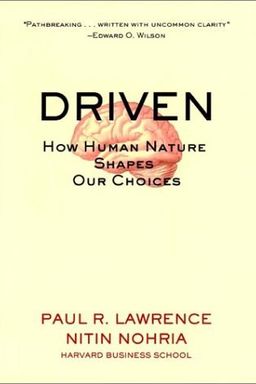
Driven cover

Driven

by Paul R Lawrence and Nitin Nohria

Driven explores the four innate drives that shape human behavior: acquire, bond, learn, and defend. Unveil how these primal instincts influence modern life and how understanding them can enhance personal decisions, relationships, and organizational success.

Human Nature and the Four Drives

Why do people pursue wealth, cling to relationships, seek knowledge, and react fiercely to threats? Paul R. Lawrence and Nitin Nohria argue in Driven: How Human Nature Shapes Our Choices that these impulses arise from four fundamental, biologically grounded drives—to acquire, bond, learn, and defend. They are not mere metaphors but distinct limbic modules wired into your brain through evolution. Together they create the architecture of motivation and explain everything from personal decision-making to institutional design.

The four drives and their interplay

The drive to acquire (D1) pushes you to seek resources, experiences, and status. The drive to bond (D2) draws you into caring, trusting relationships. The drive to learn (D3) fuels curiosity and mastery of understanding. Finally, the drive to defend (D4) activates alarm and protection whenever something valued feels threatened. These drives interact dynamically: sometimes they reinforce each other (as in teams that jointly pursue goals and discovery), but often they conflict, producing the moral dilemmas that require conscious choice.

From biology to culture

Early chapters trace how the modern mind emerged—from hominid fossils at Olduvai Gorge to the Upper Paleolithic Great Leap, when symbolic thought, language, and cumulative culture exploded. That leap required links between limbic emotion and prefrontal reasoning, as illustrated by the Phineas Gage case that revealed how damage to such connections destroys judgment and responsibility. Neuroscience (Antonio Damasio, Joseph LeDoux) shows emotion is not primitive noise but an integrating signal—bridging drives and reason.

Emotion as functional intelligence

Charles Darwin proved that many emotional expressions are innate by comparing species and studying human infants and the blind. Robert Plutchik extended this to a psychoevolutionary wheel showing how basic affect clusters around drives—love around bonding, fear around defense, curiosity around learning, pride around acquisition. Emotion signals which drive is active and gives conscious thought its urgency. Edward Deci and Kurt Lewin explain that willpower arises when multiple motives compete—emotion tells you which one matters most.

Skill sets, culture, and the social contract

Humans inherit specialized skill sets that make cultural learning possible—Howard Gardner’s multiple intelligences (linguistic, musical, spatial, interpersonal) are examples. Alan Fiske’s four relational models—Communal Sharing, Authority Ranking, Equality Matching, and Market Pricing—are the social scaffolds that let D1 and D2 coexist in every society. Across evolution, females selecting for balanced partners (combining ambition, love, intelligence, and protection) and prolonged dependency (neoteny) fostered extended bonding and led to institutional contracts, from families to nations.

Applications and implications

You can observe the four drives in everyday life and organizations. The Whitehall studies reveal how status (D1) affects physical health, while the Hawthorne experiments show that social recognition (D2) drives productivity as much as pay. Companies such as Hewlett-Packard succeeded by designing work that balances all drives—rewarding achievement, nurturing teams, fostering learning, and providing stability. When societies ignore any drive—markets without trust, schools without curiosity, or states without security—they create dysfunction. The authors propose a guiding rule: every institution should offer chances to satisfy all four drives.

From theory to consilience

Lawrence and Nohria end by urging consilience—a unification of disciplines around testable models of human nature. Their framework integrates biology, psychology, economics, and organizational science. Through experiments (neural imaging of drive activation or cross-country social-contract comparisons), the theory invites empirical confirmation. The overarching insight is that understanding your drives allows you to build institutions and personal practices that align biology with culture—fulfilling ancient emotions in modern forms.

Core takeaway

Human nature is organized around four innate motives that generate emotion, choice, and culture. To live well—or design effective organizations—you must recognize, balance, and fulfill them together.


Evolution of Mind and Motivation

Lawrence and Nohria begin by tracing how our biological brain became a cultural engine. The human mind didn’t just enlarge—it restructured itself to integrate feeling and reason. This evolutionary story explains the roots of all four drives.

The Great Leap of cognition

For millions of years, hominid tools barely changed. Then about 75,000 years ago, Cro-Magnon peoples suddenly produced art, music, and symbolic rituals. Anthropologists call this moment the Great Leap. According to cognitive theorists like Merlin Donald, it occurred when episodic and mimetic memory evolved into mythic and theoretic levels—language and external symbols allowed ideas to persist beyond one generation.

Emotion-cognition fusion

Neuroscience confirms evolution fused feeling with reason. The Phineas Gage accident demonstrated what happens when limbic–prefrontal connections are severed: intellect may remain, but judgment vanishes. Antonio Damasio’s and Joseph LeDoux’s work on affective markers shows that emotion supplies the motivational tagging necessary for rational decisions. Without those emotional signals, values lose meaning.

Symbolization and cooperation

Once language and symbolism connected specialized skills—technical, social, ecological—humans could mix knowledge domains. Steven Mithen’s idea of cognitive fluidity explains how hunters used social metaphors to predict animal behavior; this blending created imagination and strategic foresight. From then on, culture became cumulative, not static—a distinctly human innovation.

Implications for the drives

These evolutionary developments set the stage for the four drives to manifest in balance. Acquisition provided survival advantage, bonding stabilized cooperation, learning extended skill transmission, and defense protected the results. Together they produced a flexible yet deeply emotional species—capable of morality, creativity, and war. Understanding this coevolution lets you see motivation not as arbitrary psychology but as biological design refined through cultural scaffolding.

Evolutionary insight

The modern mind emerged when limbic emotion and symbolic reasoning merged, giving your drives the power to transform instinct into culture.


Emotion as Nature’s Compass

Emotions aren’t inconvenient residues—they’re functional compasses guiding you toward fulfilling your innate drives. The book’s middle chapters explain how emotion translates biological imperatives into cultural action.

Darwin and innate expression

Darwin documented universal emotional expressions—in newborns, the blind, and other species—to prove emotions were biologically embedded. They evolved because they facilitated communication and coordination long before language. Fear warns of threats, love signals safe cooperation, and curiosity drives exploration.

Freud, Plutchik, and emotional architecture

Freud described drives as energy sources of action; Plutchik extended the map, showing how primary affects (joy, trust, fear, anger) combine to form complex emotions (love, curiosity, pride, remorse). His wheel links directly to Lawrence and Nohria’s four-drive schema: emotions radiate from biological motives like acquisition or defense and guide rational planning.

Will and conflict resolution

Edward Deci and Kurt Lewin propose that volition emerges when drives conflict. You feel tension, deliberate, and choose which motive to serve now. That inner contest triggers emotions that inform judgment—frustration, guilt, satisfaction. For instance, deciding whether to stay loyal to friends (D2) or pursue promotion (D1) is precisely the interplay of drives and emotional guidance.

Neural mechanism

Modern brain imaging supports this model: sensory cues first hit limbic centers (emotions attach), then prefrontal areas plan responses, and signals loop back to limbic regions to activate action. Far from separating fact and feeling, the process shows that reason without emotion is inert. You must feel something to value outcomes.

Practical implication

Emotions are information—they tell you which drive is active and how strongly. Respecting them allows decisions and institutions to stay biologically coherent while culturally adaptive.


Drives in Action: Acquire, Bond, Learn, Defend

Each drive produces distinct behaviors and societal consequences. Understanding them individually clarifies why markets boom, friendships heal, schools transform, and wars erupt.

Acquire (D1)

D1 motivates pursuit of resources and status. The Whitehall studies reveal how lower rank correlates with worse health because relative deprivation triggers chronic stress. Evolutionary cravings for prestige and rich foods once served survival, now fuel consumption excess. Yet D1 also drives innovation and trade—when tempered by D2’s trust, it creates prosperity instead of envy.

Bond (D2)

Humans crave affiliation as much as sustenance. Experiments and field studies (Baumeister and Leary, Putnam’s Italian comparison) prove social connection predicts happiness and civic effectiveness. D2 explains cooperation, moral sense, and loyalty—but also tribal in-group bias. Institutions must channel bonding toward inclusive communities rather than exclusionary ones.

Learn (D3)

Curiosity appears in infancy (Karen Wynn’s number-alteration experiments) and persists lifelong. Loewenstein’s information-gap theory shows curiosity arises when knowledge feels incomplete and provokes action to close that gap. Organizations that nurture D3—like GE under Jack Welch—raise productivity by empowering problem-solving. Suppressing curiosity breeds alienation and stagnation.

Defend (D4)

D4 protects what you value. Joseph LeDoux and Michael Davis mapped amygdala circuits that trigger fear before conscious thought—a survival shortcut. At group level, this drive builds armies and legal systems. Leaders often misappropriate defense rhetoric to justify aggression, so balancing D4 with bonding and learning becomes crucial for peace and civic health.

Actionable lesson

Each drive enriches life but can distort it if unchecked. Recognizing their emotional origins lets you design personal and organizational contexts that balance ambition, belonging, curiosity, and safety.


Building the Human Social Contract

Humans eventually learned to bond not just with individuals but with ideals, symbols, and collective entities—creating what Lawrence and Nohria call the social contract. This leap in bonding set the stage for organized societies.

Biological scaffolds

Neoteny—prolonged childhood—made sustained adult cooperation necessary. Parental bonding extended to community-level care. Female mate selection reinforced this trajectory, favoring balanced partners who showed ambition (D1), love (D2), intelligence (D3), and protection (D4). Over generations, such preference reshaped male psychology toward social responsibility.

Symbolic bonding

Once language allowed abstraction, humans could attach emotion to symbols—flags, rituals, moral codes—and bond to imagined communities (Deacon’s “symbolic species”). That produced loyalty beyond kinship and enabled large-scale cooperation, governance, and religion. Moral rules (“help, don’t harm”) evolved to stabilize these extended bonds, turning instincts into ethics.

Institutional evolution

The resulting social contracts built civilizations but carried risks: bonding also invites out-group hostility. Biblical and modern genocidal examples show how solidarity can flip into hostility if D4 dominates. The authors suggest rational institutions and cross-group bonding to enlarge empathy and prevent destructive polarization. This is the biological foundation of law, democracy, and human rights.

Concept summary

The social contract is an adaptive innovation—biology meets symbol. It scaled bonding from family to nation, making complex cooperation possible but demanding constant moral management.


Designing Organizations and Policies

From evolution to enterprise, the same drives govern collective behavior. Lawrence and Nohria use organizations to test their theory, showing how engaging all four drives yields healthier systems.

Learning from history

The Hawthorne studies revealed social recognition profoundly boosts productivity—evidence for D2. The Whitehall health gradient showed rank affects wellbeing—evidence for D1 and D4. Both imply that organizations ignoring emotional needs suffer measurable harm.

Corporate case studies

Ford’s assembly line optimized acquisition (D1) but crushed learning and bonding; GM later suffered internal competition; Japanese auto firms balanced all drives through team-based systems; Hewlett-Packard institutionalized this balance through shared purpose, learning culture, and job security. These examples prove that engaging all drives produces adaptability and loyalty.

Policy implications

Macro-level policies follow similar logic. Russia’s shock therapy reforms targeted D1 through market incentives but ignored bonds, learning, and defense—causing collapse. Ireland’s tripartite agreements and educational investments satisfied all drives gradually, creating stability and growth. The principle: economic systems must fit human nature, not abstract ideology.

Management blueprint

Design work so that employees can acquire fair rewards, bond through trust, learn through problem-solving, and feel secure. Leaders should visibly commit to organizations and model social contracts internally. Institutions guided by this balance thrive, while one-drive systems decay or alienate participants.

Practical design rule

Every system—firm, school, or nation—must offer meaningful chances to fulfill all four drives. Balance, not dominance, is the key to sustainable success.


Consilience and the Path Forward

In closing, Lawrence and Nohria challenge you to turn theory into evidence. They envision a unified science of motivation that bridges biology and society—a project of consilience.

Testing the model

Biological tests could use brain imaging to track drive-specific limbic activation. Organizational tests could measure how balance among drives predicts performance. Societal tests might extend Putnam’s social capital indices to include acquisition, learning, and defense metrics. Combining data would make human-nature theory empirically robust.

Consilience as method

E. O. Wilson’s call for interdisciplinary humility frames their goal. Economists must recognize non-rational drives; biologists must admit cultural flexibility; sociologists must accept biological grounding. Integrated models will yield more predictive and humane policy. The four drives offer a common language across fields.

Purpose for you

Understanding these drives helps you interpret daily conflicts—between ambition and care, curiosity and safety—as not personal flaws but evolutionary features. Balance leads to well-being; institutional alignment with these motives leads to social health. The work’s closing message is optimistic: design consciously, test rigorously, and aim for harmony among the drives that make us human.

Final takeaway

Consilience turns philosophy into action—using science to shape societies that fulfill acquisition, bonding, learning, and defense together.

Dig Deeper

Get personalized prompts to apply these lessons to your life and deepen your understanding.

Go Deeper

Get the Full Experience

Download Insight Books for AI-powered reflections, quizzes, and more.