
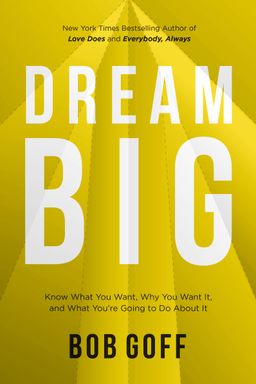
Dream Big cover

Dream Big

by Bob Goff

Dream Big by Bob Goff inspires readers to reconnect with their dreams and pursue them with clarity and confidence. It provides practical tools for overcoming obstacles, understanding true motivations, and creating a fulfilling life path. By embracing honesty and audacity, readers can transform their aspirations into achievable realities.

Dreaming Big: Discovering and Living Your God-Given Ambitions

Have you ever felt like your life was running on autopilot—busy, respectable, but somehow lacking deep purpose? In Dream Big, Bob Goff invites you to step off the treadmill of expectations and rediscover what you truly want from your one extraordinary life. He argues that God instills in every person a set of unique ambitions—hopes and missions that can change the world if we have the courage to pursue them. But unlocking those ambitions isn’t about frantic self-improvement; it’s about awakening to who we already are, refining our sense of purpose, and acting on it with love and faith.

Goff blends his signature mix of humor, storytelling, and spiritual insight to propose a framework for doing just that. He contrasts success and true significance by teaching how to identify the ambitions worth pursuing, clear away the self-doubt that holds us hostage, and move forward with resilient belief. Through personal anecdotes—from teaching in prisons to starting schools in war zones—he demonstrates how joy, courage, and divine purpose can transform even the most ordinary life into something enduringly beautiful.

Why Big Dreams Matter

For Goff, “dreaming big” is not about fame, wealth, or headline-making achievements. It’s about embarking on a journey toward the most authentic version of ourselves, the one God designed with intention. He believes that every ambition worth chasing has two handles: love and hope. These forces are the levers that lift us out of fear and invite us to make a difference beyond ourselves. To pursue small ambitions is to live a safe but shallow life; to dream big is to participate in the creative work of a God who delights in infinite possibility.

Yet, Goff warns, clarity and courage rarely come easily. Many people, he says, treat their ambitions like the clutter in his old college closet—valuable things lost in chaos because they’ve never been sorted or placed on a proper shelf. The work begins when you slow down enough to recognize what matters and what can be discarded. The act of reflection is not a luxury; it’s a necessity for living awake.

A Framework for Discovery and Action

Across seven major parts, Goff introduces a process he calls the Dream Big Framework. It begins with honest self-reflection—understanding who you are, where you are, and what you really want. From there, he encourages readers to build absurd expectations, explore opportunities courageously, clear their personal and spiritual obstacles, take decisive action, expect inevitable setbacks, and finally, sustain belief as they “land the plane.” This isn’t a one-time exercise; it’s a lifelong cycle of renewal and reinvention. (Readers may notice echoes of Rick Warren’s Purpose-Driven Life and Steven Pressfield’s The War of Art, but Goff’s approach is more relational and whimsical.)

Each section reads like a storytelling workshop for the soul. His anecdotes—a misused thermometer, a rock-climbing date that builds lifelong trust, a disastrous rafting trip on the Nile, and even his failed attempts to meet the Pope—illustrate universal truths about fear, humility, and the unpredictable grace of failure. He weaves humor into the sacred, showing how a life of faith is meant to be an adventure packed with both blunders and breakthroughs.

Love, Faith, and the Courage to Begin

More than anything, Goff’s message is an invitation to rewrite your story with intention. He insists that fixing your eyes on your purpose—rooted not in ego but in service—transforms the heaviness of striving into the lightness of love. Faith, he writes, is not a list of doctrines but action that grows from belief. “Faith is what you do about what you believe.” This conviction drives his counsel: stop waving at your ambitions like children running after a departing car—chase them, follow them, and trust that God goes with you.

Goff’s theology of ambition rejects the notion that Christians must choose between humility and audacity. To dream big is not to boast—it’s to join God in redeeming the world, one crazy idea at a time. “Don’t settle for what’s available,” he writes, “go after what will last.” In this way, Dream Big becomes both spiritual guide and personal playbook for those longing to integrate their deepest callings with courageous practice.

Why It Matters Now

In an age of distraction, cynicism, and comparison, Goff’s reminder feels revolutionary: we are not spectators in our own lives. The difference between those who drift and those who live with meaning comes down to one decision—to trade the comfort of what’s easy for the adventure of becoming fully awake. Whether you’re discerning a career change, rekindling faith, or rediscovering buried dreams, Dream Big offers both the inspiration and the tools to move from vague longing to joyful action. Its central question—“What will you do with your one extraordinary life?”—lingers long after the last page, daring you to start.


Don’t Go Alone: The Power of People

From the start, Bob Goff insists: dreams are never solitary adventures. “If you’re serious about your ambition,” he writes, “surround yourself with people who love you well.” His marriage to Sweet Maria becomes the master metaphor for this truth. Where he is spontaneous, explosive, and caffeinated on curiosity, she is serene, grounded, and reflective. They are, in his words, “the balloon and the string.” Together, they embody how faith and ambition require community—a network that both lifts you and keeps you tethered to what matters most.

Anchoring in Authentic Relationships

Maria’s quiet strength teaches him (and us) that purpose doesn’t need a platform. When she published her own book, instead of hosting a nationwide launch, she ordered pizza, made root beer floats, and enjoyed the moment with her family. Her understated choice illustrates Goff’s theme: significance grows from authenticity, not applause. The people worth having around you are those who remind you of your deepest identity when the world dangles applause in exchange for performance.

For dreamers, this means building a circle grounded in truth. Goff encourages seeking both supporters and challengers—people who fan your ambitions and those who stretch your patience. “Find easy friends to do life with,” he says, “and difficult ones to love.” The first group keeps you inspired; the second keeps you humble.

Learning Love Through Difference

Goff’s stories transform daily life into parables of partnership. When he invited Maria rock climbing on one of their first dates, she looked up and realized she could literally trust him with her life—he was the one holding the rope. That tale becomes a metaphor for pursuing ambitions with trust, vulnerability, and mutual care. Dreaming alone may feel heroic; dreaming together makes growth sustainable.

Through humor—his texts misreading “creeps” for “crepes”—he reminds readers that shared laughter builds endurance. Comparison and competition, by contrast, sap it. Drawing on biblical wisdom (“God doesn’t compare what He creates”), Goff elevates community from a feel-good accessory to a spiritual discipline. In a world obsessed with independence, Dream Big reclaims interdependence as the birthplace of both joy and clarity. Surrounded by people who call you back to truth, you’ll find your ambitions—like his pursuit of Sweet Maria—worth the climb.


Failure Happens: From Thermometers to Grace

In a chapter titled “Thermometer,” Goff uses two hilariously disastrous childhood stories—a broken-nose nap time incident and an unfortunate encounter with a rectal thermometer—to show that everyone fails, often spectacularly. Failure, he insists, is not disqualification but education. It’s how grace becomes more than a concept—it becomes muscle memory.

Messing Up as a Spiritual Discipline

His point is simple but profound: “We all mess up. It’s what we do next that defines us.” Just as he accidentally breaks a classmate’s nose in his eagerness to be the “wake-up fairy,” Goff shows how unchecked ambition can backfire when it seeks attention instead of growth. Likewise, his frantic thermometer moment becomes a comic confession of pride and ignorance. God, he notes, still finds ways to use us, even when we can’t tell one end of life’s thermometer from the other.

Ultimately, these stories reveal a theological truth often overlooked in goal-setting culture: brokenness breeds authenticity. He contrasts law students from Pepperdine with prisoners in San Quentin, observing that the inmates, despite literal confinement, possess a kind of spiritual freedom missing in those still enslaved to perfection. (In this regard, Goff’s view aligns with Brené Brown’s work on vulnerability as strength.)

Grace Over Performance

Dreaming big doesn’t mean being flawless—it means failing forward. For Goff, grace gives permission to begin again without shame. The same God who “smiles at the bright future you have with Him” isn’t keeping score but urging you to keep moving. Every mistake becomes a rehearsal for redemption, every splintered ambition a chance to start anew. “God isn’t grimacing at your failures,” he writes. “He’s nuts about you.” In a society obsessed with success metrics, this theology of misfires feels radical: mistakes aren’t detours. They’re directions.


Who Are You, Where Are You, What Do You Want?

At the center of Dream Big lies Goff’s three guiding questions—simple but seismic: Who are you?, Where are you?, and What do you want? They form the scaffolding for honest self-discovery, cutting through noise and pretense to expose what’s real beneath the surface.

Who Are You?

To answer this, Goff invites you to “get under the ice cap”—his metaphor for diving beneath the visible layers of your life to uncover buried motives and fears. Borrowing from his story about crawling beneath a glacier with a French pilot named Deni, he urges readers to move past surface-level self-definition and explore what drives them at their core. Your identity, he says, isn’t constructed through achievements or reputations but revealed through radical honesty before God. Real self-awareness requires consistent appointments with yourself—he jokes about a friend who literally parks outside a dialysis clinic weekly just to reflect.

Where Are You?

This question isn’t about geography but biography. “If you want to get in the race, you need a starting line,” Goff writes. Where you truly are emotionally, spiritually, and relationally determines your next step. He likens it to God’s conversation with Adam and Eve after the Fall: “Where are you?” wasn’t a GPS query—it was an invitation to self-awareness. Denial keeps us stuck in shame; honesty sets us in motion. Admitting you’re lost is the first step toward finding your coordinates again.

What Do You Want?

This, Goff claims, is the most difficult of all. Most people answer with what they think they’re supposed to want (“world peace”) rather than what they actually desire (“a surfboard,” “a better relationship,” “courage”). Authenticity requires naming real wants before refining them. “Don’t fake noble,” he says. “Be real—it’s more noble.” The irony is that once desires are honest, they often realign naturally with God’s heart. Jesus himself asked, “What do you want me to do for you?” not because He lacked insight, but because clarity transforms longing into action. Until you articulate your true desires, your life remains a dream still wrapped in the packaging.


Exploring Opportunity with Bold Curiosity

For Goff, dreaming big is inseparable from risky curiosity. In chapters like “Keep the Moon in the Window,” he argues that opportunities rarely arrive as fully mapped plans—they emerge when you move. Much like navigating by the moon while flying his seaplane, he advises keeping your ambition in view and adjusting course through constant mid-flight corrections. The worst mistake, he says, is waiting until everything makes sense before you start.

Movement Over Mastery

Instead of “waiting for the perfect moment,” Goff leads by example—writing letters to the Queen of England and the Pope, knowing full well he’ll be turned down. (He quotes the White House switchboard number—202-456-1414—as proof that access to possibility begins with a simple dial.) The point isn’t the result; it’s the practice of stepping into the stream of chance. Each small action—one handwritten note, one conversation—creates momentum, which he likens to a daisy chain of little wins. “You can’t go down every path at once,” he writes, “but start walking one, and doors start recognizing your footsteps.”

Be Fully Present

Exploring opportunity also means reclaiming attention in an age of chronic distraction. “Be where your feet are,” he says, warning that busyness masquerades as progress. Like mindfulness author Jon Kabat-Zinn, Goff equates presence with power: the ability to notice divine breadcrumbs scattered through daily life. He encourages pruning distractions, setting boundaries, and saying deliberate no’s to make space for deliberate yeses.

Faith as Participation

Underlying these stories is a robust faith in God’s ongoing invitation. “Faith doesn’t mean waiting for maps,” Goff writes. “It’s off-roading with Jesus.” Opportunity, then, is less about luck and more about availability—to God, to others, and to your own growing courage. The more available you become, the bigger your world gets. Availability, not ability, is the secret ingredient to living out your callings.


Clearing the Path: Letting Go and Starting Fresh

Many people, Goff observes, never reach their ambitions because they’re dragging unnecessary baggage. He uses gripping metaphors—from Stockholm syndrome to anchors and kelp on a sailboat—to describe how limiting beliefs, stale commitments, and fear act as invisible captors. Freedom begins when you identify what’s holding you hostage and perform your own “hostage negotiation.”

Confronting Limiting Beliefs

Like old keys in a junk drawer, many of our fears once fit a lock that no longer exists. They’re inherited stories—parents’ anxieties, teachers’ criticisms, cultural scripts—that have outlived their usefulness. Goff argues that awareness dissolves their power. By naming them (“I’m not enough,” “I missed my chance”), you begin replacing limitations with launching beliefs—truths instilled by grace and affirmation. His grandparents’ love, expressed through nickels saved for visiting his room, becomes his prototype for nurturing belief in others. Launching beliefs, he says, create lift just as surely as fear creates drag.

The Discipline of Quitting

Twice a week, Goff literally quits something every Thursday—a job, a routine, a bad habit—to keep space open for new endeavors. “Backing the boat down,” as sailors say, allows old kelp to fall away so you can move again. In a society addicted to adding, quitting becomes an act of faith. He even humorously cuts the pockets out of his jeans to remind himself daily that life is defined not just by what we hold but what we release.

Letting go also means learning to say no beautifully. “Say your no with kindness and grace,” he advises. “People will thank you for it.” Boundaries, in this model, aren’t walls—they’re runways cleared for meaningful flight. If ambition is propulsion, discernment is navigation. Without pruning, even holy dreams can suffocate under good intentions. This chapter’s rallying cry—“Quit what isn’t working. Do it Thursday.”—captures Goff’s broader engineering of joy: less drag, more lift.


Take Action and Live on the Edge of Yikes

“Comfortable people don’t need Jesus,” Goff declares in one of the book’s most memorable lines. To live a big dream, you must embrace discomfort—the thrilling, terrifying moment he calls living “on the edge of yikes.” Real growth happens at that boundary between fear and faith. Whether leading reconciliation projects in Somalia or learning to pick locks at age sixty, Goff models the paradox: risk is holy when driven by love.

Action Over Analysis

In stories ranging from his humanitarian efforts in war zones to jumping dirt bikes and failing gloriously, Goff dismantles the myth that clarity precedes action. “Faith looks like pulling back on the throttle,” he jokes, even as his own crashes prove that courage involves bruises. He contrasts planners stuck in 10:34—the minute before the Wright brothers took flight—with those willing to risk 10:35 and launch. Action, not perfection, separates dreamers from doers.

Fail Forward

Across multiple “epic fail” stories—being jailed in India, misadventures that endangered him, or losing his family’s lodge to fire—Goff reveals failure as sacred compost. Instead of asking “Why me?” he asks, “What is God surfacing here?” Even tragedy, he discovers when his wife confronts past trauma after losing their lodge, can expose deeper healing. “God will burn down whatever it takes to get to the truth of our lives.”

This is radical resilience: failing doesn’t brand you disqualified—it proves you’re alive. By rehearsing bravery through small daily risks—calls, letters, yeses—you prepare for larger leaps. Living awake is less about triumph than about trust.


Sustain Belief and Land the Plane

The final chapters of Dream Big shift from ignition to endurance. Starting a dream is one thing; sustaining belief through turbulence is another. Goff offers two metaphors—rock climbing and landing an airplane—to show how to stay anchored and finish strong.

Check Your Ropes

While college climbing with friends, Goff forgets to tie his safety rope into the mountain, realizing mid-climb that both he and his partner could fall. The moment becomes a life parable: don’t just look tied in—be tied in. A frenzy of spiritual activity (meetings, volunteering, ministry) can resemble security, but authenticity requires connection to God Himself, the immoveable rock. Sustaining belief, then, means anchoring your identity in grace rather than outcomes. From there, Goff adds another lesson from a friend with a terminal brain tumor: choose words carefully. “When you only have a few left,” she said, “you want them to mean more than all the words before.” Goff concludes that faith, like speech, should be fewer words, more power—“Be not afraid” said often enough to become muscle memory.

Ground Effect

Pilots experience “ground effect”—the cushion of air that keeps a plane hovering just above the runway. Many people hover similarly over their dreams, endlessly planning but never landing. His counsel: “Pitch, pick, and point.” Pitch forward toward risk instead of pulling back in fear; pick a landing—something concrete; and keep pointing at it. Stop circling—touch down and build something.

Matters of the Heart

The book ends with Kelly’s story—a heart transplant recipient who climbs the world’s tallest peaks, whispering to her new heart when to beat harder and when to rest. It becomes Goff’s ultimate metaphor for spiritual wholeness: learning to communicate honestly with our hearts and others, to push forward in purpose but also pause for grace. Sustaining belief, he concludes, is equal parts courage and tenderness. “Maybe it’s time,” he writes, borrowing Kelly’s words, “to whisper to your own heart… it’s time to rest.”

Dig Deeper

Get personalized prompts to apply these lessons to your life and deepen your understanding.

Go Deeper

Get the Full Experience

Download Insight Books for AI-powered reflections, quizzes, and more.