
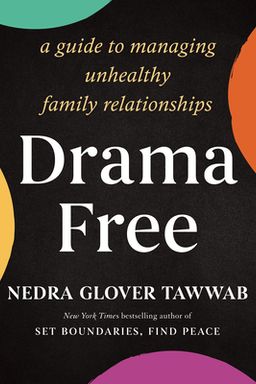
Drama Free cover

Drama Free

by Nedra Glover Tawwab

Drama Free is your guide to navigating and healing from dysfunctional family relationships. Learn to recognize patterns, set boundaries, and find support outside of your family to grow into the person you deserve to be.

Breaking the Cycle of Family Dysfunction

Have you ever wondered why certain family patterns seem impossible to escape? Why your relationships often echo the same tensions, emotional silences, or dramas you witnessed growing up? In Drama Free, therapist Nedra Glover Tawwab argues that the roots of much of our emotional suffering can be traced back to our family systems—and that awareness, boundaries, and self-leadership can set us free. Her central claim is that we can unlearn dysfunction and create healthier relationships, even when the people around us never change. But doing so demands courage, clarity, and consistent self-care.

Tawwab draws on her years as a therapist and her popular social media presence to illuminate the hidden rules that govern family interactions. She maintains that dysfunction isn’t limited to obvious forms of abuse—it's the unspoken rules, denial, codependency, and guilt that quietly shape generations. Healing doesn’t mean fixing others; it means accepting what you can’t control and rewriting your own story. Her approach is compassionate but direct: you may not ever have had a healthy template for love, but you can create one now.

Family as the Source of Our Patterns

Every relationship begins in the family. The home teaches us how to love, communicate, attach, and even argue. If those early lessons were laced with neglect, chaos, or perfectionism, we unconsciously drag them into adulthood. Tawwab explains that dysfunction can look like addiction, boundary violations, emotional manipulation, or even the constant covering up of problems to maintain appearances. Many people normalize these patterns because they think “that’s just family.” The first step toward breaking free is recognizing that emotional neglect is just as damaging as overt abuse.

For example, Carmen in the opening chapter grows up in a household filled with alcohol abuse and verbal fights. She tries to talk about the pain but is told to keep quiet—just one of many signals teaching her to doubt her own feelings. It’s only when Carmen sees healthier families around her that she begins to question what she considered normal. That awakening—seeing your family system clearly—is the first act of rebellion against dysfunction.

Unlearning Dysfunction Through Awareness

Tawwab urges readers to start with awareness. Using tools like the Adverse Childhood Experiences (ACE) survey, journaling, and therapy, you can trace your triggers back to their origins. Her clinical insight echoes the findings of trauma researchers like Bessel van der Kolk in The Body Keeps the Score: the body remembers what the mind tries to forget. Childhood stress, neglect, or chaos literally rewires the brain for hypervigilance and mistrust. Healing involves re-training your nervous system to respond differently, one relationship at a time.

Awareness is not blame. Tawwab emphasizes that most parents did what they could with the tools they had. But ignorance and pain perpetuate cycles. As she puts it, “Ignorance is bliss because it absolves us of the need to change.” Your task isn’t to indict your family but to understand how the system shaped you—and decide what to keep and what to release.

Boundaries and Codependency

A core focus in Tawwab’s philosophy, first outlined in her bestselling Set Boundaries, Find Peace, is that love without limits becomes enabling. Families often blur the line between care and control, creating codependent or enmeshed relationships. In Drama Free, she defines boundaries as expectations and limits that protect your peace. Healthy boundaries may look like saying no to intrusive relatives, clarifying what topics are off-limits, or deciding how much emotional labor you’re willing to offer. In dysfunctional systems, boundaries are seen as betrayal because they disrupt the family’s unspoken rules of silence and self-sacrifice.

Chelsea and Briana’s story, two twins entangled in mutual dependence, illustrates this tension. When Briana gets engaged and begins to distance herself to build autonomy, Chelsea accuses her of being “controlled” by her fiancé. Tawwab reframes the conflict: boundaries aren’t rejection—they’re a declaration of individuality.

Intergenerational Trauma and the Possibility of Change

The middle chapters—“Repeating the Cycle” and “Trauma Across Generations”—connect family dysfunction to broader social and historical trauma. Addictions, neglect, and unspoken pain ripple through generations because they are learned coping mechanisms. Tawwab details how trauma can transmit biologically through stress responses (echoing Joy DeGruy’s concept of Post Traumatic Slave Syndrome and research on epigenetics). But patterns aren’t destiny. The choice to heal begins the moment you recognize a behavior that doesn’t serve you—even if others refuse to change.

The book offers diverse examples of “cyclebreakers”—people who stop gossiping, refuse emotional blackmail, or simply decide not to repeat the parenting style they endured. These moments of awareness may spark resistance from others (“You think you’re better than us”), but they’re signs of growth. Change threatens dysfunctional systems because it calls everyone else to account. Yet, as Tawwab reminds us, thriving means choosing peace even if the family remains stuck in its drama.

Healing, Growth, and Redefining Family

In the second half of the book, Tawwab walks readers through practical strategies for healing. She divides the process into three movements—unlearning, healing, and growing. “Healing” involves naming resentment, practicing self-care, expressing anger safely, and replacing toxic forgiveness with genuine emotional processing. “Growing” is about redefining family: learning to parent yourself, select healthy friends as chosen family, and build boundaries with parents, siblings, or in-laws.

This progression from awareness to autonomy parallels the concepts in Adult Children of Emotionally Immature Parents by Lindsay C. Gibson and Running on Empty by Jonice Webb. In all, the message is the same: healthy adulthood means moving beyond survival to authentic self-leadership. The final chapters encourage redefining love, forgiveness, and connection on your terms. You may not be able to reconcile with your family—but you can reclaim your peace.

Key Takeaway

Healing family trauma doesn’t mean erasing the past—it means refusing to repeat it. You cannot change your parents, siblings, or relatives, but you can change how you show up. That’s the essence of becoming “drama free.”


Recognizing Hidden Family Dysfunction

Nedra Tawwab begins her exploration by helping readers recognize that dysfunction is often the norm disguised as love. Many families portray control, silence, or criticism as care. Differentiating between “normal family quirks” and unhealthy systems is part of healing.

When Love Looks Like Control

In families like Carmen’s, substance misuse and verbal abuse masked as discipline teach children to internalize chaos. Emotional neglect—parents who are consistently unavailable, critical, or withdrawn—produces adults who second-guess their needs. Tawwab emphasizes that dysfunction thrives on denial: “That’s just how we are” becomes a shield against accountability.

The result? Grown children who normalize mistreatment from partners, friends, and coworkers. They learn to equate love with rejection or validation with perfectionism. These patterns don’t disappear until we name them for what they are. (In It Didn’t Start With You, Mark Wolynn similarly describes how unacknowledged pain becomes inherited behavior.)

The Danger of Pretending

Pretending everything is fine is one of the most damaging family traditions. Tawwab recounts how children of addicted or abusive parents often protect the parent’s image, internalizing shame and silence. But ignoring big problems doesn’t bring peace—only unresolved trauma disguised as tolerance. The first step toward a drama-free life is brutal honesty about what really happened, even when others refuse to acknowledge it.

This honesty, she explains, is not betrayal—it’s courage. Owning the truth may bring guilt or grief, but it builds agency. Once you admit your parents were emotionally unavailable, controlling, or hurtful, you can learn to provide for yourself what was missing.

Healing Through Awareness

Tawwab advises starting with reflection rather than blame: What roles did you play to survive the system? The placater? The responsible one? The scapegoat? She connects this to well-known family roles from family systems theory and codependency literature, showing how each child’s coping mechanism reflects the larger dysfunction. Understanding these roles restores compassion—for yourself and for how others coped, too.

Key Takeaway

Recognizing dysfunction isn’t disloyalty to your family; it’s loyalty to your future self. Awareness is the seed of transformation.


Boundaries, Codependency, and Enmeshment

Boundaries are Tawwab’s signature concept, expanded here within family contexts. She defines them as “expectations and needs that help you feel safe.” Without them, families drift into codependency and enmeshment—the inability to separate your identity from another person’s emotional turbulence.

Codependency: The Care That Hurts

In codependent families, “helping” often means rescuing others from consequences. Parents over-function for adult children, siblings fix each other’s lives, or partners play therapist. Tawwab reminds you that empathy without boundaries becomes enabling. True care respects autonomy—even when letting others struggle is painful.

Her advice: stop controlling what isn’t yours. Instead of fixing your sibling’s finances, offer guidance once and step back. If your mother overshares, tell her what topics you can’t discuss. Change begins not when others comply, but when you behave differently.

Enmeshment: When Separation Feels Like Betrayal

Enmeshment blurs boundaries so completely that saying no feels like abandonment. In Briana and Chelsea’s story, the twin bond becomes a prison. When Briana sets limits, Chelsea interprets it as rejection. In reality, Briana is asserting selfhood—a necessary act of individuation. Tawwab normalizes this process: autonomy is not selfish; it’s survival.

Resistance will come. In dysfunctional families, boundary-setting feels like rebellion against loyalty, culture, or tradition. Members may use guilt, shame, or silence to restore “normal.” But as Tawwab notes, people who value your compliance over your well-being were never honoring you in the first place.

Practice, Not Perfection

Boundaries resemble muscle memory—they strengthen with repetition. Start small: decline minor requests, pause before answering, and give yourself permission to disappoint people. Each act of self-respect disrupts generations of conditioning. (This mindset parallels Brené Brown’s insights that vulnerability and boundaries define authentic connection.)

Key Takeaway

Boundaries are not barriers; they are bridges to healthier love. They teach others how to treat you—and teach you that peace is your responsibility.


Generational Trauma and Family Cycles

Tawwab devotes significant attention to intergenerational cycles of trauma—the unconscious repetition of wounds passed from parent to child. Abuse, addiction, neglect, and denial don’t end with one generation; they reappear in new forms until someone chooses awareness.

How Trauma Travels

In Chapter 5, she describes scientific evidence linking trauma to changes in brain and gene expression. Drawing on Joy DeGruy’s work on post-traumatic slave syndrome and Michael Yapko’s research on depression, she connects the dots between suppressed pain, substance misuse, and emotional disconnection. Families often minimize the past with statements like “It wasn’t that bad” or “Leave the past in the past.” Yet denial is a form of inheritance—it teaches children to distrust their emotions.

Donald’s story, a man repeating his family’s alcoholism, captures this perfectly. He believes he’s “functional” because he’s employed, missing that addiction manifests not only in chaos but in subtle avoidance of pain. His healing begins when his wife leaves and he finally asks: “Can I change on my own, or will I need support?”

Patterns We Repeat

Among the most common multigenerational patterns Tawwab lists are gossiping, emotional neglect, people-pleasing, financial instability, and unrealistic appearances. Each one masks fear and shame. You might swear not to be like your parents, only to discover you’ve replicated their coping mechanisms under new disguises.

Breaking the cycle begins with identification. Ask: What scripts did my family hand me about love, success, or sacrifice? Which ones do I still perform for acceptance? Once acknowledged, you can choose to rewrite them, replacing secrecy with communication and punishment with empathy.

From Shame to Growth

Shame, Tawwab explains, is the glue holding dysfunction together. Families stay silent not because they forget—but because they’re afraid to be seen as broken. Her antidote is self-compassion: “I am not a product of my environment. I am a product of my choices.” (This echoes trauma researcher Gabor Maté’s reminder that compassion, not condemnation, heals trauma.)

Key Takeaway

You cannot heal what you continue to minimize. Breaking generational trauma requires confronting shame with honesty and choosing new behaviors daily.


Healing When Others Won’t Change

What if the people causing your pain refuse to acknowledge their behavior? Tawwab dedicates an entire section to managing relationships with those who won’t or can’t change. Acceptance, not persuasion, becomes the tool for peace.

Acceptance Is Not Endorsement

Tiffany’s story reveals this paradox. Her mother, Rita, is financially irresponsible and constantly relies on her adult daughter for support. Tiffany resents her but also feels obligated to help. Instead of trying to “fix” Rita, Tawwab guides Tiffany to shift expectations and create new boundaries—deciding how much help she can give and under what conditions. Acceptance means acknowledging who someone is today, not wishing for a version of them that never existed.

You Can’t Shame People into Growth

Through examples and research—from University of Michigan studies on shaming to the movie Full Metal Jacket—Tawwab demonstrates that humiliation only triggers defensiveness. Instead of moralizing, she urges curiosity and self-focus: What can you control? Your reactions, your availability, your energy. This shift dismantles the illusion that peace depends on others changing first.

Helping Without Enabling

The key is to differentiate compassion from codependence. Helping empowers others; enabling protects them from consequences. Examples of enabling include giving money you can’t afford or solving problems others could solve themselves. Healthy helping, on the other hand, includes emotional support, setting clear expectations, and stepping back when needed.

Key Takeaway

When people won’t change, you can still choose peace by changing your reactions. Acceptance is freedom disguised as surrender.


Forgiveness and Estrangement

In Chapter 9, Tawwab tackles one of the most taboo subjects: ending family relationships. Sometimes, peace requires distance. She reframes estrangement not as rebellion but as self-preservation when harm continues unchecked.

Jacob’s story illustrates this painful path. His father’s untreated PTSD and verbal abuse lead Jacob to finally cut ties. Tawwab lists the common triggers for estrangement—from childhood wounds to money conflicts—and emphasizes that the decision rarely comes suddenly. It’s the culmination of years of failed boundaries and conditional love.

Healthy vs. Toxic Forgiveness

Forgiveness can heal, but only when it’s genuine. “Toxic forgiveness” skips emotional processing for the sake of appearances. True forgiveness involves acknowledgment, accountability, and new boundaries. You can forgive and still walk away. She warns against pressure from relatives who say, “You only get one mother.” Shared DNA doesn’t require shared suffering.

Coping with Guilt and Judgment

Guilt often haunts those who choose separation, especially when society upholds unconditional family loyalty. Tawwab encourages self-compassion and clarity: guilt doesn’t mean you did something wrong—it means you care. Over time, replacing guilt with grief allows healing to begin. As she writes, “You aren’t betraying your family by speaking your truth; you’re honoring your health.”

Key Takeaway

Sometimes forgiveness means release, not reconciliation. You owe peace to yourself more than loyalty to dysfunction.


Repairing the Parent–Child Relationship

Parents and children, Tawwab argues, often misremember the same story differently. Healing across generations requires empathy for both perspectives. Through case studies like Anthony and his estranged father, she shows how anger can coexist with compassion.

Seeing Parents as People

A powerful exercise she offers: replace “my mom” or “my dad” with their first name and ask, “What is this person’s story?” This reframing humanizes them without excusing harm. Parents bring their own trauma into the parenting role. Understanding this provides context without relinquishing accountability. It’s empathy with boundaries.

Practicing Grace Without Erasure

Anger toward parents is natural; pretending it doesn’t exist only deepens the wound. Tawwab differentiates between “getting over” emotions and moving through them. You don’t have to rush peace. Her tools—letter writing, therapeutic dialogue, and gradual boundary-building—help rebuild trust if reconciliation is possible, or bring closure if it’s not.

Reparenting Yourself

If your parents remain emotionally immature or absent, you can still heal by reparenting your inner child: nurturing yourself, creating routines, and offering the validation you missed. This act turns dependency into empowerment. (Therapist John Bradshaw and Jonice Webb similarly advocate self-parenting to replace childhood deprivation.)

Key Takeaway

You may never get the apology you deserve, but you can give yourself the love you were always owed.


Troubleshooting Sibling, Child, and Extended Family Ties

Later chapters apply Tawwab’s approach to specific family roles—siblings, adult children, and extended relatives. Her message is consistent: every relationship can heal or stabilize through clarity, boundaries, and empathy.

Siblings: From Rivalry to Respect

Sierra and Sylvester’s story depicts how parental favoritism breeds resentment. Tawwab teaches that parents shape sibling dynamics by how they mediate conflict or show fairness. Adult siblings can heal by naming resentment (“I felt less seen”) and forcing openness (“I want to rebuild on equal terms”). Healing doesn’t require forced closeness—only honesty and boundaries that protect your peace.

Parent–Child Repair in Adulthood

For parents, accountability is key. The chapter on children encourages acknowledging harm without defensiveness: “I was wrong” is more healing than “I did my best.” Adults can model vulnerability for their kids, even late in life. For adult children, letting go of control—inviting parents to grow or maintaining distance if they won’t—is equally valid.

In-Laws and Blended Families

Merging families brings new boundaries. In-laws require diplomacy; stepfamilies require patience and unity language (“we,” “our”). Whether it’s navigating gossip, differing parenting styles, or favoritism, Tawwab urges compassion without submission. Building harmony means defining your own household’s rules and inviting love without strings.

Key Takeaway

Every family role can be redefined through boundaries and grace. Healthy relationships are chosen, not owed.


Creating Chosen Family and Community

In one of the book’s most hopeful sections, Tawwab describes how healing sometimes means building the family you never had. Chosen family—friends, mentors, neighbors—can provide the safety and consistency missing in blood ties.

Redefining Family

Dan’s story captures this possibility: raised with minimal family support, he found belonging through his neighbors, the Reddings. They became his lifelong “surrogate parents.” Tawwab highlights that roles and titles don’t always align—some mothers aren’t nurturing, and some friends are. Family is defined by care, not DNA.

She lists core qualities of healthy relationships—trust, authenticity, mutual support—and encourages readers to model them first. Becoming the person you needed is how you attract similar people. (This principle echoes bell hooks’ assertion that love is an action, not a noun.)

Supporting Yourself

While external community is vital, self-support remains foundational. Tawwab outlines five skills: knowing yourself, reducing self-neglect, trusting your judgment, focusing on your needs, and being who you needed. These habits turn independence into interdependence—creating healthy connections rooted in self-respect, not desperation.

Key Takeaway

You can rebuild family through choice and consistency. Healthy love begins with self-trust and radiates outward.


Thriving Beyond Survival

In her concept of “thriving vs. surviving,” Tawwab reframes healing as more than damage control—it’s the creation of a joyful new legacy. Surviving stops the cycle; thriving begins a new one.

Cyclebreakers and Conscious Living

Cyclebreakers intentionally disrupt inherited dysfunction, often facing guilt and alienation. Whitney’s story, for example, shows how trauma repetition in romantic relationships transforms once she enters therapy and takes responsibility. The thriving individual doesn’t just avoid harm; they cultivate emotional maturity, autonomy, and interdependence.

From Victim to Creator

Tawwab challenges the identity of being a victim of circumstance. Childhood trauma explains pain—it doesn’t define potential. You may not have learned emotional regulation at home, but you can teach yourself now. Every act of self-education—reading, therapy, introspection—is a rebellion against the past. Responsibility is empowerment disguised as burden.

Choosing Peace Over Drama

Peace, she reminds, is not passive; it’s intentional. Choosing not to argue, not to gossip, and not to fix others is radical resistance to dysfunction. As Tawwab writes in her conclusion, “You are no longer a child in a dysfunctional home. You’re an adult with choices.” This final affirmation reframes family healing not as erasing history but as writing a new one.

Key Takeaway

Thriving means creating what you needed and choosing growth over guilt. Your peace is the proof that the cycle has ended.

Dig Deeper

Get personalized prompts to apply these lessons to your life and deepen your understanding.

Go Deeper

Get the Full Experience

Download Insight Books for AI-powered reflections, quizzes, and more.