
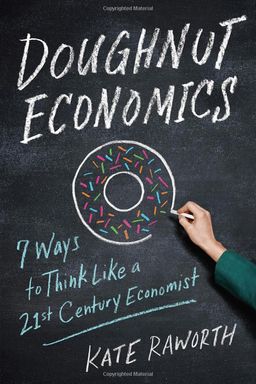
Doughnut Economics cover

Doughnut Economics

by Kate Raworth

Doughnut Economics by Kate Raworth offers a groundbreaking approach to redefine economics for the 21st century. It challenges the myth of endless growth, proposing a doughnut-shaped model to balance human prosperity and ecological sustainability. This transformative read presents a new vision for an equitable, thriving world.

Re‑Drawing Economics for the 21st Century

What if economics stopped chasing endless growth and started guiding humanity toward balance? In Doughnut Economics, Kate Raworth argues that we need a new economic story—one that puts life, fairness, and ecological safety at its center. Instead of measuring success by GDP, she proposes a compass: the Doughnut. Inside lies a social foundation that ensures human needs; outside sits the ecological ceiling that keeps us within the planet’s limits. The safe and just space between these rings is where both humanity and Earth can thrive.

The Doughnut as Compass

The social foundation represents universal essentials—food, water, health, education, housing, energy, political voice, and equity. Falling below it means deprivation. The ecological ceiling marks planetary boundaries identified by scientists like Johan Rockström and Will Steffen: the limits on climate, biodiversity, land use, freshwater, and more. Overshoot them, and civilisation risks collapse. You can visualize the Doughnut as Earth’s “Goldilocks zone”—not too little, not too much.

Seeing the Economy as Embedded

Raworth dismantles the famous Circular Flow diagram you may have seen in textbooks—households and firms trading money and goods in neat loops. That model leaves out unpaid care, natural inputs, commons, and planetary energy flows. In its place, she draws the Embedded Economy: a system nested within society and the living world, powered by the sun and sustained by the commons. This redraws who has agency—households, states, businesses, and commons—each playing a role in provisioning rather than competing for dominance.

A New Portrait of Humanity

The book also replaces the myth of Homo Economicus, the rational calculative self maximizing profit, with a richer human portrait: social, interdependent, value-driven, and ecologically aware. Experiments like the Ultimatum Game show people punish unfairness even at personal cost, disproving narrow rationality. We approximate decisions under uncertainty, act through networks, and care deeply about justice and belonging. Economics should reflect that reality to design systems that nurture cooperation instead of eroding it.

Systems Thinking and Feedbacks

Raworth encourages you to see economies as complex systems, full of feedback loops and delays. Reinforcing feedbacks amplify inequality and growth; balancing loops stabilize and adapt. This understanding helps design leverage points—small changes with large effects. The 2008 financial crisis exemplified a reinforcing instability described by Hyman Minsky; climate change’s carbon accumulation is another feedback-driven challenge. Systems thinking replaces futile control with stewardship, promoting resilience and adaptability.

Distribution by Design, Not Accident

Inequality isn’t inevitable; it’s designed. From Kuznets to Piketty, research shows that who owns assets and sets the rules determines outcomes. Raworth reframes equality as a design question—ownership, taxation, labour rights, and governance must embed fairness. Distributive systems ensure everyone has access to the Doughnut’s social foundation without breaching ecological ceilings.

Regeneration and Growth Agnosticism

Finally, Raworth turns growth from obsession to possibility. Economies should sustain human flourishing whether they grow or not. Regenerative design—circular production, renewable energy, and reusing materials—makes prosperity compatible with planetary boundaries. The goal becomes to thrive in balance, not expand forever. (Note: This draws on ideas echoed by Herman Daly’s Steady-State Economics and Janine Benyus’s Biomimicry.)

Core Message

Redraw the pictures, reframe the assumptions, and redesign the institutions: when economics learns to follow life’s patterns instead of resisting them, humanity can finally live within the safe and just space of the Doughnut.

Through vivid diagrams, historical reflection, and practical examples—from local currencies in Kenya to cooperative enterprises in Cleveland—Raworth offers a playbook for reimagining economics as a tool for human and planetary thriving.


The Doughnut Compass

The Doughnut model is a visual guide to align economic design with both human and planetary wellbeing. It replaces the unbounded upward GDP curve with two concentric rings: the inner social foundation and the outer ecological ceiling. Your aim is to ensure people meet essential needs without overshooting the Earth's limits.

Social Foundation

The social base includes basic rights and services—food, water, health, housing, education, energy, income, work, networks, gender equality, voice and justice. Falling short means deprivation and exclusion. These fundamentals mirror the UN’s Sustainable Development Goals. Raising all humans above this baseline is the essence of social justice.

Ecological Ceiling

Outside the outer ring lie planetary thresholds identified by Earth-system scientists. Transgressing boundaries in climate, biodiversity, and nitrogen cycles threatens the stable Holocene conditions that made civilization possible. Humanity has already crossed several of these lines—a sign of ecological overshoot.

Balancing Population, Distribution, Aspiration, Technology, and Governance

Raworth shows five forces shape whether we can live inside the Doughnut: population growth, resource distribution, consumption aspiration, technology choice, and governance quality. Redistribution, technological innovation, and ethical aspiration are the levers enabling collective balance.

Guiding Idea

Economics’ goal is no longer infinite expansion but thriving in the safe and just space between the social floor and ecological ceiling.

In practice, governments and communities use the Doughnut to diagnose local deficits and overshoots, reframing policy from 'grow more' to 'thrive in balance'—a shift from quantity to quality of development.


Economy as Embedded System

Raworth redraws economics from a self-contained marketplace to an embedded social-ecological system. The old Circular Flow diagram focused on firms and households swapping money and goods, omitting unpaid care, natural services, and commons. The new imagery shows the economy nested within society and Earth, powered by solar energy and bounded by ecological reality.

Four Realms of Provisioning

The embedded model identifies four provisioning domains: household (care and community labor), market (exchange by prices), commons (shared stewardship), and state (collective governance). Each must cooperate for sustainability. Elinor Ostrom’s research proves commons can outperform markets and states when designed for trust and reciprocity.

Power and Omission

By seeing the economy as embedded, you notice what earlier models hid—who holds power, who is excluded, and what environmental costs are ignored. It shifts questions from “How do we make markets efficient?” to “When should markets exist at all?” and “How do we embed finance and trade to serve well-being?”

Key Insight

What economists draw determines who gets counted. Redrawing the diagram restores society, commons, and planet to the center—where they belong.

This reframing also justifies policies like community-led urban planning and stewardship models used in Kokstad and Patagonia’s regenerative supply chains—examples of economies designed to fit inside ecological and social systems, not stand outside them.


Rethinking Human Nature

Economic theory long revolved around a cartoon of humanity: rational, self-interested, perfectly informed, and detached. Raworth restores complexity by showing humans are social, moral, and embedded in nature. This has immense policy consequences—from taxation to welfare to innovation design.

Five Shifts

People are social and reciprocating: experiments reveal a deep sense of fairness. We hold fluid values that evolve by context, as Shalom Schwartz’s value research shows. We are interdependent through social networks. We approximate rather than calculate; heuristics create efficient everyday decisions. And we are embedded in the living world—our wellbeing depends on its health.

Policy Implications

Designing policies for real humans means protecting intrinsic motives. Monetary fines may crowd out moral ones, as seen in the Haifa daycare experiment. Instead, nudge social norms, activate shared identities, and invest in civic framing that nurtures cooperation. (Parallels exist with Richard Thaler’s and Elinor Ostrom’s findings.)

Human-Centered Economics

When economics educates people as self-maximizers, society behaves that way. Teaching a richer portrait empowers communities to act fairly and protect shared life systems.

You can apply this by reforming incentive systems, promoting citizen participation, and cultivating cooperation in businesses and communities—aligning economic practice with genuine human nature.


Systems, Feedback, and Resilience

Rather than functioning as predictable machines seeking equilibrium, economies are living systems of feedback and delay. Recognizing this helps you spot fragility before collapse and design for resilience instead of perfection.

Understanding Stocks, Flows, and Loops

Stocks are accumulations—resources, wealth, trust; flows change them. Reinforcing loops amplify inequality and growth; balancing loops sustain stability. Delays cause cycles, whether in climate carbon accumulation or credit expansion. Mistaking these nonlinear dynamics for linear progress invites crisis.

Seeing Crises Differently

Financial instability follows Minsky’s insight that calm breeds turmoil. Climate dynamics mirror a bathtub—reducing inflows below outflows is required to lower accumulation. Network fragility research by Andy Haldane shows how systems flip suddenly when connectivity becomes concentrated.

Design Message

Small leverage points matter more than big levers. Economic resilience comes from adaptability, diversity, and feedback awareness—not prediction and control.

Learning systems thinking lets you design policies and businesses for self-organization, regeneration, and long-term stability—foundations for economies capable of thriving within the Doughnut.


Distributive and Regenerative Design

Raworth argues that true prosperity requires economies to be both distributive and regenerative. Distribution ensures value circulates fairly; regeneration ensures production restores rather than depletes Earth. Both principles demand redesign of ownership, production, and finance.

Distributive Ownership

Who owns enterprises determines who benefits. Shareholder primacy traps firms in extractive logic. Marjorie Kelly’s concept of rooted membership and stakeholder finance flips that logic—employees and communities become insiders and beneficiaries. Cooperatives like Evergreen in Cleveland and partnerships like John Lewis show this design at work.

Regenerative Industry

Industrial systems can follow nature’s cycles. The circular economy, symbolized by the butterfly with biological and technical wings, keeps nutrients circulating. Sundrop Farms and Newlight Technologies exemplify regeneration via solar and carbon-negative processes. Park 20|20 in the Netherlands demonstrates cradle-to-cradle architecture where materials live multiple lives.

Design Over Growth

Such systems work even in slow or no-growth contexts. The shift from 'growth addiction' to 'growth agnosticism' lets societies measure success by health, equality and ecological repair instead of endless GDP rise. Reframing taxes, finance, and job design enables safe landings on the S‑curve of development.

Practical Takeaway

Redesign ownership, finance, and industry together, and you make economies distributive by design and regenerative by function.

These strategies replace inequality and depletion with shared prosperity and ecological renewal—a model for durable wellbeing in both developing and post‑growth societies.


Money, Commons, and Innovation for All

Money and knowledge—two unseen architectures—shape who gains and who serves. Raworth explores how redesigning them can democratize power and enable regenerative outcomes.

Monetary Redesign

Today, most money originates as bank debt funding speculation. Alternatives like Green QE or People’s QE could redirect creation toward public investment. Complementary currencies—from Mombasa’s Bangla Pesa to Ghent’s Torekes—show how local exchange strengthens community resilience. Demurrage, conceived by Silvio Gesell, encourages circulation, while regenerative finance models like John Fullerton’s Evergreen investing aim at patient, life-serving capital.

Commons and Open Innovation

Intellectual property can restrict innovation, but commons unlock collective progress. Marcin Jakubowski’s open-source tractors and the Open Building Institute demonstrate distributed production worldwide. Governments can act as Partner States—open-licensing public research, funding makerspaces, and supporting peer networks. These commons embody democratic innovation, making tools and knowledge available to all.

Technology and the Dividend of Automation

Automation can deepen inequality unless gains are shared. Robot dividends and co‑ownership of publicly funded patents, as proposed by Mariana Mazzucato, would ensure collective benefit. Shifting taxes from labour to resource use further balances impacts.

Final Message

Commons in money and knowledge are the social infrastructure of a distributive economy—enabling creation, circulation, and stewardship that keeps everyone within the Doughnut.

Local currencies, cooperative banks, and open-source designs show that wealth can be co‑created, not monopolized—foundations for a thriving regenerative civilization.


Power of Visual Frames

Every paradigm begins with a picture. The final lesson of Raworth’s book is that what you draw determines how you think. Samuelson’s Circular Flow once taught generations to see economics as a closed loop of money. Raworth’s Doughnut redraws the frame as a living compass—compact enough to teach, powerful enough to transform discourse.

Framing and the Mind

Visuals shape cognition; people remember diagrams long after formulas fade. George Lakoff’s work on framing explains why refuting old metaphors reinforces them. The Doughnut communicates complex interdependencies clearly enough for cities, companies, and international negotiators to act on shared goals. (The UN’s adoption of the framework in environmental policy shows its bridging potential.)

Picturing a Better World

To transform economics, start by redrawing it. Replace profit maximization charts with images that include people, community, and planet. Teaching new diagrams rewrites mental boundaries. When students sketch the Embedded Economy instead of Circular Flow, they literally see their world differently.

Closing Thought

With a pencil, you can redraw the world. The Doughnut is more than an idea—it's a map that helps humanity find its way back inside planetary and social boundaries.

When you adopt new frames, you change what counts as success, what problems are visible, and what futures are imaginable—and that is how the new economics begins.

Dig Deeper

Get personalized prompts to apply these lessons to your life and deepen your understanding.

Go Deeper

Get the Full Experience

Download Insight Books for AI-powered reflections, quizzes, and more.