
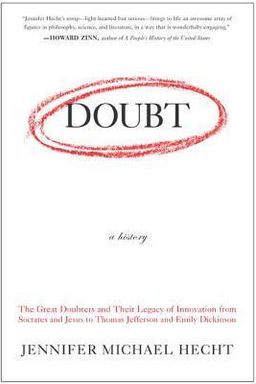
Doubt A History cover

Doubt A History

by Jennifer Michael Hecht

Doubt: A History uncovers the influential yet hidden role of doubters from Socrates to Emily Dickinson. By exploring the power of skepticism, Jennifer Michael Hecht reveals how doubt has driven innovation, challenged authority, and shaped our modern worldview, offering readers a fresh perspective on the history of ideas.

The Human Story of Doubt

What if doubt, rather than belief, is the truest marker of human consciousness? In Doubt: A History, Jennifer Michael Hecht argues that uncertainty is not a marginal footnote to faith—it is its full parallel narrative. Across continents and millennia, from the Greek Atomists and the Indian Carvaka to Job’s cries and Zen’s koans, Hecht shows how humanity repeatedly confronts the same existential rupture: our need for meaning against a silent, indifferent universe.

Tracing doubt as a global inheritance

You can follow doubt as a continuous network of thought, reaction, and practice. Ancient materialists from Democritus to Lucretius rewrote the cosmos as atoms and void. Eastern teachers like the Buddha and Mahavira transformed metaphysical questions into disciplines of body and mind. Jewish texts like Job and Ecclesiastes made protest and resignation their theology. Greek and Roman philosophers—Epicurus, Stoics, Skeptics—offered self-sufficient ways of living. Christianity then reshaped doubt into the drama of inner faith, while later rationalists and scientists rebuilt it into critical philosophy. This panoramic continuity proves that doubt is no accident; it is a deliberately cultivated human strategy for living well in uncertainty.

The Great Schism: human craving vs. cosmic silence

Hecht centers her story on what she calls the Great Schism—the gap between moral, purposeful human consciousness and an apparently indifferent universe. Every tradition grapples with this divide. Some project meaning outward, asserting divine justice or providence (Plato, Stoics, Abraham, Paul). Others shrink ego inward, learning to harmonize with what simply is (Cynics, Buddhists, Zen practitioners). The contrast frames the recurring question: do you reconcile the universe to your sense of justice, or reconcile yourself to a universe that lacks it?

A pattern of transmission and adaptation

Doubt’s story is not linear but migratory. Greek thought flowed through Roman dialogue, early Christianity, Islamic rationalism, Jewish philosophy, and Eastern meditation. Each culture reinterpreted inherited questions: whether in Gnostic suspicion of the creator’s goodness, in Neoplatonism’s mystic ascent to the One, or in medieval Islamic falsafa’s defense of philosophy as devotion. Suppression only displaced doubt; exile and translation carried it forward—from Alexandria’s murdered Hypatia to Baghdad’s translators, to Averroes’ Aristotelian commentaries that later sparked Europe’s Scholastic revival.

Why this matters today

Hecht’s narrative extends into modernity, where scientific, feminist, and secular movements inherit this legacy. Darwin’s evolution, Mill’s liberalism, Sanger’s freethought, and Zen’s "Great Doubt" all turn uncertainty into a constructive force. Doubt is no longer merely denial; it becomes an ethical and psychological technique—learning to live without guarantees yet still act justly. Whether in post-Holocaust theology or modern therapy’s embrace of 'not-knowing,' Hecht insists empathy and meaning are forged through questioning, not certainty.

Core idea

Doubt is a universal method for reconciling fragile human hope with cosmic indifference. Across history, to doubt well is to live intelligently and compassionately within mystery.

If you take one lesson from Hecht’s grand arc, let it be this: the history of belief is also the history of refusal. The most vibrant cultures, from ancient Athens to modern Berlin, test their gods, rewrite their rituals, and keep asking questions whose answers never fully arrive. Doubt is humanity’s recurring act of faith—in truth itself.


Ancient Foundations: Greece, India, and Israel

Hecht begins in the ancient world, where doubt first becomes an organized intellectual practice. In Greece the pre-Socratics transform myth into mechanism; Thales and Anaximander explain creation without gods. Xenophanes mocks anthropomorphic deities, while Heraclitus teaches that flux, not divine plan, governs all. Plato and Aristotle rationalize divinity into timeless forms and logical order—the beginnings of philosophy as a substitute for faith.

Greek therapies for the indifferent cosmos

Epicurus cures fear by showing death is nothing; Stoics align human virtue with natural order; Skeptics suspend judgment to find peace. Lucretius’s poetic atomism proclaims that marvel itself requires no gods. These schools respond differently to the Great Schism: some raise the world up to moral meaning, others train you to accept its indifference gracefully.

Indian materialists and Buddhists: doubt as release

In India, the Carvaka deny the afterlife and celebrate sensory joy; Jainism turns doubt into strict nonviolence and karmic hygiene; Buddhism introduces anatman—the idea of no enduring self—and teaches liberation by meditative practice, not belief. (Note: These traditions challenge Western models by making religious systems non-theistic.) Doubt becomes practical: change your consciousness and suffering dissolves.

Jewish voices of protest and resignation

The Book of Job and Ecclesiastes show the emotional face of doubt. Job demands moral coherence from God and receives a vision of natural vastness instead—a replacement of justice with awe. Ecclesiastes shrugs, embracing small joys. Both texts preserve the question of divine fairness as an ongoing internal dialogue within faith. When the Hellenistic Antiochus enforces Zeus worship, the Maccabean revolt exposes how cosmopolitanism can spark both philosophical doubt and militant belief.

Insight

By the end of antiquity, you see doubt functioning not just as negation but as therapy—methods for peace amid uncertainty. From Indian yoga to Epicurean gardens, it becomes lifestyle, not rebellion.

Hecht’s ancient panorama teaches you that whenever communities mix gods and schools—from Jerusalem to Alexandria—skepticism blooms. Doubt arises most where human diversity makes comparison unavoidable, revealing religion and reason as mutually defining forces.


Faith’s Inversion: Jesus to Augustine

Hecht turns to Christianity as the moment when belief and doubt intertwine permanently. The Gospels themselves exhibit doubt: Jesus prays for reprieve in Gethsemane and cries 'Why have you forsaken me?' at crucifixion—a divine figure wrestling with abandonment. Faith becomes the central drama. Early Christianity replaces Jewish law and ritual with inner conviction; your salvation hinges on what you believe, not merely what you do.

Paul and the politics of inner faith

Paul universalizes this inwardness. Abraham is justified by trust before circumcision, so ritual becomes secondary. He introduces obedience to political authority as proof of faith’s social order (Romans 13). This makes inward belief both private and politically stabilizing—an ingenious adaptation for empire. It also plants psychological tension: sincerity itself becomes the problem. You now doubt whether you believe correctly enough.

Gnostics and ascetic revolts

Gnosticism flips God’s moral frame—perhaps the world’s creator is flawed; perhaps salvation lies in secret inner knowledge. Mani’s dualism perfects ascetic rejection of matter. Both movements treat cosmic injustice as proof that conventional theology deceives. Though condemned as heresy, their spiritual grammar—fear of impurity, pursuit of hidden truth—enters Christian monasticism. Asceticism becomes institutional doubt: suspicion of the body turned spiritual discipline.

Neoplatonism and Augustine’s synthesis

Plotinus gives Christianity philosophical muscle, teaching ascent to the transcendent One. Augustine takes it further: in Confessions, he dramatizes inner hesitation and conversion, integrating Platonic reason with biblical grace. His model legitimizes questioning as a path that ends in submission. Doubt becomes method but not rebellion—a spiritual apprenticeship for truth you cannot prove but must live.

Takeaway

Christianity transformed outward ritual doubt into internal psychological drama; asking becomes believing. Augustine’s legacy—question but obey—frames Western faith for centuries.


Transmission, Suppression, and Survival

The collapse of pagan academies and rise of imperial Christianity nearly silenced philosophical doubt in the West. Hypatia’s murder in 415 CE and Justinian’s closure of the schools in 529 mark cultural trauma. Yet ideas survive by migration. Exiled philosophers move east, and Syrian, Persian, and later Arabic translators preserve Aristotle, Plato, and logic. This Mediterranean loop—Edessa to Baghdad to Spain—keeps the intellectual flame alive.

Islamic rationalism and its crises

Under the Abbasids, the Mutazilis champion reason; Ibn al-Rawandi and al-Razi critique prophecy and invent radical freethought. Al-Ghazzali’s mystical turn warns that philosophy leaves heart-empty, while Averroes reasserts reason as compatible with faith. Their debates reintroduce Aristotelianism to Europe, fueling Scholastic thought and rational theology. (Note: Latin Averroism later triggers Christian crackdowns, showing doubt’s cyclical peril.)

Jewish rationalism and mystic resupply

Maimonides harmonizes revelation and reason through negative theology: say what God is not. Gersonides adds astronomy and limitation of divine knowledge. Kabbalah rebounds mystically—Moses de Leon’s Zohar turns mystery into cosmic repair. Rational clarity provokes devotional depth; Jewish thought proves doubt can generate both philosophy and re-enchantment.

The paradox of preservation

Even suppression cannot exterminate questions; exile and translation resurrect them. Texts survive by moving languages and faiths. Boethius’s Consolation of Philosophy becomes Europe’s bridge; Baghdad’s translators seed medieval universities. Doubt’s endurance depends on motion—the more it migrates, the more it matures.

Lesson

Where authority suppresses questioning, translation and exile become its instruments of survival. Doubt travels best when forced to move.


Modern Doubt: Science, Feminism, and Freedom

By the 19th century, doubt leaves monasteries and enters laboratories and lecture halls. Science turns ancient atomism and skepticism into empirical power. Darwin’s evolution and Dalton’s atomic theory strip teleology from nature; Huxley’s 'agnosticism' defends open inquiry as moral virtue. Trials like Scopes dramatize secularism against literalism and show public skepticism as civic education.

Secular activism and feminist freethought

Hecht highlights women who made doubt social. Fanny Wright lectures on freedom; Ernestine Rose rejects biblical patriarchy; Margaret Sanger’s 'No Gods, No Masters' clinic turns secular ethics into bodily autonomy. Elizabeth Cady Stanton’s Woman’s Bible rewrites scripture as human document. Doubt becomes a moral engine—questioning divine authority to reform human rights.

From Mendelssohn to Reform Judaism

Mendelssohn’s Enlightenment synthesis makes Jewish law behavioral, not creedal. His heirs create Reform Judaism, translating tradition into rational ethics. The Pittsburgh Platform of 1885 consecrates this shift—faith as cultural identity, compatible with science. Doubt transforms religion from metaphysics into community and conscience.

Secular states and civic rituals

France’s Festival of Reason and revolutionary calendars exhibit how political orders absorb religious form. Robespierre’s Supreme Being cult and modern totalitarian rites show the recurring danger: expelling belief can create secular religions of power. Hecht warns that meaning cannot be eliminated—societies will always ritualize conviction, even if godless.

Ethical insight

Freethought, feminism, and science prove that doubt can be activism. To question inherited certainty is the first step toward public justice.


Catastrophe, Philosophy, and the New Inner Practice

The 20th century forces doubt into its most painful territory: catastrophe. After Auschwitz, Elie Wiesel and Richard Rubenstein confront divine silence itself. Theology fragments into 'death of God' theories or cultural reconstruction. Mordecai Kaplan’s Reconstructionism turns Jewish identity into civilization rather than creed—ritual and art replace metaphysical claims. Hecht frames this shift as doubt’s ethical maturity: even disbelief can sustain community.

Modern philosophy’s transformations

Kant moves doubt from theology to epistemology; Schopenhauer mourns meaning yet borrows Buddhist detachment; Kierkegaard dramatizes faith’s absurd leap; Nietzsche rejoices in God’s death as creative rebirth; Wittgenstein and Russell separate sense from nonsense; and existentialists like Sartre and Camus transform uncertainty into responsibility. You learn that modern doubt is no longer despair—it becomes method for living authentically.

Zen and therapeutic adoption

In the East, Zen’s Great Doubt ritualizes questioning into awakening. Masters like Takasui teach probing 'What is the subject that hears?' without seeking answers. In the West, thinkers from Schopenhauer to Mark Epstein and Viktor Frankl adapt doubt into therapy and existential meaning-making—turning uncertainty into resilience. 'Not-knowing' becomes a healing stance, parallel to scientific and philosophical skepticism.

Living in mystery

Hecht closes the arc by showing that doubt’s ultimate achievement is equilibrium: neither nihilism nor belief, but intelligent engagement with the unknown. After centuries of ruptures—religious, scientific, and existential—you return to the same question as Job and the Buddha: how to live justly in an inexplicable world. The answer, she proposes, is practice—curiosity, compassion, and preparedness to doubt again.

Final message

The long history of doubt teaches not what to believe, but how to continue believing in inquiry itself. Doubt is endurance: the art of staying awake inside mystery.

Dig Deeper

Get personalized prompts to apply these lessons to your life and deepen your understanding.

Go Deeper

Get the Full Experience

Download Insight Books for AI-powered reflections, quizzes, and more.