
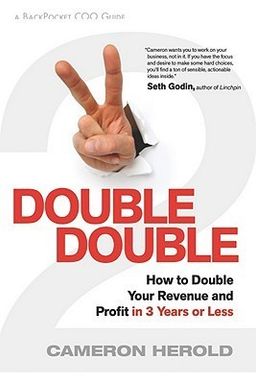
Double Double cover

Double Double

by Cameron Herold

Double Double provides entrepreneurs with practical strategies to rapidly double their business revenue and profit. Learn how to visualize goals, leverage technology, enhance communication, and build a resilient company culture to achieve sustainable growth in just three years.

Doubling Your Company in Three Years

What if you could double your company’s revenue, profit, and even your personal free time in just three years? Double Double by Cameron Herold poses this ambitious, yet surprisingly attainable challenge. Herold insists that hyper-growth isn’t reserved for Silicon Valley titans—it’s a discipline built on focus, culture, and vision. Having engineered explosive growth at companies like 1-800-GOT-JUNK?, he reveals how entrepreneurs—from those running $500,000 ventures to multimillion-dollar firms—can build momentum that compounds.

Herold’s central argument is that businesses fail to grow rapidly not because they lack talent or opportunities, but because they lack clarity and focus. He contends that any entrepreneur can achieve fast, sustainable growth by mastering a combination of planning, building, and leadership. The book traces a journey from crafting a vivid three-year vision (the “Painted Picture”) to reverse-engineering specific goals, nurturing a world-class culture, and executing with relentless discipline. Herold’s promise: if you apply focus consistently across strategy, people, and execution, doubling your company’s size within three years becomes not just possible—but probable.

Why This Matters

Fast growth attracts talent, energizes teams, and amplifies impact—but only if handled intentionally. Herold warns that chasing growth without solid preparation can backfire. Borrowing lessons from sports psychology and entrepreneurial experience, he argues that disciplined visualization, goal setting, and leadership behavior are indispensable. The promise isn’t just more revenue; it’s doubling profit and doubling your team’s enjoyment of work.

A Three-Part Journey

The book unfolds in three major sections. Part One: Preparing for Fast Growth shows you how to build clarity through vision and backward planning. Herold’s “Painted Picture” technique demands that you describe what your company will look and feel like three years from now in vivid, sensory detail—without worrying about how you’ll get there. Next, he teaches “reverse engineering”: breaking the dream into measurable SMART goals and defining projects and boundaries to make fast growth feel structured.

Part Two: Focused Actions for Fast Growth dives into execution—focused hiring, communication, meetings, marketing, and PR—and culminates with strategies for productivity and technology leverage. Herold’s real-life stories—from transforming messy offices at Nurse Next Door to landing 5,200 media hits for 1-800-GOT-JUNK?—demonstrate how small operational choices create multiplier effects.

Part Three: Focus on Leadership explores the psychological and emotional side of entrepreneurship. Growth, he says, is a roller coaster—and to survive it, leaders must manage their energy, build advisory boards, and find balance. Herold is candid about burnout and stress, offering advice rooted as much in mindfulness as in metrics. He emphasizes that doubled businesses should lead to doubled freedom and happiness, not just doubled chaos.

The Philosophy of Focus

Herold’s mantra throughout the book is “focus.” It’s not about working harder—it’s about narrowing attention to what impacts growth most. He urges entrepreneurs to identify their “critical few” projects rather than drowning in “important many.” This philosophy reappears in chapters on hiring (seek A players only), meetings (run short, structured huddles), and marketing (target precisely, not broadly). Each discipline becomes a lens for refinement rather than expansion.

Why It’s Different

Unlike dense academic tomes on scaling businesses, Double Double reads like a conversation with a seasoned entrepreneur sitting across the table, coffee in hand, sketching diagrams on a napkin. Herold’s credibility stems from experience—his growth models worked at companies studied by Harvard and Queen’s MBA programs. The book isn’t theoretical; it’s filled with executable frameworks, checklists, and anecdotes that ground each idea.

The overarching vision is daring yet attainable: a future where your company’s systems run smoothly, your employees are aligned around a shared dream, your profits soar, and you enjoy the luxury to breathe again. Herold’s guidance builds not just businesses—but leaders capable of scaling without losing balance.

Herold’s ultimate message: “Energy. Honesty. Vulnerability. Discipline. Focus.” The magic lies not in complexity but in clarity—knowing exactly where you’re going, aligning everyone around that picture, and executing systematically until you arrive there.

By combining entrepreneurial psychology, operational rigor, and a contagious belief in possibility, Double Double becomes both a roadmap and a reminder: fast growth isn’t luck—it’s learned focus.


Painted Picture: Crafting Your Future Vision

Herold opens the growth journey with what he calls a “Painted Picture”—a vivid, written description of your company three years in the future. The idea started with athletes visualizing success, and Herold adapted it for business. Just like Olympic high jumpers who imagine clearing the bar before they leap, leaders must imagine the company they want to build before they start executing.

Leaning Out Into the Future

Herold’s visualization technique began when he heard an entrepreneurial coach describe success as “leaning out into the future.” It means you plant one foot in the present and another three years ahead. Your task isn’t to explain how things will happen—it’s to describe what they will look like when they’ve happened. He used the approach while at 1-800-GOT-JUNK?, helping founder Brian Scudamore visualize everything from new headquarters to media coverage on Starbucks cups. These visions later materialized—proof that clarity attracts alignment.

How to Create Your Painted Picture

To start, Herold says you must physically step away from your daily grind—get out of the office, go to a forest, or sit by the water. Leave your laptop behind; instead, write by hand. Forget metrics and obstacles. Ask: what do I see, hear, and feel in my company three years from now? What are clients saying? What is the media writing? What are employees discussing at the water cooler? This exercise unlocks creativity that spreadsheets never do.

Your Painted Picture should fit into three or four pages and describe your business across categories—marketing, operations, culture, customer experience, and profitability. Herold often reminds leaders to focus on the “where,” not the “how.” Like visionary founders such as Walt Disney or Steve Jobs, your role is to imagine; others will engineer the logistics.

Bring It to Life

Once written, the Painted Picture must be shared widely. Herold insists that everyone—employees, suppliers, even clients—should see it. Don’t fear competitors copying the vision; since it doesn’t include “how,” they can’t reproduce your execution. The more people who understand your destination, the more allies you’ll attract.

At 1-800-GOT-JUNK?, entire walls were turned into “Can You Imagine?” boards where employees added their own dreams. One imagined getting the company featured on Dr. Phil. Another visualized a Harvard Business School case study. Both came true because those ideas were made visible. The exercise transforms vague ambition into collective commitment.

Refer and Refresh

Herold recommends revisiting the Painted Picture quarterly. At each planning retreat, have team members read it and underline phrases that resonate. Doing this repeatedly strengthens alignment and keeps momentum alive. Companies like MCI and RedBalloon even read portions aloud before meetings to anchor decisions in their vision.

“Conceive, believe, achieve” became the mantra at 1-800-GOT-JUNK?—a reminder that shared visualization isn’t mystical; it’s managerial.

Creating your Painted Picture gives you something tangible to stand for—a future so compelling that people want to help you build it. It turns leadership from tactical management into inspired storytelling, and that’s the foundation of every rapid-growth company.


Reverse Engineering Goals for Real Growth

Once your vision is painted, you need a roadmap to reach it. Herold’s tool for this is “reverse engineering”—working backward from your goals to outline what needs to happen today. It’s how he scaled College Pro Painters and later structured 1-800-GOT-JUNK?’s jump from $2 million to $100 million.

Start with the End and Work Back

Reverse engineering starts with identifying your end goal vividly and then asking: what must be true one year from now, one quarter from now, one week from now to make this a reality? It’s the opposite of vague goal setting—it’s architectural thinking. For example, when Herold was 21, he wanted $12,000 profit from his painting company in a summer. He calculated all the inputs: number of jobs, number of painters, gross margins per labor hour, and tracked them daily. The clarity turned ambition into math.

SMART Boundaries

Herold adapts the familiar SMART framework—Shared, Measurable, Attainable, Relevant, and Time-based. He encourages sharing goals with mentors or suppliers to build accountability. Every key performance target—from revenue growth to employee satisfaction—should have numbers attached. You should know the boundary conditions too: how much debt is acceptable, how many hours you’ll work, what values you won’t compromise. Setting boundaries prevents overreach and burnout.

Choosing the Critical Few

Herold emphasizes focus again: pick only 15 to 20 projects per year for the company, two or three per department. Use Post-it note brainstorming (a GE-inspired “WorkOut” method) where teammates vote on which projects will yield the highest impact relative to their cost and urgency. The outcome is a plan driven by data, not by politics. He cites College Pro Painters and Modern Purair, who used this method to increase system sales by 60 percent in 18 months.

From Goals to Tasks

Finally, document what needs to happen, who owns it, the deadline, and resources required. Herold compares it to planning a dinner party—invite guests, plan the menu, sequence the tasks. Every major project should have milestones and a person accountable for each. Leadership’s role isn’t micromanagement but alignment: ensuring tasks tie directly to the Painted Picture.

“Measure obsessively,” Herold says. “People who hit goals religiously are the ones who track them religiously.”

The reverse engineering mindset turns big dreams into daily actions. It’s the difference between wishing and building—and the key to maintaining momentum toward that three-year doubling target.


Creating a World-Class Culture

Herold believes that rapid growth rests on one consistent foundation—culture. Without it, companies fracture under their own expansion. Drawing from mentors like Greig Clark of College Pro Painters, he describes culture as “slightly more than a business, and slightly less than a religion.”

Designing the Physical Environment

The physical workspace mirrors a company’s energy. When Herold walked into Nurse Next Door’s cluttered office, he told them no great employee would work there. They created “Wasteless Wednesday” to purge junk weekly. The result: cleaner space, higher morale, and better retention. He advocates open offices over private silos—everyone, even executives, should share the same buzz. Google’s playful openness is his benchmark (contrasted with Microsoft’s isolation).

Social Culture and People Magnetism

Culture also means designing daily interactions. Herold highlights companies like I Love Rewards and Rethink Advertising, which use unconventional touches—bars in the office, ping-pong meeting tables, and fun dress codes—to spark connection. The aim isn’t gimmickry; it’s authenticity. He warns leaders not to fake enthusiasm but to embody it.

To boost morale, give more freedom: send people home early, expand vacations to five paid weeks, and share profits openly. Herold cites European employers who outperform by offering more rest. “Two weeks off says you’re a mediocre employer,” he writes.

Dream Management

Inspired by Matthew Kelly’s The Dream Manager, Herold encourages leaders to help employees achieve personal dreams—get out of debt, learn a skill, take a life trip. At 1-800-GOT-JUNK?, he helped staff create “101 Dream Goals” lists. One employee ended up watching hockey from behind the Canucks’ bench after Herold made a call. Another achieved financial independence. Loyal employees cross walls for leaders who elevate their lives.

Entrepreneurial Culture and Ownership

Herold’s hallmark of world-class culture is shared ownership. He urges transparent financials and profit sharing so that “every employee acts like a co-owner.” When team members see metrics openly, they start finding efficiencies. One staffer saved $6,000 by switching the company’s water coolers. Another cut waste by collecting unused office supplies. This internal entrepreneurship multiplies profits.

“Culture trumps process any day,” Herold insists. Plans and policies fail; culture endures.

Building a world-class culture is never an afterthought. It’s the invisible architecture that attracts A players, keeps them energized, and ensures that rapid growth feels like a shared triumph rather than a corporate strain.


Focused Hiring: Building an A-Team

Herold declares hiring the most critical growth lever: “At the end of the day, you bet on people, not strategies.” His approach mirrors Jim Collins’s dictum from Good to Great—get the right people on the bus, the wrong ones off, and then give them clear seats.

Know Exactly Who You’re Hunting

Herold learned recruitment from his grandfather’s duck hunts: you must know which species you’re targeting. In business, that means defining your ideal hire—positive, skilled, aligned with your culture—and refusing to settle. He insists on planning staffing needs one year out, even mapping future org charts three years forward, as he did during 1-800-GOT-JUNK?’s explosive growth.

Recruiting Like a Pro

Great employees rarely apply cold—they’re poached. Herold advises using networks, LinkedIn, and referrals to find people working elsewhere for “B-level” companies. He’d rather wait than hire wrong. In one case, he interviewed sixteen candidates over three days and hired none. “Leaving without a duck,” he jokes, “is better than bagging the wrong one.”

The Group Interview

Herold’s unconventional “group interview” method screens for cultural fit and leadership potential. Eight candidates sit together and answer rapid-fire questions—about their favorite books, movies, and the most stressful time of their lives. He rotates speaking order and observes chemistry. The test reveals authenticity and energy. From eight, he selects two or three for deeper one-on-ones. It’s speed dating for talent and culture.

In one memorable twist, 1-800-GOT-JUNK? applicants were required to read the company’s Painted Picture before the interview and respond with “Interview me” only if they resonated. It instantly filtered for passion.

Firing the Wrong People

Herold doesn’t shy from the flip side. He recounts his mentor forcing him to name and fire an employee by noon. “You’ve been stealing six months of his life,” he was told. The lesson: keeping misaligned people hurts everyone. Let them leave with dignity and mentorship for their next stage.

Hiring A players raises the bar for the whole team. Firing C players frees the group to excel. Each act is cultural surgery for fast-growth companies.

Herold’s hiring philosophy turns talent acquisition into strategic design—planned, selective, and uncompromising—so your company scales on strength, not strain.


Focused Communication and Meetings

Communication, Herold says, is the lifeblood of focus. Without structured conversation, businesses drown in confusion. His mantra: “No agenda, no attenda.” Strong communication habits and precise meetings make fast growth possible.

Listen More Than You Speak

Herold quotes George Bernard Shaw: “The illusion of communication is that it has taken place.” Leaders must listen twice as much as they talk. He advocates open offices—no private doors, even for CEOs—to encourage flow of information. When people see each other, alignment increases.

Race to the Conflict

Healthy organizations face issues fast. Herold learned at College Pro Painters: when conflict arises, confront it in person, not by email. Define the problem, admit your contribution, express feelings honestly, and seek a win-win solution. This builds trust and speed. He even uses emotional intelligence frameworks like “When you…, I feel…, I need…” to depersonalize conflict.

Focused Meetings

Meetings reflect culture. Herold outlines multiple types: daily huddles (7 minutes), weekly action reviews (90 minutes), quarterly retreats, profit-sharing sessions, and one-on-one “GS&R” coaching meetings. Each has structure, purpose, and time limits. “Compress time,” he says—halve planned durations. Meetings should end five minutes early so people transition smoothly.

At 1-800-GOT-JUNK?, the daily huddle became legendary—hundreds of employees met at 10:55 to share good news, metrics, frustrations, and a closing cheer. The ritual unified teams around daily goals. Many businesses Herold coached adopted their own huddles and saw communication soar.

“The speed of the leader is the speed of the group.” When leaders model focused communication, teams move faster and morale climbs.

In sum, growth depends less on perfect systems than on rhythm—structured conversations, short touchpoints, and transparent discussion. The right words, said often, create alignment that multiplies results.


Marketing, PR, and Productivity Power

Herold teaches that growth isn’t just operational—it’s directional. Marketing and public relations fuel visibility, while productivity systems sustain momentum. His toolkit turns focus into motion.

Focused Marketing

Marketing must be narrow, not noisy. Herold recalls early College Pro Painters days: instead of marketing to everyone, he targeted just 150 homeowners and avoided weaker neighborhoods. He built market share by dominating small, specific territories—what Seth Godin might call “micro tribes.” Every contact counted like “27 hits,” the number of impressions needed before a customer acts. The rule: aim for depth, not breadth.

He’s also a fan of bootstrap marketing. Barter ads, negotiate late slots, and never pay full price. At 1-800-GOT-JUNK?, he traded free junk removal for photo shoots and used branded trucks as rolling billboards—“parketing.” Guerrilla tactics, he says, amplify culture and cash flow simultaneously.

PR as Sales

Herold redefines PR as “free sales.” It’s not communications; it’s closing. Instead of hiring PR firms, he built teams that cold-called journalists like sales reps. The principle: writers need stories as much as you need attention. Pitch ideas that serve their audience and your brand simultaneously. He trained junior salespeople to land 5,200 media hits—including Oprah and The Wall Street Journal. For small businesses, he suggests using HARO, Google Alerts, and handwritten follow-ups—because “thank-you notes stand out in a digital world.”

Focused Productivity

Rapid growth requires systems for speed. Herold recommends measuring five to ten key metrics per department—simple, visible dashboards using colors: green (above expectations), yellow (okay), red (below expectations). He urges leaders to review numbers weekly and share income statements monthly. Transparent measurement creates ownership and reveals opportunities faster.

Leveraging Technology

Finally, Herold shows how tech leverage doubles time efficiency. Simple tools—Google Docs, Skype, iPhones, and virtual assistants—can replace costly software or staff. He outsourced transcription to Sweden and admin tasks to Manila for one-tenth the U.S. cost. “Rip off and duplicate” is his motto: use what others already perfected. For entrepreneurs fearing tech, he advises learning one shortcut weekly and hiring millennials who love teaching it.

Every focus area—marketing, PR, productivity—shares one thread: clarity before complexity. Measure what matters, communicate value vividly, and use technology as a multiplier, not a distraction.

Together, these disciplines form Herold’s “action engine.” When combined, they turn visions into velocity.


Leadership, Balance, and the Roller Coaster

Herold’s final lessons pivot from strategy to psychology. Entrepreneurs, he admits, live on a roller coaster of highs and lows. Understanding and managing this ride separates burned-out owners from balanced leaders.

The Emotional Ride

Herold describes five stages of entrepreneurial emotion: uninformed optimism, informed pessimism, crisis of meaning, crash and burn, and informed optimism again. Each stage has actions attached. In the highs, resist reckless spending; channel energy into recruitment and PR. In the lows, seek support, focus on small wins, and don’t isolate. His refrain: you’ll ride this cycle continually, but you can choose whether to scream or throw your hands up and laugh.

Building a Board of Advisers

For stability and accountability, Herold advocates assembling a non-formal board of advisers. Unlike directors, advisers can’t fire you—they guide you. Choose builders, not lawyers; mentors who’ve scaled companies before. Share your Painted Picture and metrics openly. Transparency turns advice into insight. Board discussions should emphasize future strategy, not daily firefighting.

Work-Life Mastery

Finally, leadership demands balance. Herold learned after burnout: work-life balance isn’t optional—it’s fuel. Schedule family time first. Review weekly wins. Exercise often. Check email twice daily, not constantly. He even urges entrepreneurs to craft a personal Painted Picture—one that includes joy, hobbies, travel, and time with children. It’s the “double” of happiness alongside business success.

“Culture begins with the leader’s energy,” Herold writes. “When you slow down and play hard, your company speeds up.”

Fast-growth companies need steady leaders. By embracing emotional cycles, surrounding yourself with mentors, and living fully, you ensure that doubling your business also doubles your life.

Dig Deeper

Get personalized prompts to apply these lessons to your life and deepen your understanding.

Go Deeper

Get the Full Experience

Download Insight Books for AI-powered reflections, quizzes, and more.