
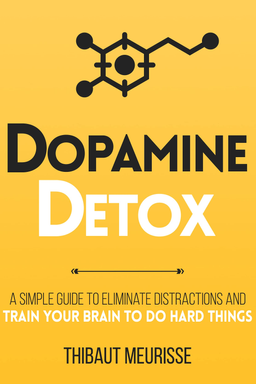
Dopamine Detox cover

Dopamine Detox

by Thibaut Meurisse

Navigate the distraction-heavy modern world with ''Dopamine Detox,'' a practical guide to reducing digital noise for improved focus. Through a 48-hour detox, regain control over your attention and pursue your goals with clarity.

Reclaiming Focus in the Age of Overstimulation

When was the last time you could focus deeply—without checking your phone, switching tabs, or responding to a notification? In Dopamine Detox: A Short Guide to Eliminate Distractions and Train Your Brain to Do Hard Things, Thibaut Meurisse argues that modern life’s constant stream of stimuli—social media, emails, videos, and junk food—has hijacked our brain’s reward system. The result? Chronic restlessness, poor focus, and perpetual procrastination. But the good news, Meurisse insists, is that you can reset your brain through a simple process: the dopamine detox.

At its core, the book teaches you how to eliminate unnecessary stimulation to regain control of your attention. By stepping away from quick dopamine hits, you allow deeper motivation and focus to resurface—making difficult, meaningful work not only possible, but enjoyable. This short guide explains the science of dopamine, why modern environments overactivate it, and how structured detox periods can restore mental clarity and productivity.

The Science of Wanting More

Meurisse begins with a clarifying point: dopamine isn’t the “pleasure molecule” most people think it is. Rather, it’s the chemical of anticipation—the neurotransmitter that drives you to seek rewards. Evolution wired dopamine to motivate behaviors essential for survival, like eating and reproduction. However, modern technology has hijacked this ancient mechanism. Every notification, ‘like,’ or email ping signals a potential reward, triggering dopamine surges that keep you hooked. The irony? The more you chase stimulation, the less satisfaction you actually feel.

Because dopamine fuels the desire to pursue novelty, overstimulation makes regular tasks—like writing reports, studying, or exercising—seem unbearably dull. As your brain adapts to higher dopamine levels, it begins to crave constant excitement. Meurisse calls this the hijacking of attention: a cycle that leaves you unmotivated for the very work that would bring lasting fulfillment.

Recognizing the Modern Dopamine Trap

In the modern world, Meurisse claims, companies compete ruthlessly for your focus because attention equals profit. Platforms like Facebook or YouTube are optimized to keep you scrolling through endless “open systems” of stimuli. These systems never end—there’s always another video, notification, or update waiting. Each engagement delivers a small dopamine rush that reinforces the habit. The book draws parallels to addiction research: just like substance abuse, overuse of digital media strengthens neural pathways that demand ever stronger stimuli to achieve the same effect.

This isn’t limited to technology. High-fat foods, impulsive shopping, and even overexercising can become dopamine traps. By unconsciously chasing stimulation, you condition your brain to reject stillness and hard work. As Meurisse puts it, “You lose the ability to do the difficult things that would have the biggest positive impact on your life.”

The Purpose of a Dopamine Detox

To fix this overstimulated state, Meurisse prescribes the dopamine detox—a structured break from external stimuli that helps your brain recalibrate. Scientifically, it’s not about “flushing out” dopamine but lowering the baseline stimulation level. When you stop flooding your brain with easy rewards, everyday tasks like reading or working begin to feel rewarding again. The detox can be complete (48 hours with no stimulating activities), partial (eliminating one major source like social media), or intermediate (24 hours of reduced input). The key is replacing stimulation-seeking habits with calming, reflective behaviors like journaling, meditation, or walking.

The rationale behind this approach is supported by cognitive psychology and behavioral research: breaking addictive loops requires both awareness and environmental control (a concept echoing James Clear’s Atomic Habits, where small environmental shifts produce major behavioral changes). Meurisse upholds that by creating friction between you and your distractions, you make discipline easier to sustain.

From Detox to Discipline

Once you’ve reset your dopamine baseline, the work begins. The book transitions from detoxing to doing the work: planning your day intentionally, choosing one key task to attack first, and training focus through consistency. As he notes, “Productivity is consistent focus on your most impactful tasks.” Meurisse introduces practical tactics like closing “open systems” (apps with endless inputs), creating morning routines, and using friction to curb temptation. The more predictable your daily environment, the less likely you’ll relapse into overstimulation.

Ultimately, the message is empowering: you don’t need immense willpower to regain focus. You just need structure and awareness. By controlling your environment and exposure, you make focus the default state rather than the exception. Over time, you recover motivation, clarity, and patience—a trifecta that modern life has eroded.

Why This Matters

Meurisse’s argument speaks to a collective ailment of the digital era: distraction has become the enemy of depth. The dopamine detox is a modern-day mindfulness practice for the overstimulated mind. You don’t need a monastery or a week-long retreat—you need to pause the flood of stimuli that compete for your brain’s reward circuits.

By learning to tolerate boredom, savor focus, and prioritize meaningful action over mindless consumption, you reshape your relationship with work and pleasure. As the author concludes, fulfillment doesn’t come from chasing excitement—it comes from mastering attention. In other words, peace of mind isn’t found in doing more; it’s found in wanting less.


Understanding Dopamine: The Motivation Molecule

To reclaim control over your focus, Meurisse explains, you must first understand dopamine. Contrary to popular belief, dopamine is not a pleasure chemical—it’s a motivation chemical. It doesn’t make you enjoy rewards; it drives you to pursue them. This distinction is key to decoding your daily habits and cravings.

Dopamine’s Real Role in Behavior

From an evolutionary standpoint, dopamine ensured survival by encouraging exploration. It nudged early humans to hunt for food, seek shelter, and reproduce. The brain rewarded effort by making those pursuits feel urgent and important. In modern life, however, those instincts are exploited. When your phone pings with a notification, or when you anticipate likes on a post, your brain releases dopamine in anticipation—not in response to enjoyment. The pursuit itself keeps you hooked.

This explains why digital addictions feel endless. After scrolling social media, binge-watching, or monitoring stock updates, you rarely feel satisfied—you just crave more. Dopamine drives the wanting, not the having. As neuroscientist Daniel Lieberman describes in The Molecule of More, dopamine is future-oriented; it pushes you toward novelty but cannot make you content. Meurisse leverages this insight to argue that overstimulation weakens your ability to start or complete hard tasks, because your brain is conditioned to chase short-term excitement instead of long-term rewards.

The Addiction Feedback Loop

The brain’s dopamine system functions as a feedback loop: more stimulation leads to tolerance, and tolerance fuels the need for stronger stimuli. This is the foundation of addiction. Every swipe and tap becomes a mini gamble, with unpredictable “rewards” (new messages, updates, or data). The uncertainty enhances dopamine’s power, similar to slot machines. This craving for more novelty makes quiet, deep work feel unnatural. As Meurisse writes, the more you feed the loop, the more your mental baseline shifts toward chaos.

Reclaiming Balance

To break the cycle, you must reduce stimulation so the brain’s baseline readjusts. This means deliberately pausing what triggers constant anticipation—social media, news, email refreshes, etc.—and replacing them with activities that calm and ground you. Over time, your brain relearns to derive satisfaction from slower, less frequent rewards. This restoration of balance allows inner motivation to resurface.

“No amount of stimulation will ever give you the lasting fulfillment you’re seeking.”

By understanding dopamine’s true role, you can stop mistaking restlessness for motivation and start designing your life around deep, meaningful focus.


The Hijacked Brain: How Society Trains Distraction

Meurisse declares that focus has become one of the scarcest resources on earth, and for good reason: we live in an environment engineered to steal it. Modern technology, marketing, and consumer culture thrive by hijacking the dopamine system you just learned about. Once you see how this happens, it becomes easier to resist.

The Economy of Attention

Every time your attention is captured, someone profits. Platforms like YouTube, Instagram, and Facebook have built trillion-dollar empires by monetizing your dopamine triggers. Meurisse points out that notifications, infinite scrolling, and algorithmic suggestions are not arbitrary—they’re scientifically optimized to keep you anticipating the next reward. Even small red icons or vibrations are designed to exploit your brain’s reward centers, a technique known as ‘intermittent variable reinforcement.’ The more randomness in the reward, the more addictive the behavior becomes.

As you consume more, your tolerance rises. Before long, you need constant stimulation—not just from screens but from food, music, and overactivity. The overstimulated brain loses its capacity for long-term thought, a theme echoed by psychologist Mihaly Csíkszentmihályi, who warned that attention determines the quality of life. Meurisse builds on this by arguing that overstimulation fragments your mental energy, leaving you reactive rather than intentional.

The Short-Term Thinking Trap

One of the most damaging consequences of this overstimulation is what Meurisse calls “the short-term trap.” The more instant gratification you pursue, the harder it becomes to think long term. He cites researcher Edward Banfield’s finding that long-term perspective is the single most reliable predictor of success. Yet our brains, rewired for fast dopamine feedback, resist patience. We want results now, whether in fitness, relationships, or career progress. This is why motivational content and “get-rich-quick” schemes are so appealing—they promise immediate gratification.

In contrast, long-term success requires the opposite: calm focus, sustained effort, and uncomfortable patience. To illustrate, Meurisse notes that Jeff Bezos built Amazon for nine years before turning a profit—proof that strategic patience outweighs quick wins. The digital world, however, conditions us to crave constant progress updates, making endurance feel alien.

Recognizing Overstimulation and Mental Traps

Meurisse invites readers to reflect on their own overstimulation. What do you reach for when you’re bored? Checking emails? Watching another YouTube video? These behaviors create what he calls stimulation traps—mental loops that perpetuate distraction. He identifies four common traps:

  • “Returning to work is easy”: You believe you can resume focus anytime, but usually you can’t.
  • “You can do it later”: A dangerous delay pattern that erodes self-trust.
  • “Excitement equals fulfillment”: Mistaking temporary stimulation for happiness.
  • “You’re missing out”: The fear of missing out (FOMO) keeps you tethered to endless updates.

Recognizing these patterns is the first step toward detaching from them. Once you understand how the system manipulates you, you can start engineering your own environment around focus rather than distraction.


The Power and Process of Dopamine Detox

Having explained overstimulation’s damage, Meurisse offers a solution: the dopamine detox. It is a practice of strategic withdrawal—reducing or eliminating external stimulation to allow your brain to return to equilibrium. The aim is not to purge dopamine but to recalibrate your tolerance for it.

The Three Types of Detox

Meurisse outlines three main approaches:

  • 48-Hour Complete Detox: Cutting out nearly all stimulation—including internet, phone, TV, music, and even sugar. This reset mimics deep silence retreats, like Vipassana, where participants avoid external input entirely to reestablish mental clarity.
  • 24-Hour Detox: A more accessible version that pauses unnecessary inputs for a single day. It works as a “mini reset” for overwhelmed minds.
  • Partial Detox: The most flexible approach, where you remove your biggest personal distraction—such as YouTube or Twitter—over an extended period.

Rather than relying on willpower, the detox builds intentional friction between you and your triggers. This environmental approach aligns with behavioral science findings that small contextual changes—like removing cues—dramatically reduce unwanted behaviors (similar to insights from BJ Fogg’s Tiny Habits).

What to Do During Detox

Without your usual digital stimuli, you may feel restless. That’s a sign of withdrawal—not from dopamine itself but from overstimulation. Meurisse suggests replacing “high dopamine” activities with calm, mindful actions like journaling, meditating, walking, or reading quietly. The goal is to observe cravings without judgment and line up healthier habits to fill the vacuum.

“Once you’ve removed the excess noise, seemingly boring tasks become not only tolerable but deeply satisfying.”

The Transformation

After a detox, you’ll notice that tasks you previously avoided—like planning, reading, or creative work—feel easier and more rewarding. The brain’s need for constant novelty fades, leaving space for deeper satisfaction. You become calmer, more focused, and better at delaying gratification. By practicing regular detoxes—or extending them into daily routines—you train your brain to enjoy stillness and concentration again.

In short, dopamine detox is a reset button for the modern brain: it helps you unlearn the compulsion for constant engagement so you can reclaim your ability to do meaningful, “hard things.”


The Three-Step Formula for Lasting Change

Meurisse teaches that an effective dopamine detox is not only about abstaining—it’s about designing a system for focus. He proposes a simple three-step method that turns intention into durable habit: identify, add friction, and start in the morning.

Step 1: Identify Your Big Distractions

Begin by listing two columns: Can and Can’t. In one, include calm, productive behaviors (journaling, walking). In the other, your most tempting distractions (checking emails, watching YouTube). Ask: “If I stopped one thing, what would most improve my productivity?” Awareness itself weakens habit loops. As behavioral psychologist Charles Duhigg notes, labeling your triggers reduces their unconscious pull.

Step 2: Add Friction

Next, make your distractions harder to access. Disable app notifications, store your phone in another room, or even unplug your Wi-Fi. Meurisse shares his own version—placing his modem in his building’s storage room, behind multiple doors. The extra effort discouraged impulsive retrieval. Conversely, make productive tasks frictionless. Keep your work setup ready: notebook open, music playing, timer set. Humans, he reminds us, are “lazy by design”—use that to your advantage.

Step 3: Start First Thing in the Morning

Finally, tackle your most important task before your brain is overstimulated. Create a low-dopamine morning ritual—stretch, meditate, or write three goals. Starting with calm focus sets the tone for everything that follows. Studies show that early actions form momentum patterns: your first choice can predict your day’s discipline level. By aligning your mornings with focus rather than stimulation, you prevent relapse before it begins.

This three-step structure transforms detox from a temporary fix into a life design principle—an intentional system for controlling your input so you can reclaim ownership of your attention.


Doing the Hard Work: From Procrastination to Flow

Once the noise is lowered, Meurisse turns the spotlight to where the magic happens: doing the actual work. Detoxing sets the stage, but daily execution cements transformation. He emphasizes three pillars—focus, consistency, and impact—as the foundation of productive living.

Plan with Intention

Meurisse advocates writing down three to five essential tasks each morning using plain pen and paper. This tangible act transforms vague intentions into visible commitments. Prioritize the one task that would make the biggest difference if completed today. The practice parallels Gary Keller’s idea in The One Thing: success comes from focusing on what matters most, not from managing an endless to-do list.

Focus Through Routine and Environment

The author urges you to work at the same place and time each day. This ritual conditions your brain for automatic concentration. For example, Stephen King writes at a fixed hour daily, regardless of inspiration. You can set a similar trigger—like making tea before work or lighting a candle—to signal your brain it’s time to focus. Breaks are allowed but intentional; Meurisse recommends 45-minute focused blocks followed by short rest.

Avoid Open Systems

One of his most actionable ideas is distinguishing between “open” and “closed” systems. Open systems—like email or social media—offer endless stimuli with no closure, making them distraction factories. Closed systems, such as Word documents or PowerPoint slides, have clear endpoints. By starting your day in a closed system, you prevent cognitive leakage. Meurisse’s own rule: open your writing document before touching anything else online.

Building focus, he says, is like strengthening a muscle: through repetition and rest. The more regularly you show up for deliberate work, the more natural deep concentration becomes. Eventually, you develop flow—a state of total immersion that replaces overstimulation with effortless productivity.


Preventing Dopamine Relapse and Sustaining Focus

Completing a dopamine detox feels liberating, but maintaining it is the real challenge. Meurisse dedicates the final section of the book to relapse prevention—how to stay focused long after the detox period is over.

Building Self-Awareness and Systems

Relapse usually begins subtly—with a quick phone check, a small distraction, or a single “innocent” video. Recognizing these moments early is key. Instead of guilt, apply awareness. Meurisse normalizes relapse as part of the process; the brain craves familiarity. By pausing and restarting your routine, you regain control without shame. He recommends setting up contingency plans: pre-committing strategies to safeguard your focus. For example, storing your phone away before bed or using website blockers during work hours.

Cultivate the Here-and-Now Neurochemicals

To maintain calm focus, Meurisse encourages activating the opposite of dopamine—the “here-and-now” neurotransmitters like serotonin, endorphin, and oxytocin. They bring peace, satisfaction, and presence, counterbalancing dopamine’s future-oriented craving. Practices that raise these chemicals include meditation, stretching, contemplative walking, and meaningful social interaction. He even recommends embracing boredom as a skill—simply doing nothing helps your brain rest from constant pursuit.

Designing a Sustainable Lifestyle

Ultimately, Meurisse reframes the detox as not a one-time cleanse but a long-term system. The world will always push stimulation; your job is to defend your attention. Adopt sustainable routines that lower stimulation daily—like morning quiet time or digital sabbaths. His challenge: commit to a 30-day routine that reinforces focus and mindfulness. Through repeated practice, you solidify new neural pathways that anchor calm and clarity, even amid chaos.

The takeaway: relapse prevention is self-awareness plus structure. When you design your life to nurture peace instead of noise, focus becomes effortless—and distraction loses its appeal for good.

Dig Deeper

Get personalized prompts to apply these lessons to your life and deepen your understanding.

Go Deeper

Get the Full Experience

Download Insight Books for AI-powered reflections, quizzes, and more.