
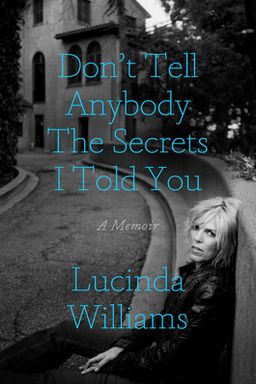
Don't Tell Anybody The Secrets I Told You cover

Don't Tell Anybody The Secrets I Told You

by Lucinda Williams

The Grammy Award-winning musician shares the hardships that informed her music.

Singing the Truth: Art, Trauma, and Becoming

How do you turn a life of instability, grief, and grit into songs that feel like home to strangers? In "Don't Tell Anybody The Secrets I Told You," Lucinda Williams argues that telling the unvarnished truth—about family, bodies, class, desire, and art—becomes both a survival strategy and a creative engine. She contends that the messy, gothic particulars of one southern life can become universal if you write them cleanly, sing them honestly, and refuse to let anyone else define your sound or your story. But to do that, you have to see clearly: the roots you carry forward, the ghosts in your rearview mirror, the industry machines you’ll wrestle, and the intimate relationships that will bruise and bloom along the way.

In this memoir-manifesto, you’ll move with Williams from a peripatetic, complicated childhood in the Deep South to embassy-sponsored folk tours in Mexico; from Houston barrooms and Austin blues kitchens to a Silver Lake duplex where she pens the songs that change her life. You’ll hear why a British punk label took a chance when Nashville and L.A. couldn’t figure her out, how an album can take years—and multiple producers—to get right, and what it costs to insist on your own sound. You’ll also witness a throughline of tenderness and ferocity: toward her mother’s illness and death, her father’s poetry and decline, her lovers’ brokenness and brilliance, and her own unshakeable vocation.

Why this story matters now

Williams’s life—rich with Methodist preachers and street singers, university salons and juke joints—puts a living pulse under terms like “Americana” and “alt-country.” She shows you that categories often come after the fact; the work begins with listening to where you’re from and refusing to be shamed by it. Her grandfather hid socialist convictions under a pastor’s collar; her father, the poet Miller Williams, taught craft and conscience; her mother endured mental illness and unspeakable abuse. Out of that crucible came a writer who believes the blues can absolve unnecessary guilt, that a Flannery O’Connor story can name your town, and that a song like “Car Wheels on a Gravel Road” can turn a crying child in a backseat into a national moment of recognition.

What the book argues

Williams argues three things at once. First, the personal and the political braid together in American roots music; telling the truth about a mother’s breakdown, a union meeting, or a racist principal is a kind of public service (think of Margo Price’s memoir or Bruce Springsteen’s Born to Run for kindred insistence). Second, artistic persistence beats industry consensus: after decades of odd jobs, demo dead-ends, and patron angels, the work finds its season. Third, craft is reverent and stubborn—she defends un-bridged blues forms when executives demand “proper” structures; she fights for the exact vocal take, the right compression, the right cover photograph, even when a New York Times Magazine piece calls her “difficult.”

What you’ll encounter

You’ll meet key mentors—poets like John Ciardi and Flannery O’Connor; folklorists like Harry Oster; blues elders like Mance Lipscomb; producers like Steve Earle and Ray Kennedy—alongside a rogue’s gallery of lovers who spark songs (“Metal Firecracker,” “Lake Charles,” “Those Three Days”). You’ll traverse the hard birth of Car Wheels on a Gravel Road—from early sessions with Gurf Morlix and Rick Rubin’s label turbulence through Earle’s studio to Mercury’s release—and see how that album, plus Essence and World Without Tears, form a daring trilogy about childhood, eros, and the state of the heart.

How to read this memoir as a manual

If you make anything—songs, essays, programs—you’ll recognize her mix of discipline and drift. She sets scenes with sensory specifics (a fig tree in Baton Rouge, a Silver Lake baseball field lit for coyotes), then zooms out to process trauma in therapy and in song. Her “guardian angels”—from civil rights lawyer Tom Royals to benefactor Hobart Taylor—demonstrate how communities and benefactors midwife late-blooming talent. And her postscript reads like a pocket ars poetica: read widely, ride trains, protest politely, learn a language, and dance badly if you must.

Core bet

“We carry our roots forward,” Williams writes in action more than declaration. The bet of this book is that if you face the ghosts—closets, hospitals, dive bars, boardrooms—you can build a body of work that lets other people face theirs.

By the end, you haven’t just traced a career; you’ve learned a way of paying attention. And you might ask yourself what Williams asks relentlessly: What story are you brave enough to tell, and what sound will you fight to protect?


Roots and Restlessness: Southern Gothic Childhood

Williams roots her artistry in a childhood that reads like a Flannery O’Connor story she’s been asked to live inside. You move with her from Lake Charles to Macon to Baton Rouge to New Orleans, the daughter of two Methodist-preacher lineages and a poet father whose tenure arrives late. It’s a world of Putt-Putt outings during maternal breakdowns, oxygen tents and tracheotomy scars, camellias and hickory switches, and a piano that comes and goes because music is both albatross and balm for her mother, Lucille. The restlessness—twelve moves by eighteen—turns into a muscle Williams later uses on tour buses and in hotel rooms where she writes the songs that keep her steady.

A divided home, a double inheritance

Her father, Miller Williams, is a liberal Arkansas poet who sells refrigerators at Sears while courting verse; her mother, a gifted pianist scarred by sexual abuse and mismanaged psychiatric care, cycles through lithium, shock treatment, and bouts of drinking. The refrain—“It’s not her fault, she’s not well”—teaches young Lucinda to hold compassion and wounds at once. It also plants the seeds of her lifelong attention to mental health, later processed in songs like “Sweet Side” and in therapy practices that revisit the locked closet she remembers at age three.

The South as classroom and stage

Downtown Macon gives her Blind Pearly Brown playing “God Don’t Ever Change” on the sidewalk; Milledgeville delivers O’Connor’s house, peacocks, and a lesson in protecting your writing time behind a screen porch. In Baton Rouge, an aunt’s plastic-covered sofa sits near “little books about being saved” (details that surface verbatim in “Bus to Baton Rouge”). Meanwhile, her paternal grandfather hides union meetings in a church basement and faces down segregationists, shaping Williams’s moral pitch (compare to Springsteen’s blue-collar anthems or Mavis Staples’s civil rights hymns).

Making songs from rooms you leave

Williams shows you how memory becomes composition. The rattling rhythm of “Car Wheels on a Gravel Road” comes from the literal soundtrack of childhood—screen doors slamming, dogs barking, telephone poles flicking by as a crying child stares out a backseat window. When she first played it live at Nashville’s Bluebird, her father recognized the girl in the lyric before she did. The lesson: sometimes your subject knows you before you know your subject.

Fathers, preachers, and beer-drinkin’ souls

There’s family lore that clarifies her sensibility: her grandfather Ernest, a radical preacher from the Arkansas hills, reads the Bible with sixth-grade eyes and ends up defending sharecroppers and integration. Her father, told by a test he lacked “verbal aptitude,” becomes a celebrated poet anyway, meets Hank Williams at a gas-station bar, and learns he has “a beer-drinkin’ soul”—code for never losing touch with working-class roots. That story becomes Williams’s own creative compass: carry both the seminar and the honky-tonk.

Why this matters to your work

You may not be southern, but you likely carry some version of this doubleness: parts of your origin that nurture and parts that haunt. Williams models how to keep both in the frame without collapsing into self-pity or denial. She refuses to romanticize or disparage her South; instead, she documents, sings, and edits. If you’re crafting your own work, her method teaches you to name the fig tree and the plastic slipcover—and then to ask where the song wants to go.

Field note

Williams’s childhood is “southern gothic” not as brand but as weather pattern: flashes of grace, long humid spells of dread, and a persistent ache that teaches you to read the sky.

(Context: Readers who value memoirs of artistic becoming—Patti Smith’s "Just Kids," Brandi Carlile’s "Broken Horses"—will recognize the alchemy: how a hard start becomes a voice that can hold complexity without flinching.)


Finding a Voice: Folk, Blues, Literary Mentors

Williams’s voice is a braid: folk rigor, blues candor, and literary bloodlines. You see the strands form early. At twelve, she studies fingerpicking with Alan Jokinen, an LSU poetry grad who also gigs in rock bands; her first songs learned are Elizabeth Cotten’s “Freight Train,” Peter, Paul and Mary staples, and Dylan’s “To Ramona,” whose “watery eyes” teach her the weight one word can add. She hears Woody Guthrie and Pete Seeger’s humor on Songs to Grow On and feels a door open: poetry can be plainspoken and radical at once.

Chile, Mexico, and a transnational folk education

A year in Santiago (1964) on her father’s Amy Lowell fellowship expands the map. She meets poet Nicanor Parra and is haunted by Violeta Parra’s “Gracias a la vida,” an anthem that later reads like a prelude to Violeta’s suicide. Mexico (1970–71) turns into a boot camp: the U.S. embassy books thirty shows around the country for “Folk Music from Spiritual to Protest with Clark Jones and Cindy Williams.” Playing cafeterias and artists’ salons, she learns to switch from spirituals to Dylan to traditional ballads with the same integrity. Touring becomes classroom and microphone, and the lesson sticks: you can carry a whole tradition in a duo.

Bread Loaf, O’Connor, and the poet’s backbone

Summers at the Bread Loaf Writers’ Conference immerse her in workshop culture: critique by day, readings by night, parties that remind her later that writers can out-debauch musicians. Flannery O’Connor—guarding her mornings like a hawk—becomes the example of artistic boundary-setting. A near-rape on a Vermont roadside at seventeen, and the way she talks herself out of harm—“Would you please get off me?”—becomes a dark thread she later faces in therapy and song (“Wakin’ Up”). The craft takeaway: attention, precision, and self-protection are not optional extras; they’re the scaffolding that lets the work rise.

Blues elders as antidote to shame

In Texas, a rolling blues caravan flips a switch. Watching Furry Lewis sip whiskey all day or Mance Lipscomb feast on greasy barbecue with white bread, she feels guilt unclench. The blues, she realizes, is not license to self-destruction; it’s permission to live unguarded after a day of work. These men embody a no-resumé purity—playing because the songs demand to be played—that becomes her standard when industry people later push her toward slickness. (Compare this to the “noble savage” critique she herself raises and refuses to hide behind; she’s explicit about romanticizing none of it.)

Dylan as North Star, but not a cage

A student drops Highway 61 Revisited onto her family turntable; it’s a conversion. She chases Dylan’s catalog, then meets him years later at Gerde’s Folk City—a quiet barstool “Bobby Dylan” who tells her to keep in touch. Two decades on, she opens for him and Van Morrison without exchanging a word; the earlier moment remains the true benediction. The lesson she carries: be mentored by the work, not by proximity.

The “guardian angel” network

Tom Royals, the Mississippi civil rights attorney, gets her into Malaco to cut her first Folkways album in an afternoon. Hobart Taylor bankrolls a New York demo with T Bone Burnett and Taj Mahal. These figures don’t “discover” her; they enable her to keep practicing in public until the right label and the right songs line up. If you’re building your own path, Williams’s map says: cultivate readers, not just buyers; the former often become the scaffolding you need.

Craft credo

“I wanted to rock way before I was able to,” she admits. So she keeps learning—picking styles, songbooks, languages, stages—until the sound in her head meets the band in her room.

(Context: This braid of folk discipline, blues ethos, and literary rigor puts her in conversation with artists like Gillian Welch and Rhiannon Giddens, who fuse scholarship with groove.)


Hustle and Heartbreak: The Long Road to a Breakthrough

Williams’s “overnight success” takes decades. After the Malaco-cut Folkways debut (for $300), she scrapes by in New Orleans and New York—playing Andy’s on Bourbon Street between strip clubs, losing laundry to a laundromat thief, subletting in the East Village with a crocheter and a busker—while writing songs and meeting idols in odd corners. At Folk City, Mike Porco introduces “Bobby Dylan” at the bar; later, Dylan invites her to keep in touch. In Austin and Houston, she gig-hops with Lyle Lovett and Nanci Griffith while absorbing Lightnin’ Hopkins and hanging at Anderson Fair. She becomes the kind of act other musicians recognize long before A&R does.

Industry doors open and slam

A Columbia development deal hands her six months to write, demo, and stop selling gourmet sausages in supermarkets. She writes “Changed the Locks,” “Side of the Road,” “Crescent City,” and “Passionate Kisses” in a Silver Lake duplex with avocado trees out back—songs that will anchor her self-titled Rough Trade album and ripple across decades (Mary Chapin Carpenter later turns “Passionate Kisses” into a Grammy). Yet Columbia passes: “too country for rock, too rock for country.” Executives demand proper bridges; she points to Dylan and Neil Young and keeps her structures intact.

The right misfit label

Rough Trade America, a punk outpost, hears the demo and simply says yes. With $15,000, Williams and guitarist-producer Gurf Morlix record fast at Dusty Wakeman’s Mad Dog studio in Venice. The resulting 1988 album—“I Just Wanted to See You So Bad,” “The Night’s Too Long,” “Crescent City”—frames Williams as a writer’s writer who can also grind a band. The lesson: sometimes the best fit is not the “right” genre label but the place that trusts your instincts.

Love as accelerant and ash

Clyde Woodward III—a “poet on a motorcycle” type—powers the geography and heat of songs like “Lake Charles” and “Crescent City.” His charm and addictions make him a muse and a cautionary tale; he dies of cirrhosis in 1991, years after their breakup, the “angel whisper” lines in “Lake Charles” echoing his last hours. Frank Stanford, the feral Fayetteville poet, dies by suicide in 1978—his “The Light the Dead See” an epitaph in Williams’s scrapbook—and becomes “Pineola.” These stories aren’t gossip; they’re the raw ore she refines.

Alt-country before “Americana”

In 1980s L.A., Williams lives out what will later be called Americana: sets with X, the Long Ryders, Los Lobos, and Dave Alvin at Raji’s and Al’s Bar; a residency with David Mansfield and David Miner; and a night when a heckler’s injuries lead to a coerced opening slot deal. She marries and amicably divorces Long Ryders drummer Greg Sowders; writes “Side of the Road,” “Passionate Kisses,” and “Am I Too Blue”; and keeps hearing “not quite” from labels. Then Rough Trade puts her on the road in the States and Europe and the life finally fits.

A moral about persistence

Williams frames her late bloom as feature, not flaw: “It happened when it was meant to happen.” The crucial pattern is work over time—odd jobs, tiny showcases, dozens of “no’s,” guardian angels at pivotal turns, and a stubborn fidelity to her song’s shape. If you’re mid-bruising in your own field, her cadence suggests reframing: keep your bridges off if the song doesn’t want one; your tribe will find you.

Line that lingers

“A British punk label had to give me a chance.” Translation: the right champions may live two doors down the hall you weren’t planning to walk.

(Context: Compare to John Prine’s launch on Atlantic via Kris Kristofferson or Sturgill Simpson’s early indie arc; great American songwriters often break sideways, not straight up.)


Control, Craft, and Controversy: Making Car Wheels

Few records earn the folklore that follows Car Wheels on a Gravel Road. Williams lets you behind the studio glass—and the tabloid glare—to show what “perfectionism” looks like from the inside. It’s not neurotic dithering; it’s fidelity to a sound she can hear and won’t betray. The album’s journey—across producers, studios, labels, and years—becomes a masterclass in asserting artistic vision amid conflicting loyalties and gendered narratives.

From Rick Rubin to Steve Earle to Roy Bittan

Initially signed to Rick Rubin’s American, Williams begins recording with longtime collaborator Gurf Morlix. Rick suggests fresh blood; Williams balks at betraying her band but feels stifled and says so. Sessions in Austin stumble; tempers fray; “Jackson” refuses to land. A break leads to a cameo singing on Steve Earle’s record with engineer Ray Kennedy. Their rough mixes floor her: that’s the sonic world she wants—present, compressed, breathing. She recuts tracks with Steve and Ray, then adds final touches with E Street Band’s Roy Bittan in L.A. The sound in her head is finally the sound in the speakers.

Label purgatory and the sexism of “difficult women”

Rubin holds the finished album while American changes distributors—two lost years that spark rumours and a New York Times Magazine profile painting Williams as “in pain.” Danny Goldberg at Mercury hears the record, writes a $450,000 check to buy her contract, and releases it in 1998 with the cover photography Williams fought for (Birney Imes’s Juke Joint image; Shelby Lee Adams’s Appalachian portrait on the back). Meanwhile, a prior RCA experience has already taught her what happens when a numbers man hasn’t heard of Blonde on Blonde. She torches a radio “remix” of “Six Blocks Away” that buries her vocal and says so on a SXSW panel—earning her freedom from RCA.

Friendships fractured, reputation fixed

The cost is real: Morlix won’t speak to her decades later, convinced his mixes were better; friends nurse hurt feelings about loyalty and credit. Williams doesn’t gloat about the Grammy win (Best Contemporary Folk Album) or the sales that follow; she mourns the lost friendship even as she defends the record that became a benchmark. Holly George-Warren and others name the double standard: Bruce Springsteen and John Fogerty take years and control; they’re called meticulous. Women do it and become “difficult.”

What the record carries

Car Wheels gathers her childhood (“Jackson,” “Car Wheels”), her lovers’ shadows (“Lake Charles,” “Metal Firecracker”), and her moral eye (“2 Kool 2 Be 4-Gotten”) into a soundscape that’s both road dust and cathedral. The compression Williams loved on Steve’s mixes serves the intimacy of her voice—forward without gloss, aching without syrup. It’s the sound of a writer insisting that lyric and timbre are the same fight.

Takeaways for your battles

If you’ve ever felt gaslit about your standards, Williams offers a template. She listens to her gut, tests it in multiple rooms, seeks allies who hear what she hears, names pressure when it turns to harm, and keeps the work central even as relationships strain. It’s not a tidy process; it’s an honest one. The win isn’t the trophy; it’s the record that still sounds like your intention years later.

Principle

Artistic control is not domination; it’s stewardship. You’re protecting a frequency only you can hear until others can hear it too.

(Context: Think of Joni Mitchell demanding Henry Lewy’s touch; Prince fighting for masters; Phoebe Bridgers producing her own sessions. Williams stands squarely in that lineage.)


Love, Loss, and Reinvention: From Essence to Now

After Car Wheels, Williams refuses to repeat herself. Essence (2001) strips back narrative in favor of mood and groove—her father calls it “graduated” toward poetry. World Without Tears (2003) rocks harder, blends spoken cadences, and chronicles desire and damage with a new candor. Across these records and beyond, love and loss aren’t side plots; they’re studio gear. Lovers ignite songs; grief deepens the mic.

Desire in the frame

“Right in Time” turns a Silver Lake kitchen and a woman’s fantasy into a noir short film; “Hot Blood” talks lust without apology—a corrective to rock’s male monologues. Williams names the men directly and obliquely: the bassist Roly Salley (“Metal Firecracker,” “Still I Long for Your Kiss”); the gifted, chaotic Ryan Adams (“Those Three Days”); the young bartender Billy Mercer (“Fruits of My Labor,” “Righteously”). These songs don’t just process men; they track her own patterns—drawn to “poets on motorcycles,” wary of losing herself, fierce about keeping the work intact.

Grief as instrument

Her mother’s death in 2004—complicated by an expensive funeral her mother didn’t want and a family power struggle—becomes “Fancy Funeral,” a protest hymn against performative mourning. Her father’s Alzheimer’s and final years ask new questions of legacy and love; she writes him a note affirming he’s still a poet even if he can’t write. The tenderness throughout the memoir makes clear: the songs are not therapy substitutes; therapy is therapy (she describes inner-child work). But the songs hold and transmit what therapy clarifies.

Violence faced and sung

Williams recounts intimate partner violence with harrowing clarity: a relapse-prone partner in Burbank who escalates into assault in a Memphis hotel hallway and in her apartment; art and help get her out. “Wakin’ Up” on Good Souls Better Angels (2020) documents the arc without voyeurism. Before publishing, a trusted artist warns her she’ll be asked about it publicly; she chooses to tell the truth anyway, prioritizing what her story might do for others. It’s courage as editorial choice.

Partnership and steadiness

Enter Tom Overby, a Midwestern music executive with a silver tooth and a poet’s ear. He becomes her manager and husband, proposes with a nudge toward diamond shopping, and marries her onstage at First Avenue with her father officiating. He’s the rare partner who understands her moods as weather, not judgment, and can search the streets outside a studio until she picks up the phone. The result: a steadier touring life, a home in Studio City (and Nashville), and a runway for albums like West (2007) and Little Honey (2008), many written at her beloved Safari Inn.

The postscript as practice

Williams’s closing “how to live” list isn’t a brand add-on; it’s the working code that got her here: read across the canon (Bukowski to the Bhagavad Gita), ride trains, protest gently, learn languages, talk to construction workers, dye your hair, pet a pig, don’t fear the reaper, wear beads, watch a caterpillar. It’s quirky, secular-sacred, and exact—like her songs.

Throughline

From embassy cafeterias to the Paramour mansion studio, from a Baton Rouge closet to a Radio City sellout, Williams keeps choosing the same thing: tell it plain, sing it true, and carry your roots forward.

(Context: Fans of memoirs that double as craft books—Mary Gauthier’s "Saved by a Song," Jeff Tweedy’s "How to Write One Song"—will find Williams’s playbook both braver and more granular about the costs and the consolations.)

Dig Deeper

Get personalized prompts to apply these lessons to your life and deepen your understanding.

Go Deeper

Get the Full Experience

Download Insight Books for AI-powered reflections, quizzes, and more.