
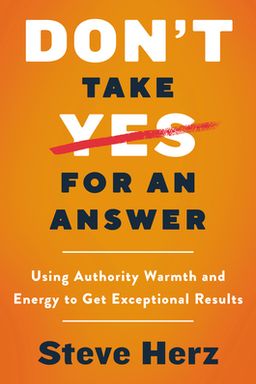
Don''t Take Yes for an Answer cover

Don''t Take Yes for an Answer

by Steve Herz

Don''t Take Yes for an Answer reveals the secrets to achieving career breakthroughs by mastering three key communication skills: authority, warmth, and energy. Learn how to make compelling first impressions, embrace feedback, and inspire others to reach your full potential.

Stop Taking Yes for an Answer: The Art of AWE

When was the last time someone gave you honest, uncomfortable feedback that actually helped you grow? In Don't Take Yes for an Answer, talent agent and performance coach Steve Herz argues that modern culture—saturated with empty praise, superficial affirmation, and risk-averse workplaces—has made us allergic to honesty. We’ve traded constructive criticism for counterfeit compliments, inflating egos while deflating potential. Herz’s central message is provocative yet liberating: if you want to achieve your true potential, you must learn to reject false yesses and embrace tough feedback. Real growth begins when you stop accepting safe approval and start pursuing uncomfortable truth.

Drawing from his decades as a talent agent representing on-air personalities at top networks like ESPN, CNN, and CBS, Herz introduces a simple but powerful communication framework called the AWE method. It stands for Authority, Warmth, and Energy—the three traits that define how we connect with others and determine whether we inspire respect, trust, and enthusiasm. Through vivid examples from broadcasting, business, sports, and the military, he shows that excelling in these soft skills—the elusive 85 percent of success—can transform careers and relationships more than any technical expertise ever could.

The Power of Honest Feedback

Herz opens with a story that defines his worldview: as a young law student, he expected to receive a job offer from a prestigious firm—until a senior partner bluntly told him he was “an atrociously bad summer associate.” The rejection crushed him, but it also freed him. That honesty redirected his career and ultimately led him to his true calling in talent representation. The lesson: truth may sting, but false approval kills momentum. Our culture’s obsession with comfort—trophies for participation, inflated grades, and “nice” HR euphemisms like “downsizing” instead of firing—creates professionals who plateau early and cannot handle critique.

To move beyond mediocrity, Herz argues, we must invite radical candor from others and develop self-awareness to recognize our blind spots. Everyone has “spinach in their teeth”—those hidden flaws in communication, attitude, and habits that subtly sabotage success while others are too polite to mention them. The first step toward mastery is seeing yourself as others see you.

AWE: The 85 Percent Formula for Success

Herz draws on the century-old Carnegie Foundation study showing that only 15 percent of financial success depends on technical knowledge, while a staggering 85 percent depends on soft skills—personality, communication, and leadership. Building AWE means mastering those three dimensions of human connection:

  • Authority — Projecting confidence and credibility without arrogance. Authority earns respect.
  • Warmth — Earning trust through empathy, humility, and understanding. Warmth transforms colleagues into collaborators.
  • Energy — Infusing passion and conviction into communication. Energy inspires others to follow and engage.

Each element of AWE can be learned, observed, and improved. The book’s structure reflects this: after diagnosing the societal and personal barriers that blunt our growth, Herz devotes successive chapters to the science and practice of Authority, Warmth, and Energy—how to build them in your voice, body language, and everyday interactions. Along the way, he introduces unforgettable figures like football coach Tom Coughlin, Navy Admiral Mike Mullen, and media executives who transformed results by turning up one or more aspects of their AWE.

Why AWE Matters Now

Herz situates his argument in the context of our hyperconnected, performance-driven world. In workplaces where technical capability is assumed, communication skills become the ultimate differentiator. The tragedy, he observes, is that most people plateau because no one teaches them how to refine these nontechnical attributes. AWE bridges that gap—serving as both a diagnostic tool and a growth map.

At its heart, Don't Take Yes for an Answer is a manifesto for humility and continual improvement. It asks you to replace complacent self-congratulation with curious self-examination, to turn away from counterfeit affirmation and toward authentic connection. Whether you’re a manager, a performer, or a parent, the ability to blend authority, warmth, and energy determines how deeply people trust, follow, and believe in you. Like Carnegie’s century-old insight, Herz’s AWE model reminds us that success isn’t about what you know—it’s about how effectively you make others feel understood, inspired, and confident in your leadership.


The Counterfeit Culture of Yes

Herz begins by diagnosing what he calls the epidemic of counterfeit yeses—those hollow affirmations that masquerade as encouragement but actually stunt personal and professional growth. Over decades, Western society has conspired to shield individuals from failure and criticism, creating what Herz calls a “grade-inflated life.” We praise too soon, reward mediocrity, and avoid rejection at all costs. The result: millions of professionals who mistake silence for success and politeness for progress.

Trophy Culture and Inflated Praise

Herz illustrates how the ‘everyone gets a trophy’ mentality—designed to promote self-esteem in children—has produced adults who expect constant validation. Participation ribbons, inflated grades, and an avoidance of harsh truths have eroded the line between genuine achievement and mere effort. According to Harvard and Stanford studies he cites, the A has become the most common college grade in America, tripling since the 1960s. Those who grow up being told they’re exceptional for doing the minimum arrive at work unequipped to face honest feedback.

Workplaces Without Truth

Herz goes further: even corporate culture reinforces the illusion of yes. Few managers dare to give blunt feedback anymore, fearing lawsuits or damaged morale. HR departments often use euphemisms like “reorganization” or “redundancy” instead of calling underperformance what it is. Employees like “Ina,” a talented analyst Herz coached, were told they needed coaching—but never that their jobs depended on it. She mistook mentorship for security and never realized until too late that her communication style lacked authority and passion. Rather than correcting course, she was quietly “coached out.” Herz’s verdict is brutal but true: many companies prefer polite attrition to honest confrontation.

The Hidden Cost of False Positivity

When everyone receives an A, no one knows what excellence really means. By insulating people from discomfort, organizations inadvertently create mediocrity. Herz compares this to a doctor who refuses to diagnose an illness to avoid upsetting the patient. The disease—in this case, poor communication or lack of confidence—spreads undetected until it metastasizes into major career stagnation. Only by inviting accurate feedback can individuals “treat” their weaknesses before they become terminal.

Herz calls for a cultural reset: to reward self-awareness over self-delusion. The antidote to counterfeit yes is a willingness to seek real critique and to interpret silence not as approval but as a warning. “No” doesn’t mean rejection—it means opportunity. As Zig Ziglar said, “Your attitude, not your aptitude, determines your altitude.” Herz’s version: the honest ‘no’ is the fuel that powers your next level.


Authority: Confidence Without Arrogance

Authority, Herz explains, isn’t about dominance or volume—it’s the quiet strength that commands respect and inspires confidence. You don’t need a title to project authority; you need self-belief, clarity, and control over your communication. Through stories of leaders ranging from broadcast coaches to Bill Belichick, Herz shows that authority begins in how you use your voice, body, and presence.

Voice: The Sound of Credibility

Herz introduces the “PPV” formula—Pitch, Pace, and Volume—as the technical foundation of authority. A lower, steady pitch conveys composure; varied pacing keeps engagement; and controlled volume signals confidence without aggression. Think Barbara Jordan or Martin Luther King Jr.—each used rhythm, silence, and power strategically. Herz shares examples of clients who undermined their own credibility with high, singsong voices or filler words like “like” and “you know.” Eliminating these habits can instantly elevate perception. (He likens practicing PPV to a musician mastering scales—discipline produces natural harmony.)

Body Language and Presence

Nonverbal cues speak before words do. Herz recounts his neighborhood cobbler Maria, whose tiny frame and thick accent didn’t diminish her command. Her posture, eye contact, and stillness conveyed self-assurance so absolute that customers trusted her instantly. Authority radiates from posture that’s upright, gestures above the waist, and movement that’s deliberate. Even dress contributes: not about fashion, but congruence. Steve Jobs’ simple black turtleneck worked because it was authentic to him—it said, “I know who I am.” Mark Zuckerberg’s hoodie worked until it didn’t; when he donned suits to appear more polished, it seemed forced. Authority can’t be costume—it’s coherence between inner conviction and outer expression.

Detachment and Alignment

True authority arises from detachment—the confidence to stand back and let others decide freely. Peter Bregman, one of Herz’s sources, calls it “authoritative detachment”: the mindset of presenting your best ideas without needing everyone’s validation. Maria the cobbler mastered it—she diagnosed a shoe’s flaw, offered the fix, and stepped aside; her certainty made clients return. Similarly, leaders who align with their teams—as Admiral Mike Mullen did by joking and connecting with soldiers—strengthen trust, not hierarchy. Authority, Herz concludes, is never imposed. It’s earned the moment others sense you believe in yourself.


Warmth: The Seed of Trust

If authority earns respect, warmth earns trust. Herz calls it “the most underappreciated tool in the AWE arsenal.” Warmth means showing humility, empathy, and authenticity—it’s about making others feel seen and understood. Without it, authority turns into authoritarianism, and energy becomes aggression.

Real Connection Over Performance

Herz learned this the hard way early in his career. In an attempt to impress a promising journalist, he monopolized the conversation with stories proving his competence. She never called back. His colleague summed up the failure: “You didn’t connect.” Though Herz had authority, he lacked warmth. The revelation transformed how he met clients thereafter: speak less, listen more, find commonality. That shift soon doubled his business.

Warmth in Leadership

To illustrate warmth as leadership power, Herz recounts the story of NFL coach Tom Coughlin. Known for rigidity and barked orders, Coughlin’s New York Giants rebelled—until he added human warmth. He started chatting with players, even taking them bowling. As he built connection, performance soared, culminating in two Super Bowl wins. Likewise, Navy Admiral Mike Mullen realized that dropping hierarchy—cracking jokes, showing curiosity—opened soldiers up more than any speech could. These transformations prove that people don’t give their best out of fear; they give it when they feel cared for.

Practicing Everyday Warmth

Herz details practical habits for projecting warmth: steady your breath, smile sincerely, soften your gaze, point your feet toward your listener, lean in without crowding. Even small adjustments like not speaking with your hand on the doorknob (from Dr. Michael Levine’s doctor training example) communicate respect and attentiveness. Vulnerability matters too—sharing selective personal struggles or imperfections can increase relatability. ESPN reporter Holly Rowe’s openness about her cancer battle strengthened her rapport with millions, proving that vulnerability fused with professionalism amplifies trust rather than weakening it.

In short, warmth is about creating safety. It’s the difference between compliance and commitment. As Herz notes, leaders like Costco founder Jim Sinegal or banker Jeff Feig built massive loyalty simply by acknowledging people and fostering cultures of empathy. Authority wins minds, but warmth wins hearts—and sustaining success requires both.


Energy: The Power to Inspire Action

Energy, the third pillar of AWE, is what animates authority and warmth into motion. Herz defines it as “usable power”—the contagious enthusiasm that draws people to you and propels teams toward a goal. It’s not hyperactivity or volume; it’s emotional commitment made visible.

Contagious Passion

Herz’s favorite classroom story comes from Vanderbilt law professor Barry Friedman, whose constitutional law lectures were legendary for their energy. By pacing, varying his tone, and using his whole body, he transformed dense legal doctrine into electrifying performance. His passion made students care. Similarly, Lawrence Epstein, COO of the UFC, turned a fringe, stigmatized sport into a global empire through sheer conviction. His “relentless optimism,” Herz writes, persuaded legislators to legalize mixed martial arts nationwide. The takeaway: energy multiplies influence when paired with authenticity and purpose.

Authenticity and Alignment

Energy works only when it feels real. Overdone enthusiasm reads as artificial and drains others. Herz highlights Josie Thomas of CBS, whose combination of warmth and vibrant energy made even tense diversity negotiations feel affirming. Contrast that with a comedian who bombards the room with jokes but never reads the crowd—more noise than connection. True energy involves attunement: adjusting your intensity to match the people and moment so that communication flows like rhythm. Think of it as “getting on someone’s frequency.”

Service and Flow

Service, Herz insists, is the most sustainable fuel for energy. Billionaire investor Mike Novogratz learned to overcome his stage fright by reframing speaking as an act of service rather than self-display. “Life’s about service,” he recalled from mentor Tony Robbins’ advice. “If you go onstage thinking, ‘How can I serve my audience?’—it’s no longer about you.” That shift turns nervous energy into generous energy. When people sense you’re serving them—not performing for them—they engage fully. Herz calls this state “flow,” echoing psychologist Mihaly Csikszentmihalyi: the effortless alignment of purpose, presence, and passion.

Energy, then, is both internal ignition and external spark. You fuel it through preparation, passion, and service—and you sustain it by reading others and making space for their energy too. As Herz writes, “If warmth is the seed for relationships, energy is the water that keeps them growing.”


Feedback, Growth, and the Journey to Mastery

In his closing chapters, Herz returns to his original premise: the pursuit of excellence demands perpetual growth. The most successful people he’s coached—including elite broadcasters and executives—share one trait: they never take yes for an answer. Like athletes chasing new personal records, they frame every success not as arrival but as the next starting line.

Grow or Die

Herz categorizes ambitious people into two types: those who accept yes as validation, and those who treat it as insufficient. The latter thrive because they crave improvement over comfort. To reach that mindset, you must actively solicit constructive criticism, make it safe for others to be honest, and convert critique into practice. Herz himself did this by asking trusted friends to nitpick his podcast appearances—even after receiving public praise. The feedback was humbling—and transformative.

From Conscious to Unconscious Competence

Mastery, Herz explains, unfolds in four stages: unconscious incompetence (you don’t know what you lack), conscious incompetence (you realize it), conscious competence (you correct it deliberately), and finally unconscious competence—the effortless excellence of habit. AWE mastery is the same: with awareness and repetition, the behaviors become second nature. At that point, your confidence, compassion, and charisma operate on autopilot.

Raising the Bar

Herz ends with the metaphor of Roger Bannister’s four-minute mile. Once he broke it, others quickly followed—the barrier was psychological, not physical. Similarly, when you elevate your own standard of communication and connection, you reset what’s possible for yourself and those around you. Greatness is a practice, not a label.

The final takeaway: improvement is infinite. AWE isn’t a destination but a discipline—a triad of self-awareness, empathy, and enthusiasm that redefines how you lead and live. Whether you’re asking for feedback, managing a team, or simply greeting a colleague, every moment becomes a chance to embody more authority, warmth, and energy. Growth, after all, is the one yes worth taking.

Dig Deeper

Get personalized prompts to apply these lessons to your life and deepen your understanding.

Go Deeper

Get the Full Experience

Download Insight Books for AI-powered reflections, quizzes, and more.