
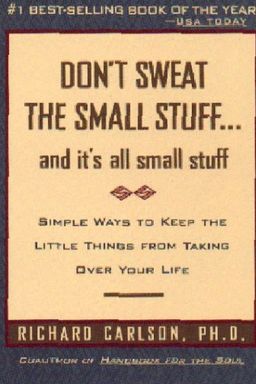
Don’t Sweat the Small Stuff    and It’s All Small Stuff cover

Don’t Sweat the Small Stuff and It’s All Small Stuff

by Richard Carlson

Discover how to find peace and happiness in a chaotic world with ''Don’t Sweat the Small Stuff.'' Learn to transform stress into serenity, appreciate the present, and build stronger relationships with practical guidance and insightful wisdom.

The Art of Not Sweating the Small Stuff

Have you ever felt that your life was one big emergency? That even the smallest inconvenience—a slow cashier, a misplaced file, or a missed call—can send your stress levels soaring? In Don't Sweat the Small Stuff... and It's All Small Stuff, psychologist Richard Carlson challenges this frantic way of living. He argues that inner peace isn't found by removing life's difficulties but by transforming how you respond to them.

Carlson invites you to embrace what he calls “the path of least resistance,” where serenity and perspective become your guiding compass. Instead of letting minor irritations spiral into mental snowballs, he teaches you to cultivate habits—patience, compassion, humility—that dissolve stress before it takes hold. The book’s core message rests on two deceptively simple rules handed to Carlson by Wayne Dyer: 1) Don’t sweat the small stuff, and 2) It’s all small stuff.

Why We Turn Life Into an Emergency

Most of us were trained from childhood to measure success by control and perfection. We rush through our days believing everything must be achieved right now, and anything short of perfect order signals failure. Carlson’s simple observation—that life is rarely perfect and never meant to be fair—becomes revolutionary once you pause to absorb it. By expecting life's imperfections, you immediately free yourself from being constantly frustrated by them.

He illustrates this through stories from his clients and his own conversations with family. A mother overwhelmed by housework discovers peace only when she stops treating dirty dishes like moral failures. A businessman chasing deadlines learns that his “to-do list” will never be empty—not even on the day he dies. The liberation comes, Carlson says, when you truly accept that your baskets (of chores, goals, responsibilities) are never meant to be empty. Life simply flows—not ends—through them.

The Power of Gentle Perspective

The book’s strategies recenter your attention from external achievements to internal serenity. Carlson contends that the way you relate to your problems, not the size of your problems, determines your peace. He encourages compassionate self-observation: catch your “snowball thinking,” those spiraling thoughts that turn small worries into catastrophes. Interrupting your own internal drama instantly returns control of your happiness.

“Life is a test. It is only a test.”

When Carlson frames life as a test—not a battle—you reclaim curiosity and calm in place of aggression. A missed flight or a late project becomes another pop quiz in flexibility, not a personal indictment.

Why These Ideas Matter

This shift from reactive to reflective living echoes ancient spiritual teachings. Carlson blends insights from Zen and mindfulness (similar to Jon Kabat-Zinn’s Wherever You Go, There You Are) and modern stress psychology. He redefines achievement: victory is not measured by getting everything done, but by remaining serene while it’s undone. When you stop fighting reality, you conserve energy for gratitude and kindness.

Across the book’s 100 short essays, Carlson offers daily practices—from smiling at strangers to meditating for five minutes—to train attention away from irritation toward appreciation. His advice is practical and spiritual, simple yet transformative. He helps you learn that your happiness doesn’t have to wait until conditions improve; it begins the moment you stop believing life is an emergency.

By the end, Carlson leaves you with a gentle but powerful challenge: live each day as if it might be your last. Because someday it will be. The message isn’t grim; it’s freeing. When you realize time is precious, you stop using it to worry. You start using it to love, to serve, and to enjoy life’s imperfection. That, Carlson insists, is the lasting wisdom—not to sweat the small stuff, and to remember that, in truth, it’s all small stuff.


Shifting from Stress to Stillness

Carlson’s first major lesson is to radically lower your tolerance for stress. In a world that glorifies busyness and overwork, he flips the narrative: the more you can handle stress, the more stress you will attract. You don’t earn serenity by toughening your nerves; you earn it by noticing stress early and refusing to feed it.

Recognizing the Snowball

Imagine waking up at 2 a.m. remembering a call you need to make. That simple thought quickly snowballs into imagining everything that could go wrong tomorrow—the emails, deadlines, family drama. Carlson teaches you to catch that snowball at its first roll: notice the thought, name it gently (“there I go again”), and redirect your mind back to gratitude. By doing this, you prevent your mental snowball from turning your night into an avalanche of anxiety.

Defusing Stress Before It Explodes

When you feel your mind racing or body tensing, Carlson suggests a deceptively simple phrase: Life isn’t an emergency. He recounts stories of parents and workers overwhelmed by perfectionism—such as a mother who treated her messy kitchen as a crisis—and how repeating this mantra brought instant relief. The phrase gently resets perspective: no one is pointing a gun at your head; the pressure is self-made. By changing that internal dialogue, you reclaim control of your peace.

Patience as a Practice

To quiet the inner “rush,” Carlson introduces “Patience Practice Periods.” These are small, intentional intervals—five to thirty minutes—where you commit not to be bothered. During this window, any irritation becomes your classroom. If your kids yell or someone cuts you off, instead of reacting, you remind yourself, “I’m practicing patience.” It’s simple mindfulness disguised as everyday peace training. Over time, patience stops being an exercise and becomes your natural posture toward life.

The Gift of Doing Nothing

Carlson even redefines boredom. He calls it therapy for the mind. In a culture of constant stimulation, allowing yourself moments of “human being” instead of “human doing” resets clarity. Those pauses—staring out a window, sitting quietly without tasks—are where you realize that peace isn’t earned; it’s what's left when urgency dissolves.

(This echoes the ideas found in Jon Kabat-Zinn’s mindfulness teachings and Blaise Pascal’s quote: “All of humanity’s problems stem from man’s inability to sit quietly in a room alone.” Carlson transforms that insight into everyday practice: catch your thoughts, breathe, and begin to live in the stillness beneath the storm.)


Living in the Present Moment

At the heart of Carlson’s philosophy sits one timeless truth: you can only be happy now. Most unhappiness arises not from what’s happening but from mentally time-traveling—worrying about tomorrow or regretting yesterday. If you want relief, bring yourself back to the present moment.

Breaking the Habit of Someday

Carlson describes how people constantly postpone joy. We say, “I’ll relax when the bills are paid, when the kids are grown, when my career is stable.” But he reminds you that life isn’t a rehearsal—your someday is already today. Quoting Alfred D’Souza, he notes, “For a long time it seemed that life was about to begin… and then it dawned on me that these obstacles were my life.”

It’s a powerful wake-up call. When you stop waiting, you start living. You realize that happiness isn’t the reward at the end of the list but the way you walk through the list itself.

Selecting What Truly Matters

Carlson suggests a mental mantra: “Will this matter a year from now?” Almost always, the answer is no. Whether it’s a fumbled presentation, a rude comment, or a late train, the question restores scale and calm. This trick dissolves stress by reminding you that you are worrying about micro-moments inside a vast, impermanent universe.

Life As a Test

For Carlson, life isn’t punishment—it’s practice. Every challenge, from a difficult coworker to an unplanned delay, is a test on patience and perspective. You don’t “pass” by solving the problem perfectly; you pass by keeping your peace while you face it. When you face life this way, ordinary frustrations lose power over you.

In short, present-moment awareness isn’t about meditation alone—it’s about transforming your daily perception of urgency into calm curiosity. (Similar to the Stoics like Marcus Aurelius, who taught that peace lies in focusing only on what you can control, Carlson urges: control your reaction, not reality.)


Compassion and Kindness as Daily Practice

Carlson believes compassion isn’t optional—it’s the core skill of peaceful living. When you open your heart to others, your own anxieties shrink. He urges the daily cultivation of empathy through small gestures, not grandiose service.

Practicing Compassion

Compassion begins with intention. Carlson advises asking, “How can I be of service today?” He quotes Mother Teresa: “We cannot do great things on this earth. We can only do small things with great love.” When you see other people’s struggles as equal to your own, anger softens into grace. A stressed postal clerk becomes a teacher of patience; a rude stranger becomes a mirror of your own urgency.

Random Acts of Kindness

Carlson celebrates anonymous giving as pure joy. Paying someone’s toll, leaving a note of gratitude, picking up litter with your kids—these quiet actions build a habit of benevolence. The purpose isn’t praise but presence. Often, the anonymous act plants a chain of kindness that ripples outward. (A similar concept appears in altruism research—prosocial behavior elevates both giver and receiver.)

Service Without Reciprocity

He challenges you to do favors without expecting them returned. Every hidden expectation—“I helped her, so she should help me”—pollutes joy with a silent contract. True service, Carlson says, is its own reward. Your peace increases in direct proportion to your generosity.

The Joy of Small Things

Even tending a plant becomes practice for unconditional love. A plant doesn’t apologize or perform; you love it simply because it lives. When you can love that plant regardless of its bloom, you are learning how to love people without needing them to change. This everyday compassion, he insists, transforms the ordinary into extraordinary.

Carlson’s kindness strategies converge into a lived philosophy: fill your life with love. Don’t wait for more affection from others—become the source. Love, he writes, is an infinite resource that expands as it’s given. The more you give away, the more your life quietly fills with it.


Humility and Letting Go of Ego

Most stress comes from ego—the craving to be right, important, or superior. Carlson dismantles these illusions through humility, teaching that peace emerges not from proving yourself but from releasing the need to win attention.

Choosing Kindness Over Being Right

Carlson’s advice to “choose being kind over being right” may sound trivial, but it’s revolutionary in relationships. He invites you to notice the impulse to correct others—the quick “Yes, but…” or “Actually, that’s not true.” Every correction reinforces your ego's need to triumph. Choosing kindness instead preserves connection. He uses a touching story about his wife, Kris, who let him take credit for an idea that was hers. Her generosity created harmony instead of conflict. In her humility, Carlson witnessed strength greater than any argument.

Letting Others Have the Glory

Another form of ego surrender is allowing others to shine. When you stop hijacking conversations with your own stories, you discover the quiet confidence that arises from listening. Your self-worth no longer depends on external validation—it becomes internal contentment.

Making Peace with Imperfection

Carlson’s antidote to perfectionism is simple acceptance. Whether it’s a scratch on your car or a misstep at work, perfectionism is a war against reality. Making peace with imperfection frees your creative energy, allowing beauty to emerge in its natural chaos.

“You become what you practice most.”

Carlson suggests that every time you practice acceptance, listening, or generosity, you reinforce peace as your habit. Your personality is built one response at a time—so choose wisely.

Ultimately, humility doesn’t mean weakness—it’s relaxing your grip on self-importance. (This idea mirrors teachings by Wayne Dyer in Your Erroneous Zones, who argued that ego is the barrier between human potential and peace.) Carlson offers a similar liberation: when you stop fighting to be impressive, you become genuinely peaceful.


Perspective and Acceptance

In moments of chaos, maintaining perspective is your spiritual anchor. Carlson reminds you that in the vast timeline of existence, today's annoyance—a flat tire, a rude email—will vanish like smoke. Cultivating perspective transforms drama into calm observation.

Learning Flexibility

Carlson demonstrates flexibility through everyday examples. When his writing schedule collides with his child waking up early, he reframes the disruption as an opportunity to be present. Flexibility, he shows, isn’t compromise—it’s intelligence adapting to the moment. Expect change, and you’ll suffer less when it arrives.

Seeing Life as Transient

His parable, “Get Comfortable Not Knowing,” tells of a wise man who responds to every situation—loss, gain, grief—with “Maybe so, maybe not.” The moral: we never know whether an event is good or bad until the larger context unfolds. This Buddhist-like perspective nurtures calm in uncertainty.

Acceptance of What Is

Whenever life defies your expectations, Carlson invites radical acceptance. “Be open to what is,” he writes. To fight reality is to suffer twice—once from the event, and once from your resistance. Acceptance doesn’t mean passivity; it’s recognizing that fighting what’s already true steals peace you could use for progress.

The 100-Year Perspective

One of Carlson’s most freeing mental exercises is imagining how trivial current problems will seem a century from now: a traffic jam or broken device becomes laughable against eternity. When you adopt time’s long view, daily stress shrinks instantly.

This teaching resonates with Stoic philosophy and modern mindfulness: acceptance and long-term perspective are antidotes to fear. Once you internalize them, serenity stops being rare—it becomes default.

Dig Deeper

Get personalized prompts to apply these lessons to your life and deepen your understanding.

Go Deeper

Get the Full Experience

Download Insight Books for AI-powered reflections, quizzes, and more.