
Idea 1
How Language Shapes the Economy We Believe In
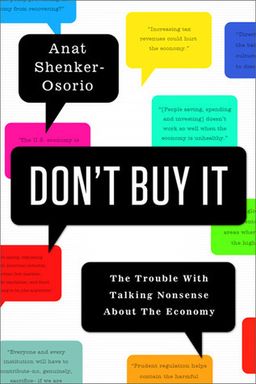
Do you ever wonder why words like “the economy is recovering” or “the markets are nervous” sound so natural, even though economies aren’t alive and markets don’t have feelings? In Don't Buy It, communication strategist Anat Shenker-Osorio argues that language doesn’t simply describe our economic beliefs—it creates them. We don’t just talk about the economy; we talk it into being. When we describe it as a living being, a natural force, or a god, we unconsciously surrender our sense of control and accept inequality as inevitable.
Shenker-Osorio contends that progressives have lost the economic argument not because their ideas are wrong, but because their words are. Conservatives have weaponized language—framing the economy as self-reliant and moral, rewarding the virtuous and punishing the lazy—while progressives have used metaphors that reinforce precisely those assumptions. The result? Even those who fight for fairness end up talking like free-marketeers.
Why Metaphors Matter
According to Shenker-Osorio, our brains depend on metaphor to understand complex, abstract systems like “the economy.” We compare it to tangible things—a body that can be sick or recovering, a storm that we must weather, or a machine that needs fine-tuning. These metaphors aren’t neutral. They make invisible assumptions about what the economy is and what to do about it. If it’s a body, we shouldn’t interfere too much; if it’s a machine, we can adjust the gears.
She draws on the research of linguists George Lakoff and Mark Johnson (authors of Metaphors We Live By) to show that metaphors prime political beliefs more powerfully than facts. When Stanford psychologists replaced the phrase “crime is a beast” with “crime is a virus,” respondents shifted from punitive to preventive attitudes—without realizing they had been influenced. Likewise, talk of an “ailing economy” trains audiences to believe it will self-heal, not to call for intervention.
The Language Trap Progressives Fall Into
Progressives make three major mistakes in their storytelling: they assume facts are persuasive, they use the same metaphors as conservatives, and they mix metaphors so wildly that they appear incoherent. Shenker-Osorio analyzes political speeches, media coverage, and nonprofit campaigns (“Fight Crime, Invest in Kids” being a favorite example of mixed messaging) to show how left-leaning communicators unintentionally echo right-wing frames.
Calling the economy “sick,” “weak,” or “stormy” tells people that fluctuations are natural and regulation is futile. Using phrases like “tax relief” or “government spending” validates the conservative worldview that taxes are a burden and spending is wasteful. Even President Obama’s speeches are critiqued for oscillating between casting the economy as a car to drive and a patient to heal—two incompatible metaphors that confuse audiences about the government’s role.
Reclaiming the Economic Story
What’s the alternative? Shenker-Osorio urges progressives to redefine both what the economy is and why it exists. The economy isn’t a supernatural being or an autonomous system—it’s a human-made construction whose purpose is to support people and the planet. She proposes two interlocking metaphors to drive this message:
- The economy as a vehicle: It’s something people design and operate. It needs a driver (government), rules of the road (regulations), and maintenance (public investment).
- The economy as a journey facilitator: Its purpose is to move everyone forward in life, not serve itself. Progress is measured by shared well-being, not just growth or GDP.
These metaphors foreground agency, interconnectedness, and direction—qualities that remind citizens that they, not abstract markets, shape economic outcomes. They also open space for positive values like fairness, sustainability, and solidarity.
Why This Matters Now
The book positions itself after the Great Recession of 2008, when, despite widespread anger at Wall Street, conservatives managed to blame government rather than deregulation. Shenker-Osorio argues that the Left missed its opportunity to rewrite the national narrative because it lacked a coherent story about how the economy failed and how to fix it. While right-wing think tanks like Heritage and Cato spoke in moral and natural terms (“the economy needs freedom,” “markets heal themselves”), progressives led with data and policies divorced from compelling moral language.
Ultimately, Don’t Buy It is a call to linguistic consciousness and political courage. To change the economy, Shenker-Osorio insists, we must first change the story we tell about it. The economy should no longer be our master—it should be our vehicle. And we, not the markets, belong in the driver’s seat.